A digital transformation services implementation checklist should connect technology investment to a better operating outcome. Replacing software without changing ownership, data, policy, support and measurement usually digitizes the existing delay. A credible program chooses a bounded service or value stream, establishes a baseline, redesigns the end-to-end experience and proves that the organization can operate the new model before scaling it.
This checklist is for executives, transformation leads, product owners and delivery partners. It complements the digital transformation guide for business teams, the enterprise implementation checklist and the digital transformation FAQ. Use each section as an evidence gate with a named owner and decision, not as a list to mark complete after launch.
Define the service outcome and transformation boundary
Select an end-to-end outcome visible to users or operators, such as onboarding a supplier, resolving a claim or fulfilling an order. Map every channel, handoff, approval, record, exception and support intervention. Include policy constraints and manual work outside official systems. GOV.UK's Service Standard emphasizes understanding users, solving a whole problem, multidisciplinary delivery, security, accessibility and measurable success; those principles apply beyond public services.
Write a baseline and target in operational terms: elapsed time, completion, rework, error, accessibility, service cost and risk. Separate outcomes from outputs. A new CRM, cloud platform or AI assistant is an output until observed behavior improves. State exclusions, dependencies and a stop threshold. If the program cannot name what evidence would change funding or scope, governance will default to milestones and presentation quality instead of value.
| Decision area | Evidence required | Accountable owner | Gate question |
|---|---|---|---|
| Outcome | User need, baseline and target | Business sponsor | Is the problem material and measurable? |
| Service boundary | Journey, channels and exceptions | Product owner | Does scope cover a whole usable outcome? |
| Data | Authority, quality and permitted use | Data owner | Can decisions be trusted and explained? |
| Technology | Architecture and lifecycle assessment | Technical owner | Can the design be secured and operated? |
| Change | Roles, skills and adoption plan | Operations leader | Will daily work actually change? |
Create decision rights before delivery accelerates
Name one accountable sponsor, one empowered product owner and owners for architecture, data, security, privacy, service operations and organizational change. Define which decisions teams can make autonomously and which require escalation. Keep an outcome backlog that joins process, policy, data and technology work. A steering committee should resolve tradeoffs and remove constraints; it should not become a late design-review queue that measures progress by documents produced.
Use incremental funding tied to evidence. Release a coherent slice to a bounded group, compare results with baseline and fund the next constraint. Track assumptions and decisions separately from requirements so learning can change direction transparently. Include suppliers in the same governance model: deliverables, data rights, security evidence, service levels, change process, skills transfer and exit must be explicit. NIST CSF 2.0's Govern function reinforces that cybersecurity decisions belong in organizational risk governance.
Redesign process and policy before automating steps
Challenge every handoff and approval. Ask what risk it controls, what evidence it consumes, who has authority and whether a rule can be simplified. Remove duplicate data entry and approvals that exist only because systems cannot share status. Preserve human judgment where context or consequence demands it, but give reviewers complete information and clear decision criteria. Automation of a poorly designed process makes errors faster and more difficult to question.
Design exception paths alongside the common journey. Define missing information, duplicate requests, policy conflicts, dependency outages, appeals, correction and customer support. Make state and ownership visible. If work leaves the system for email or spreadsheets, record why and how it returns to the authoritative workflow. Policy owners should approve changed rules and effective dates, while product teams retain versioned decision logic and evidence for material outcomes.
Establish data authority, quality and lifecycle controls
Inventory the records required by the target service and identify an owner and authoritative source for each material element. Define shared terms, identifiers, validation, quality thresholds, retention, deletion and access. Profile real data early; migration plans based on diagrams miss duplicates, undocumented codes and history that cannot be interpreted. Decide whether records will be migrated, referenced, archived or retired, and rehearse reconciliation before cutover.
Minimize collection and clarify lawful or authorized use for personal and sensitive data. Track lineage for reports and automated decisions. Design exports, correction and deletion into the workflow rather than adding them after production. Data governance should enable delivery through reusable contracts and decision rights, not require bespoke approval for every field. Measure quality at the point a bad value harms a service outcome, then route exceptions to an owner.
Modernize technology around owned service capabilities
Assess applications by business criticality, change friction, security, supportability, data coupling and lifecycle risk. Choose retain, retire, replace, rehost, replatform or refactor per capability; do not apply one migration strategy to an entire estate. Define target boundaries, integration contracts, identity, observability, resilience and recovery before selecting products. Managed cloud services change responsibility rather than eliminating it, so ownership of configuration, limits, data and incident response remains necessary.
Build shared platform capabilities only where multiple teams genuinely need them: identity, delivery pipelines, telemetry, policy enforcement and data exchange are common candidates. Provide a supported path with documentation and service expectations. Avoid a central platform that becomes a mandatory ticket queue. Architecture decisions should include reversibility and exit. Keep data exportable, use open or documented interfaces and rehearse recovery from provider or integration failure.
| Implementation gate | Proof before expansion | Failure signal | Response |
|---|---|---|---|
| Service proof | Users complete the whole outcome | Work continues in side channels | Redesign journey or boundary |
| Data proof | Migration and reconciliation pass | Unknown codes or mismatched totals | Clean, map or reduce scope |
| Control proof | Security, privacy and access tests pass | Exceptions require unsafe bypass | Build bounded support path |
| Operations proof | Runbook and recovery exercise succeed | No owner can restore service | Clarify ownership and rehearse |
| Value proof | Outcome improves without guardrail harm | Activity rises but result does not | Stop or change intervention |
Prepare people, accessibility and operating support
Map how roles, decisions, performance expectations and workload change. Involve frontline users and affected customers in research, prototypes and pilots. Training should use realistic cases, including exceptions, and happen close to adoption. Provide job aids and safe practice environments. Managers need transition capacity because running old and new processes simultaneously can increase risk. Do not interpret resistance as a communications problem until the team has examined incentives and usability.
Apply WCAG 2.2 and inclusive research across the complete process, including authentication, documents, notifications and support. Provide assisted paths without creating second-class records. Build operational administration, case history and correction tools into the first production slice. Name service ownership, support hours, incident escalation, security response and supplier contacts. A transformation is not complete when software deploys; it is complete when the new service can be supported, changed and recovered.
Run an evidence-led implementation loop
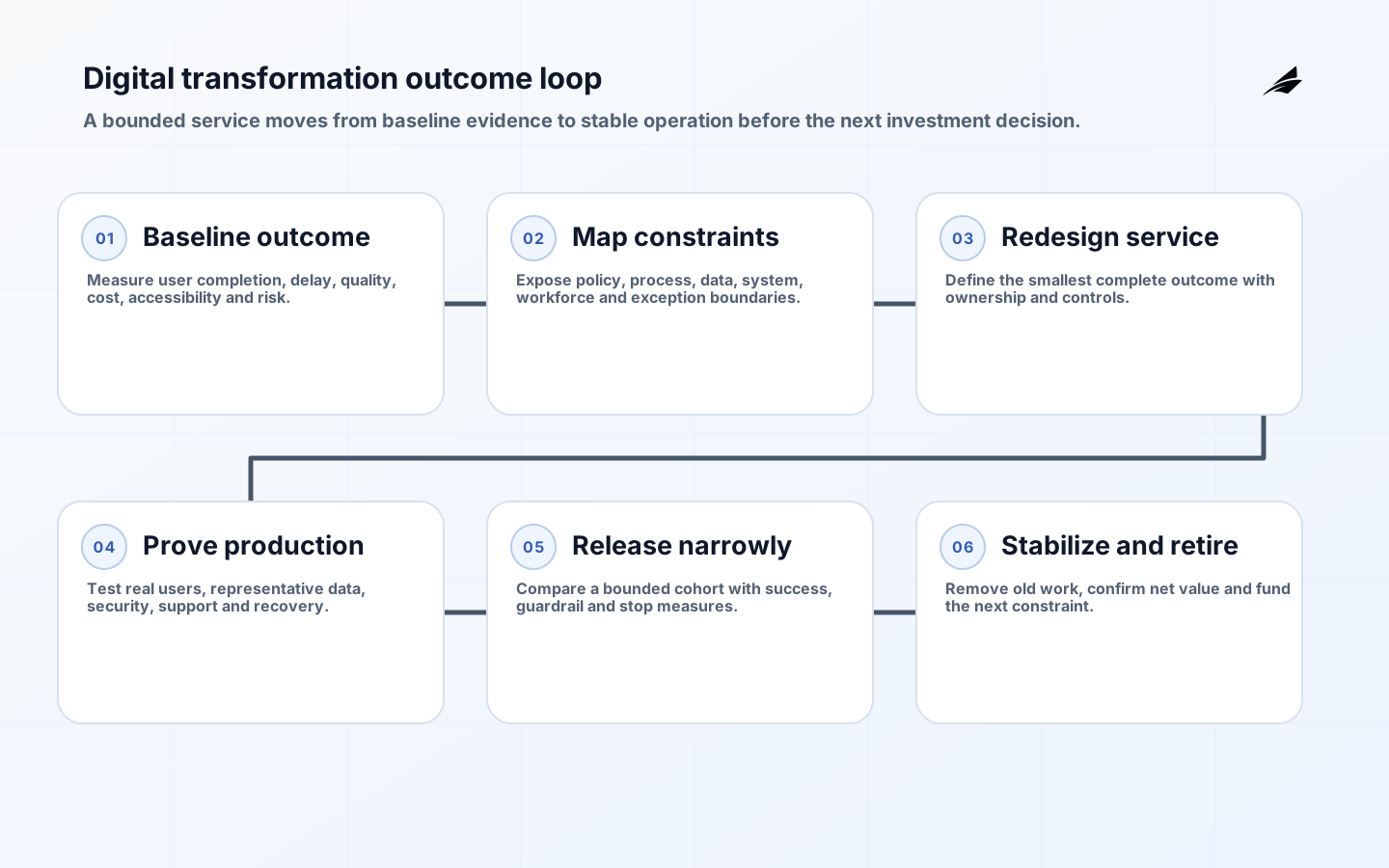
- Baseline one end-to-end outcome and agree success, guardrail and stop measures.
- Map policy, process, data, technology, people and exception constraints.
- Redesign the smallest complete service slice with explicit ownership and controls.
- Build and test with real users, representative data and operational recovery scenarios.
- Release to a bounded cohort and compare evidence with the original baseline.
- Stabilize, retire replaced work and fund the next constraint only when justified.
Measure outcomes, controls and delivery health
Use a balanced set of measures: user completion and satisfaction; elapsed time and rework; quality and exception age; security and privacy events; accessibility findings; service availability and recovery; adoption and support burden; run cost and avoided legacy work. Segment results so averages do not hide exclusion or a failing customer group. Define calculation, source, owner and review cadence for every measure before launch.
Create a monthly outcome review and a shorter operational review during transition. Compare actual results with baseline and record decisions. Avoid attributing every improvement to the new technology when staffing, demand or policy changed simultaneously. Use pilots, cohorts or phased rollout where feasible. Benefits realization should subtract transition cost, ongoing licenses, platform operations, process overlap and control work, not only implementation invoices.
Key takeaways
- Anchor transformation in one measurable end-to-end service outcome.
- Govern process, policy, data, technology and people as one delivery system.
- Fund coherent slices based on evidence rather than a long feature inventory.
- Build security, accessibility, support and recovery into production acceptance.
- Retire replaced work and measure net outcomes after full operating cost.
Frequently asked questions
How long should a digital transformation take?
An enterprise program may span years, but the first bounded service outcome should produce production evidence in months, not remain in discovery indefinitely. Sequence the portfolio into independently valuable slices and stop initiatives that cannot demonstrate learning or operational benefit.
Should the organization choose a platform first?
Usually define outcomes, constraints and capability needs first. A platform may accelerate delivery when its operating model, data, security, integration and exit fit are proven. Product demonstrations cannot replace workflow and lifecycle assessment.
What should a transformation partner hand over?
Require source and configuration, architecture decisions, data mappings, tests, security evidence, access, runbooks, service measures, supplier records, licenses, known risks and an exit plan. Verify transfer by having the receiving team operate a release and recovery exercise.
Conclusion
Digital transformation succeeds when the organization can deliver and operate a better service, not merely purchase newer technology. Set a measurable boundary, redesign the complete workflow, establish trustworthy data and controls, and release in evidence-led increments. The checklist is complete only when the new operating model works and the old burden has genuinely been removed.