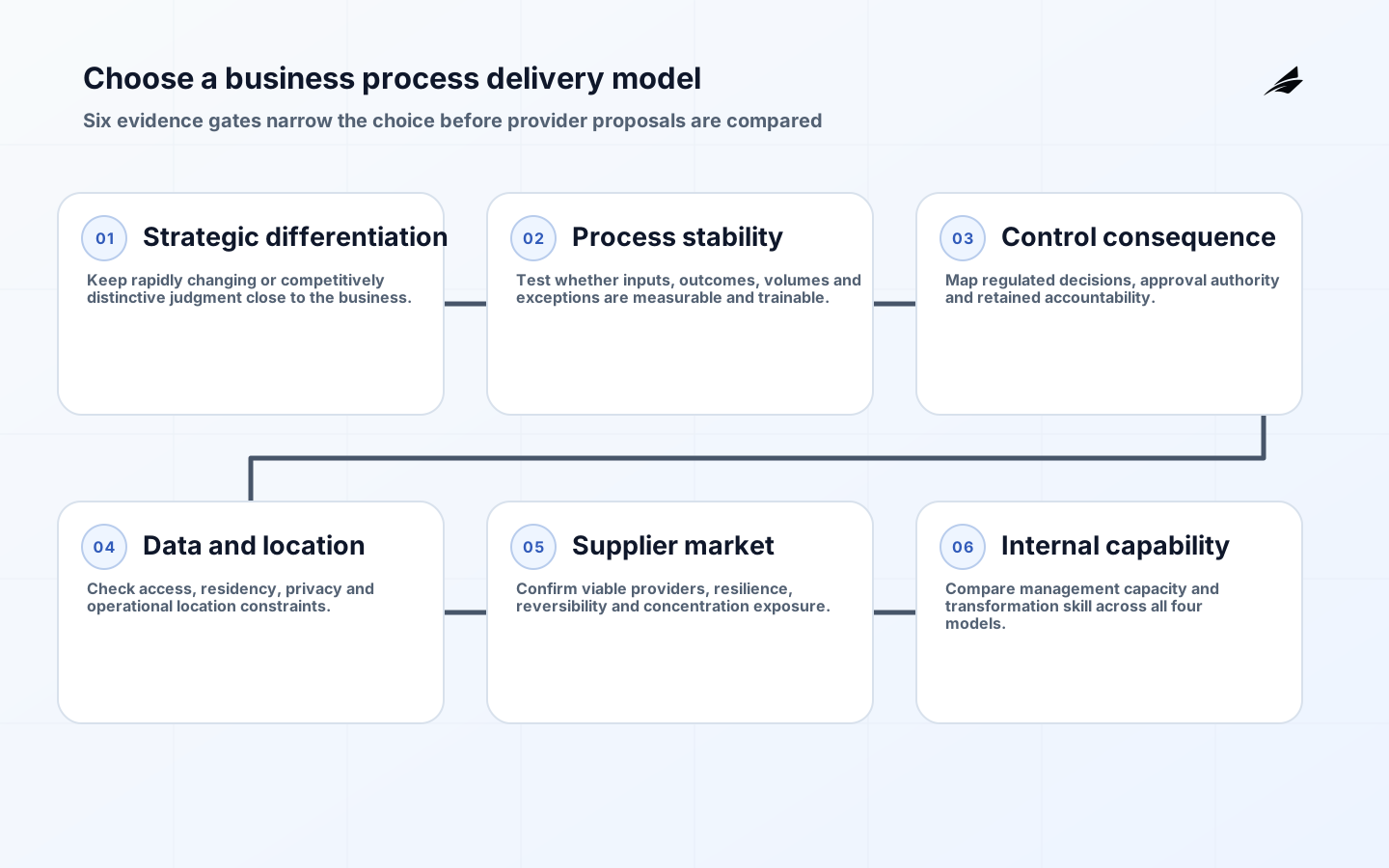
Business process services (BPS) combine people, workflow, technology, controls and performance management to operate a defined business process. A provider might handle accounts payable, customer support, claims, procurement administration, HR operations, data management or another repeatable service. The arrangement can be outsourced, co-sourced, run through a captive shared-service center or split across internal and external teams. BPS is therefore a delivery model, not a synonym for sending tasks to a cheaper location.
A useful buyer question is not 'What can we outsource?' but 'Which outcomes and capabilities should we own, and which delivery model best meets them?' The UK Government's Sourcing Playbook recommends a proportional delivery-model assessment before insourcing, outsourcing or re-procuring a service. That discipline translates well to private organizations: compare options using service quality, control, resilience, capability, transition risk and whole-life cost.
Know when business process services fit
BPS is most credible when the work has a stable purpose, observable inputs and outcomes, sufficient volume, trainable judgment, accessible data and an owner able to govern the service. It may still include complex exceptions, but those exceptions must be identifiable and routed. A process that changes weekly, depends on undocumented relationships or has no agreed outcome should be stabilized before a long-term service commitment.
| Signal | Good candidate | Warning sign |
|---|---|---|
| Demand | Measurable volume and seasonality | No reliable workload data |
| Process | Defined states, exceptions and handoffs | Success depends on hidden workarounds |
| Data | Known sources, owners and quality rules | Conflicting systems with no authority |
| Control | Approval, access and audit requirements can be designed | Accountability is expected to transfer with the task |
| Value | Quality, speed, resilience or capability can improve | The business case is only a headline labor-rate comparison |
Scope the service as an operating contract
A process name is not a scope. 'Accounts payable' could mean mailbox monitoring, invoice capture, supplier verification, purchase-order matching, exception resolution, approval routing, posting, payment proposal, supplier queries, reconciliations, reporting and records retention. List each activity and state what is included, excluded, retained internally or dependent on another team. Use APQC's Process Classification Framework as a reference taxonomy, then adapt it to the organization's actual work.
Map the current and target process with roles, events, decisions, exceptions, systems and evidence. BPMN 2.0.2 is a formal standard when machine-readable notation or detailed modeling is useful; a simpler swimlane can work for discovery. The important outcome is shared meaning. Every handoff must name the sending role, receiving role, required data, acceptance rule, clock and escalation path.
- Service outcomes and customer groups
- Volumes, arrival patterns, languages, locations and channels
- Activity boundaries, exception classes and retained decisions
- Applications, interfaces, data ownership and record retention
- Control objectives, approval limits, segregation of duties and audit evidence
- Service hours, continuity priorities, dependencies and recovery expectations
- Reporting, governance forums, change control, transition and exit deliverables
Compare delivery models before selecting a provider
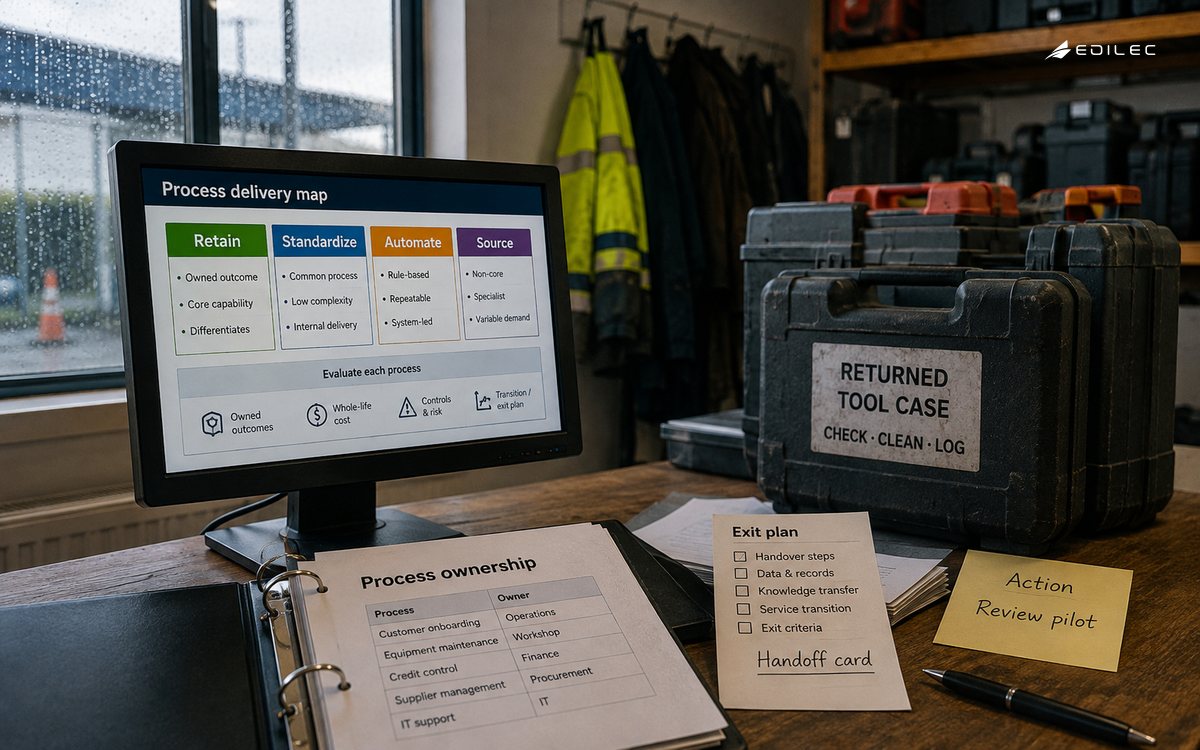
Assess at least four options: improve the internal team, create a shared-service capability, outsource a defined service, or use a hybrid model. Automation can apply to any option; it is not a delivery model by itself. Score options against weighted criteria agreed before supplier proposals arrive. Include control, service quality, access to skills, time to improve, management capacity, resilience, data restrictions, reversibility and whole-life cost.
| Model | Strength | Tradeoff | Best fit |
|---|---|---|---|
| Internal improvement | Maximum proximity and control | Requires internal capacity and transformation skill | Strategic or rapidly changing processes |
| Captive shared service | Standardization with retained employment and knowledge | Setup cost and internal service-management burden | Common work across multiple business units |
| Outsourced managed service | Access to scale, process expertise and service discipline | Supplier dependency, transition and contract-management risk | Stable, measurable processes with a viable market |
| Hybrid or co-sourced | Retains critical judgment while adding specialist capacity | More handoffs and governance complexity | Processes with separable routine and high-risk work |
Build a whole-life cost model
A credible estimate starts with a technical and operating baseline, not a supplier's unit price. The GAO Cost Estimating and Assessment Guide calls for defined purpose, scope and schedule; a work breakdown structure; assumptions and data; suitable estimating methods; sensitivity and risk analysis; documentation; and updates using actual costs. Apply those principles to each delivery option so the comparison is like for like.
Model setup, run and exit separately. Setup includes discovery, process redesign, migration, integration, security review, environments, training, parallel run and change management. Run cost includes transaction or capacity charges, retained management, licenses, cloud, quality assurance, audit, support, indexation and change requests. Exit includes data extraction, knowledge transfer, overlap, replacement procurement, contract termination and system decommissioning. Add ranges for volume, wage, currency, inflation, automation and exception-rate assumptions.
| Cost block | Examples | Evidence |
|---|---|---|
| Baseline | People, systems, facilities, rework, delays, management overhead | Finance ledger, time study, volumes and quality records |
| Transformation | Design, migration, integration, remediation, training, dual running | Work breakdown, rate cards, estimates and risk ranges |
| Steady state | Service fees, retained team, platforms, audit, governance and change | Demand model, pricing schedule and operating design |
| Risk and variability | Volume bands, exceptions, inflation, currency, delays, service credits | Scenario and sensitivity analysis |
| Exit | Data return, knowledge transfer, overlap, termination and replacement | Exit plan, asset register and tested extraction |
Do not assume every current cost disappears. Managers, controls, systems and premises may remain. Separate cashable savings from avoided future cost, capacity released and quality benefits. Present a range with assumptions, not a single precise figure. The Sourcing Playbook's should-cost approach is designed in part to reduce low-cost-bid bias; buyers should similarly challenge prices that depend on unrealistic demand, automation or exception assumptions.
Design controls and data ownership into the service
Control design should begin with the objective and evidence. For each consequential action, define who initiates, checks, approves and records it; which access is required; what system enforces the rule; and how exceptions are reviewed. COSO's Internal Control framework emphasizes confidence in operational and reporting information, while ISO quality principles emphasize process approach, evidence-based decision making and improvement. Translate those ideas into daily behavior, not a policy appendix.
- Maintain a role matrix and periodically recertify access.
- Separate incompatible duties and monitor emergency access.
- Keep authoritative records, data definitions, lineage and quality ownership.
- Log approvals, overrides, exports, configuration changes and failed interfaces.
- Reconcile transactions between workflow and systems of record.
- Define retention, deletion, location, subprocessors and data-return obligations.
- Test controls after process, system, supplier or automation changes.
Manage supplier, concentration and technology risk
Due diligence should cover delivery capability, financial viability, security, privacy, workforce practices, subcontractors, locations, insurance, continuity, technology dependencies and incident history. NIST SP 800-161 treats service and technology suppliers as part of cybersecurity supply-chain risk management. Map the full chain, including cloud platforms, automation products and specialist subprocessors, then assign notification and approval rules for material changes.
Avoid concentration that makes a single provider, location or platform an unrecoverable dependency. Require current process documentation, asset and interface registers, exportable data, source or configuration escrow where justified, continuity tests and a usable exit plan. Service credits may compensate for a missed target but do not restore customer trust or operational capacity; resilience must be engineered and exercised.
Align pricing and KPIs with controllable outcomes
Input pricing suits work where the buyer directs resources and retains delivery risk. Transaction pricing can fit standardized units but needs precise definitions and quality gates. Outcome-based pricing can align incentives only when outcomes are attributable, measurable and protected against gaming. Many services need a hybrid: stable capacity, variable demand bands, separately governed change and incentives tied to balanced quality, timeliness and control measures.
| KPI family | Example | Anti-gaming companion |
|---|---|---|
| Timeliness | End-to-end cycle time by priority | Age of open exceptions and reopened cases |
| Quality | Right-first-time completed cases | Downstream corrections and sampled defect severity |
| Control | Reconciliations and approvals completed on time | Overrides, access exceptions and audit findings |
| Experience | Requester effort or satisfaction after closure | Abandonment, repeat contacts and complaints |
| Improvement | Validated benefits from approved changes | Benefit persistence and total change cost |
Pilot the operating model, then transition in waves
The pilot should test the service, not stage a demonstration. Choose representative volume and exceptions, use production-like controls and integrations, and compare results with the baseline. The Sourcing Playbook recommends pilots for first-generation outsourcing because they reveal environment, constraints, requirements, risks and opportunities. Define entry, success, stop and rollback criteria before starting.
- Discover and baseline: validate scope, volumes, variants, controls, costs and pain points.
- Design: agree target process, retained organization, data model, technology, measures and governance.
- Prove: run a bounded pilot with real cases, exceptions, continuity tests and independent quality review.
- Prepare: complete knowledge transfer, access, runbooks, migration rehearsal, training and support readiness.
- Transition: move one process, region or customer segment at a time with parallel reconciliation and daily command review.
- Stabilize: resolve root causes, confirm controls, update the cost model with actuals and obtain service acceptance.
- Improve: operate a governed backlog; retest controls and baselines after material change.
Plan people impacts with the same rigor as systems. Identify retained roles, transferring knowledge, training, communications, local legal obligations and critical-person dependencies. Do not remove internal capability before the new service has demonstrated stable performance and recoverability. Edilec's enterprise systems service can connect process design with workflow and integration delivery, while the workflow integration guide provides deeper system-boundary guidance.
Example: a hybrid accounts-payable service
A growing company finds that invoice volume has doubled, but the process varies by business unit. Discovery reveals reliable purchase-order matching for most established suppliers and a smaller set of tax, new-vendor and payment-detail exceptions. The target model keeps policy, vendor-master approval, treasury and high-risk exceptions internal. A service team runs intake, matching, supplier queries and standard exception preparation on a shared workflow.
The pilot covers one business unit and includes duplicate checks, changed-bank-detail controls, end-to-end reconciliation and a continuity exercise. Pricing combines a capacity floor with transaction bands; quality and control failures are excluded from completed volume. The governance dashboard balances cycle time with downstream corrections, aged exceptions and control overrides. Only after stable reconciliation and knowledge-transfer evidence does the company move the next unit.
Common risks and practical responses
| Risk | Early indicator | Response |
|---|---|---|
| Scope ambiguity | Work is repeatedly labeled out of scope | Create activity and exception catalog with ownership and pricing |
| Loss of knowledge | Answers depend on a few individuals | Capture decisions, pair teams and test reverse knowledge transfer |
| Low-cost bid bias | Price assumes unproven automation or unrealistically low exceptions | Use a should-cost range and scenario tests |
| Weak adoption | Business units route work around the service | Design with users, simplify intake and publish accountable support routes |
| Supplier lock-in | Data, runbooks or configurations are not exportable | Contract, test and govern exit deliverables from the start |
| Metric gaming | Headline SLA improves while complaints or rework rise | Balance speed, quality, control and experience measures |
Key takeaways
- Choose a delivery model using evidence; do not begin with a provider or location.
- Scope activities, exceptions, systems, controls and retained accountability in operational detail.
- Compare whole-life cost ranges, including transformation, retained organization, variability and exit.
- Use a representative pilot with stop and rollback criteria before transition.
- Balance KPIs and preserve data, knowledge and exit options throughout the contract.
Frequently asked questions
What is included in business process services? The service can include people, process execution, workflow technology, data handling, controls, reporting and continuous improvement for a defined business outcome. Exact activities and retained responsibilities must be specified; the label alone has no standard scope.
How is BPS different from BPO? The terms overlap. BPO often emphasizes contracting work to an external provider, while BPS can describe a broader managed operating capability and may be internal, external or hybrid. Buyers should focus on the proposed delivery and accountability model rather than the acronym.
How long does implementation take? There is no responsible universal duration. It depends on process variants, data quality, integrations, controls, locations, workforce change and procurement. Build an evidence-based schedule from a work breakdown, pilot and transition waves, with contingency for identified risks.
How should a buyer compare costs? Compare in-house, shared, outsourced and hybrid options on the same scope and demand scenarios. Include baseline, transformation, retained management, technology, risk, variability and exit; then update the estimate with pilot and operating actuals.
Which work should remain internal? Typically retain policy, risk appetite, regulatory accountability, strategic process ownership, supplier governance and decisions whose consequence or context cannot be responsibly delegated. The exact boundary should follow risk and capability analysis.
Conclusion
Business process services succeed when the operating model is clearer after sourcing than before it. The buyer should know what outcome is promised, who owns every decision, how cost changes with demand, which controls produce evidence, how service quality is measured and how operations continue if the arrangement ends. That clarity turns a commercial contract into a governable service and gives automation, shared services or outsourcing a fair test against real business results.