Digital twin interoperability is the ability to preserve asset identity, meaning, relationships, state, and authority when information crosses engineering tools, operational systems, and twin platforms. Exporting JSON is not enough. Two models may both contain a property named temperature while disagreeing about sensor location, unit, aggregation window, quality, source timestamp, writable authority, and whether the value describes a physical asset or a simulation.
A portable architecture separates the enterprise asset record from any vendor runtime representation. It uses durable identifiers, governed concepts, versioned model packages, and tested mappings. Platform-specific capabilities can still be used, but their dependency and exit path remain visible. The goal is not one universal schema; it is controlled translation without silent semantic loss.
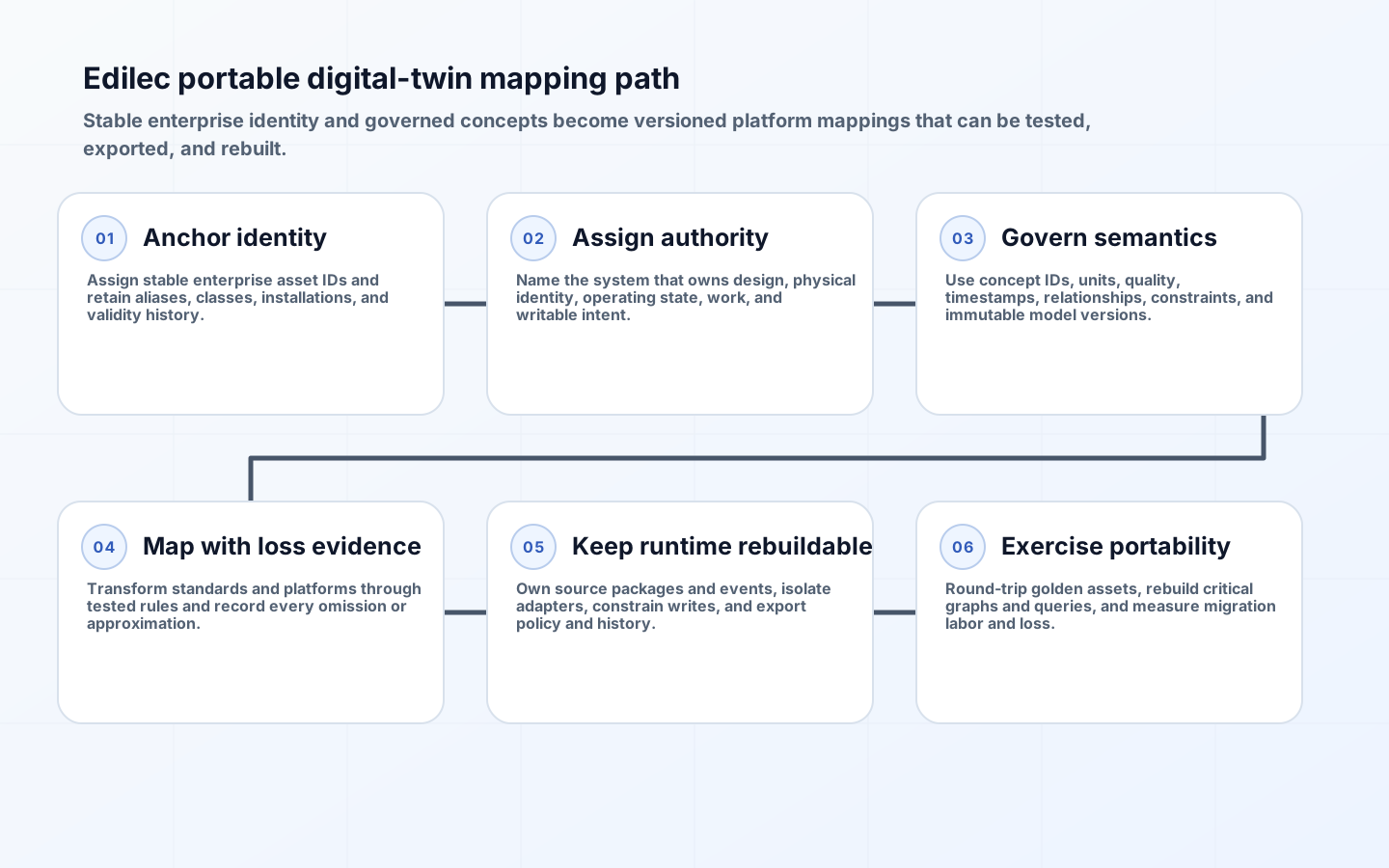
Establish asset identity and source authority first
Create a stable enterprise asset identifier independent of hostname, network address, platform object ID, and current owner. Link serial number, manufacturer identity, model, engineering tag, location, parent, installation, and lifecycle state as governed aliases with validity periods. Distinguish asset class from individual instance. Define which system owns each attribute: product lifecycle management may own design characteristics, the asset registry physical identity, SCADA current operational state, and maintenance software work history.
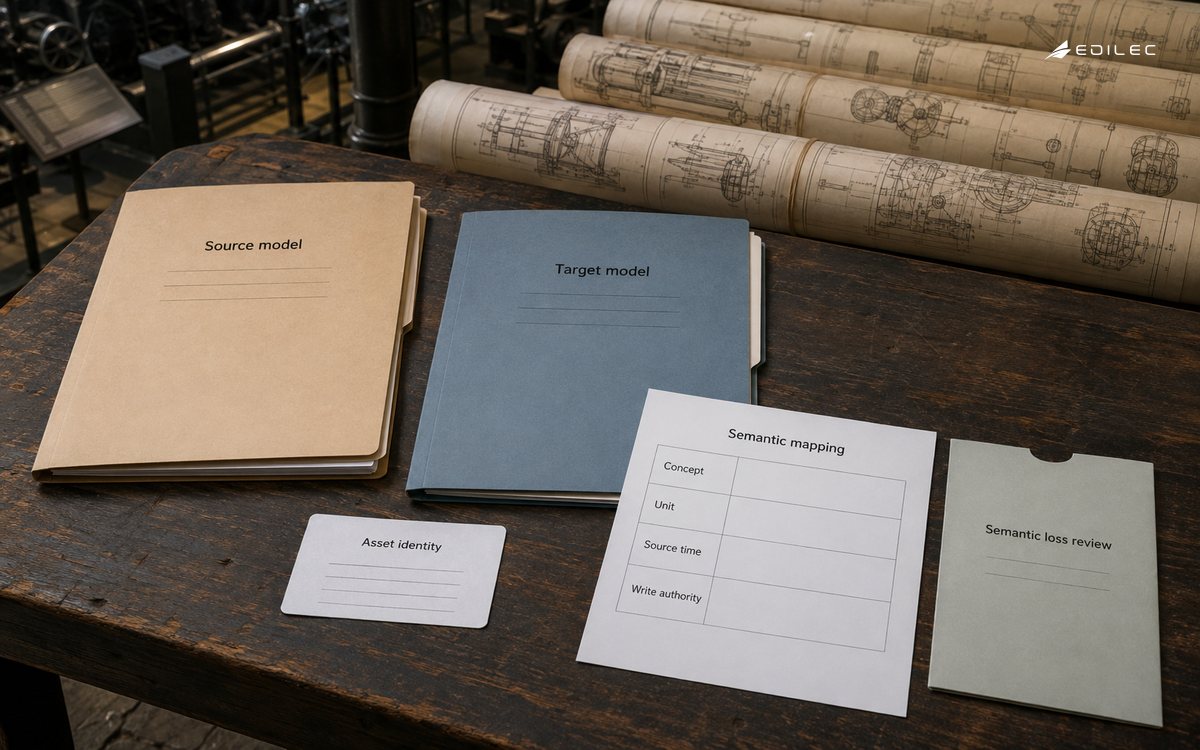
Identity resolution should produce evidence, not guesses. Store mapping method, confidence, effective time, reviewer, and collision state. Never auto-merge assets solely because labels resemble each other. The W3C Thing Description 1.1 provides a formal information model for metadata, properties, actions, events, protocol forms, and security definitions; its Thing Model concept is useful for distinguishing templates from deployed instances.
| Layer | Canonical content | Typical authority | Portability rule |
|---|---|---|---|
| Identity | Stable ID, aliases, class, installation history | Enterprise asset registry | Never substitute a platform object ID |
| Semantics | Concept IDs, units, data types, quality, constraints | Domain governance and standards | Use resolvable definitions and version them |
| Structure | Composition, hierarchy, connections, topology | Engineering and operations owners | Record relationship type and validity |
| Behavior | Properties, events, commands, limits | Equipment and control owners | Separate observation from writable intent |
| History | Measurements, events, changes, work outcomes | Source systems by record class | Preserve source time, provenance, and retention |
Use standards for their intended interoperability boundary
The Asset Administration Shell defines an industrial digital representation with a metamodel, APIs, security, package format, and standardized submodels. The IDTA AAS specification set published Release 25-01 material including metamodel, API, data specification, security, and AASX packaging. AAS is well suited to exchanging structured industrial asset information and submodel templates across lifecycle participants, provided teams constrain versions and semantic identifiers.
Digital Twins Definition Language (DTDL) expresses interfaces, telemetry, properties, commands, components, and relationships for digital-twin solutions. The official DTDL repository publishes language material and tooling. WoT Thing Description focuses on interoperable interaction metadata and protocol bindings. These are not interchangeable wrappers. Select a canonical boundary based on the exchange: supplier asset package, runtime graph, web interaction contract, or analytics event. Mapping everything into the richest model can create complexity without preserving authority.
Build versioned mapping contracts and a semantic loss ledger
For each source and target pair, map stable identity, class, concept identifier, value type, unit conversion, cardinality, relationship direction, quality, timestamps, command semantics, access policy, and lifecycle state. Store the mapping as code and data under version control. Generate deterministic output from immutable input fixtures. A loss ledger should name every source concept omitted, flattened, approximated, or moved to an extension, with impact and owner.
Prefer concept identifiers and vocabularies over matching display labels. Unit conversion must include dimension and precision; Celsius-to-Fahrenheit is different from converting an interval average whose window was lost. Preserve unknown extensions so a round trip does not erase vendor information, but isolate them from canonical business logic. Use namespaces to avoid collisions. Validate syntax with each standard's schema, then add domain validation for required identifiers, ranges, relationship rules, and authority.
| Test | Example | Failure exposed | Required result |
|---|---|---|---|
| Round trip | AAS to canonical to AAS | Dropped qualifier or extension | Equivalent meaning or documented loss |
| Unit conversion | Pressure value and limits | Converted value but unchanged alarm limit | All related quantities converted consistently |
| Version skew | Old source model to new target | Renamed field interpreted as new concept | Explicit compatibility rule or quarantine |
| Identity collision | Two suppliers reuse local tag | Accidental asset merge | Namespace and review conflict |
| Relationship semantics | Contains versus connected-to | Flattened graph changes meaning | Typed directed relationship retained |
| Write authority | Platform property maps to command | Unauthorized bidirectional synchronization | Mapping rejected unless authority is explicit |
Design a portable runtime and event boundary
Keep source records and model packages in an organization-controlled repository using open, documented serialization. Feed platform twins through an adapter that can rebuild them. Publish state changes as versioned events containing enterprise asset ID, concept ID, source, source time, ingestion time, quality, model version, and event ID. Consumers should not depend on opaque graph IDs or undocumented change streams. Maintain export tooling and test it before procurement renewal.
Avoid active-active writes across twin platforms unless a conflict algorithm and authority exist for every property. A safer model has one command service validate intent and write to the operational authority; twins receive resulting state as observations. Cache-derived views can be rebuilt. Keep access policy in a portable decision layer where possible, but map platform permissions explicitly and test least privilege. Encryption, tenant boundaries, deletion, and audit export must survive migration.
Govern model versions and migration with evidence
Use immutable semantic versions for released model packages. Add fields and relationships compatibly, deprecate before removal, and publish migration functions with fixtures. Record the model version on every instance and event. For breaking changes, dual-publish a bounded cohort, compare derived outcomes, migrate stored instances, and keep reversal until consumers prove compatibility. A registry should show producers, consumers, mappings, owners, and retirement dates.
Score platform lock-in across model expressiveness, proprietary functions, event APIs, query language, identity, security policy, history storage, workflow, visualization, and egress. A useful feature may justify dependency; hidden dependency cannot be priced. Run an annual portability exercise that rebuilds a representative twin graph and critical query in a neutral test environment from exported assets, mappings, events, and policy.
Key takeaways
- Anchor every platform object to a durable enterprise asset ID and explicit source authority.
- Choose AAS, DTDL, WoT, or another model for a specific exchange boundary rather than forcing false equivalence.
- Treat mappings as versioned software with fixtures, domain validation, and a semantic loss ledger.
- Keep source model packages and events portable enough to rebuild vendor runtime views.
- Test migration and round-trip meaning before dependency becomes a renewal surprise.
FAQ
Does an enterprise need one canonical twin model?
It needs canonical identity, concepts, and authority for shared decisions. Separate domain models can remain optimized for engineering, operations, and service when mappings are governed. One enormous schema often slows ownership without eliminating translation.
Can AAS and DTDL be used together?
Yes. AAS may package supplier and lifecycle submodels while DTDL represents a cloud runtime graph. Map through enterprise identity and concept IDs, document losses, and avoid treating either platform's internal identifier as the asset key.
How is twin portability measured?
Measure exported model and instance coverage, unmapped concepts, round-trip loss, rebuild time, consumer changes, policy equivalence, history completeness, and time to reproduce critical queries. A successful file export alone proves very little.
Operate twin quality as an observable service
Monitor unresolved identities, alias collisions, unmapped concepts, invalid units, stale observations, relationship cycles, unauthorized writes, mapping failures, model-version skew, export lag, and consumer rejection. Set service objectives by criticality: an energy dashboard may tolerate delayed state, while a maintenance recommendation needs correct component identity and calibration context. Quarantine invalid updates rather than partially mutating a twin. Provide operators with the source record, mapping version, validation reason, and safe replay action.
Create golden asset packages that cover composition, multilingual labels, optional fields, vendor extensions, relationships, commands, bad quality, and model upgrades. Run them through every adapter in continuous integration. Add production samples only after removing sensitive plant and supplier data. Contract tests should verify both representation and meaning, such as a command remaining non-writable after a round trip or an observation retaining source timestamp and unit. Track mapping coverage by business-critical concept, not by percentage of JSON fields.
Procurement should require documented API and export limits, bulk extraction, model and event versioning, deletion, audit retention, regional availability, and support horizons. Estimate exit labor before signing: model conversion, history movement, identity reconciliation, policy recreation, consumer changes, validation, and dual-run. Keep the portability exercise small enough to repeat but representative enough to include one difficult extension and one writable workflow. The objective is credible optionality, not a promise that switching platforms will be free.
Document deletion and retention across canonical records, platform replicas, event logs, exports, backups, and derived analytics. A portable architecture must be able to locate an asset's representations and apply an approved lifecycle disposition without destroying unrelated equipment history. Verify the result through sampled readback and exception reporting.
Conclusion
Interoperable twins depend on stable identity, explicit authority, and honest translation. Standards provide powerful structures, but portability comes from versioned mappings, retained source evidence, and repeated rebuild tests. That discipline lets teams use platform strengths without surrendering the meaning of their assets.