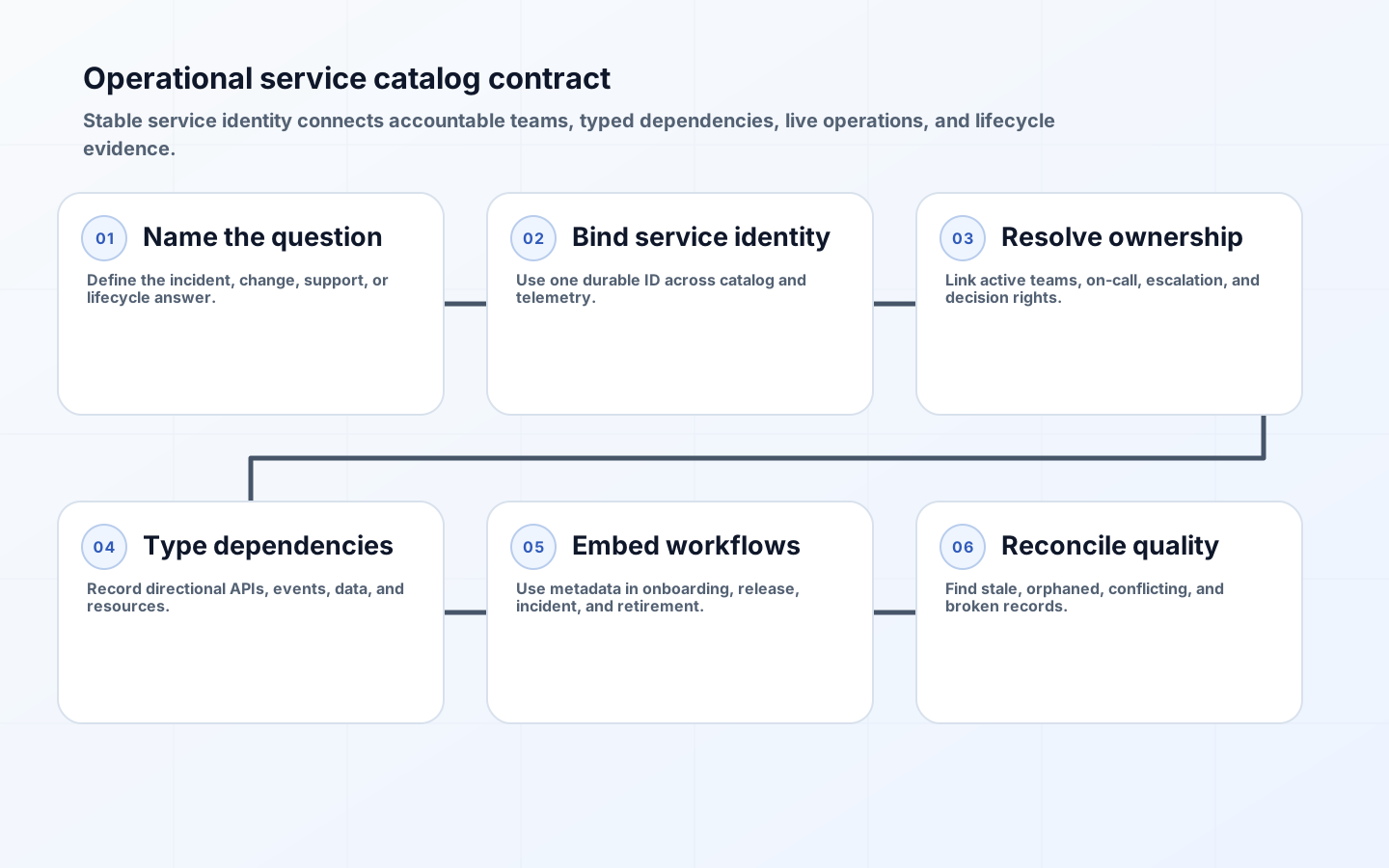
A software service catalog earns its place during an incident, a risky change, or an ownership handoff. At those moments, a responder needs to identify the customer-facing service, accountable team, current on-call path, runtime components, critical dependencies, operating objectives, and escalation route. A catalog that only lists repositories and cloud resources cannot answer those questions. It is an inventory, not an operational ownership system.
The implementation goal is a small, governed graph assembled from authoritative sources and maintained through normal engineering workflows. The graph should reflect how teams reason about services without pretending to be a real-time topology engine. Backstage explicitly describes its catalog as a centralized view of ownership and metadata and cautions that catalog relations are a human mental model rather than an exhaustive dynamic map. That distinction keeps scope useful.
Start with operational questions
Write the questions the catalog must answer before choosing entity types. Incident response may ask who can make a traffic change and which service objective is burning. Change review may ask what depends on an API and whether a deprecation has an owner. Support may ask where to escalate a failed customer journey. Architecture may ask which systems cross a regulated boundary. Each question implies a minimum node, relationship, freshness expectation, and consumer.
Rank questions by decision consequence and frequency. A team name that is one day stale may be tolerable; an on-call route that points to a dissolved team is not. Avoid an early demand to catalog every library, queue, host, and transitive edge. Backstage guidance notes that the catalog is not the right place for every dynamic relationship. Link to telemetry, deployment, and discovery systems for live detail while keeping stable ownership and service semantics in the catalog.
Define a stable service and system model
Use a few durable entity classes. A domain represents an area of business responsibility. A system groups components and resources that cooperate to provide a capability. A component is a deployable service, website, library, or data pipeline. An API is a provided or consumed contract. A resource represents infrastructure or data that needs operational context. A group is the accountable team, not an individual who may move roles next week. Add custom kinds only when they support a concrete query that standard entities cannot express.
| Entity | Required operational meaning | Typical source | Avoid |
|---|---|---|---|
| Domain | Business responsibility boundary | Architecture portfolio | Using it as a cost center only |
| System | Customer or internal capability | Service owner declaration | One system per repository |
| Component | Deployable or operated software unit | Code repository or deployment platform | Ephemeral process instances |
| API | Versioned interaction contract | API registry or specification | Undocumented database coupling |
| Resource | Operationally significant infrastructure or data | Cloud, data, or platform inventory | Every transient runtime object |
| Group | Accountable team with a support path | Identity or HR directory | Naming a single employee as owner |
Make ownership an executable contract
An owner field should resolve to a valid team entity and carry responsibilities. Define who accepts incidents, approves production change, maintains documentation, funds lifecycle work, and decides deprecation. These roles can be one team or several, but ambiguity should be explicit. Include a primary operational owner, business or product owner, security contact where required, and support tier. Do not use a generic platform team as owner merely because it hosts the service; hosting responsibility and service outcome responsibility are different.
Connect groups to the enterprise identity source so renamed or dissolved teams are detected. Require a handoff when ownership changes: accepting team, effective time, open risks, on-call readiness, access, objectives, and outstanding incidents. A catalog entry should not silently transfer because a repository was moved. Add validation that blocks production onboarding when no resolvable operational owner exists, and report orphaned entities as work with a due date rather than quietly hiding them.
Represent dependencies with direction and purpose
A generic depends-on edge is often too weak for impact analysis. Record whether a component consumes an API, publishes an event, reads a data product, uses a shared resource, or participates in a customer journey. Name direction from consumer to provider and distinguish required synchronous dependencies from optional or asynchronous ones. Include contract identity and environment where material. Do not infer criticality only from traffic volume; a rarely used settlement or recovery path may be essential.
Treat declared relations as design intent and telemetry relations as observed evidence. Compare them, but do not overwrite one with the other. A newly observed call may reveal undocumented coupling or test traffic. A declared edge with no recent telemetry may be a dormant contingency. Store timestamps and provenance so users know whether an edge came from source control, an API specification, cloud discovery, or traces. Route disagreements to owners and preserve the last accepted relation until resolved.
Publish a minimum operational metadata contract
| Field | Why responders need it | Freshness rule | Validation |
|---|---|---|---|
| Stable service ID | Correlates catalog, telemetry, incidents, and cost | Immutable | Unique and non-reused |
| Lifecycle | Sets support and change expectations | At every transition | Allowed state machine |
| Operational owner | Routes action and accountability | Daily identity sync | Resolvable active group |
| On-call and escalation | Reaches a capable responder | Near real time | Synthetic route test |
| Tier and objectives | Frames impact and urgency | On objective approval | Linked SLO and reviewer |
| Dependencies | Supports diagnosis and change impact | On contract or architecture change | Valid targets and typed edges |
| Runbooks and dashboards | Moves from discovery to action | On release review | Authenticated link check |
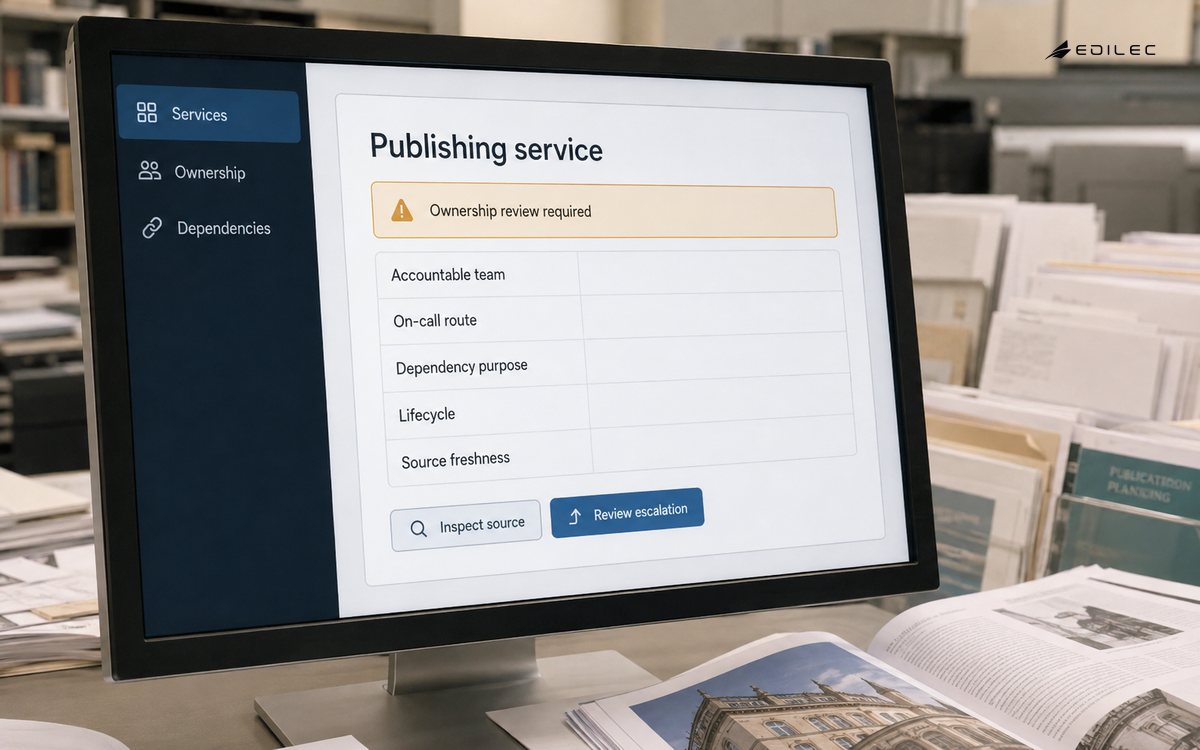
Use one stable identifier across catalog and telemetry. OpenTelemetry service semantic conventions define attributes such as service name, namespace, instance ID, and version; the catalog should establish the organization-level naming contract while telemetry supplies runtime instances. Avoid deriving identity from display names or repository paths. Renames should change labels, not break incident history, dashboards, cost records, or dependency references.
Assign authority per field and reconcile conflicts
There is rarely one source of truth for an entire catalog entry. Source control may own component description and API declarations; the identity directory owns groups; the deployment platform owns active versions; the on-call system owns schedules; the SLO repository owns objectives. Define authority at field level, then ingest and stitch records by stable ID. Backstage's catalog processing model similarly ingests entities from authoritative sources, applies policies and processors, and assembles relations for presentation.
Set deterministic precedence and surface conflicts. If source control names Team A while the service registry names Team B, do not pick the most recent timestamp without context. Flag the discrepancy, notify both stewards, and retain provenance. Measure missing owners, invalid relations, stale links, duplicate IDs, unresolved conflicts, and processing failures. A completeness score is useful only when weighted by operational consequence; a missing tag should not offset a broken on-call route.
Embed the catalog in delivery and operations
Create catalog records from software templates or repository onboarding, then require owners to update metadata through the same review process as code. Release pipelines can validate service identity, owner, lifecycle, production tier, runbook, and objective links before first deployment. Incident tools can enrich alerts with ownership and dependency context. Change systems can query affected services. Deprecation workflows can find consumers and track acknowledgements. These integrations make accuracy valuable to the teams who maintain it.
Keep access proportional to sensitivity. Broad discovery of service names and owners is usually beneficial, but security contacts, recovery procedures, data classifications, or regulated dependencies may need restricted views. Audit metadata changes and privileged reads. Do not turn the catalog into a copy of secrets, credentials, customer data, or detailed vulnerability findings. Link to protected systems and carry only the minimum classification and routing metadata needed for decisions.
Roll out by service journey, not asset count
Pilot with one customer journey that crosses several teams. Model its systems, components, APIs, owners, objectives, on-call paths, and critical dependencies. Run an incident and a change-impact exercise using only the catalog entry, noting every missing answer. Improve the contract, automate ingestion, and then onboard the next journey. This produces evidence of operational value sooner than importing a million assets and discovering that none has a reliable owner.
Measure time to identify an owner, successful escalation rate, percentage of production services with tested support paths, unresolved orphan age, dependency acknowledgment during change, and catalog-assisted incident outcomes. Search counts and page views show adoption but not correctness. Periodically ask owners to attest high-consequence fields, while continuously validating what machines can check. Retire entities through an explicit lifecycle that removes routing and relationships without reusing their IDs.
Key takeaways
- Design the catalog around incident, change, support, and lifecycle questions rather than total asset coverage.
- Use stable service identities, team ownership, typed dependency relations, and field-level provenance.
- Separate declared architecture from observed runtime evidence and reconcile disagreements visibly.
- Integrate catalog checks into onboarding, release, incident, change, and deprecation workflows.
- Measure whether people reach the right owner and make better decisions, not merely how many records were imported.
Frequently asked questions
Is a software service catalog the same as a CMDB? They can overlap, but a software catalog usually emphasizes developer and operator ownership of logical services, components, and APIs. A CMDB often covers broader configuration items and service management processes. They can exchange governed identifiers instead of replacing each other.
Should the catalog discover all dependencies automatically? Discovery is valuable evidence, but automatic traffic observation cannot determine business criticality, dormant recovery paths, or intended contracts by itself. Compare observed edges with owner-declared relations and investigate differences.
Who should own catalog quality? Platform teams own schema, ingestion, validation, and experience. Service teams own semantic accuracy for their services. Identity, on-call, SLO, and deployment systems remain authoritative for their fields. Shared quality requires explicit stewardship at each boundary.
Conclusion
A useful catalog is a maintained contract between systems and teams. It gives every operated service a durable identity, accountable owner, support route, lifecycle, objective, and understandable dependencies while linking to live evidence elsewhere. When those fields participate in real workflows, catalog maintenance stops being clerical inventory work and becomes part of reliable software operation.