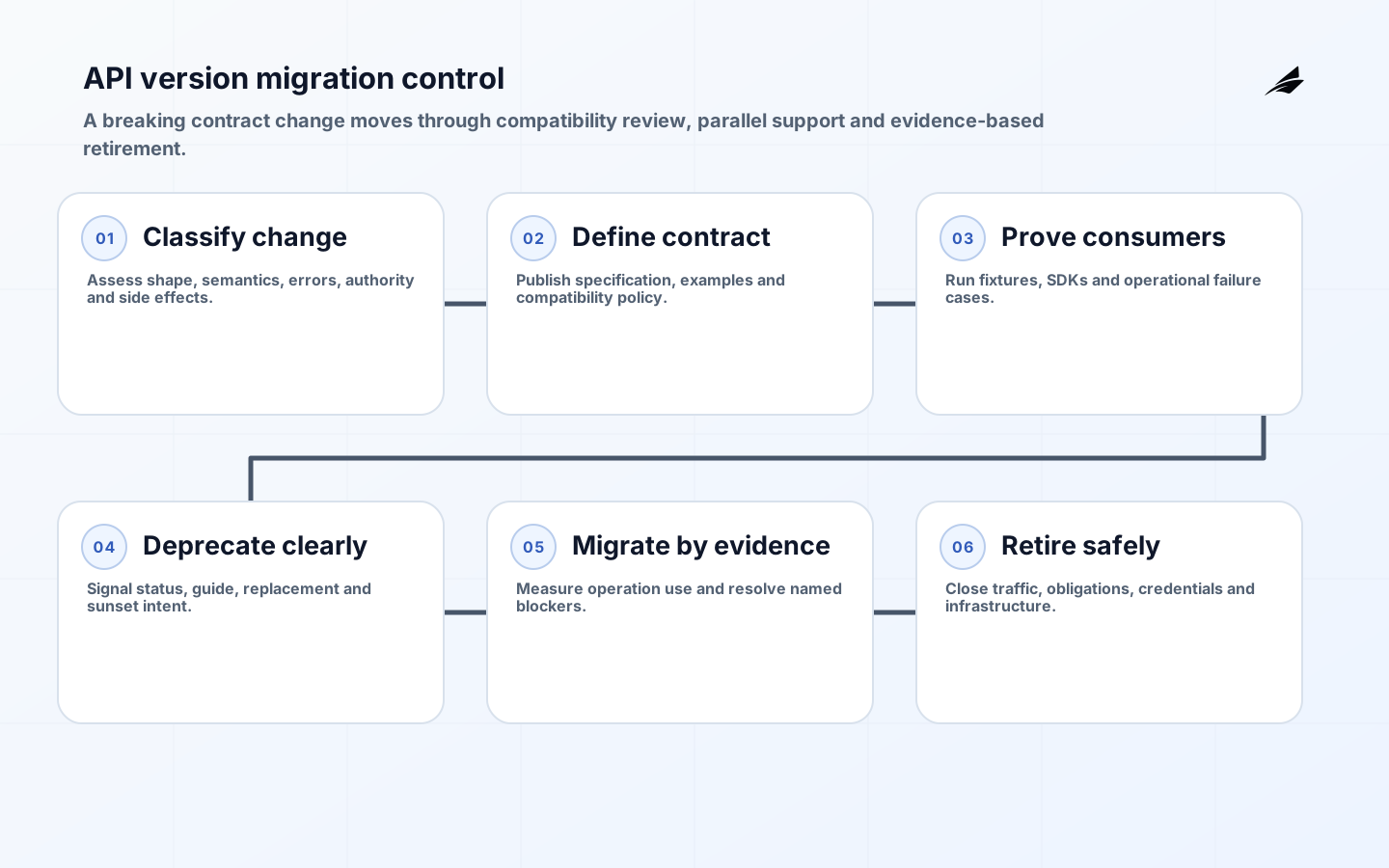
API Versioning for Service Businesses: Compatibility and Migration Guide requires more than selecting tools or assembling a feature list. The implementation must connect a defined business outcome to data, authority, failure behavior and permanent ownership. This guide explains the decisions a buyer, product leader and delivery team should settle before committing the full build. It uses current primary standards where they define a useful control, while keeping the architecture proportional to the actual workflow and consequence.
The practical goal is an operable service: people can complete the intended work, understand state and exceptions, and recover when a dependency or decision fails. Scope therefore includes discovery, design, integration, security, delivery, rollout and support. The sections below can be used for proposal review, architecture workshops and acceptance planning. Related reading includes API Versioning: Mistakes and Fixes, API Versioning for Custom Software: a Practical Guide, API Versioning Checklist for Reliable Digital Operations.
Version the contract only when compatibility requires it
An API version is a promise about observable behavior, not a label for every release. Most implementation changes, performance improvements and optional capabilities should ship without a new public version. Define the contract first: resources, methods, fields, errors, authorization, side effects, ordering, limits and timing relied on by consumers. RFC 9110 supplies common HTTP semantics; changing those semantics under the same operation can break clients even if JSON shape is unchanged. Use a new version when a necessary change cannot be introduced compatibly within the existing promise.
Create an API change record that identifies affected operations, clients, data and behavior. Review it before implementation so a compatible design remains possible. New endpoints, optional fields or capability negotiation may avoid a version split. Do not overload an existing field with a new meaning. If a security issue requires immediate incompatibility, document the emergency decision and provide diagnostics that help consumers distinguish intentional rejection from service failure.
Maintain a written compatibility policy
Classify changes with consumer evidence. Removing or renaming fields, adding required inputs, changing identifier format, narrowing accepted values or altering side effects is usually breaking. Adding optional response data may break strict parsers. Tightening authorization can be necessary for security but still requires migration planning. Google AIP-180 provides a detailed backward-compatibility vocabulary for resource-oriented APIs. Publish your own rules, include examples and test generated and hand-written clients. A policy should state what consumers must tolerate, such as unknown fields, and what providers will preserve.
Build a compatibility suite from production-like requests and responses, including unknown fields, enum values, pagination, errors and concurrency. Generated clients can reveal specification breaks while hand-written clients reveal undocumented assumptions. Review server behavior against old request fixtures on every release. Record deviations approved for security or correctness. Compatibility is two-sided: providers preserve promises, while consumers avoid parsing prose or assuming response order that was never guaranteed.
| Area | Decision | Evidence |
|---|---|---|
| Change | Compatibility assessment | Preferred treatment |
| Add optional response field | Usually compatible for tolerant clients | Ship in current version and test strict clients |
| Rename resource field | Breaking | Dual field or new version with migration |
| Add required request field | Breaking | Default, phased validation or new version |
| Change error prose | Compatible if clients do not parse text | Keep stable problem type and structured fields |
| Tighten authorization | Security-required but operationally breaking | Notify, stage and provide diagnostics |
Choose a versioning style consistently
Path, query and header versioning can all work. Path versions are visible and easy to route but can encourage duplicated resource design. Headers keep resource identifiers stable but require tooling and cache awareness. Date-based versions can communicate a contract snapshot but still need a clear support policy. Choose one style based on clients, gateways, documentation and operational constraints. Keep API contract version distinct from OpenAPI Specification version and application release version. Never route by an undocumented combination of date, media type and account flags that consumers cannot reproduce.
Document routing and cache semantics for the chosen style. A version header must be included in cache keys and gateway policy; a path version must not accidentally create distinct authorization or rate-limit behavior. Provide one canonical example in every SDK and command-line sample. Reject unsupported versions with a structured error and list supported alternatives. Avoid silently defaulting old clients to the newest breaking contract when a version value is absent.
Keep errors and retries stable
Error behavior is part of compatibility. Preserve HTTP status semantics and provide machine-readable details. RFC 9457 defines Problem Details for HTTP APIs with type, title, status, detail and instance fields; consumers should branch on stable type or extension data rather than parse prose. Document idempotency and retry behavior for mutating operations. Adding a new error type can be breaking when clients assume a closed set. Do not expose implementation details or sensitive data in error responses. Contract tests should cover failure, rate limit, timeout and partial-success paths, not only successful examples.
Define stable problem type URIs under organizational control and publish remediation guidance. Keep occurrence detail safe and localized without making clients parse it. Include correlation identifiers that support investigation but do not expose internal topology. Retry guidance should distinguish rate limit, temporary dependency failure and invalid request. Test that intermediaries preserve status and headers. A version migration should not replace precise errors with generic success responses containing an error field.
Signal deprecation before shutdown
Deprecation is a lifecycle, not a release-note sentence. Inventory consumers and usage by authenticated client, operation and version. RFC 9745 defines the Deprecation response header and points to RFC 8594 Sunset for a planned unresponsive date. Provide a stable deprecation link, migration guide, replacement mapping, test environment and support contact. Announce through channels clients actually monitor. The deprecated API should retain behavior during the window; silent degradation is not a migration mechanism. Set dates based on consumer effort, contractual obligations, data retention and release cycles.

Set internal gates before announcing sunset: replacement completeness, SDK availability, documentation, observability and support readiness. Capture baseline traffic by client and operation. Send notices to technical and commercial contacts, but rely on response signaling and developer dashboards as durable channels. Track acknowledgement for critical partners. Revisit the date only through an accountable exception process; repeated indefinite extensions teach consumers that published lifecycle dates have no meaning.
| Area | Question | Control |
|---|---|---|
| Lifecycle stage | Provider evidence | Consumer action |
| Supported | Current specification, tests and service targets | Build new integrations |
| Deprecated | Deprecation signal and migration guide | Plan and test replacement |
| Sunset scheduled | Date, usage reports and escalation | Complete cutover |
| Exception | Named consumer, owner and expiry | Resolve blocker by agreed date |
| Retired | No traffic, obligations or recoverable dependency | Remove credentials and old infrastructure |
Run old and new contracts with evidence
Build the new version behind independent contract tests, then run representative consumer fixtures. Where safe, shadow reads or compare responses without duplicating side effects. Offer adapters or SDK updates for common clients. Track calls to removed fields or operations, not just version-level traffic. Contact material holdouts with evidence and record approved exceptions. For write APIs, define how idempotency, identifiers and resources cross versions; two versions must not create contradictory business state. Rehearse rollback of routing and schema changes before moving a production cohort.
For stateful resources, specify whether versions share the same resource identifiers and persistence. Test a resource created through the old contract and read or updated through the new one. During shadow comparison, normalize expected differences before flagging divergence. Rate-limit migration tests separately from production where needed. Provide a conformance environment with deterministic fixtures. After cutover, monitor business outcomes and support cases, not only HTTP error rates.
Operate versions as products
Assign an owner, support state and retirement date to each public version. Keep specifications, examples, changelog and generated artifacts synchronized in one release process. Validate OpenAPI documents and use diff tooling as an input to review, not an infallible judge of behavior. Monitor traffic, errors, latency, rate limits and migration adoption by consumer. Review security fixes across every supported version. Limit the number of concurrently supported versions so the organization can test and patch them credibly. A version is retired only when traffic, data and contractual obligations are resolved.
Maintain a version matrix listing operations, environments, owners, consumers, dependencies, security status and end dates. Review it in architecture and product planning because supporting an old version consumes delivery capacity. Automate publication from reviewed specifications and keep changelog entries tied to diffs and examples. Run a retirement checklist that removes routes, secrets, jobs, dashboards and documentation while preserving records required for audit or historical support.
Key takeaways
- Treat versioning as management of observable contracts, not application releases.
- Write compatibility rules and test real consumer behavior.
- Keep structured errors, retries and side effects stable.
- Use standardized deprecation signals, usage evidence and a supported migration window.
Frequently asked questions
Should the version be in the URL?
It is a reasonable choice, especially for public APIs and simple routing, but not mandatory. Consistency, documentation, caches, client tooling and lifecycle control matter more than the location alone.
Should a REST API use semantic versioning?
Semantic versioning can describe client libraries or specifications, but an HTTP API evolves continuously and may support several contract snapshots. Define compatibility and support rules rather than relying on a version number to explain impact.
How long should an old API version be supported?
There is no universal duration. Base the window on consumer inventory, migration effort, contracts, criticality and release cadence. Publish the policy before deprecation and measure actual adoption.
Conclusion
API versioning for service businesses is a disciplined compatibility and migration practice. A durable program defines what consumers may rely on, changes contracts only when necessary, stabilizes error and retry behavior, signals deprecation through standard mechanisms and proves that consumers have moved before retirement. That approach protects partner operations without freezing the API against useful change.