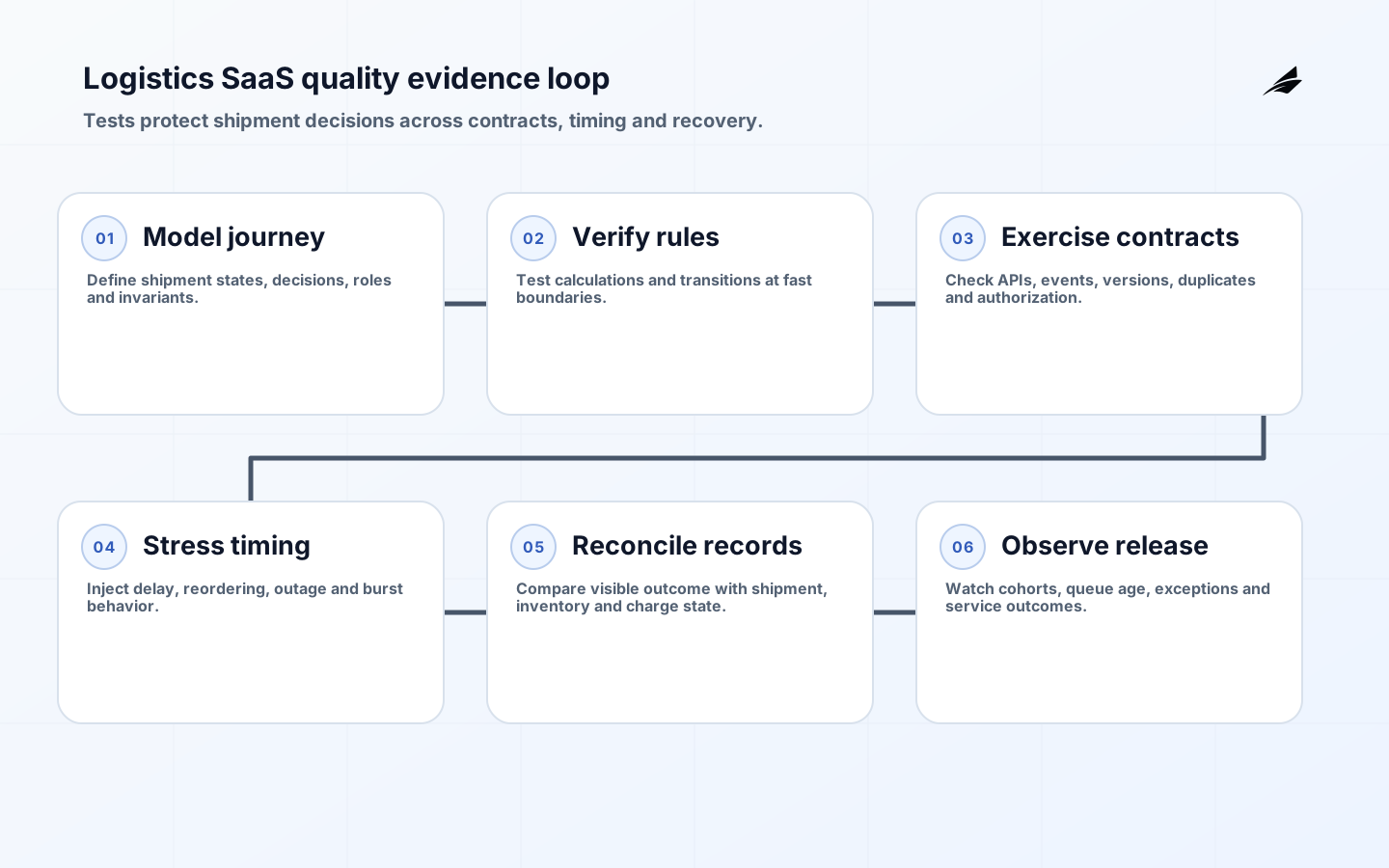
QA automation for logistics SaaS must prove that operational decisions remain correct when events are late, duplicated, reordered, incomplete or supplied by a failing partner. A passing login test says little about whether a shipment can be booked, tendered, tracked, rerouted, delivered, invoiced and reconciled across carriers, warehouses, customers and internal teams. The test strategy therefore begins with business state and evidence. It automates repeatable checks at the smallest useful boundary, then verifies a smaller set of complete journeys under realistic timing and failure conditions.
The target is not the highest possible test count. It is fast, trustworthy information about release risk. A useful suite tells a team which contract changed, which shipment state became impossible, which tenant or role was exposed, and whether recovery preserved the record of truth. This guide complements the implementation checklist and logistics QA FAQ by explaining how to design coverage and operating evidence.
Model quality from logistics outcomes
List the decisions the platform supports: accept an order, promise a pickup, select a carrier, release inventory, calculate an estimated arrival, record a chain-of-custody event, approve an exception or authorize payment. For each decision, identify authoritative inputs, allowed states, time assumptions, monetary or service consequences and the role permitted to act. Turn those rules into executable examples before choosing automation tools. A scenario should say what happened in the business, not merely which button was pressed.

Use a state model for each durable record. A shipment might move from planned to tendered, accepted, picked up, in transit, exception, delivered and closed, but real products need cancellation, correction, return and dispute paths. Define transitions that can be repeated safely and those that must be rejected after commitment. GS1 EPCIS provides a common model for visibility events; even when the product uses a different internal schema, its concepts of what, when, where, why and how help expose ambiguous event handling.
| Quality risk | Automated evidence | Failure example |
|---|---|---|
| State integrity | Transition and invariant tests | Delivered shipment returns to in-transit after a late event |
| Integration contract | Schema, authorization and compatibility tests | Carrier adds a value that breaks deserialization |
| Timing | Virtual-clock and delayed-message scenarios | ETA uses ingestion time instead of event time |
| Tenant isolation | Cross-tenant negative tests | Operator can query another customer's tracking record |
| Recovery | Replay and reconciliation tests | Retry creates a duplicate charge or pickup |
Place tests at the cheapest reliable boundary
Keep deterministic domain rules in fast unit or property tests: route eligibility, weight validation, transition guards, allocation totals and charge calculations. Test service boundaries with controlled databases and message brokers so serialization, constraints and transaction behavior are real. Contract tests verify that APIs and events conform to an agreed OpenAPI or event schema. End-to-end tests should cover a limited portfolio of critical journeys. If every rule is tested only through a browser, feedback will be slow and failures difficult to diagnose.
Browser automation remains important for role-sensitive work, accessible error handling and multi-step recovery. Use resilient locators based on roles and labels instead of CSS structure. Assert the user-visible business outcome and durable record, not animation timing. Control external systems through approved fakes or test environments; never make a release depend on an uncontrolled public carrier sandbox. Record which substitutes were used so a passing test is not mistaken for live interoperability evidence.
Test APIs and events as products
Every external contract needs examples for success, validation failure, authorization failure, throttling, timeout, duplicate delivery and incompatible version. Verify additive changes, unknown enum values and optional fields. For webhooks, sign and timestamp messages, reject invalid signatures and test key rotation. For queues, distinguish redelivery from a new business event through stable identifiers and idempotency records. Confirm that retries stop, dead-letter handling is visible and operators can replay a corrected event without bypassing authorization.
Create event fixtures from documented, synthetic scenarios rather than copying production customer data. Include boundary values and realistic combinations: split shipments, partial delivery, timezone changes, unit conversion, negative adjustments and reordered scans. Store schema version and expected state with each fixture. When a defect is found, reduce it to the smallest reusable scenario and add it at the lowest boundary that reproduces the problem. This makes the regression suite an accumulating description of logistics behavior.
| Test layer | Primary purpose | Typical cadence |
|---|---|---|
| Domain rules | Prove calculations, transitions and invariants | Every change |
| Component | Prove persistence, broker and service behavior | Every pull request |
| Contract | Detect producer-consumer incompatibility | Every contract change and build |
| Journey | Prove critical user and system paths | Release candidate |
| Resilience | Prove delay, outage, replay and recovery | Scheduled and before material releases |
Build disposable data and credible environments
A logistics test environment must be repeatable enough to diagnose failures. Provision isolated tenant data, known users and stable integration endpoints for each run. Create records through public or supported setup interfaces where practical, but use purpose-built fixtures for complex histories. Reset or uniquely namespace runs so parallel suites cannot affect each other. Freeze clocks when testing schedules, then add selected real-time scenarios to reveal timeout behavior. Never rely on one long-lived shared shipment that every test mutates.
Production-like does not mean a full copy of production. Match the behaviors that can change outcomes: database constraints, queue delivery semantics, identity claims, network boundaries, feature flags and relevant service versions. Masking production data is not automatically safe or representative. Prefer generated data with explicit coverage. Where regulated documents or addresses are involved, limit retention and access, and make cleanup an asserted part of the test run.
Verify performance, resilience, security and accessibility
Load tests should model operational bursts, not a smooth average: morning dispatch, carrier status backfill, marketplace promotion or warehouse reconnect. Measure queue age, decision latency, error rate and recovery in addition to HTTP throughput. Inject dependency delay and partial failure to confirm that the platform degrades visibly. A dashboard that responds quickly while processing events hours late is not healthy. Define freshness objectives for the decisions users make and alert on breaches.
Include cross-tenant access, object authorization, export limits and administrative actions in security regression. Test keyboard navigation, focus, labels and error identification for dispatchers using dense interfaces. Confirm that status is not communicated by color alone. Mobile and low-bandwidth checks matter when drivers or field staff interact with the system. Quality is the ability of the whole service to support work under expected constraints, not just correctness on the development laptop.
Build the first ninety days around evidence
In the first month, agree the state model, critical journeys, contract inventory and failure taxonomy, then make the fastest domain and contract tests mandatory. In the second month, provision disposable environments, add representative event fixtures and automate reconciliation for the first journey. In the third, exercise delayed events, partner outage, load and recovery, then release to a bounded cohort with production observation. Review escaped defects by the missing evidence they reveal, not by the person who introduced them. This sequence produces a stable quality system while still delivering visible product work.
Use quality gates that support release decisions
Classify tests by the decision they inform. Pull-request gates should be fast and deterministic. Release-candidate gates may include broader contracts, journeys and migrations. Scheduled suites can exercise expensive resilience and partner scenarios. Quarantine is not a permanent home for flaky tests: assign an owner, record the suspected cause and fix or remove the test by a deadline. A flaky blocking suite teaches teams to ignore failures, which is worse than a smaller reliable gate.
Publish a release quality summary with changed domains, tests executed, known gaps, unresolved defects and rollback evidence. Observe the release by tenant cohort and workflow, using trace context across producers and consumers as OpenTelemetry recommends. Compare expected and actual event volumes, queue age and business exceptions. Automation shortens feedback, but a named person still accepts residual risk and decides whether evidence is sufficient for the change.
Key takeaways
- Turn shipment decisions and state transitions into executable examples.
- Keep most rules below the browser and reserve end-to-end tests for critical journeys.
- Test duplicate, delayed, reordered and incompatible events explicitly.
- Use synthetic, isolated data and environments that reproduce consequential behavior.
- Tie automation results to a human release decision and production observation.
Frequently asked questions
Does logistics QA automation require AI?
No. Deterministic business rules, contracts and known journeys should remain deterministic tests. Machine learning can help prioritize cases or detect unusual behavior, but its recommendations need evaluation data, confidence handling and human review. It should not replace clear expected outcomes where the business rule is known.
Should tests call live carrier APIs?
A small scheduled interoperability check may call an approved partner test endpoint. Most release tests should use controlled contract substitutes, because live sandboxes can be unavailable, rate-limited or mutable. Keep separate evidence for internal correctness, contract conformance and actual partner interoperability.
What coverage number should a team target?
Line coverage alone cannot show whether logistics decisions are protected. Track critical transition, contract, role and failure-mode coverage. Use code coverage to find unexercised implementation, but judge readiness by the business risks and recovery paths the suite can demonstrate.
Conclusion
A professional logistics SaaS test strategy makes uncertain operations reproducible. It models state, contracts, timing, isolation and recovery, then places each check at a boundary that produces fast and interpretable evidence. The result is not a wall of green tests; it is confidence that shipment decisions remain accountable when the surrounding network behaves imperfectly.
Start with one high-value journey such as booking through delivery. Draw every state, event and external contract, add duplicate and delay scenarios, and reconcile every resulting record. That slice will reveal the architecture and environment work needed for a dependable wider suite.