Background Jobs in Production: Delivery, Retries, and Recovery
Background jobs turn slow, scheduled, or failure-prone work into a separate delivery path. That is useful for sending receipts, importing records, rendering files, and calling third parties, but it also means the request that accepted the work is no longer the process that completes it. In production, a job is an agreement: a caller hands over a durable description of work, a worker performs it under bounded resources, and the system records whether the intended effect happened. Teams that treat a queue as merely a performance tool often discover too late that duplicate delivery, stale payloads, and silent failures are product behavior. A reliable design makes those states deliberate and visible. For this operating step, name the accountable owner, supporting evidence, exception route, and next measurable check.
Define the delivery contract before adding workers
Start by naming the business effect, not the function name. “Generate the monthly invoice for account 42” is a clearer contract than “run billing worker.” Include an immutable job identifier, the target record or version, the actor or triggering event, an expiry rule, and the permissible outcome. A queue provides asynchronous hand-off; it does not guarantee exactly-once execution. Assume a worker can receive the same message more than once, stop midway, or resume after the surrounding record changed. The right response is idempotent effect handling: store a completion key close to the protected side effect, make repeated attempts safe, and preserve enough context for an operator to explain what happened. Within this part of the system, name the accountable owner, supporting evidence, exception route, and next measurable check.
| Decision | Production rule | Evidence to retain |
|---|---|---|
| Identity | Give every accepted job and business effect separate stable IDs. | Enqueue time, trigger, payload version, correlation ID. |
| Durability | Acknowledge only after work is durably recorded or the effect is safe to repeat. | Queue receipt, completion record, retry history. |
| Freshness | Reject work that is no longer valid rather than replaying an old instruction. | Expiry reason, current record version, owner. |
| Authority | Re-check permissions when a delayed job performs a sensitive action. | Policy decision and audit event. |
Choose retry behavior by the effect, not by habit
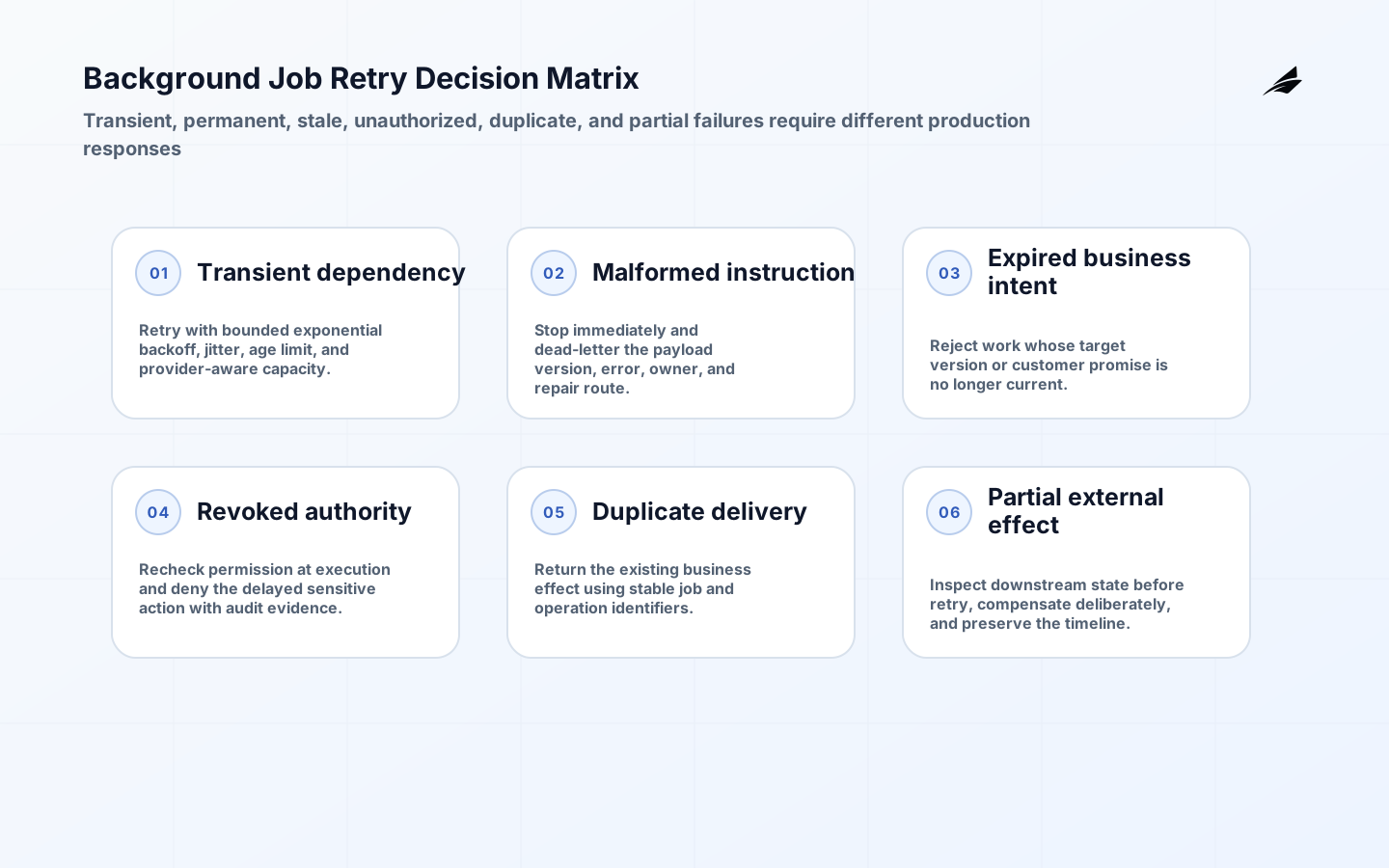
A retry is useful only when the failure may change. A temporary network refusal, a saturated provider, or a rate limit can merit delayed retry with exponential backoff and jitter. A malformed payload, revoked permission, or missing prerequisite will repeat the same failure until a person or upstream process changes the state. Separate transient, permanent, and ambiguous outcomes. Ambiguous outcomes deserve special care: a timeout after a payment request does not prove that no payment occurred. Query the provider using an idempotency key or reconciliation record before sending again. For API-facing workloads, connect the same error semantics used in REST API contracts to the worker’s error classification. When implementing this part of the system, name the accountable owner, supporting evidence, exception route, and next measurable check.
- Set a maximum attempt count and a maximum elapsed age; endless retries turn a defect into recurring cost.
- Use backoff and jitter so a dependent outage does not become a synchronized retry storm.
- Put failed permanent work in a reviewable dead-letter state with the original reason and next owner.
- Make the handler safe when it is called twice, including downstream writes and notifications.
- Throttle by tenant, provider, or workflow when one noisy source can starve more important work.
- Test an interruption after each external side effect, not only a clean exception before it.
Protect capacity and be explicit about ordering
Queues conceal a capacity-planning problem until arrival rate exceeds useful throughput. Measure arrivals, successful completions, job age, concurrency, dependency latency, and the age of the oldest work. A long queue is not automatically unhealthy; a short queue that drops important work is worse. Set concurrency according to the slowest protected resource, such as a database connection pool or an external provider’s rate limit, then give critical and best-effort workflows separate lanes. Ordering should be a declared per-key property, not a system-wide hope. If a customer’s state transitions must remain ordered, partition by customer and make out-of-order work detect and defer itself. Global ordering is expensive and rarely needed. Before releasing this part of the system, name the accountable owner, supporting evidence, exception route, and next measurable check.
| Signal | Question it answers | Useful response |
|---|---|---|
| Oldest job age | Is a customer-visible promise becoming late? | Page the workflow owner when it breaches the service objective. |
| Retry distribution | Are failures temporary or a repeating defect? | Group by error class and halt harmful retry classes. |
| Queue depth by lane | Which work is crowding out another kind of work? | Reserve capacity or apply tenant limits. |
| Dead-letter rate | Is recovery work accumulating beyond human capacity? | Assign cases and fix the upstream contract. |
Make each job traceable across the hand-off
A support engineer should be able to follow one customer action from request to enqueue, worker attempt, dependency call, and final state. Use a correlation identifier and propagate trace context where the platform allows it; W3C Trace Context and OpenTelemetry signals provide interoperable vocabulary for those boundaries. Record structured fields instead of only human prose: job type, business identifier, attempt number, result class, latency, and dependency. Avoid placing secrets or unnecessary customer data in payloads or logs. Observability is an operating interface, so it should answer which work is affected, whether it is safe to retry, and who owns the decision. While operating this part of the system, name the accountable owner, supporting evidence, exception route, and next measurable check.
Prepare recovery and change as first-class operations
Workers outlive deploys. Version payloads so a new worker can understand queued work from the previous release, or keep a compatible handler until old messages drain. When a migration changes the meaning of a record, decide whether existing jobs should use a snapshot, translate to the new contract, or be cancelled and recreated. Runbooks should distinguish replay, compensate, and manually resolve. Replaying is appropriate when the effect is known to be absent; compensation is appropriate when an incorrect effect must be undone; manual resolution is appropriate when the business meaning cannot be inferred safely. These decisions belong in the workflow design, not in an incident channel. When changing this operating step, name the accountable owner, supporting evidence, exception route, and next measurable check.
Background jobs takeaways
- Model a job as a durable business instruction with a safe repeated effect.
- Classify failures before choosing retry policy; not every error is transient.
- Use lanes, limits, and per-key ordering only where the business outcome needs them.
- Expose job age, attempts, error class, and ownership in the same operational view.
- Treat dead letters and replay as controlled recovery, not a button that erases uncertainty.
Background jobs FAQ
Can a queue guarantee exactly-once processing? Usually the useful promise is at-least-once delivery combined with an idempotent business effect. How long should a job retry? Set the window from the customer promise and dependency behavior, then stop before stale work becomes harmful. Should workers share the web application database? They can, but connection budgets and migrations must account for both populations; separate execution capacity does not remove shared data constraints. During support for this part of the system, name the accountable owner, supporting evidence, exception route, and next measurable check.
Conclusion
Background jobs become dependable when the team designs for the things that happen after enqueue: repetition, delay, changed state, partial success, and recovery. Build the small contract around those realities, instrument the hand-off, and give operators a safe choice for exceptional work. The result is asynchronous execution that remains explainable when it matters. To validate this part of the system, name the accountable owner, supporting evidence, exception route, and next measurable check.
A serious background jobs review starts with a real case. Bring the triggering request, visible outcome, information available to the decision maker, and a case where the normal path failed. Compare identity, timing, permissions, dependency state, version, and policy. Decide which facts must become part of the contract and which remain implementation detail. This prevents an all-too-common production failure: a plausible rule is built, yet no one can later explain why it produced a particular outcome. Durable evidence lets support resolve a case, engineering reproduce it, and product decide whether the behavior still serves the intended user.
Change management must be part of background jobs. Before rollout, identify systems and people relying on the current behavior, choose a compatibility window where needed, and prepare a correction path. During rollout, watch signals that reveal a broken assumption instead of waiting for a broad report. After rollout, compare intended results with observed cases and preserve decisions that should guide the next release. This is practical delivery discipline: it keeps a small change from becoming an untraceable operational surprise after several dependencies and owners have accumulated.
Access and data handling are part of background jobs, even where the feature appears technical. Use the least information necessary to complete the workflow, make privileged actions attributable, and distinguish diagnostics from material a broad audience can see. Review who can alter the contract, who can see exception detail, and how long records remain available. The strongest result is not a longer policy document. It is an operating path where the permitted action, its reason, and its result can be understood by the people accountable for delivery.
Feedback is an input to background jobs design. A support pattern, near miss, failed correction, or confusing hand-off can reveal a missing state or ambiguous term. Capture the case without blame, identify the smallest durable improvement, and verify that the next person sees the new rule at the moment it matters. Some improvements belong in validation, others in documentation, tests, observability, or interface language. The choice should follow the failure mechanism. Over time, this loop keeps system rules legible as original authors, integrations, and delivery cadence change.