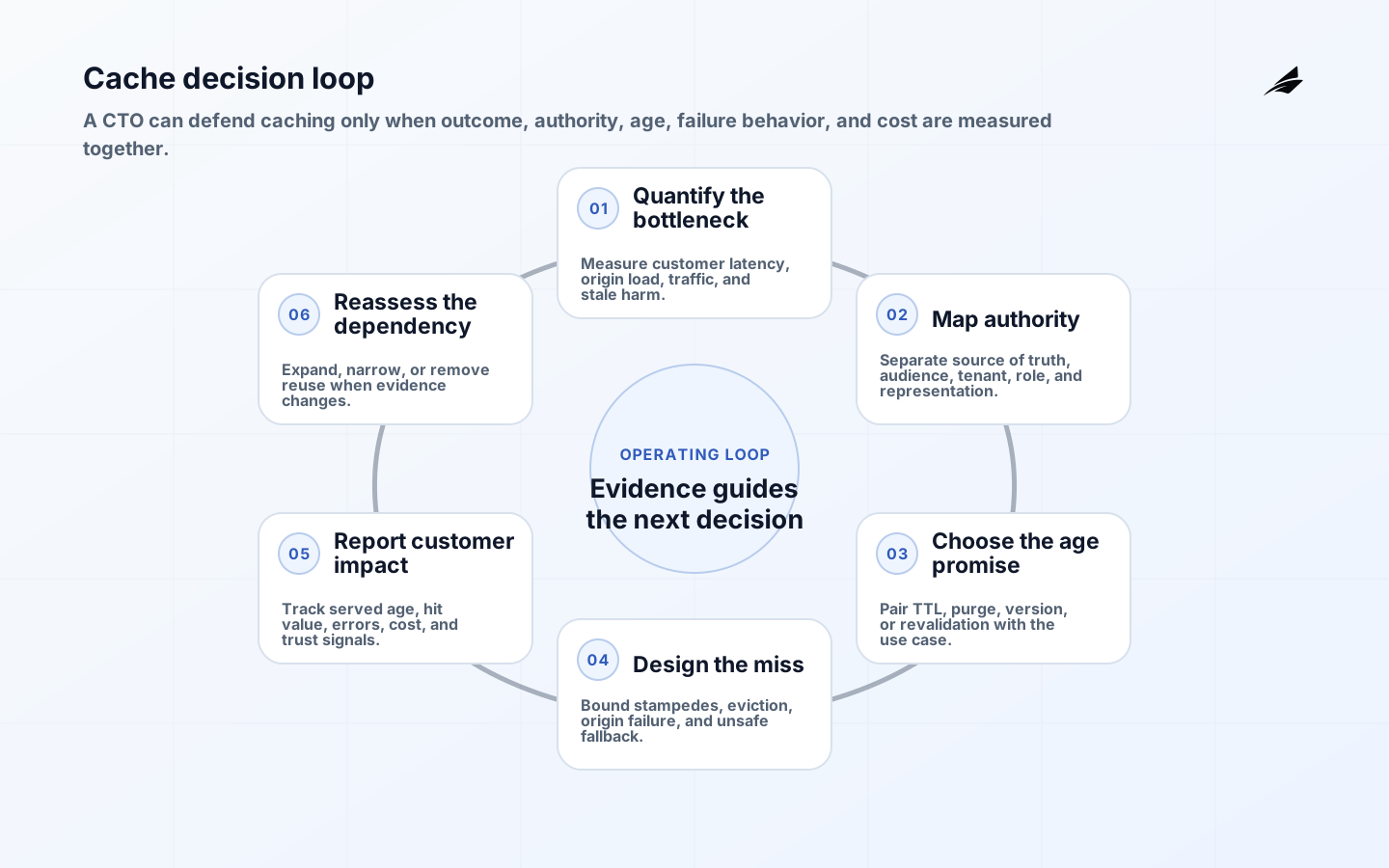
Caching strategy is a product and reliability decision, not merely a faster database lookup. A cache stores a copy that may be older, incomplete, or absent, so the design must say what can be reused, for how long, for whom, and what happens when the copy is wrong. A CTO should ask which customer outcome needs latency improvement, what correctness contract applies, and whether the team can operate another stateful dependency. RFC 9111 describes HTTP cache semantics; MDN’s caching guide explains the browser and intermediary model, while Cache-Control reference makes directives concrete.
Start with the outcome, not the cache product
Baseline origin latency, error rate, payload size, request frequency, read-to-write ratio, and the cost of a stale answer. A catalog image, a permission decision, a stock quantity, and a payment status do not share a safe freshness policy. State the target in customer terms: first content appears within a budget, a read-heavy endpoint reduces origin load, or a report remains available during a dependency slowdown. Redis eviction guidance is useful when the working set exceeds memory. If the baseline is unknown, a cache hit ratio can become a vanity metric that rewards serving old data rather than improving the service.

| Data | Typical reuse | Control to decide |
|---|---|---|
| Public static asset | High | Versioned name and long lifetime |
| Product description | Medium | Release or content invalidation |
| User-specific dashboard | Conditional | Identity-scoped key and permission review |
| Balance or entitlement | Low or bounded | Short lifetime, revalidation, or no cache |
Map boundaries, identity, and authority
A cache key is an authorization boundary as well as a lookup key. Include every input that changes the permitted representation: tenant, user, locale, role, feature flag, currency, and relevant version. Never assume that hiding a field in the UI prevents a shared cached response from exposing it. Keep the authoritative write path separate from the reusable read path. Decide whether a cache may return stale data during origin failure, and make that choice explicit in the endpoint contract. Security review should examine cache keys, headers, invalidation, logs, and eviction, not just the database query.
Choose freshness and invalidation together
A time-to-live is a blunt but understandable promise: readers may see a value for a bounded period. Event-driven invalidation can reduce staleness but creates delivery and ordering concerns. Revalidation lets the origin confirm a representation without transferring the full payload. Select one or combine them based on the data contract, then test a delayed event, duplicate event, missed event, and origin timeout. Document whether stale-while-revalidate, stale-if-error, or negative caching is allowed. The MDN Cache-Control reference makes the policy vocabulary concrete for HTTP responses.
| Pattern | Useful when | Main risk |
|---|---|---|
| Fixed TTL | Change frequency is predictable | Stale window is accepted without context |
| Explicit purge | A business event defines freshness | Missed or out-of-order invalidation |
| Revalidation | Payload is costly but validators are cheap | Origin still becomes a dependency |
| Stale on error | Availability matters during outages | Users may act on old information |
Design misses, stampedes, and eviction
A miss should have a bounded origin path, not an unprotected thundering herd. Use request coalescing, jittered expiry, sensible timeouts, and a circuit or admission policy where the workload warrants it. Decide whether a failed lookup is cacheable and for how long; negative results can protect an origin but may hide a newly created record. Memory pressure is not an edge case. Redis documents several eviction policies, each with different implications for frequently used and recently written keys. Observe evictions, memory fragmentation, item size, and hot keys before choosing a policy by habit.
Prove one cacheable read path
Start with one endpoint whose origin behavior is measurable. Add cache key logging without sensitive values, hit and miss counters, age at read, origin fallback latency, invalidation outcomes, and a way to compare cached and authoritative responses in a controlled sample. Load test cold start, warm traffic, a hot key, a cache restart, and a slow origin. A rollout should have a feature flag, a bypass path, and a clear owner for false freshness or unexpected load. If the slice cannot explain why an answer was served, it is not ready for broad reuse.
Make the economics visible
Compare the value of lower latency and origin relief with memory, network, invalidation work, incident risk, and operational attention. A remote cache can increase latency for small responses or add a failure domain when the origin was already adequate. Track p50 and tail latency, origin requests, hit ratio by key family, stale responses, eviction rate, error fallback, and customer-facing outcomes. A single aggregate hit ratio hides a cache that is excellent for harmless assets and unsafe for a critical workflow. Review the data slice by slice with product and support owners.
- Name the freshness contract and acceptable stale behavior for each cached representation.
- Treat cache keys as part of identity and authorization design.
- Test invalidation ordering, missed events, hot keys, cold starts, and dependency failure.
- Instrument age, origin fallback, evictions, and customer impact alongside hits.
- Keep a bypass and rollback path for every production cache change.
- Retire caches whose complexity exceeds their measured benefit.
Key takeaways
A sound caching strategy makes reuse conditional on correctness. Define the outcome, classify data, scope keys to identity, choose freshness and invalidation together, design failure behavior, and measure the full service rather than only hits. CTOs should fund caching when it solves a demonstrated bottleneck and insist on ownership when it adds a new stateful dependency.
A cache governance example
For a user-specific dashboard, write down the key dimensions, membership authority, freshness promise, purge event, fallback, and incident owner. Test a user removed from a tenant, a role changed while an entry is warm, a locale changed, and a dashboard record updated immediately after a read. Measure age served and compare a sample with the source. If the cache cannot explain why a response was safe for that user, narrow the scope or remove the reuse. Governance is what keeps a performance optimization from becoming an authorization shortcut.
CTO cache decision signals
For each cached representation, name the source of truth, audience, key dimensions, maximum age, invalidation producer, fallback, retention, and owner. Run a matrix: same user after a write, another user in the tenant, a role change while an entry is warm, a locale change, a deleted record, a missed event, and a restarted cache. Compare the result with authority and retain only aggregate evidence that cannot expose sensitive values. Ask whether data can be stale during an outage and whether a person could make an irreversible decision from it. If not, route that action to the origin even when the surrounding screen uses a cache. Review capacity as tenants and data grow; a key safe at one thousand projects may fragment or create hot keys at a million. Keep bypass and purge documented, and remove the cache when its benefit no longer justifies another stateful dependency.
Caching strategy FAQ
Is a short TTL always safer?
It reduces the maximum stale window but does not solve a wrong key, unsafe sharing, an invalidation race, or a stampede at expiry. Safety comes from the complete correctness contract and tested fallback behavior.
What hit ratio should a team target?
There is no universal target. Set a goal per data class against origin load, tail latency, freshness, and customer outcomes. A high ratio that returns unauthorized or stale data is a defect, not success.
When should a CTO reject a cache?
Reject it when the origin meets the service objective, the data has no safe reuse contract, the team cannot operate invalidation and recovery, or the expected benefit is smaller than the added failure and maintenance surface.
A CTO caching decision in practice
Suppose a multi-tenant product serves a read-heavy project summary. The origin query joins membership, project state, task counts, and a feature flag. The team first measures p95 latency and finds that the summary is slow during reporting windows, while membership changes must be reflected within two minutes. The cache key therefore includes tenant, project, user role, locale, and summary version. A task update publishes an invalidation event, but a fixed short TTL remains as a backstop. A missed event is detected by an age metric and a sampled comparison with the origin. During an origin outage, the system may show a clearly marked summary that is at most five minutes old, but it never uses that path for an authorization or billing decision. A warm-up job is rejected because it would create an avoidable load spike; request coalescing is used instead. The CTO approves the cache only after the team demonstrates bypass, purge, hot-key handling, memory limits, and a dashboard that separates harmless assets from user-specific data. This is a strategic decision because it trades latency against correctness, capacity, and an additional operational dependency.
Questions before expanding reuse
Ask who owns a stale answer, what a customer can do with it, how a permission change reaches the cache, which event can be lost, how a cold restart affects the origin, and which metric triggers rollback. Review the answer quarterly because traffic, data shape, and product policy change. A cache is not a permanent performance badge; it is a conditional service component that should be simplified or removed when the origin improves or the freshness contract tightens.
Conclusion
Caching earns its place when it improves a named customer or operating outcome without weakening correctness. Make freshness, scope, invalidation, failure, and ownership explicit before selecting technology. The result is a faster service that remains explainable when traffic, data, or dependencies behave badly.
A CTO should also review the cache as a dependency portfolio item. Ask who owns the origin, the cache, invalidation, memory capacity, security review, and incident response. Compare the cost of a remote cache with query optimization, precomputation, or a simpler HTTP policy. If the team cannot state what happens during a cold start or missed event, the strategy is not ready for production.