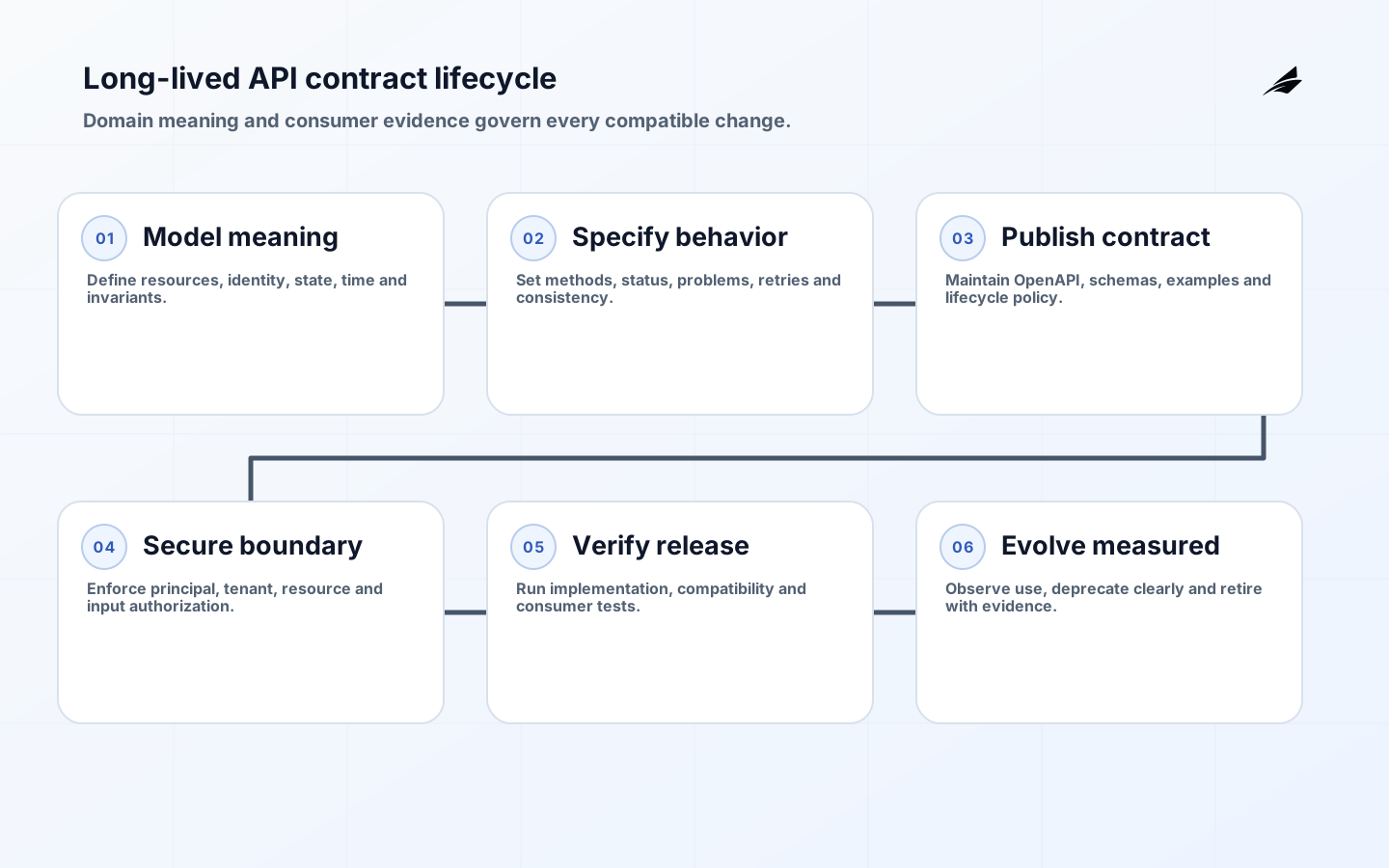
API contract design for long-lived products is the work of making distributed change predictable. A contract includes more than paths and JSON fields: resource meaning, HTTP semantics, identity, authorization, validation, errors, retries, ordering, pagination, rate behavior, lifecycle and support commitments. Producers and consumers deploy independently, so an ambiguous default or silently changed field can fail far from the release that caused it. A durable API allows useful evolution while giving consumers enough stability, signals and time to adapt. That requires product governance and operational evidence as well as an OpenAPI document.
This guide focuses on HTTP APIs used by products, partners and internal services. Related articles cover REST API contract mistakes, API versioning in production and API platform design. Begin by identifying consumers, consequences and ownership. A public payments API and an internal reporting endpoint may use similar syntax but need different compatibility, security, availability and deprecation commitments.
Model domain meaning before endpoints
Define resources, identifiers, states, commands and invariants in domain language. Decide which record is authoritative and whether identifiers are opaque, stable and unique across tenants. Distinguish absent, unknown, empty and zero. Document time zone, precision, currency and units. For state transitions, state who may perform them, valid starting states and whether reversal is possible. Avoid exposing database tables as the public model; storage changes more often than business meaning. A contract should be understandable without reading the producer's source code.
Choose endpoint shapes from consumer tasks and resource relationships. Use consistent naming and representation patterns but do not force every operation into CRUD when a domain command has distinct validation and consequence. A cancellation, approval or retry may deserve a command resource or action that can be tracked. Keep derived display fields separate from values consumers should use for decisions. Document eventual consistency and when a read reflects a write. Include examples with edge cases, not only happy-path placeholders.
| Contract question | Decision to publish | Failure if omitted |
|---|---|---|
| Identity | Format, stability, scope and reuse | Consumers join or cache the wrong record |
| State | Allowed transitions and terminal conditions | Invalid actions appear to succeed |
| Time and money | Zone, precision, unit and rounding | Different consumers calculate different results |
| Consistency | Read-after-write and event timing | Retries or reconciliation create duplicates |
Use HTTP semantics deliberately
RFC 9110 defines method and status semantics. Use safe methods for retrieval and respect idempotent behavior. A successful response should identify whether a resource was created, updated, accepted for later processing or returned unchanged. Use conditional requests with entity tags where concurrent updates matter. Return an appropriate not-found, conflict, precondition or validation response rather than 200 with an error object. Status codes are not the complete contract, but consistent semantics let clients, gateways, caches and operators reason about behavior.
Design retries at the operation level. Network failure can leave a client uncertain whether a write occurred. Idempotency keys can make a bounded command safely repeatable when the server stores key, request fingerprint and result for a documented period. Reject reuse with different input. Natural resource identifiers and conditional creation may solve other cases. Do not retry every failure automatically: authentication, validation and policy errors need correction, while rate and transient responses need bounded backoff. Document retry-after behavior and maximum processing windows.
Standardize errors, pagination and asynchronous work
RFC 9457 defines a problem-details format with fields such as type, status, title, detail and instance. Create stable problem types for conditions consumers can handle and add extension fields only with clear semantics. Do not expose stack traces, secrets or internal database details. Validation errors should point to fields or parameters in a documented way. Keep human text useful but let clients branch on stable machine identifiers. Correlate each failure with an operational trace that support can locate without revealing sensitive system internals.
For large collections, prefer cursor or continuation pagination when data changes frequently. Define sort order, cursor lifetime, page limits and behavior when records are added or removed. Links can be represented using RFC 8288 concepts or documented fields. For long-running operations, return an operation resource with state, timestamps, result or problem and cancellation rules instead of holding a connection indefinitely. Define webhook or event delivery separately, including signature verification, retries, ordering, duplicate handling and replay. Consumers should reconcile from authoritative API state rather than trust a single notification.
Keep the machine contract and examples executable
Use OpenAPI to describe operations, parameters, security, requests, responses and schemas. Select the version and JSON Schema dialect intentionally because tooling support differs. Treat the description as source or generated evidence with one accountable owner; hand-edited documentation and code can drift. Include realistic examples, constraints, formats and nullable or optional behavior. Avoid declaring every string unconstrained. Generate clients only after inspecting their public surface. A generated client cannot resolve an ambiguous contract and may amplify poor naming or exception handling.
Lint for style and completeness, then run schema and behavior tests. Producer tests verify implementation responses against the contract. Consumer contract tests capture real assumptions without letting one consumer dictate the entire API. Compatibility analysis should detect removed operations, narrowed inputs, newly required fields, changed types, response removals and semantic changes that syntax cannot see. Run examples in documentation. Test authorization and problem responses as first-class cases. Keep contract artifacts traceable to the deployed version so incident responders know which behavior was promised.
| Change | Typical compatibility | Safer approach |
|---|---|---|
| Add optional response field | Usually compatible for tolerant clients | Document and test consumers do not reject unknown fields |
| Make input required | Breaking | Add new operation or staged version |
| Change field meaning | Breaking even if schema matches | Introduce a new field and migrate explicitly |
| Add enum value | Potentially breaking | Require unknown-value handling or version |
| Tighten rate limit | Operationally breaking | Signal, observe and phase with consumers |
Design authorization and data boundaries into every operation
Authentication identifies a principal; authorization decides whether that principal may act on this resource in this context. Enforce object and function authorization server-side for every operation. Resolve tenant from trusted identity and resource ownership, not a freely supplied header. Use scopes as coarse grants and domain policy for resource-level decisions. Prevent over-posting by defining writable fields per operation. Validate content type, size, nesting and format before business processing. Apply rate and abuse controls by meaningful principal and cost, not only by source address.
Minimize sensitive data in responses, logs and errors. Encrypt transport, rotate credentials and support revocation. Separate administrative APIs and apply stronger controls. Document data retention and deletion effects, including asynchronous replicas and events. Threat-model enumeration, replay, confused-deputy, injection and cross-tenant access. Security changes can be breaking: disabling a legacy authentication method or adding proof-of-possession may require consumer migration. Treat them as planned lifecycle work while responding urgently to active vulnerabilities.
Evolve contracts with evidence, not version numbers alone
Prefer compatible additive change when semantics remain clear. Use a new version when a consumer must change behavior or when maintaining the old meaning would make the contract misleading. Whether version appears in path, header or media type is less important than consistent routing, documentation, telemetry and support. Do not create a new major version for every feature. Maintain a compatibility policy defining what producers may add, what consumers must tolerate and how emergency security changes are handled.
Deprecation needs inventory and communication. Measure active consumers by credential, operation and version while protecting privacy. Publish replacement guidance, examples and a realistic support window. RFC 8594 defines a Sunset response header that can communicate when a resource is expected to become unresponsive, and links can point to policy or migration material. Headers complement direct communication; they do not reach an unmonitored integration owner. Rehearse retirement, keep rollback criteria and return an intentional response after shutdown rather than a confusing infrastructure error.
Operate the contract as a product
Assign an owner, support path, availability objective and change process. Instrument request count, latency, errors and saturation by operation, version and consumer class without putting secrets or high-cardinality personal identifiers into metrics. Trace downstream calls and include a correlation identifier in supportable responses. Monitor validation failures, authorization denials, idempotency conflicts, webhook backlog and deprecated use. A low server error rate can hide consumer failure caused by a newly required interpretation, so combine telemetry with support and contract-test evidence.
Publish a changelog and migration guides. Provide a sandbox or test fixtures that reflect production semantics without exposing production data. Maintain status and incident communication appropriate to the audience. During incidents, preserve contract behavior where possible; returning syntactically valid fabricated data is worse than a clear failure. Review capacity and rate policy before customer launches. Periodically remove unused fields or versions through the same evidence-based lifecycle. Long-lived does not mean frozen; it means change is explicit, observable and respectful of consumer investment.
A six-step contract design sequence
- Map consumer tasks, domain meaning, authority and consistency.
- Define HTTP methods, statuses, retries and problem types.
- Specify schemas, pagination, asynchronous operations and examples.
- Threat-model identity, tenancy, input and sensitive output.
- Automate contract, compatibility and consumer tests in delivery.
- Release with telemetry, support, deprecation policy and consumer inventory.

Key takeaways
- Contract meaning includes behavior and lifecycle, not just schemas.
- Use HTTP semantics and explicit idempotency to make failure recoverable.
- Give clients stable problem types and observable asynchronous state.
- Test implementation, compatibility and consumer assumptions together.
- Deprecate with inventory, communication, replacement and measured retirement.
Frequently asked questions
Must every long-lived API be RESTful?
No. RPC, GraphQL, event and streaming interfaces can be durable. The same concerns remain: meaning, compatibility, authorization, errors, retries, observability and lifecycle. Choose the interaction model from consumer tasks and operational constraints, then specify it precisely.
Should the first API path include v1?
It can, but the marker does not create a compatibility strategy. Decide what constitutes breaking change, how versions coexist and how consumers migrate. Some teams reserve explicit versions for incompatible change; others version from the first public release for routing clarity.
Is an OpenAPI file the contract?
It is an important machine-readable part. It cannot fully express every domain invariant, authorization rule, consistency promise or lifecycle commitment. Combine it with examples, policy, behavior tests, operational objectives and support documentation, then verify the deployed implementation against it.
Conclusion
A long-lived API gives producers room to improve while protecting consumers from surprising change. Model domain meaning, use protocol semantics deliberately, make failure and retries explicit, secure every resource and automate compatibility evidence. With consumer telemetry and a credible deprecation process, the API becomes an operated product contract rather than a fragile serialization boundary.