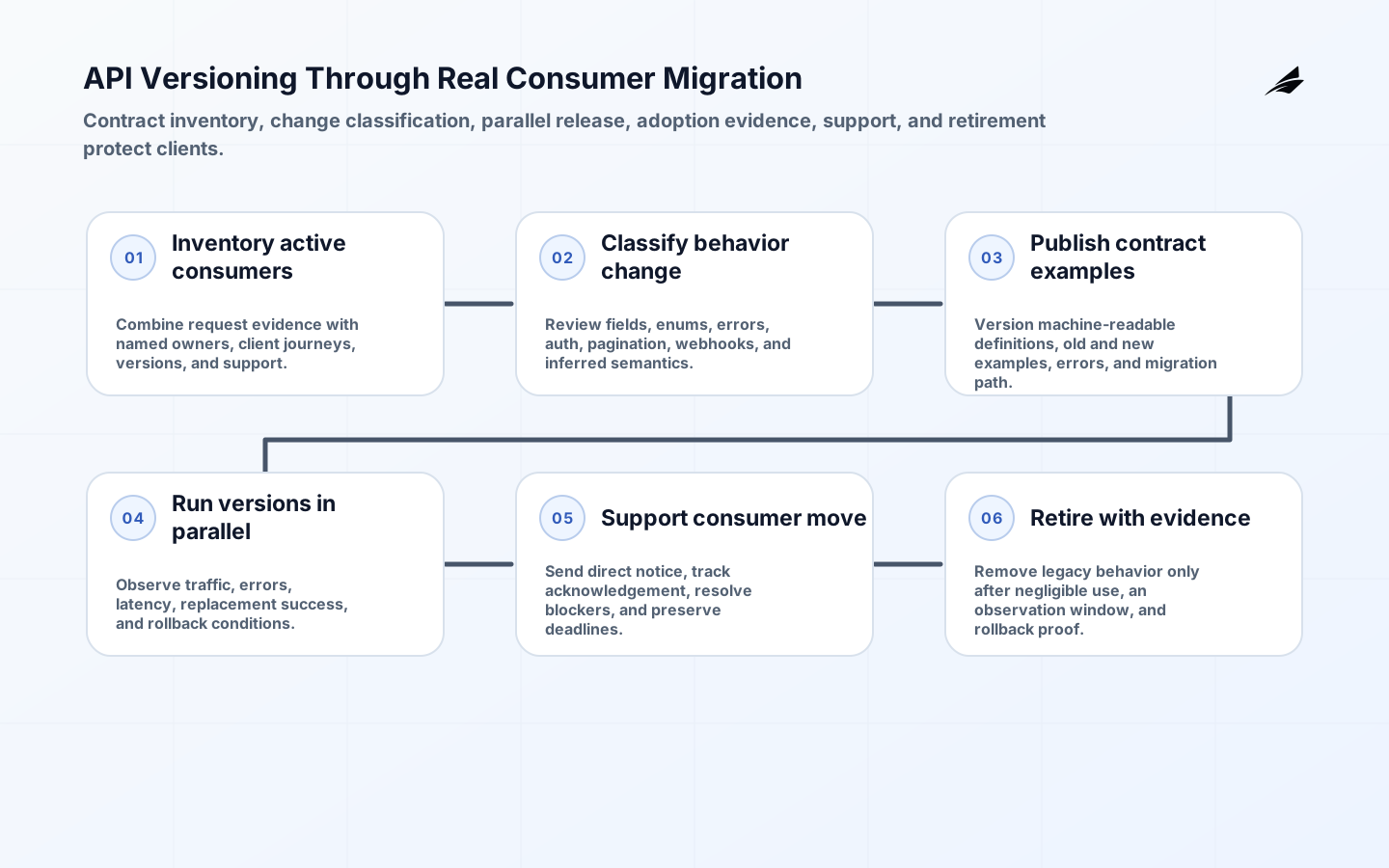
API versioning is not primarily a URL-format decision. It is a promise about what an existing client may continue to send, receive, and infer after a service changes. A mobile application that treats an omitted field as false, a partner that retries a particular error, and an internal workflow that exports a CSV all become consumers of that promise. CTOs should therefore begin with the business capabilities exposed by an API and the clients that rely on them. The HTTP semantics standard is a useful anchor: method, status code, header, and representation meaning are part of the interface, not incidental implementation detail. Good API versioning makes those meanings explicit before a release turns a small change into an integration incident.
Define the compatibility boundary
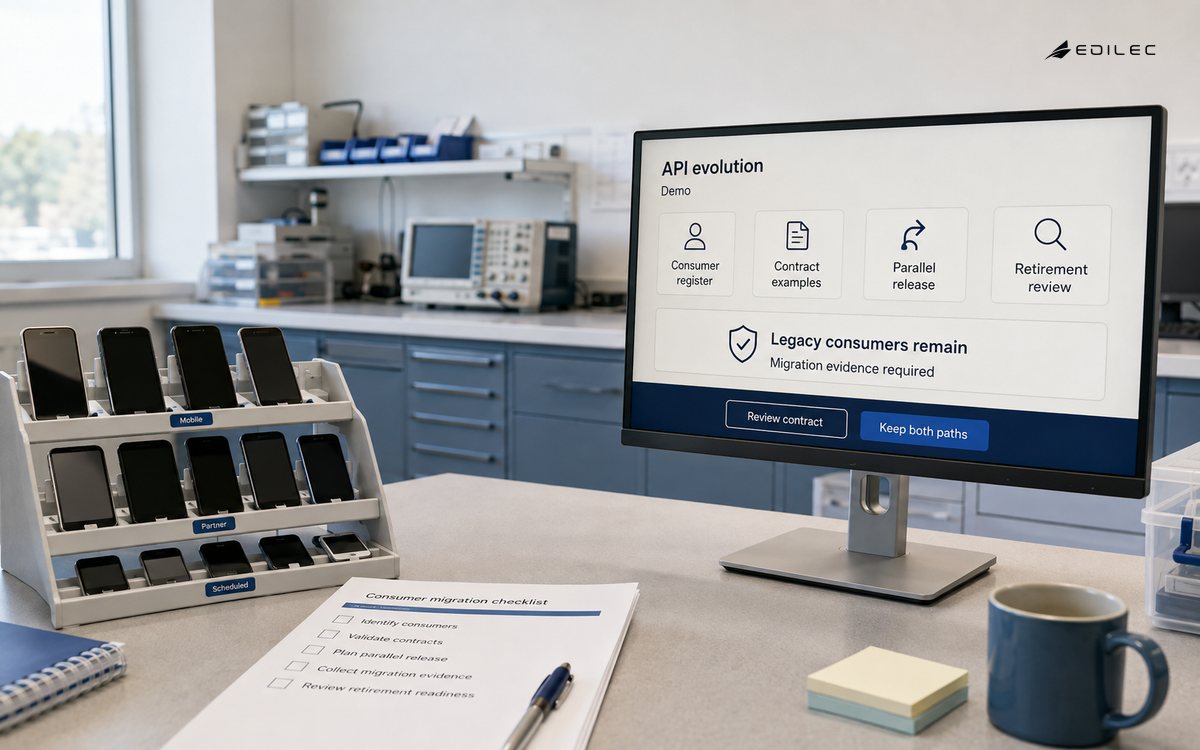
Start by writing down the contract surface. Include paths, query parameters, request and response fields, status codes, headers, pagination behavior, authentication scopes, rate-limit behavior, webhooks, and documented examples. A field can be structurally present yet semantically breaking when its default changes, an enum gains a value that an older client rejects, or an error changes from a retryable server failure to a validation failure. The OpenAPI Specification gives teams a common way to publish much of this surface, but it does not decide compatibility for them. Pair the definition with representative requests and expected failure cases, then name the product owner who can accept a behavior change on behalf of each important consumer.
| Change | Usually compatible when | Review before release |
|---|---|---|
| Add optional response field | Clients ignore unknown fields and the new value does not alter an existing default. | Generated clients, strict schema validators, signed payloads, and CSV exports. |
| Add enum value | Clients have an explicit unknown-value branch. | Mobile releases, switch statements, analytics pipelines, and business rules. |
| Change error representation | Status, retry guidance, and stable error identifiers remain usable. | Support automations and clients that parse message text. |
| Remove or narrow input | No active client sends the value and an alternate path is documented. | Partner integrations, queued retries, and long-lived device software. |
Choose a versioning policy that matches change risk
A path prefix, media-type version, query parameter, or date-based release label can all work, but none repairs an unclear policy. Use a new version for a change that requires a consumer to alter behavior; use additive evolution when old consumers can safely ignore the addition; and use a deprecation window when removal is unavoidable. Keep the policy short enough to apply in a pull request. For example: an existing field never changes meaning; errors carry a stable code; removal requires an announced replacement, usage evidence, and an expiry date. The companion guide on REST API contracts helps teams make those promises testable rather than merely documented.
- State whether an unknown response field, enum member, or error code is safe for supported clients.
- Publish a sunset date only after identifying the clients that must migrate.
- Keep a machine-readable changelog beside the contract, not in release-chat memory.
- Require contract tests for the three highest-value consumer journeys.
- Treat authentication and authorization changes as compatibility changes even when payload shapes stay the same.
Release changes with evidence, not optimism
A safe rollout begins before deployment. Compare the proposed contract to the released contract, review the diff with service and consumer owners, and exercise old and new examples in continuous integration. In production, ship the additive representation first, record which version and client identifier make each request, and expose migration guidance where developers can find it. If an endpoint serves third parties, send an announcement that names the concrete behavior, replacement, deadline, and contact route. The Problem Details RFC is helpful here because stable error types let clients and support teams distinguish invalid requests from temporary service conditions without parsing prose.
| Release stage | Evidence to collect | Exit decision |
|---|---|---|
| Design review | Contract diff, named consumers, compatibility classification, and owner approval. | Approve only when the affected behavior has a documented migration path. |
| Parallel availability | Request volume by version, errors by client, and successful use of the replacement. | Keep both paths while important consumers remain active. |
| Deprecation notice | Direct notice, documentation update, deadline, and support playbook. | Escalate accounts that have not acknowledged a required migration. |
| Removal | Zero meaningful legacy traffic for an agreed observation period and rollback instructions. | Remove the old behavior, then retain audit records and a concise change note. |
Operate the policy as part of service ownership
Measure compatibility with leading signals, not only outages. Track clients that send deprecated parameters, unknown-enum handling failures, contract-test drift, version-specific latency, and support requests attributed to a release. Traffic alone is not proof that a client can migrate: a scheduled monthly reconciliation may be quiet for weeks. Put version retirement on an engineering and product review agenda, with an owner for outreach and a clear exception process. The OWASP API Security Project also matters because a breaking authorization change can accidentally widen access when teams focus only on JSON compatibility. Review scopes, object-level checks, and logging alongside the version plan.
Avoid the two expensive extremes
Never changing an interface is not stability; it can preserve unsafe defaults and force clients to work around design flaws forever. Creating a fresh version for every minor addition is equally costly because it fragments documentation, tests, monitoring, and support. The useful middle ground is semantic discipline: preserve what clients were entitled to rely on, add where old clients are resilient, and version only when behavior must change. This approach keeps service teams accountable for the meaning of their contracts while giving product teams room to evolve. It also creates a natural link to error-handling design, where stable error identifiers often reduce the perceived need for a broad version split.
Key takeaways
- Version the behavioral promise, not just the endpoint path.
- Inventory actual consumers before classifying a change as additive.
- Make contract examples, errors, and sunset dates part of the release artifact.
- Use production evidence and a rollback plan before removing legacy behavior.
FAQ
Should every API have a version in its URL? No. A visible version can be clear, but a policy and compatibility tests matter more than the transport. When is an added field breaking? It is breaking for any supported client that cannot tolerate it, including strict generated clients. How long should deprecation last? Long enough for the slowest supported consumer to migrate, with a defined exception path rather than an open-ended promise. Can OpenAPI replace consumer communication? No. It records a contract well, but it cannot establish whether a partner has seen, understood, and tested a required migration.
Conclusion
Practical implementation note: keep a consumer register that combines automated evidence with named contacts. Log a stable client identifier where policy permits, but do not mistake an IP address or user agent for a reliable owner. For partner integrations, record the sandbox test, production onboarding contact, supported library version, and last confirmed migration. When version telemetry shows legacy traffic, inspect the workflow that generated it before sending a generic notice. Some calls originate from asynchronous retry queues or scheduled reports, so a quiet interactive client can still produce a business-critical request. Build a deprecation dashboard that distinguishes successful legacy calls, rejected legacy calls, migration-ready calls, and unknown callers. Share it with product and support during the retirement window. The goal is not surveillance; it is enough evidence to choose a safe date. Also test the rollback path: a release that removes a representation should have a short-lived configuration or deployment route that restores it while teams investigate. Document how cached responses, SDKs, and webhook retries behave during that reversal. This operational detail is what makes an API promise credible to clients that cannot update on the service team’s timetable.
Operational checklist for API versioning: before approving a material change, record the decision owner, the systems and user groups affected, the baseline signal, and the exact condition that would require rollback. During implementation, keep a short runbook with the deployment or release step, required permissions, verification query, expected result, escalation contact, and reversal action. After release, review the evidence at a scheduled point rather than relying on memory: compare the baseline with current completion time, correctness, error handling, support demand, and the effort required to make the next safe change. Capture unexpected behavior as a specific observation, not a general concern. If a manual workaround remains necessary, name its temporary owner and expiry condition. This makes API versioning a managed capability: people can see what it promises, how it behaves under stress, and what will change when a new requirement appears. It also prevents a successful pilot from becoming an undocumented production dependency. The purpose of these records is practical continuity for operators and future maintainers, not administrative ceremony.
API versioning becomes manageable when a team treats each change as an operational commitment to real consumers. Define the boundary, classify the behavior, publish examples, observe adoption, and retire only with evidence. That rhythm makes interface evolution predictable without freezing the product.