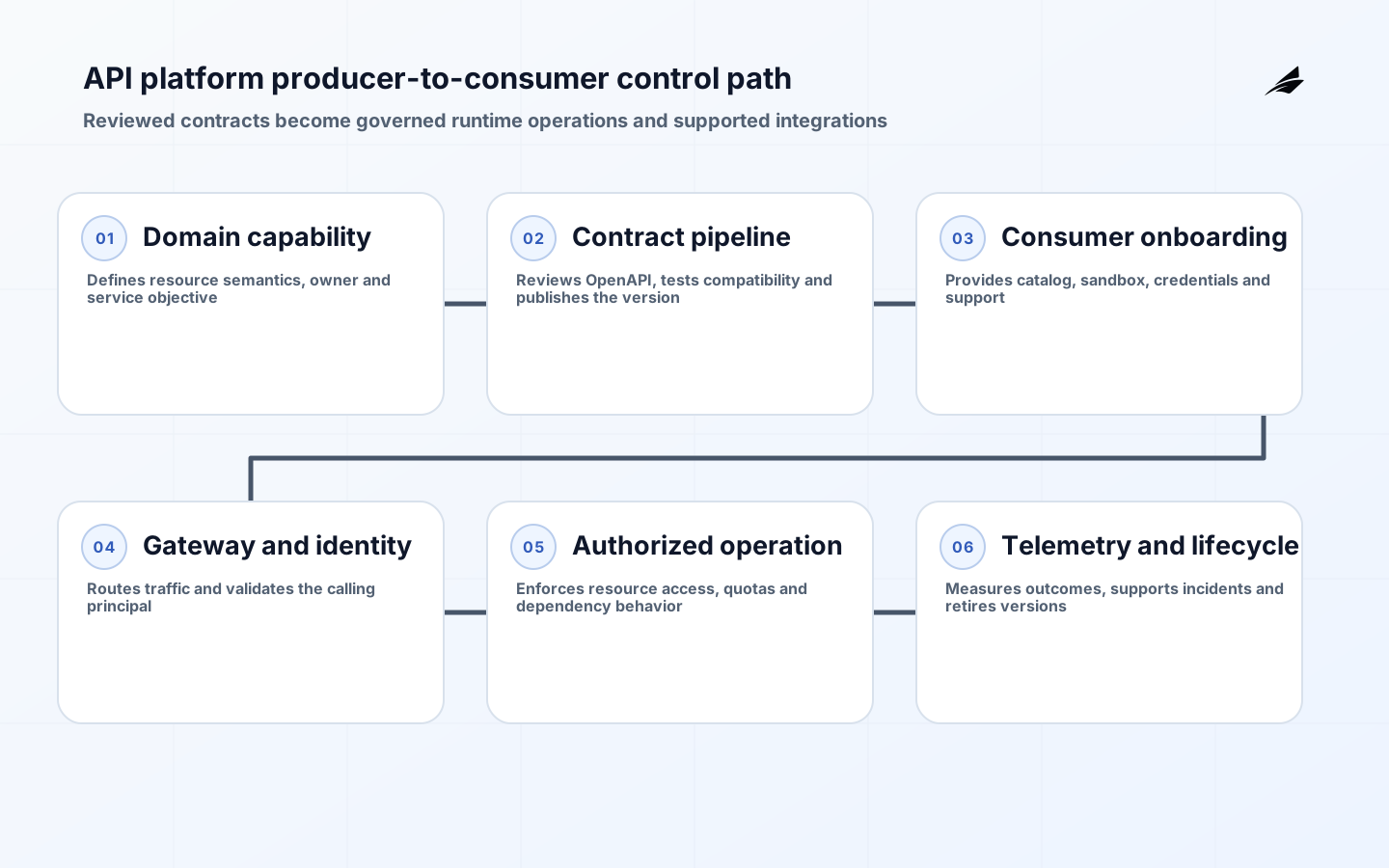
An API platform combines interfaces, runtime controls, delivery tooling, documentation, governance and support so teams can expose capabilities repeatedly. For a service business, it may connect a client portal, mobile experience, partners, internal operations and systems of record. The platform is not synonymous with an API gateway. A gateway can route and enforce policies, but it cannot decide resource ownership, repair an ambiguous contract or operate a poorly understood business process.
Design begins with consumers and capabilities. Identify what a consumer needs to accomplish, which system owns the underlying record, who may act, and what happens during delay or partial failure. Stable APIs represent business resources and events rather than screens or database tables. They reduce coupling when the contract can evolve independently and the owning team supports it. Publishing every backend endpoint through a common domain merely creates a larger centralized dependency.
Key takeaways
- Treat the API platform as a product with consumers, service objectives, ownership and a roadmap.
- Design contracts around business resources and explicit semantics before generating implementation code.
- Authorize every object and function; authentication alone does not protect tenant or record boundaries.
- Use quotas, idempotency and bounded retries to control resource consumption and duplicate work.
- Manage versions through compatibility evidence, consumer telemetry and a funded retirement path.
- Give developers self-service paved paths while allowing reviewed exceptions for real constraints.
Define the platform product and ownership model
Segment consumers: first-party applications, internal automation, strategic partners and public developers have different identity, support, latency and change needs. Create a service catalog showing API purpose, owner, data classification, audience, environment, version, service objective, dependencies and lifecycle state. The platform team owns shared capabilities and experience; domain teams own business semantics and reliability for their APIs. A review body should resolve cross-domain standards and high-risk exceptions, not approve every endpoint.

Select a first journey that crosses the necessary layers. A partner appointment API might include partner onboarding, scoped authorization, availability reads, an idempotent booking command, webhook status and operations support. This vertical slice tests the developer portal, contract workflow, gateway, identity, telemetry and incident path. Keep unrelated APIs outside the first release. Measure time to first successful call, integration failures, support questions and business completion instead of counting published endpoints.
| Capability | Platform responsibility | Domain responsibility |
|---|---|---|
| Identity | Protocols, credential lifecycle and policy hooks | Resource and action authorization |
| Contracts | Templates, linting and publication | Accurate schema, semantics and examples |
| Runtime | Routing, baseline limits and certificates | Dependency capacity and failure behavior |
| Observability | Telemetry standards and dashboards | Business signals and response |
| Developer experience | Catalog, sandbox and support channels | Onboarding and domain support |
| Lifecycle | Version policy and deprecation tooling | Consumer migration and retirement |
Design contracts with precise HTTP semantics
RFC 9110 defines the meaning of HTTP methods, status codes, representations and validators. Use those semantics deliberately. Safe methods should not trigger expected state change. PUT is defined as idempotent; POST is not automatically so, but a business command can accept an idempotency key. Distinguish malformed requests, failed authentication, forbidden action, missing resources, conflicts and rate limits. Error bodies need stable machine-readable codes, correlation identifiers and safe details without internal stack data.
OpenAPI provides a language-agnostic description that humans and tools can use. Make the specification reviewable source, validate it in continuous integration and test implementation conformance. Define schemas, required fields, formats, security requirements, errors and examples. Generated documentation and clients can accelerate adoption, but schemas cannot prove every semantic rule. Contract tests should verify representative behavior, and consumer-driven tests may reveal assumptions without granting one consumer ownership of the shared contract.
Enforce identity, authorization and abuse controls
Choose identity by actor and channel. User-delegated access, machine-to-machine clients, workloads and administrators need distinct credentials and grants. Follow current OAuth security best practice where OAuth applies: use authorization code flows with appropriate proof mechanisms, exact redirect handling and protected tokens; avoid obsolete or weak modes. Validate issuer, audience, signature, time and authorization context. Rotate secrets and keys, and make revocation and emergency disable operationally usable.
OWASP's API risks emphasize broken object-level and function-level authorization. Every request must verify that the principal may perform the action on the specific resource, even when the identifier is unguessable. Constrain fields clients may set to prevent property-level authorization flaws. Validate outbound destinations and responses when APIs retrieve remote resources. Inventory versions and hosts so forgotten test endpoints do not remain reachable. Apply payload, page, query complexity, concurrency and spend limits according to resource risk.
| Threat or failure | Design control | Verification |
|---|---|---|
| Cross-customer access | Server-side resource authorization | Use a valid token against another customer's identifier |
| Excessive data exposure | Purpose-specific schemas and field policy | Compare responses by role |
| Duplicate command | Idempotency record with scope and expiry | Retry during timeout and concurrent submission |
| Resource exhaustion | Quotas, bounds and backpressure | Burst, large payload and expensive query tests |
| Unsafe third-party call | Destination allowlist and response validation | Redirect and internal-address attempts |
| Forgotten version | Authoritative inventory and retirement | External discovery reconciled to catalog |
Engineer reliability across distributed boundaries
Define timeouts from the caller's total budget and avoid stacked defaults that exceed it. Retry only transient failures, with backoff and jitter, and cap attempts. A retry can amplify overload, so pair it with admission control and circuit behavior. Make commands idempotent where clients may not know whether a response was lost after execution. For asynchronous work, return an operation resource or event with a stable status model instead of pretending long work completed synchronously.
Service objectives should cover availability and latency for meaningful operations, not only gateway uptime. Measure dependency time, throttling, authorization denials, error classes, queue age and business completion. OpenTelemetry specifications provide common models for traces, metrics and logs, but adopt a controlled semantic convention and protect sensitive attributes. Propagate correlation without trusting caller-supplied identity fields. Give support a way to trace a transaction across services under governed access.
Create paved paths for delivery and consumption
A useful portal exposes discoverable ownership, current specifications, onboarding, credentials, environments, examples, status, change history and support. A sandbox should resemble production semantics while using synthetic data and separate credentials. Platform templates can provide secure defaults for telemetry, errors, authentication and deployment. Keep templates versioned and provide an upgrade path; copying a starter repository once does not maintain standards. Track where teams bypass the path and investigate friction.
The producer workflow should include design review for material contracts, automated linting, security checks, implementation and contract tests, deployment controls, catalog registration and operational acceptance. Risk-based exceptions need an owner, rationale, compensating control and expiry. Avoid a central platform team becoming the only team able to release. Self-service means domain teams can complete routine work safely within policy, with clear escalation for unusual requirements.
Evolve APIs without abandoning consumers
Prefer compatible additions when semantics remain intact. Even adding an enum value can break consumers that assume a closed set, so publish compatibility rules and test realistic clients. A breaking change needs a new contract boundary, migration guide, telemetry and support. Versioning in a path, header or media type is less important than consistent policy. Do not create a new version for implementation changes invisible to consumers.
Deprecation is funded product activity. Identify consumers through registration and telemetry, communicate dates and replacement behavior, provide test access, and contact high-impact owners. Retirement gates should include low or zero justified traffic, migrated critical consumers, archived specifications and disabled credentials or routes. Preserve audit and retention obligations. An old API left indefinitely expands security, testing and operational surface and prevents producers from simplifying the domain.
Roll out the platform through a representative journey
Frame the consumer outcome, model the domain, review the first contract, prove identity and the hardest dependency, then pilot one end-to-end integration. Use progressive exposure and monitor correctness, latency, denials, throttling, dependency saturation and support. Rehearse credential compromise, dependency timeout and rollback. Expand only after domain and platform owners accept the evidence. This approach tests whether the operating model works, not merely whether a gateway route returns a successful response.
Estimate platform investment across shared engineering, domain adoption, migration, developer support, runtime consumption, security, observability and legacy retirement. Early cost often sits in consumer migration and contract repair rather than infrastructure. Publish allocation rules without encouraging teams to avoid telemetry or security controls. Revisit capacity and support demand after each cohort. A platform that transfers toil from producers to one overloaded central group has not created sustainable leverage.
Frequently asked questions
Is an API gateway the API platform?
No. It is one runtime component. The platform also includes contracts, identity integration, developer workflows, catalog, telemetry, lifecycle governance, support and domain ownership. Buying a gateway does not establish useful APIs or an operating model.
Should a platform standardize on REST, GraphQL or events?
Choose by interaction. HTTP resource APIs suit many request-response capabilities; GraphQL can support flexible read composition with careful authorization and complexity controls; events decouple notification of facts. Mature platforms may support several patterns with clear criteria rather than force every workload into one protocol.
How should API platform success be measured?
Measure consumer task success, time to first successful use, reliable business operations, adoption of supported paths, change lead time, contract defects, incidents, support demand and retired legacy surface. Endpoint count and gateway traffic alone can reward duplication and accidental coupling.
Conclusion
A dependable API platform makes business capabilities easier to consume without hiding ownership or risk. Begin with a real consumer journey and a stable domain boundary. Specify semantics, enforce object and function authorization, control retries and expensive work, and observe the operation across dependencies. Give producers and consumers paved paths with explicit lifecycle rules. When compatibility and retirement are managed as product work, the platform becomes a reliable connective layer rather than an expanding collection of routes.