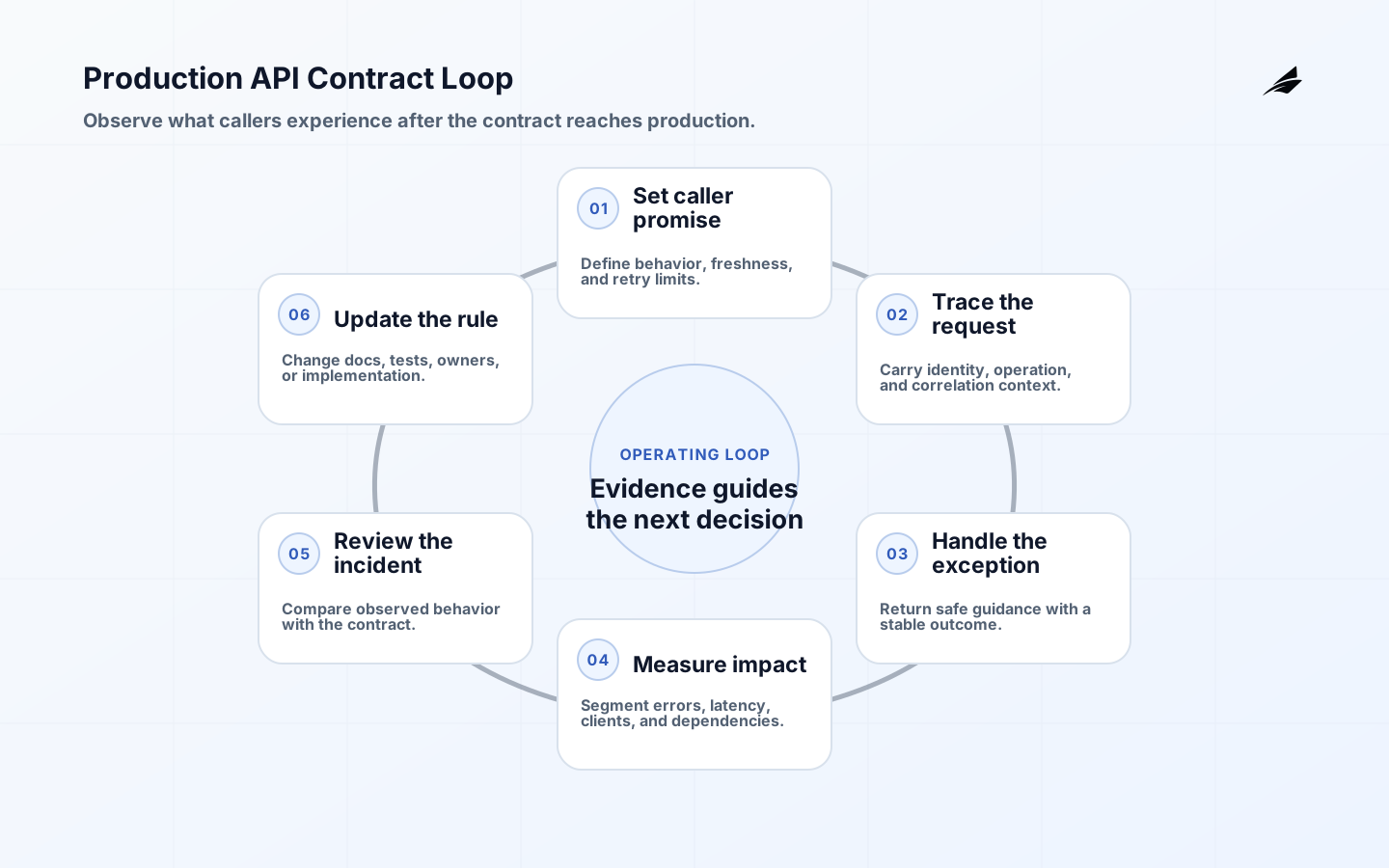
A REST API contract is the behavior a caller can rely on, not just a JSON example in a repository. Its surface includes resource names, methods, request and response shapes, status codes, pagination, authorization, ordering, cache behavior, error representation, and deprecation policy. Once external clients, mobile releases, partner integrations, or internal teams depend on that behavior, an apparently small server edit can become a breaking production change. Good REST API contracts reduce ambiguity by describing the stable intent of an operation and by making change explicit. They do not require every endpoint to look identical. They require every endpoint to let a caller distinguish success, invalid input, lack of permission, conflict, and pending work without guessing from prose or undocumented implementation details.
Give REST API contracts clear HTTP and domain meaning

Start with the domain operation, then choose an HTTP representation that does not contradict it. A GET should retrieve a representation without creating a business side effect; a POST commonly creates or submits work; PUT and PATCH need a documented replacement or partial-update meaning. The details matter when clients retry, caches reuse responses, or an intermediary handles a request differently from the application. RFC 9110 defines protocol semantics, but it does not tell you whether a purchase request is complete or merely accepted for processing. State that domain outcome directly. Use predictable identifiers, stable field names, and consistent error shapes. Avoid exposing persistence tables as API resources when their structure is not the capability clients actually need. The same discipline applies to Node APIs decisions when choosing an implementation boundary.
| Contract element | Question to answer | Caller benefit |
|---|---|---|
| Resource | What capability or representation is named? | Clear URL and ownership meaning |
| Method | What state change or retrieval occurs? | Safe retry and expectation setting |
| Status | What outcome is represented? | Reliable client branching |
| Error body | What can a caller correct or retry? | Actionable failure handling |
Evolve REST API contracts without surprising callers
Compatibility is more than whether a JSON parser crashes. A new enum value may break a client that assumes a closed list; a previously optional response field may become operationally required; changing default sorting can silently alter a reconciliation workflow. Before changing behavior, find real consumers through gateway logs, client registries, SDK versions, or product ownership records. Prefer additive changes that old clients can ignore, but verify that they actually can. When a breaking change is necessary, publish a parallel version or migration route, set a support window, give consumers examples and test environments, and measure remaining traffic before retirement. Deprecation without a visible deadline and owner is merely a comment.
- Request and response fields, including nullability, defaults, and unknown values.
- Status codes and error identifiers used by automated callers.
- Pagination, filtering, sort order, and time-zone behavior.
- Authorization scope and whether a caller can observe a changed resource.
- Rate limits, cache headers, and retry expectations under failure.
Test contracts from both sides of the boundary
A schema document is valuable only when it is kept aligned with running behavior. Generate or validate server responses against an OpenAPI description, then add contract tests around high-consequence scenarios: a missing required field, an expired credential, a stale update, a duplicate command, a paginated collection, and an unavailable dependency. Consumer-driven tests can reveal expectations that the provider's examples overlooked, but they need ownership so obsolete consumers do not block legitimate evolution forever. Test real authorization decisions separately from shape validation. A response can match its schema and still disclose another customer's record. GraphQL tradeoffs in production offers a useful comparison when a product is considering a different client-query model rather than trying to stretch REST beyond a clear resource boundary.
| Test layer | What it catches | Example |
|---|---|---|
| Schema validation | Malformed requests or responses | Required field omitted |
| Provider contract test | Documented endpoint behavior | Conflict returns stable error |
| Consumer contract test | Client reliance on behavior | SDK handles a new optional field |
| End-to-end test | Auth, data, and deployment integration | User may update only an owned record |
Observe contract health after deployment
Instrument contract version, route, status class, error identifier, latency, response size, and authenticated client category where that classification is safe and useful. Review unexpected 4xx changes as closely as 5xx errors; they can reveal a client rollout that no longer matches the service. Track deprecated-route traffic and tell the owning team before a deadline passes. Caching deserves equal care: RFC 9111 focuses on preventing an HTTP cache from reusing a response inappropriately, so sensitive or personalized representations need explicit cache rules. Never treat observability as permission to log tokens or complete request bodies. Retain the minimum evidence that lets an operator understand a contract failure and protect that evidence like the service data it describes.
Give every contract an owner and a change path
A published contract needs one accountable team even when several systems implement it. That owner curates the description, approves compatibility changes, maintains examples, and coordinates deprecation with known consumers. Ownership does not mean a central group must build every endpoint; it means callers have a clear place to ask whether behavior is supported. Keep a change log that distinguishes additive fields, behavior clarifications, security fixes, and breaking removals. For partner-facing APIs, provide a non-production environment with representative errors, rate constraints, and sample data that cannot be mistaken for customer records. For internal APIs, the same discipline prevents a rushed consumer from turning incidental behavior into a hard dependency. Contract ownership makes documentation part of the release process, much as frontend performance in production makes operational ownership visible in a user journey.
Review REST changes from a caller perspective
- Compare the proposed behavior with real client traffic and SDK usage, paying attention to assumptions about missing fields, default ordering, unknown enum values, and error identifiers.
- Verify that HTTP method semantics, status outcomes, cache directives, and retry guidance do not contradict the business action described by the resource or command.
- Test authorization with identities that have similar but different scope, including a user who can read a collection but cannot see or change a particular member.
- Publish examples for normal, validation, conflict, pending, and dependency-failure outcomes so consumers do not infer important behavior from one successful response.
- Set a migration owner and deadline before introducing a breaking version, then instrument remaining usage rather than guessing whether older callers have moved.
- Review generated documentation, gateway behavior, and deployed responses together so the contract does not drift between source code, description, and actual network behavior.
Examples are part of the contract because clients copy them into code. Keep examples realistic about identifiers, pagination, optional values, authorization failures, and asynchronous completion. Review them whenever semantics change, and avoid examples that imply a field is always present when the schema permits absence. A carefully maintained example can prevent more integration errors than an additional paragraph of abstract guidance.
Standards behind REST API contracts
The IETF's HTTP Semantics and HTTP Caching explain the protocol behavior that intermediaries and clients may rely on. The OpenAPI Specification provides a standard API description format, and OWASP's REST Security Cheat Sheet supplies practical security checks. Apply these sources with a domain model in hand: protocol correctness cannot make an ambiguous business operation clear by itself.
Treat production behavior as part of the contract
Production changes the question from “does the endpoint work?” to “what does a caller believe after every response, timeout, cache hit, and retry?” A contract must make that belief safe. Define when a write is durable, whether a 202 response means accepted or completed, which representation is authoritative, and how a client checks state after losing the connection. These details determine whether support can reconcile a record or accidentally create a second effect.
Idempotency is a business rule expressed through an interface. For a create request, an idempotency key can let the server return the same outcome for a repeated attempt, but the key scope, retention, payload mismatch behavior, and expired-key response must be explicit. For a read, caching and validators can reduce load only when freshness and invalidation match the user’s need. Document the decision where client and operator teams can find it.
Contract tests should use production-shaped failure cases: a dependency is slow, an authorization scope is missing, a response is truncated, a cache is stale, a client sends an unknown field, or a request reaches the server twice. Assert both protocol behavior and business state. A passing status-code test that leaves duplicate orders or an unreconciled job is not a passing production contract.
Make observability safe and useful. Correlate requests with a stable identifier, record route and contract version, and capture outcome categories without placing secrets or sensitive payloads in logs. Dashboards should show customer-visible failures, dependency saturation, retry exhaustion, and reconciliation backlog. Pair each signal with a response owner; an alert without authority or a runbook only moves uncertainty around.
REST API contract takeaways
- Describe domain outcomes as well as HTTP mechanics.
- Treat clients, defaults, pagination, and errors as compatibility surface.
- Test the published description against running behavior and real authorization.
- Provide a measured migration route for breaking changes.
- Watch contract-specific errors and deprecation traffic after release.
REST API contracts are a form of product design. When they express real domain outcomes, protect compatibility, and yield evidence after release, both clients and teams can change the system with much less guesswork.
Frequently asked questions
What is different about a production API contract?
It includes timing, durability, retries, caching, limits, security, observability, recovery, and ownership in addition to request and response shapes.
Should clients retry every 5xx response?
No. Retry only when the operation is safe or idempotently keyed, the failure may be transient, and the backoff and total budget are bounded. Unknown outcomes require reconciliation rather than blind repetition.
How do caching rules belong in the contract?
State which responses may be cached, their validators or freshness expectations, what changes invalidate them, and whether stale data is safe for the workflow.
Conclusion
A production REST API contract earns trust when its semantics, timing, limits, telemetry, and recovery behavior agree under pressure. Start with one representative operation, prove the hard case, and only then widen the contract’s reach.