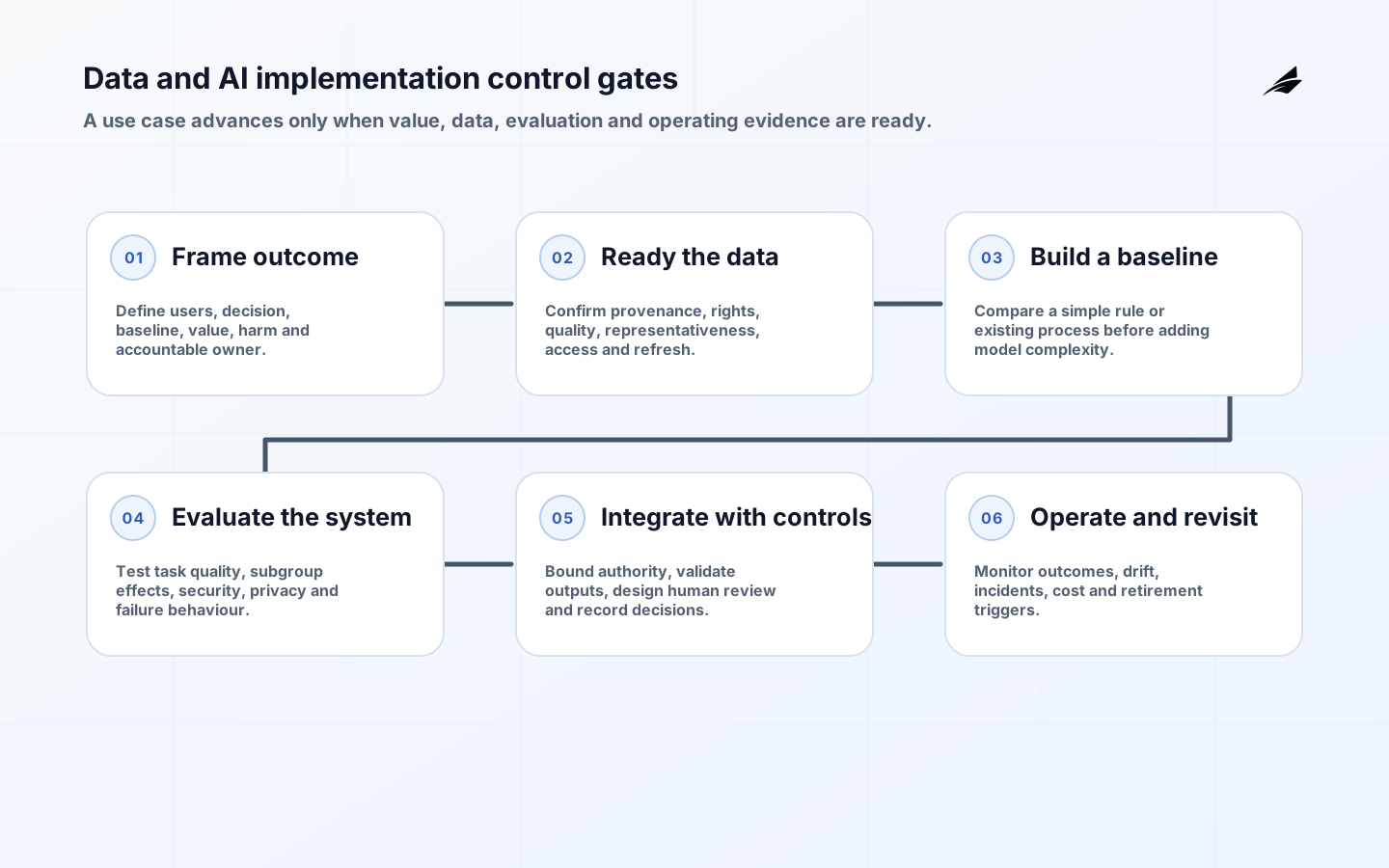
A data and AI solutions implementation checklist must cover the whole decision system, not only model training or an API connection. A production solution depends on a valuable use case, lawful and representative data, a credible baseline, evaluation against real failure costs, controlled workflow integration and ongoing ownership. The checklist below is designed for analytics, predictive machine learning and generative AI projects, with extra scrutiny wherever outputs affect people, money, safety or access to services.
Use this checklist as a release-gate companion to the data and AI scope and delivery plan and data and AI FAQ. Data pipelines can be assessed separately with the data ingestion checklist, but pipeline success does not by itself prove that an AI use is appropriate.
1. Confirm the outcome, decision and accountability
Write the use case as a change to a real decision or task. Name the user, current process, input, output, downstream action and accountable owner. Record the baseline for quality, time, cost and harm. State who is affected, who can challenge the result and what happens when the system is unavailable. If the team cannot describe the action an output enables, it is probably building a demonstration rather than an operational capability.
- Define the intended use and explicit prohibited uses.
- Estimate value as a range and identify the assumptions that drive it.
- Classify impact by reversibility, scale, sensitivity and consequence of error.
- Name the business owner, data owners, technical owner and independent reviewers.
- Set stop conditions for unacceptable harm, poor evidence or changing context.
The NIST AI Risk Management Framework is voluntary and use-case agnostic. It frames trustworthiness across validity and reliability, safety, security and resilience, accountability and transparency, explainability, privacy, and fairness with harmful bias managed. Select and balance those characteristics for the specific context rather than declaring a model “responsible” in the abstract.
2. Establish data readiness and lawful use
Inventory every data source, field and transformation used for training, retrieval, evaluation and operation. Capture provenance, collection purpose, legal or contractual basis, data subjects, geographic constraints, retention, quality expectations and access roles. Check whether the data represents the population and operating conditions in scope. Historical labels may encode an old policy or unequal access; a large dataset can still be unfit for the proposed decision.
| Data checkpoint | Evidence required | Release blocker |
|---|---|---|
| Rights and purpose | Documented permission and compatible intended use | Unclear rights, prohibited reuse or missing notice |
| Provenance | Source, time, lineage and transformation record | Untraceable fields or unverifiable synthetic content |
| Fitness | Quality measured against the decision need | Critical missingness, stale data or label ambiguity |
| Representation | Coverage and error analysis for affected groups | Material blind spot with no treatment |
| Protection | Classification, least privilege, retention and deletion test | Excessive collection or uncontrolled sensitive access |
Complete a data-protection assessment before irreversible design choices. The UK ICO guidance on AI and data protection emphasizes accountability across the AI lifecycle. Minimize prompt and feature data, separate identifiers where possible, define retention for logs and feedback, and ensure that access, correction or contest mechanisms can be supported in the deployed workflow.
3. Build a baseline and choose the simplest viable approach
Measure the existing process and build a simple comparator: a rule, search index, statistical model or human workflow. The baseline reveals whether model complexity creates enough incremental value. Compare candidate approaches on task quality, latency, privacy, security, accessibility, integration effort, explainability, portability and full lifecycle cost. A stronger benchmark score can be a worse business choice if it is unstable, difficult to supervise or too expensive at production volume.

Keep experiments reproducible. Version datasets, code, prompts, model or service identifiers, parameters, evaluation suites and environment. Record third-party terms, data handling, regional processing, update policy, rate limits and exit options. For generative systems, separate retrieval, model generation, deterministic policy checks and tool execution. A fluent model proposal must never become authorization for a sensitive action.
4. Evaluate the complete system before release
Create an evaluation set from representative historical cases, newly authored edge cases and foreseeable misuse. Prevent leakage between development and evaluation. Define expected outcomes, acceptable alternatives, prohibited behaviour and escalation conditions before running tests. Score the end-to-end system, including retrieval, preprocessing, human interaction and downstream action. The GAO AI accountability framework organizes useful questions around governance, data, performance and monitoring.
| Evaluation layer | What to test | Example measure |
|---|---|---|
| Task | Correctness and usefulness for intended cases | Precision, recall, calibrated rubric or task completion |
| Robustness | Noise, edge cases, distribution shift and dependency failure | Performance by scenario and safe-failure rate |
| Equity | Error and impact across relevant groups | Segmented false-positive and false-negative analysis |
| Security and privacy | Injection, leakage, extraction and excessive agency | Attack success, disclosure and blocked action rate |
| Human system | Comprehension, override, escalation and automation bias | Review accuracy, override quality and time |
Set thresholds per use case and impact tier. Aggregate averages can conceal a dangerous subgroup or rare catastrophic case. Document residual limitations in language users and operators can act on. Run the suite whenever data, prompts, model, retrieval, policy, tools or important dependencies change. A vendor benchmark is supporting information, not acceptance evidence for your context.
5. Integrate bounded authority and human review
Map the production workflow from input to final effect. Validate schemas and business rules outside the model. Give tools narrow permissions, idempotency keys, transaction limits and explicit approval for irreversible actions. Show reviewers the original evidence, material uncertainty and proposed action rather than only a polished summary. Define when the system must abstain, ask a question, route to a specialist or stop entirely.
Log enough to reconstruct a consequential decision: input references, data and policy versions, system components, output, validation result, human action and downstream receipt. Protect that log as sensitive data and set proportionate retention. Apply the NIST Secure Software Development Framework to the surrounding application, build infrastructure, dependencies and vulnerability response; model controls cannot compensate for an insecure delivery system.
6. Prepare monitoring, incident response and change control
Monitor outcomes, not just service uptime. Track input drift, data freshness, output quality on delayed labels, subgroup performance, abstention, overrides, complaints, unsafe attempts, latency, cost and downstream reversals. Establish sampling and human review where ground truth is delayed. The NIST AI RMF Core describes Govern as cross-cutting across Map, Measure and Manage; governance should continue after launch rather than end at approval.
Create response playbooks for data corruption, harmful output, privacy exposure, compromised integrations, vendor change and model degradation. Make it possible to disable one use case or tool without taking down unrelated capabilities. Define rollback or fallback to a known process. Reapprove material changes using the original gates, and define retirement steps for models, indexes, features, credentials, retained data and user communications.
Prepare procurement evidence before selecting a model or platform. Ask how customer data is stored, processed and deleted; whether it is used to improve a shared service; which regions and subprocessors apply; how model updates are announced; what safety and security testing is available; and how outputs, logs and configurations can be exported. Verify contractual claims with architecture and operational tests. A provider’s general compliance report does not establish fitness for a particular use or prove the customer configuration is safe.
Create a staged adoption plan for affected staff. Explain the system’s intended role, limitations, review duties, escalation path and incident reporting. Give reviewers practice cases with known errors and measure whether they identify them. Watch workload redistribution: automation may reduce routine handling while increasing difficult exceptions. Update process measures and staffing assumptions from observed work rather than treating every automated step as saved labor.
Maintain a system card that changes with the release. It should state intended users and uses, data and model versions, evaluation thresholds, known limitations, human responsibilities, monitoring, contact and approval history. Link to detailed evidence rather than compressing nuance into a score. Give operators a short version they can use during work and auditors a traceable version they can inspect after a consequential decision or incident.
Key takeaways
- Anchor the solution to a specific decision, baseline and accountable outcome owner.
- Treat provenance, rights, fitness, representation and protection as release evidence.
- Prove that added model complexity beats a simple baseline in the real workflow.
- Evaluate task quality, robustness, equity, security and human interaction by risk tier.
- Bound system authority and fund monitoring, incident response, change control and retirement.
Frequently asked questions
How small should the first pilot be?
Small enough to bound harm and learn quickly, but complete enough to test the end-to-end workflow. Choose one user group, one decision path, a controlled data scope and a fallback. A lab demo with no real reviewer, integration or outcome cannot validate operations.
Does human review make a high-risk system safe?
Not automatically. Reviewers need time, competence, evidence, authority to disagree and feedback about outcomes. Measure whether they detect seeded errors and whether workload creates rubber-stamping. Some uses remain unacceptable even with nominal approval.
Should we buy a platform or build the solution?
Separate commodity capability from differentiating workflow and risk. Buying may accelerate infrastructure, but the organization still owns use-case suitability, data rights, evaluation, integration, oversight and exit. Test portability and obtain evidence about updates, security and data handling before committing.
Conclusion
A strong data and AI solutions implementation checklist makes evidence cumulative: outcome framing guides data requirements, a baseline tests the need for complexity, evaluation defines authority, and monitoring keeps approval current. Move one bounded use case through every gate before scaling a platform. That sequence produces a service the organization can explain, control and improve, not merely a model that performed well once.