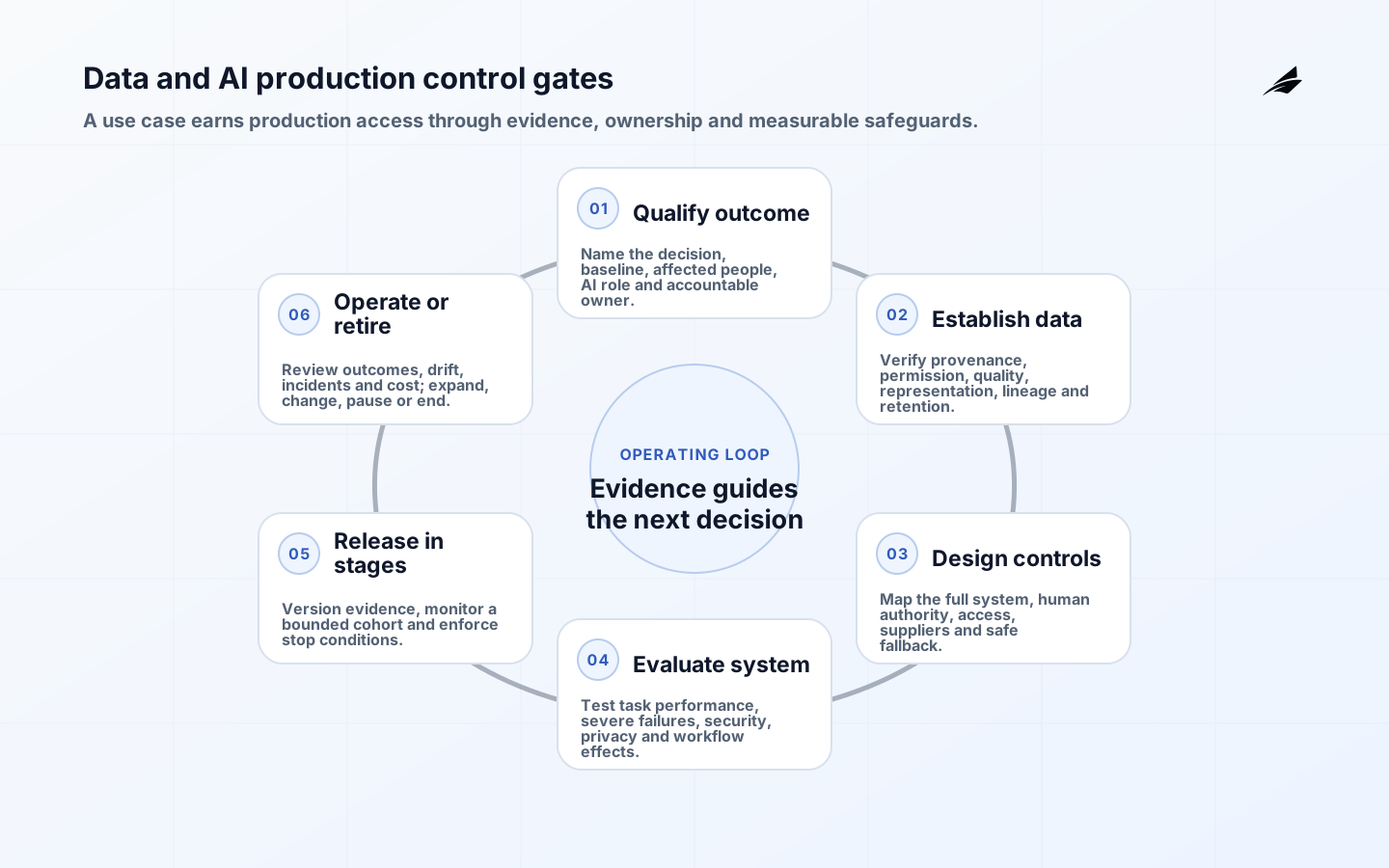
A data and AI implementation checklist should stop an attractive demonstration from becoming an unowned production dependency. The work begins with a decision or workflow, not a model. It then joins data ownership, evaluation, privacy, security, human authority and operations into one release path. This checklist is designed for a product owner, data lead, risk owner and delivery team to use together. It applies to predictive models, recommendation systems, document intelligence and generative AI, with controls adjusted to the consequence of error.
The NIST AI Risk Management Framework organizes work around Govern, Map, Measure and Manage rather than treating trustworthiness as a final review. Use those functions throughout delivery. Before starting, align this checklist with the business framing in Data and Artificial: Practical Guide for Business Teams and keep the decision questions in Data and Artificial FAQ available for sponsors.
1. Qualify the outcome and the AI role
Write the decision the system will inform, the person accountable for it and the baseline process. Specify the user population, frequency, latency, languages, accessibility needs and consequence of a wrong output. State whether AI recommends, ranks, drafts, predicts or acts. If a deterministic rule, search function or process change can achieve the outcome with less risk and cost, test that option first. Approval should depend on a measurable hypothesis such as reducing manual review time while maintaining an agreed error ceiling, not on shipping an AI feature.
Create an impact tier before selecting architecture. A low-consequence writing aid can tolerate a different review pattern from eligibility, safety, employment or education decisions. Record affected groups, potential denial of service, financial or safety harm, recourse, regulatory duties and whether the system handles sensitive data. Name prohibited uses explicitly. This early boundary becomes the basis for evaluation depth, human oversight, supplier terms, logging and release authority.
| Gate | Evidence required | Release question |
|---|---|---|
| Outcome | Baseline volume, time, quality and cost | Will the change improve a named user or operational result? |
| Authority | Accountable owner and human decision rights | Who may accept, override, pause or retire the system? |
| Impact | Affected groups, failure modes and recourse | Is the control effort proportionate to possible harm? |
| Feasibility | Rule-based alternative, data sample and integration constraints | Is AI necessary and technically plausible? |
| Value | Target metric, guardrail and review date | What evidence will justify continued operation? |
2. Establish lawful, representative and operable data
Inventory every data source with an owner, purpose, collection context, permitted use, retention rule and refresh expectation. Trace fields from source to feature, prompt, retrieval index and output. Test completeness, validity, consistency, timeliness and duplication at the level that matters to the decision. A globally high completeness percentage can hide missing values for a small but consequential group. Keep training, validation and test partitions independent, time-aware where appropriate, and protected against leakage from labels or future information.
Apply the NIST Privacy Framework to identify data processing, governance and communication risks. Minimize personal and confidential data before it enters prompts, training sets or vendor services. Document consent or another lawful basis where applicable, rights handling, deletion propagation, cross-border constraints and re-identification risk. Synthetic data may reduce exposure but does not automatically remove privacy or representation concerns. Require data contracts and automated checks at boundaries so schema drift becomes a visible operational event.
3. Design the system and its control points
Document the complete system, not just the model: user interface, source systems, transformations, model or service version, retrieval layer, policy filters, human review, downstream actions and telemetry. Record build-versus-buy decisions and the evidence available from each supplier. For hosted models, clarify whether inputs are retained or used for training, where processing occurs, how versions change, what safety controls exist and how service withdrawal is handled. Protect credentials, isolate environments and apply least privilege to data, deployment and override functions.
Define human oversight as an operating procedure. A reviewer needs enough context, time, competence and authority to disagree. Avoid a nominal approval click after the system has already made the practical decision. For automation, set confidence or policy thresholds, escalation paths and transaction limits. The NIST Secure Software Development Framework is useful for integrating security requirements, protected build environments, component verification and vulnerability response into the delivery lifecycle.
| Control area | Implementation evidence | Production signal |
|---|---|---|
| Data | Lineage, contract, quality tests and access policy | Freshness failures, schema drift and unusual access |
| Model | Version, evaluation set, limitations and approval | Quality shift, abstention and subgroup performance |
| Interaction | Prompt boundaries, citations and safe failure text | Injection attempts, unsupported output and overrides |
| Human oversight | Decision rights, training and escalation runbook | Review time, disagreement and appeal outcome |
| Operations | Deployment record, rollback and supplier contingency | Latency, errors, spend and dependency incidents |
4. Evaluate performance, risk and user experience
Create an evaluation plan before tuning. Include task success, calibration, false-positive and false-negative costs, robustness, privacy, security, bias, accessibility, latency and cost. For generative systems, build a versioned test set from approved real-world scenarios and adversarial cases. Score factual support, relevance, instruction adherence, harmful content, refusal quality and citation validity with clear rubrics. The NIST generative AI profile emphasizes risks such as confabulation, information integrity, privacy, security and misuse; test the risks that match the use case rather than adopting a generic benchmark.
Separate offline evaluation from a controlled workflow trial. A model may score well yet create more review work, encourage automation bias or fail under real permissions and document quality. Run shadow mode or a limited cohort where feasible. Compare against the baseline and examine results by meaningful segment. Record known limitations in language users can act on. Acceptance criteria must include guardrails: an average accuracy gain cannot compensate for an unacceptable severe-error rate.
5. Pass production readiness gates
- Confirm the accountable business, data, model, security, privacy and operations owners have accepted their obligations.
- Freeze or identify the released model, prompt, retrieval corpus, code, configuration and evaluation evidence so the result is reproducible.
- Complete threat modeling, privacy review, accessibility checks, abuse testing and supplier review at the assigned impact tier.
- Publish user guidance that states purpose, limitations, human review, feedback route and recourse without overstating capability.
- Verify observability, budget alerts, incident severity rules, rollback or kill switch, fallback workflow and recovery permissions.
- Approve a staged rollout with cohort, monitoring window, stop conditions and named decision maker for expansion.

Do not use a single approval meeting to compensate for missing evidence. Keep a release packet containing the system card, data record, evaluation report, architecture, risk decisions, operating runbook and change identifier. The six gates should be repeatable for material model, prompt, dataset, policy or workflow changes. Teams expanding analytics capabilities can compare this process with the operating model in Data Analytics Artificial: Practical Guide for Business Teams.
6. Operate, learn and retire
Monitor outcomes and controls, not only infrastructure. Track data quality, model behavior, severe errors, user corrections, overrides, appeals, latency, availability, security events and unit cost. Define who reviews each signal and how quickly. Sample outputs according to impact and obtain user feedback without turning sensitive interactions into an uncontrolled evaluation dataset. Re-run the approved evaluation suite when models, prompts, retrieval content or important upstream data change.
Set an evidence review date and retirement conditions at launch. A system should be paused when a stop threshold is crossed, ownership disappears, a supplier changes materially or the underlying need ends. Preserve records needed for audit and incident analysis while honoring deletion duties. A post-launch review should decide to expand, modify, restrict or retire based on observed value and residual risk. That decision closes the implementation loop and prevents pilots from becoming permanent by inertia.
Procure models and data services with evidence
Procurement should translate impact-tier controls into supplier questions and contract terms. Ask for system purpose, evaluation methods, known limitations, model and training-data provenance at an appropriate level, security assurance, incident history, accessibility, service locations, subprocessors and business continuity. Define notification for material model, safety-policy, retention or subprocessor changes. Require usable exports and deletion confirmation at exit. A provider statement that customer data is not used for training does not answer how prompts are retained, reviewed, logged or disclosed.
Run a representative trial with the intended data path and permissions before commitment. Verify rate limits, latency, failure behavior, cost controls and the ability to pin or identify model versions. Allocate responsibility for output review, abuse handling, vulnerability notification and regulatory requests. Keep a substitution or fallback plan for a critical hosted dependency. Commercial convenience should not create an AI service whose evidence, behavior or exit conditions the organization cannot govern.
Key takeaways
- Start with a bounded decision, baseline and accountable outcome owner.
- Treat data provenance, permitted use and subgroup quality as release evidence.
- Evaluate the complete sociotechnical workflow, including human review and recourse.
- Version models, prompts, retrieval content, configuration and evaluation together.
- Release in stages and retain practical pause, fallback and retirement mechanisms.
Frequently asked questions
How long should an AI pilot run?
Run it long enough to encounter representative volume, users and edge cases, but define a decision date before it begins. A four-week trial may be adequate for a frequent internal workflow; a seasonal or rare high-impact process needs a different design. Exit on evidence, not elapsed time: the pilot should prove workflow value, guardrail performance, operational support and cost at realistic scale.
Does changing a model require a full reassessment?
Use change classification. A provider patch may need regression and safety tests; a new model family, training dataset, decision role or affected population can require renewed impact, privacy, security and user review. Predetermine material-change triggers and prevent unreviewed automatic model upgrades in consequential workflows.
Conclusion
A dependable data and AI implementation checklist turns experimentation into an evidence-controlled service. Qualify the decision, establish trustworthy data, design explicit authority, evaluate realistic failure, pass repeatable production gates and keep measuring the outcome. The result is not risk-free AI; it is a system whose value, limits and owners remain visible enough to manage throughout its life.