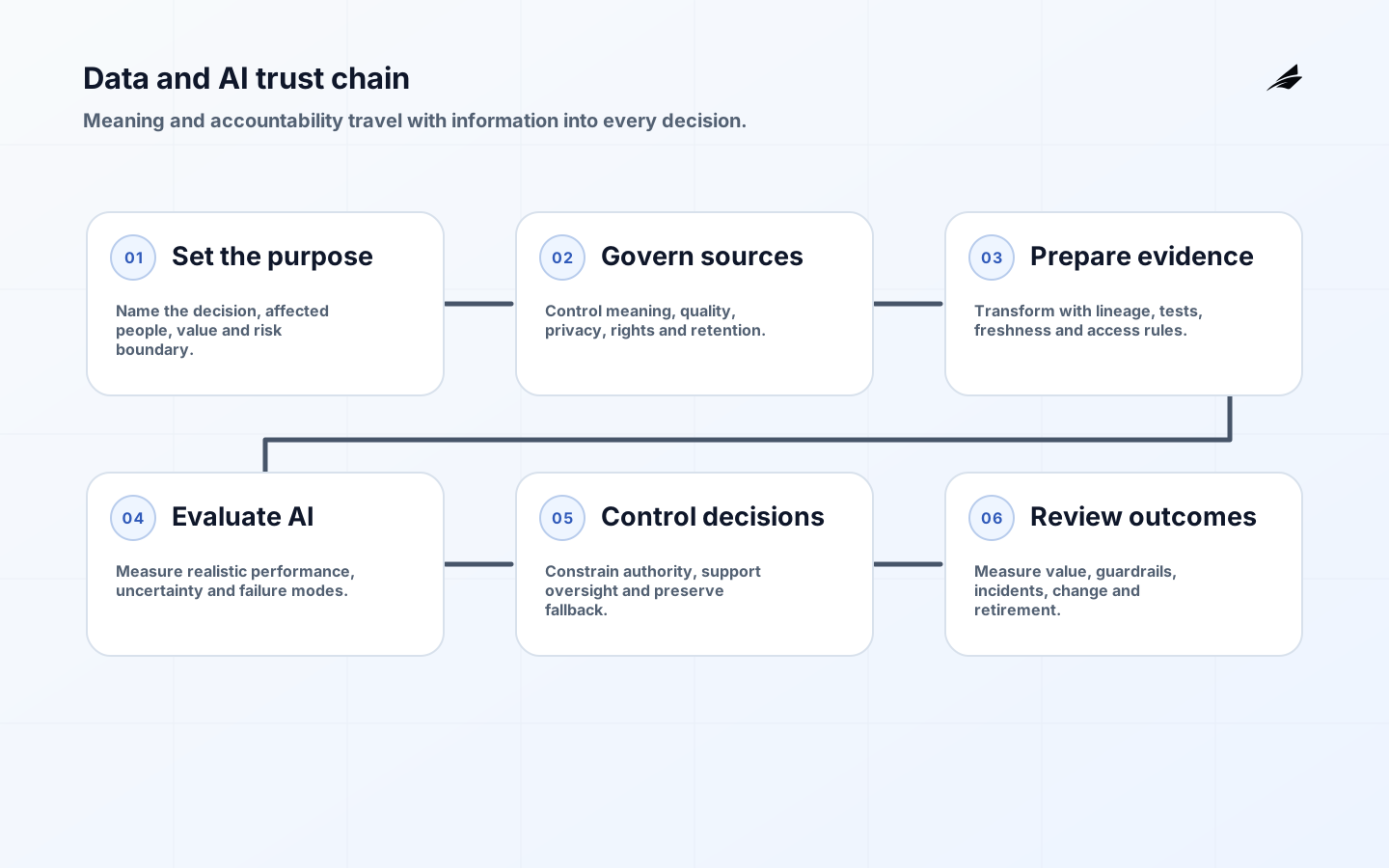
Data and artificial intelligence are related capabilities, not interchangeable purchases. Data records events, entities and context; analytical and AI systems transform those records into estimates, recommendations, generated content or automated actions. Business value appears only when the information is fit for purpose and the output changes a governed decision. This practical guide helps leaders connect data foundations, AI use cases, architecture, accountability and measurement without assuming every data problem needs a model.
Use the companion data and AI implementation checklist and data and AI FAQ during delivery. The data analytics AI guide goes deeper on analytical workflows. Start by identifying which decision or task should improve, then work backward to the evidence and controls. A strategy that begins with model access usually creates scattered experiments and duplicated data pipelines.
How data and artificial intelligence work together
An AI system consumes more than a training dataset. It may use reference data, features, prompts, retrieval documents, user context, policy rules, tool results and feedback. Each input has a lifecycle and owner. Outputs may themselves become data used by reports, future models or operational systems. Mark generated or inferred values so they are not confused with observed facts. Preserve the event time, processing time, model version and confidence needed to interpret them.
The relationship is also organizational. Domain teams understand meaning and consequences; data teams establish reliable products and metrics; AI specialists evaluate methods; engineering operates services; governance functions challenge risk; and business owners remain accountable for use. Central standards reduce duplication, while federated ownership keeps decisions close to context. A central AI team should provide platforms and assurance patterns, not become the permanent owner of every departmental outcome.
| Layer | Business question | Required evidence |
|---|---|---|
| Source records | What happened, to whom, and under what rules? | Owner, definition, rights, timestamp and quality |
| Data product | Can consumers depend on this prepared information? | Contract, lineage, tests, freshness and support |
| Model or method | What pattern or output is produced? | Version, evaluation, limitations and approval |
| Decision service | How does output affect work or people? | Policy, authority, explanation and fallback |
| Outcome loop | Did the decision create value or harm? | Outcome measure, guardrail, incident and review |
Choose data and AI use cases by decision value
Frame candidates as decision improvements: reduce the time to route a support case, identify likely equipment failure early enough to schedule maintenance, or help a researcher find evidence with traceable citations. Estimate frequency, value per decision, error consequence, available outcome data and process readiness. High-frequency tasks are not automatically good candidates; an efficient mistake can scale harm. Low-frequency decisions may justify AI only when stakes and information burden are high enough.
Compare automation levels. Analytics may inform a person, AI may recommend a next step, or a bounded service may act within thresholds. Start with the minimum authority that captures value. Consider a non-AI baseline, process redesign and purchased capability. Score data readiness separately from strategic value so an important use case with weak data becomes a foundation project rather than being discarded or rushed. Maintain a portfolio with explicit stop conditions and shared dependencies.
Govern data purpose, quality and privacy
Create a catalog of important datasets with business definitions, stewards, permitted purposes, sensitivity, retention and quality objectives. The ISO/IEC 25012 data quality model distinguishes characteristics such as accuracy, completeness, consistency and currentness; select those that matter for the use case and set measurable rules. Reconcile control totals and sample records with domain owners. Passing a pipeline test does not prove a field reflects the real-world concept the model assumes.
Map personal and confidential data from collection through model and outcome. Minimize fields and retention, restrict secondary use, and assess whether inferred attributes create new risk. The NIST Privacy Framework helps organizations manage privacy risk across data processing ecosystems. Protect data subject and customer rights across derived datasets, logs and backups. Contract terms must address vendors' storage, training use, subprocessors, location, deletion and incident cooperation, not only transport encryption.
Design a modular data and AI architecture
Separate ingestion, governed storage, transformation, feature or document preparation, model services, orchestration, policy enforcement and user experience. Use contracts at boundaries: schemas, semantics, freshness, access and failure behavior. Keep deterministic business constraints outside probabilistic prompts. Retrieval systems should preserve document permissions and effective dates. Tool calls need typed input, authentication, authorization and idempotency. This modularity lets teams replace a model or data source without rewriting the entire decision workflow.

Build observability around a correlation identifier that connects source snapshot, transformation, model invocation, retrieved evidence, policy decision, human action and final outcome. Log proportionately and protect sensitive content. Maintain separate development, test and production environments with representative but controlled data. Automate deployment manifests and rollback. For third-party models, record provider, region, version or alias, configuration and safety settings; test material provider changes before allowing them into consequential workflows.
Manage AI risk in business context
Risk depends on use, affected people, authority and failure consequences. The NIST AI RMF uses Govern, Map, Measure and Manage to connect context with action. Create tiers that determine assessment, approval, testing, monitoring and review. Evaluate validity, reliability, safety, security, privacy, transparency and fairness where relevant. Require stronger evidence for systems that influence employment, finance, health, safety or access to essential opportunities.
Human oversight is not a generic checkbox. Define what the reviewer sees, how much time is available, which decisions can be reversed and where a person can challenge an outcome. The OECD human-centred values principle emphasizes safeguards for human agency and oversight. Test reviewers for automation bias and missing context. If a person must approve hundreds of low-quality alerts, the system has automated liability rather than judgment.
| Risk signal | Control response | Evidence |
|---|---|---|
| Sensitive or consequential decision | Independent impact review and limited automation | Approval with conditions and expiry |
| Weak or delayed ground truth | Conservative thresholds and sampled expert review | Adjudicated cases and uncertainty report |
| Generative open-ended output | Grounding, adversarial tests and output validation | Versioned test suite and failure log |
| Vendor model dependency | Change notice, regression test and exit route | Provider record, evaluation and export test |
| Material model or data change | Reassessment and controlled release | Change classification and signed release |
Establish the operating model and lifecycle
Maintain an inventory linking each system to purpose, owner, data, model, vendor, deployment, users, controls, incidents and retirement criteria. ISO/IEC 42001 describes a management system for establishing, implementing, maintaining and continually improving responsible AI use. Integrate its work with existing product, data, security, privacy, risk and audit processes instead of creating a parallel approval bureaucracy that teams bypass.
Operate data and AI as a service with objectives for freshness, quality, latency, availability, cost and decision outcomes. Monitor slices that matter, not only aggregate performance. Prepare playbooks for stale data, poor output, security events, vendor outage and harmful impact. Review incidents and near misses, update controls and communicate changes to users. Retire systems deliberately by disabling interfaces, revoking credentials, preserving required evidence and removing downstream dependencies.
Measure value without hiding tradeoffs
Use a baseline and a credible comparison. Measure the completed business outcome, workflow effect, model quality and guardrails over a representative period. Include operating cost: data acquisition, review, model consumption, engineering, assurance, support and change. A system that saves analyst minutes but creates a larger exception queue has shifted work rather than removed it. Attribute value conservatively when promotions, staffing or market changes also affect the outcome.
Treat adoption as behavior, not license activation. Observe whether eligible users act on outputs, verify evidence, override appropriately and complete the intended workflow. Interview people who avoid the system; they often reveal missing data or incentives. Publish uncertainty and exclusions with results. Portfolio reviews should stop low-value work and reinvest in reusable data, identity, evaluation and platform capabilities. Honest retirement is a sign of governance functioning, not innovation failing.
Build a sequenced data and AI roadmap
Sequence work around dependencies rather than executive visibility. First establish the identifiers, access, outcome labels and process ownership shared by valuable uses. Then run bounded use cases that test the operating model. Platform investment should follow observed repetition: common evaluation, model gateways, feature preparation or retrieval controls. This prevents a large foundation program with no user pressure and prevents pilots from each building incompatible infrastructure.
Fund operation from the first business case. Forecast data stewardship, monitoring, review, vendor consumption, incident response and periodic reevaluation, not only development. Define which team pays when use expands and how shared capability is allocated. Review the roadmap quarterly against outcomes and risk. Move initiatives when prerequisites change, and preserve a written rationale so priority does not become a contest between the newest demos.
Key takeaways
- Connect data and AI investment to a recurring, owned business decision.
- Preserve the distinction between observed, derived and generated information.
- Govern purpose, semantics, quality, privacy and provenance across the lifecycle.
- Use modular architecture and deterministic controls around probabilistic components.
- Scale testing and oversight with impact, authority and uncertainty.
- Measure complete outcomes, operating cost and guardrails, then stop work that does not earn its place.
Frequently asked questions
Must data be perfect before an AI project starts?
No, but it must be fit for the bounded use and its limitations must be known. A pilot can reveal quality work, provided unsafe records are excluded and results are not generalized beyond the tested population. Define minimum thresholds and remediation ownership before release.
Does a unified platform create a data and AI strategy?
No. A platform can standardize storage, access, deployment and monitoring, but strategy still requires priorities, ownership, semantics, operating design and investment choices. Central technology without domain accountability often produces an expensive collection of unused capability.
Conclusion
Data and artificial intelligence become durable business capabilities when meaning and accountability travel with information into every model and decision. Choose uses by outcome, design modular controls, test in context and operate through change. The aim is not to maximize AI adoption; it is to improve decisions while preserving the evidence, human authority and exit options needed to trust the result.