This intelligence and data implementation checklist is designed for teams moving from research to an accountable delivery decision. Use the practical intelligence and data guide, intelligence and data FAQ and data and AI services checklist for adjacent scope, implementation and operating questions. The practical standard here is evidence: named owners, explicit boundaries, representative tests and a route to stop or correct the system when assumptions fail.
Reliable intelligence is not a warehouse, dashboard or model in isolation. It is a controlled path from an accountable decision to evidence, action and measurable feedback. The Government Data Quality Framework defines quality as fitness for purpose and emphasizes lifecycle management; W3C PROV supplies interoperable provenance concepts; and the NIST Privacy Framework connects data processing with enterprise privacy risk. These references are design inputs, not substitutes for named owners and use-specific thresholds.
Begin with the decision and its consequences
Write a decision contract before selecting a platform. Name the person or role that acts, the population in scope, cadence, available actions, current baseline, tolerated delay and consequence of a wrong answer. Separate description, prediction and recommendation: a pipeline report describes state, while a replenishment recommendation changes orders and therefore needs constraints, review and an outcome measure. Record prohibited uses as carefully as intended uses. A score built to prioritize service calls should not quietly become an eligibility decision. Interview frontline users who correct records or handle exceptions, because executive consumers rarely see the workarounds that determine whether intelligence is usable. Test whether a source-process correction or simpler rule could solve the problem before funding another analytical layer. Acceptance evidence should include representative decisions, edge cases and a named escalation route, not a visually polished demonstration.
Turn critical datasets into operated data products
For every dataset that can change the decision, document purpose, producer, steward, consumers, authoritative source, grain, schema, refresh objective, quality expectations, access, retention and support. Ownership includes correcting source defects and communicating breaking changes; it is not merely responsibility for keeping a pipeline green. Publish examples and known limitations so consumers understand what a row means. Distinguish valid competing definitions instead of forcing a false universal metric: booked revenue and recognized revenue can both be correct for different decisions. The UK Data Maturity Assessment is useful as a multidimensional prompt covering systems, skills, use, ethics, management and responsibility, but teams should assess only enough to expose blockers to the chosen decision. Product service levels should follow consequence and timing, not the prestige of the requesting team.
| Decision element | Evidence required | Acceptance question | Owner |
|---|---|---|---|
| Purpose | Decision contract and baseline | Will this change a named action? | Business owner |
| Population | Eligibility and exclusion rules | Are edge cases represented? | Data steward |
| Threshold | Cost and risk rationale | What happens on either side? | Decision owner |
| Feedback | Outcome and correction capture | Can the team learn correctness? | Operations lead |
| Stop rule | Risk or value trigger | When should use pause? | Accountable executive |
Measure quality where an error changes action
Profile completeness, validity, uniqueness, consistency, timeliness and accuracy at the source and after material transformations. Select dimensions and thresholds by declared use and segment. A monthly trend may tolerate late records that a same-day dispatch queue cannot. Give every rule an owner, severity, response window and exception path; preserve rejected records for diagnosis rather than silently deleting them. The quality-framework guidance recommends action planning, root-cause analysis, metadata and communication. Apply that by publishing a short quality statement with measurement date, affected population, limitations, incidents and remediation. Prioritize source fixes according to decision impact. A downstream dashboard patch can make one report look correct while allowing the same defect to continue into finance, customer communications and model features.

Preserve technical lineage and business meaning
Capture source, extraction, transformations, joins, filters, code version, model version and publication. Technical lineage shows movement; business lineage explains why a field or metric carries its stated meaning. W3C PROV models entities, activities and agents and can guide portable provenance, though an implementation should collect only the detail needed to reproduce a result, investigate an incident and assess downstream impact. Link deployed artifacts to versioned code and effective business definitions. Contract schema changes, run compatibility and impact checks, and notify consumers before release. Keep effective dates when definitions change so historical reports remain interpretable. When a source is corrected retrospectively, record whether reports will restate, remain frozen or expose both versions. An intelligence product without semantic change control can be technically reproducible yet still misleading.
Control access, privacy and analytical validity
Classify data, document purpose, minimize fields, restrict effective access and set retention before broad analyst availability. Review joins and derived attributes for new sensitivity: removing names does not prevent re-identification when combinations remain distinctive. Protect exports, notebooks and temporary extracts as carefully as the warehouse. Use the NIST Privacy Framework to connect processing activities, adverse effects on people and enterprise risk. For analysis, version code, parameters, environments and input references; separate exploration from production; review assumptions; report distributions and material segments, not only averages. A predictive association does not prove an intervention will work. For machine learning, prevent evaluation leakage, compare against a meaningful baseline, test error costs and give human reviewers the evidence and authority to disagree. Track overrides without pressuring staff to accept automated recommendations.
| Layer | Reliability measure | Decision evidence | Response |
|---|---|---|---|
| Source | Capture and delay | Eligible cases represented | Correct process or interface |
| Pipeline | Timely successful run | Transformations reconcile | Retry, quarantine or rollback |
| Product | Quality by dimension | Fit for declared use | Warn consumers and remediate |
| Insight | Reproducibility and uncertainty | Threshold justified | Review method or scope |
| Outcome | Feedback captured | Target improves without excess harm | Continue, revise or stop |
Operate intelligence as a feedback system
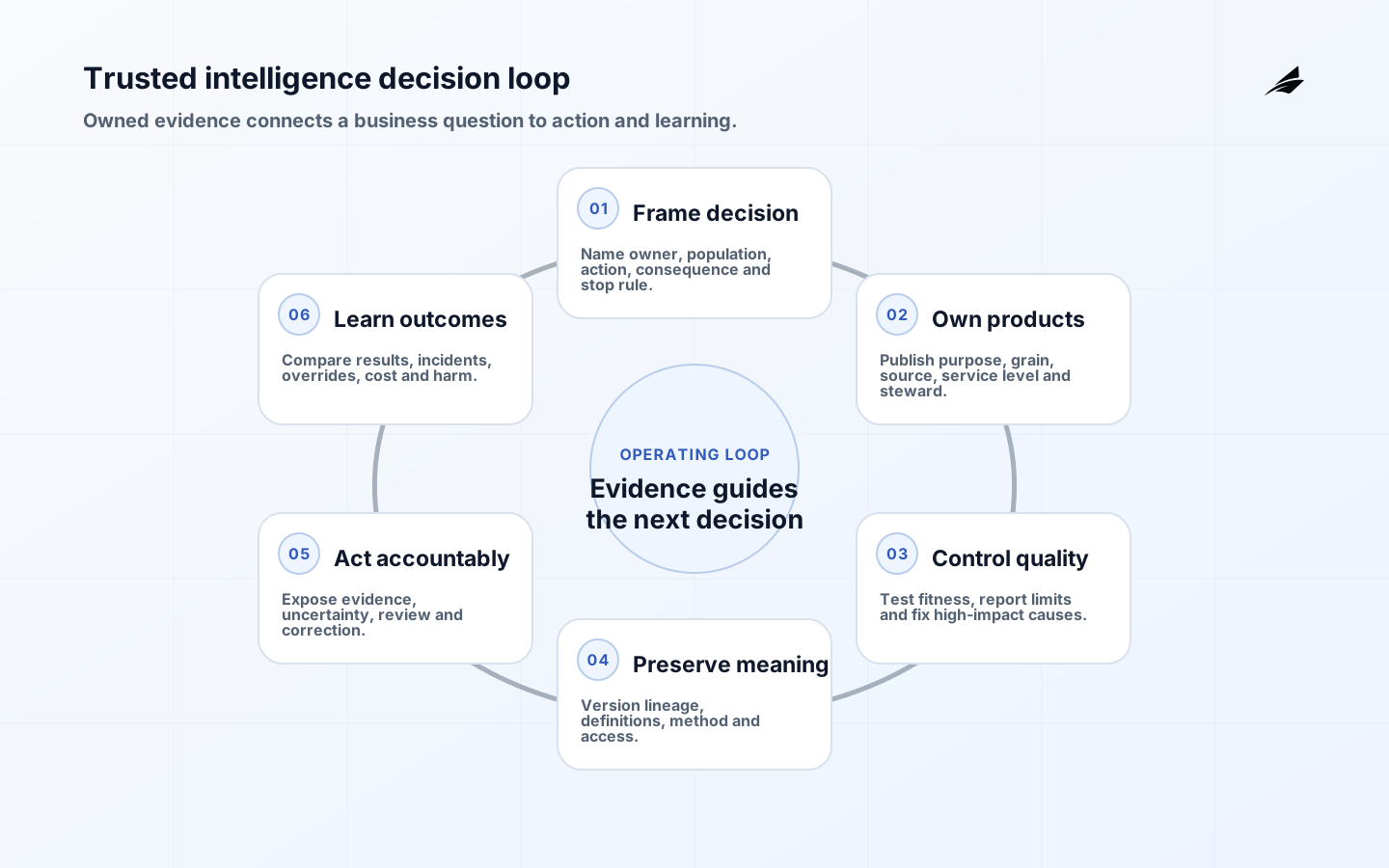
Monitor source capture, freshness, schema, pipeline runs, quality rules, access, report use, model behavior, decision actions and outcomes. Define incident severity from decision impact rather than infrastructure symptoms alone. A successful pipeline delivering stale eligibility data can be a severe business incident. Provide a visible correction route, reconcile outputs after late data or outages, and retire products that no longer have an approved purpose. Hold a periodic review with decision owner, producer, steward, analyst, privacy, security and operations. Examine changed assumptions, incidents, overrides, quality debt, cost and outcome evidence. Measure whether action improved the target without unacceptable harm, not simply whether people viewed a dashboard. This closes the loop: decisions create feedback, feedback improves products, and better products support more reliable decisions. The operating record also tells future teams why a threshold or definition exists.
Apply the checklist to replenishment intelligence
For a replenishment use case, define store and product population, supplier lead time, presentation stock, promotion rules and the planner who approves an order. Inventory, sales, transfers and supplier data each receive a grain, owner, freshness objective and quality rule. During a pilot, the team finds that returned goods update finance before physical inspection. It names financial inventory and sellable inventory separately, suppresses automated recommendations where counts are stale, and preserves a planner override. The recommendation records input versions and confidence. Outcome review compares availability, waste, overrides and supplier exceptions by store type. Repeated seasonal overrides become a policy or feature change; stale-count overrides become source-process work. Access follows assigned locations, extracts expire, and discontinued products stop generating actions. The result is explainable because the order can be traced from decision rule through evidence and human action to observed outcome.
Set acceptance gates before expanding use
Acceptance needs evidence from each owner: the business lead confirms scope and action; producers confirm authoritative capture; the steward approves definitions and quality thresholds; privacy and security owners verify permitted processing and effective access; analysts reproduce representative outputs; and operations demonstrate monitoring, correction and recovery. Test delayed data, conflicting definitions, schema change and access revocation. Specify what happens below a threshold: warn, suppress, use an approved fallback or route to manual judgment. Compare the pilot with baseline outcome, cycle time, correction effort, cost and harm. Inspect work transferred to another team. Expand only when users interpret evidence and act through the intended workflow. If results are inconclusive, test the next uncertainty instead of widening the audience. If the decision no longer matters or data cannot support it responsibly, retire the product, preserve required definitions and lineage, revoke access and remove extracts. Retirement protects users from convincing outputs whose assumptions have expired.
Set the review cadence from consequence and change. A high-impact operational decision may need daily quality status and monthly outcome review, while a strategic analysis may be reviewed at each planning cycle. Trigger an unscheduled review after source migration, definition change, new population, model update, incident or material override pattern. Record who may pause publication and how users are notified. Scheduled review should confirm that the approved purpose still exists, access remains appropriate, data is retained only as needed and outcome evidence still justifies operation. This prevents governance from becoming an annual ceremony detached from the pace of data and business change.
Key takeaways
- Start with an accountable decision, not a technology purchase.
- Operate critical datasets with explicit purpose, owners and service expectations.
- Set quality thresholds according to decision consequence and timing.
- Preserve technical lineage and changing business meaning.
- Use privacy, reproducibility, challenge and feedback as production controls.
Frequently asked questions
Do we need a new data platform first?
Not necessarily. Prove the decision, ownership and quality gaps with current systems. Invest in a platform when repeated constraints in reliability, governance, scale or delivery justify it; a platform cannot supply business definitions or accountability.
Can one dashboard be the single source of truth?
A dashboard can be an approved presentation of governed products. Authoritative records usually remain in operational systems and controlled transformations. Publish definitions, lineage, freshness and limitations instead of implying one screen is universally authoritative.
How often should quality thresholds be reviewed?
Review them when the decision, population, source, regulation or consequence changes and on a scheduled cadence proportionate to risk. Severe incidents and repeated overrides should trigger an earlier review.
Conclusion
An intelligence and data implementation checklist is successful when a consequential decision can be traced to owned products, known quality, preserved meaning, controlled analysis and accountable action. Build that chain for one material use, prove it with representative cases, protect people and uncertainty, then use outcomes to improve or stop the capability.