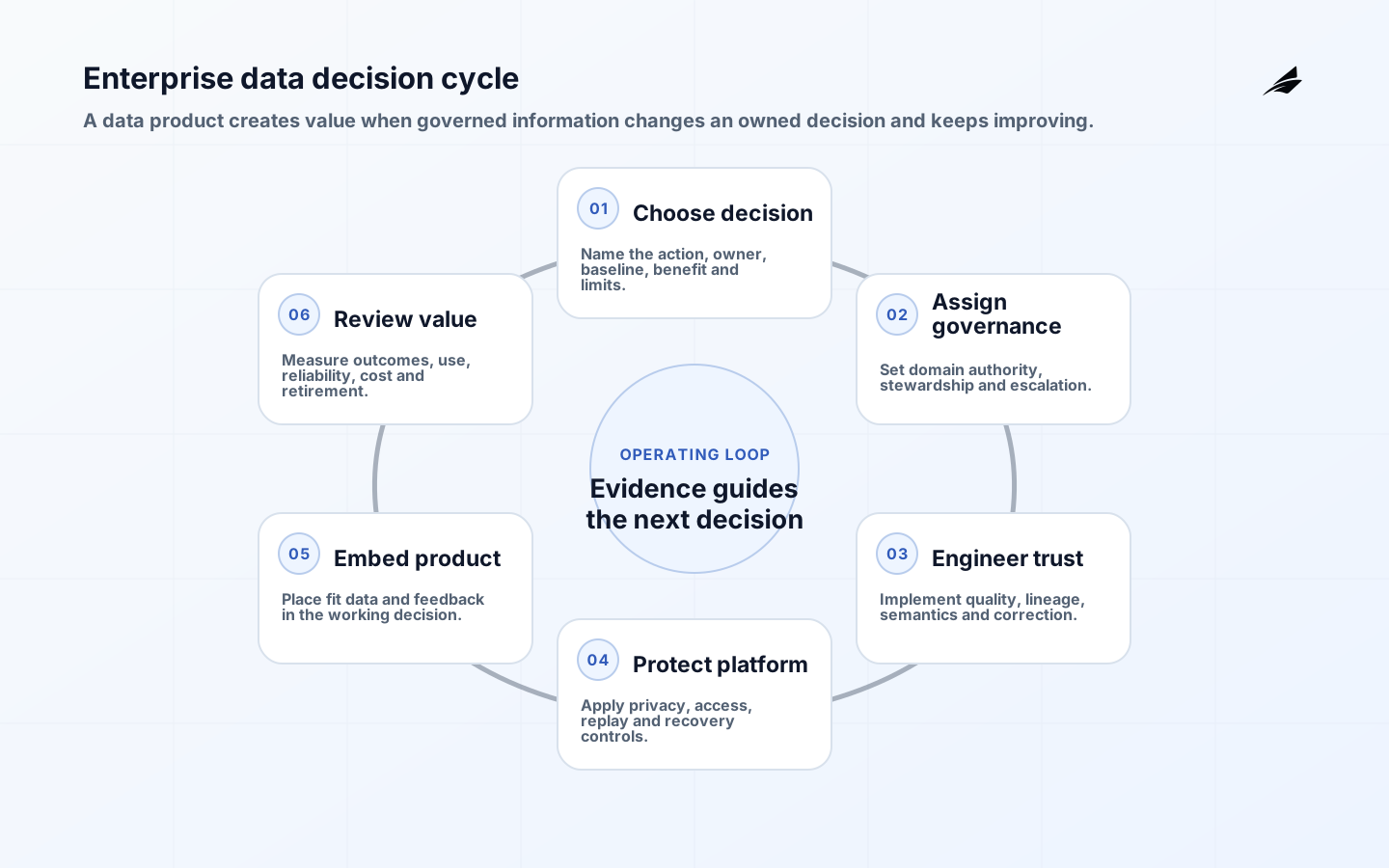
An enterprise data implementation checklist should make data work for a defined decision, service or obligation. It should not begin with a warehouse migration or a catalog license. Data becomes useful when people can discover an appropriate asset, understand its meaning and limits, access it lawfully, test its quality and act with confidence. That requires product delivery, governance and operating ownership together.
This article repairs the vague legacy phrase by focusing on the real intent: making company data work. It complements the data scope and delivery plan, the making data work FAQ and the company data work guide. The Federal Data Strategy is designed for government, but its practices around governance, inventory, documentation, standards, quality and responsible use translate well to enterprises.
1. Select priority decisions and data products
Choose a small portfolio of decisions where better information can change an outcome: replenishment, customer eligibility, equipment maintenance, revenue recognition, supplier risk or service staffing. Record decision owner, cadence, current evidence, pain, consequence and target. Define the data product as a maintained service for those users, not a one-time dataset. Name its owner, consumers, service expectations and funding.
Baseline the current path. Measure time spent locating, reconciling and correcting data; decision latency; manual extracts; inconsistent definitions; and outcomes affected by poor information. Identify legal and ethical constraints before combining sources. A use case should not proceed merely because the data exists. Document purpose, expected benefit, affected people and conditions under which the product should not be used.
| Use-case question | Required answer | Evidence | Gate |
|---|---|---|---|
| Decision | Who will act differently? | Named workflow and owner | No owner, no build |
| Value | Which outcome should improve? | Baseline and target | No measurable effect, reframe |
| Data | Are sources fit and permitted? | Profile, lineage and use basis | Material gap, remediate |
| Operation | Who maintains and supports it? | Product and service model | No durable capacity, pause |
2. Establish federated governance and ownership
Create an empowered governance body with business, data, technology, privacy, security, legal and risk representation. Its role is to set policy, resolve cross-domain conflicts and prioritize investment, not approve every field. Assign domain owners who control meaning and access decisions, stewards who maintain definitions and quality, custodians who operate platforms, and product owners who are accountable to consumers. Publish escalation and exception routes.
Inventory strategic assets with business meaning, owner, source, sensitivity, permitted uses, quality status, lineage and retention. Prioritize depth over superficial coverage. The Federal Data Strategy advises maintaining sufficient metadata for discovery and collaboration and aligning quality with intended use. A catalog entry without current ownership and operational checks can create false confidence.
Adopt standards within real communities of interest. Define shared identifiers, reference data and measures where consistency creates value; preserve legitimate domain differences where it does not. Every enterprise metric needs definition, grain, time basis, exclusions, owner and reconciliation method. Version semantic changes and notify consumers before breaking downstream decisions.
3. Engineer quality, lineage and correction
Profile sources before designing transformations. Measure completeness, validity, uniqueness, consistency, timeliness and relationship integrity according to intended use. Set expectations at producing boundaries and monitor them near the source. A global quality score hides which rule failed and who is affected. Classify issues by consequence, route them to an owner and retain correction history for important records.

Capture lineage from source through transformations to reports, models and operational decisions. Include code or rule version, execution time and source snapshot where reproducibility matters. The FAIR principles emphasize findability, accessibility, interoperability and reuse; enterprise implementation must add authorization, purpose and commercial constraints. Lineage is useful when a change or defect can be traced to affected consumers quickly.
Create a governed correction path. Consumers need a way to challenge data, see status and understand whether historical outputs will be restated. Separate source correction from local override, and expire temporary workarounds. For master entities, define matching confidence and human review for ambiguous merges. Test whether records can be unmerged and downstream effects reconciled.
4. Build a secure, privacy-aware data platform
Choose architecture from workload and governance needs: batch or streaming freshness, data volume, locality, isolation, reproducibility, interoperability and cost. Separate raw evidence, standardized domain products and consumer-specific views with clear authority. Automate deployment, schema testing, lineage and policy where practical. Design replay, idempotency, late-arriving data and backfill so repair does not duplicate or silently rewrite business outcomes.
Use the NIST Privacy Framework to identify and manage risks to people arising from data processing. Minimize collection, restrict secondary use, apply retention and deletion, and use tiered access. Sensitive attributes needed for fairness testing may require a protected analytical path rather than broad removal or broad exposure. Document the purpose and safeguards. Use NIST CSF 2.0 to govern cybersecurity across protection, detection, response and recovery.
| Control | Design question | Automated evidence | Human review |
|---|---|---|---|
| Access | Is use tied to role and purpose? | Entitlement and query logs | Sensitive-use approval |
| Quality | Is the product fit for this decision? | Rule results and freshness | Impact and exception decision |
| Privacy | Is processing necessary and bounded? | Retention and policy checks | Purpose and rights assessment |
| Recovery | Can data and lineage be restored safely? | Backup and reconciliation | Business acceptance of restored state |
5. Put data into work and measure value
Integrate the data product into the decision path with context, uncertainty and a feedback route. Train people on interpretation and limits using representative cases. Remove shadow extracts only after the governed path meets the need and fallback is understood. Measure adoption by completed decisions and reduced reconciliation, not dashboard views. Support consumers with owned service levels and visible incidents.
Review outcome, product and platform measures together. Outcome measures show changed business results; product measures show use, quality, freshness and support; platform measures show reliability, delivery lead time and cost. Segment by domain and consumer. Retire products that have no accountable use, preserve records according to policy and feed lessons into the governance backlog. Data value is realized repeatedly, not declared at launch.
Example: supplier performance data product
Define the procurement decision, cadence and allowed actions. Inventory orders, receipts, quality events, invoices and supplier attributes. Reconcile supplier and site identifiers, define timeliness and defects at an agreed grain, and document late or disputed records. Do not combine unverified allegations or sensitive information simply because it is available.
Pilot with buyers using historical cases, then shadow current decisions. Measure changed action, reconciliation effort and incorrect escalation. Show sample size, freshness, missing confirmations and source links. Give owners and, where policy permits, suppliers a correction route so disputed information does not harden into unexplained status.
Operate a monthly outcome and quality review. Source owners fix recurring defects, the product owner manages consumers and definitions, and governance resolves contested rules. Retire measures that do not support action. This ownership is more valuable than a broad dashboard with no correction path.
If the product affects renewal, increase review and preserve the exact data and rule versions used. Require an authorized person to consider context and document reasons. Monitor outcomes by supplier type and region for variation unrelated to performance. A descriptive metric can become consequential through workflow even without machine learning.
Publish a service note naming consumers, appropriate and prohibited uses, cutoff, quality thresholds, limitations, support and correction. Show health in the catalog. Give change notice and a migration window when schemas or semantics change. This turns documentation into an operating contract.
Exercise failure: delay a source, duplicate an event, alter reference data and restore a snapshot. Verify alerts, quarantine, replay, communication and reconciliation. Record which decisions may continue with stale data and which must stop. Recovery is incomplete until business outputs reconcile.
Key takeaways
- Begin with an owned decision and measurable outcome, then define the data product.
- Federate ownership while central governance sets policy and resolves cross-domain conflicts.
- Make quality rules, lineage and correction paths specific to intended use.
- Build privacy, cybersecurity, replay and recovery into the data architecture.
- Measure data value through changed work, trusted use and sustained outcomes.
Frequently asked questions
Should a company implement a catalog first?
A catalog can accelerate priority products when ownership and metadata practices exist. Starting enterprise-wide often creates empty or stale entries. Catalog the assets needed for selected decisions deeply, automate metadata capture, test discovery with users and expand from demonstrated operating patterns.
What is a good data quality target?
The level that keeps a defined decision within its outcome and risk tolerance. Critical payment or safety fields may require near-perfect controls; exploratory analysis may tolerate documented gaps. Specify rules and thresholds by field, population and freshness, plus what happens when a threshold fails.
Who owns derived data?
The product owner is accountable for the derived product, while source domain owners retain authority over source meaning and permitted use. Transformation logic, semantic definitions and consumer obligations need named owners. Shared ownership without decision rights usually means no ownership.
Create retirement criteria for every data product: no active accountable decision, replacement accepted, retention satisfied, consumers migrated and access removed. Archive definitions and decision evidence where required. Retiring duplicate products reduces contradictory metrics, support burden and exposure, and frees ownership capacity for information that people actually use.
Conclusion
Making data work is an operating discipline. Focus investment on consequential decisions, assign real ownership, engineer quality and lineage, protect people and systems, and place trusted products into daily workflows. The enterprise becomes data-driven when those products keep improving decisions after the implementation team leaves.
Set retirement criteria for every product: no active accountable decision, replacement accepted, retention satisfied, consumers migrated and access removed. Archive definitions and decision evidence where required. Removing duplicates reduces contradictory metrics, support burden and exposure. Review the retired product inventory periodically so abandoned credentials, storage and undocumented extracts do not remain active outside normal ownership and control.