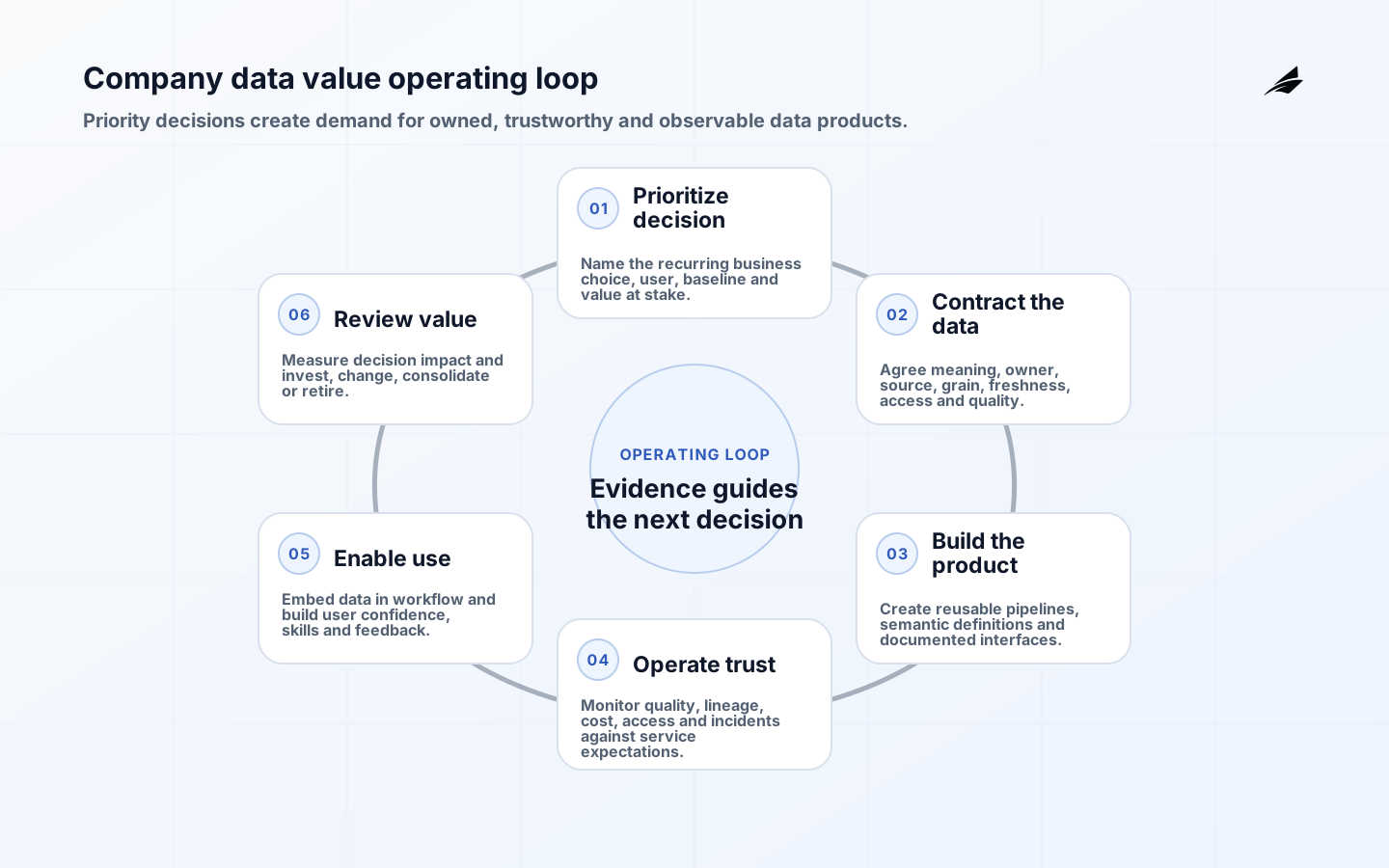
How a company makes data work is an operating-model question before it is a technology question. Data becomes useful when a named group can make a recurring decision better, using information with understood meaning, quality, timeliness and limitations. That requires business ownership, data stewardship, engineering, analytics, privacy, security and change management to work as one system. A lake, catalog or dashboard cannot create that alignment by itself.
This FAQ focuses on organization and value realization. The company data delivery plan covers scope and cost, while the implementation checklist turns the model into gates. For the data lifecycle itself, see the related company data governance FAQ.
Where should a company start making data work?
Start with three to five priority decisions, not an enterprise inventory exercise. For each, name the decision owner, cadence, options, current evidence, delay, failure cost and affected people. Examples include replenishment quantity, renewal intervention, maintenance scheduling or cash collection. Measure the current outcome and how much manual reconciliation occurs. This creates demand for specific data and makes value observable.
The Federal Data Strategy practices begin by identifying data needs for key questions and include governance, inventories, documentation, standards, quality aligned with intended use and capacity building. Although written for agencies, the sequence is useful to companies: purpose should pull governance and infrastructure, rather than a platform pushing undifferentiated data at users.
| Decision pattern | Data product | Outcome measure |
|---|---|---|
| Allocate inventory | Demand, stock and lead-time view by item-location | Availability, waste and working capital |
| Retain customers | Consent-aware account health and service history | Renewal, complaint and intervention yield |
| Maintain assets | Condition, usage and work-order history | Unplanned downtime and maintenance cost |
| Manage cash | Invoice, dispute, payment and promise-to-pay record | Days outstanding and avoidable dispute time |
What data operating model makes ownership real?
Assign an executive sponsor to portfolio outcomes, domain owners to definitions and access decisions, data product owners to user value and service health, stewards to meaning and quality, and platform teams to shared capabilities. Analytics and engineering roles should sit close enough to domains to understand context while using common standards. A council resolves cross-domain conflicts; it should not approve every field change.

Define decision rights explicitly. Who may change a customer definition, accept a quality exception, grant sensitive access, alter retention, or retire a feed? Record escalation and time limits. The Federal Data Strategy principles emphasize ethical governance, conscious design and a learning culture, including responsibility, relevance, future reuse, investment in learning and accountability. Those are useful tests for a commercial operating model too.
What is a useful data product?
A data product is a maintained information capability for known users and purposes. It has an owner, source and transformation lineage, documented semantics, access policy, quality expectations, service objectives, interface, support path, cost and lifecycle state. It may be a curated table, event stream, metric layer, feature set or API. Calling every raw dataset a product dilutes the term and hides the work needed for dependable use.
Use contracts at producer-consumer boundaries. State schema, business grain, valid values, event timing, correction behaviour, identifiers, compatibility and change notice. The W3C Data Catalog Vocabulary provides an interoperable vocabulary for describing datasets and data services in catalogs. A catalog entry is valuable when it helps a user discover, evaluate and obtain data, not merely when metadata fields are populated.
| Product promise | Control | Evidence |
|---|---|---|
| Meaning | Approved definition, grain and examples | Business glossary and consumer confirmation |
| Freshness | Expected arrival and late-data policy | Timeliness trend and incident history |
| Completeness | Required entities and fields by use | Segmented quality checks |
| Access | Purpose-aware roles and review | Entitlement and usage audit |
| Change | Versioning, compatibility and notice | Contract tests and consumer acknowledgements |
| Support | Owner, severity and recovery expectation | Runbook and service review |
How much architecture does a data program need?
Use architecture to clarify responsibilities and movement: operational sources, ingestion, storage, transformation, semantic definitions, serving, catalog, quality, lineage, identity and observation. The NIST Big Data Reference Architecture describes roles and cross-cutting management, security and privacy fabrics. Treat it as a conceptual aid, then choose the smallest architecture that meets current scale, latency and governance needs.
Prefer reusable platform capabilities for identity, orchestration, testing, metadata, secrets and monitoring, while allowing domain-specific transformations and semantics. Avoid duplicate extracts that become shadow authorities. Preserve source-system identifiers and effective times. Design correction, backfill and deletion before historical data accumulates. Portability matters most at interfaces and metadata; a nominally vendor-neutral stack can still be locked in through undocumented logic.
How should data quality be governed without blocking delivery?
Define quality relative to use. Accuracy, completeness, consistency, timeliness and uniqueness matter differently for each decision. Put controls near the source and product boundary, classify failures by impact, and establish quarantine or degraded modes. The W3C Data Quality Vocabulary supports describing quality measurements, policies and annotations. Use a small number of meaningful measures rather than a universal score that conceals context.
Create an incident path for material data failures. Notify affected consumers, stop unsafe downstream actions, preserve the bad snapshot, correct source or transformation, backfill where appropriate and verify reconciliation. Review root causes such as ambiguous ownership, silent schema changes or missing reference data. Quality work should reduce repeated manual repair, not merely increase the number of tests.
Why do technically sound data programs fail to change decisions?
They often deliver reports outside the workflow, use unfamiliar definitions or leave managers accountable for outcomes without trusting the evidence. Co-design the product with decision makers, show lineage and limitations, and embed the signal where the action occurs. Train users to interpret uncertainty and segment differences. Keep access friction proportionate: safe self-service needs governed definitions, approved environments and support, not unrestricted copies.
Measure adoption as meaningful use: decisions supported, active qualified users, time from question to answer, reduction in reconciliation, action taken and outcome change. Page views and query counts can be diagnostic but are not value. Collect feedback at the moment of use and publish known issues. Retire duplicate dashboards so users are not forced to choose among competing truths.
How should a company fund and measure the data portfolio?
Fund shared foundations as products with service objectives, and domain products according to decision value, reuse and risk. Include engineering, licensing, storage, compute, quality operations, stewardship, privacy and change support in cost. Allocate spend transparently enough to improve behaviour, but avoid chargeback mechanisms that push teams toward unsafe shadow systems. Review portfolios quarterly for adoption, service health, unit cost and outcome evidence.
Use ranges and contribution logic rather than claiming every business improvement as data value. A forecasting product may contribute to lower stock alongside policy and process changes. Record the baseline, counterfactual where feasible, leading indicators and confounders. Stop or redesign products whose users, decisions or economics no longer justify operation. Data retained without purpose still carries security, privacy and discovery cost.
Create a capability roadmap based on bottlenecks observed in the priority portfolio. If teams repeatedly wait for access, improve role and approval patterns. If definitions conflict, invest in domain stewardship and semantic contracts. If pipelines are fragile, strengthen testing and observation. This keeps platform work connected to user evidence. Avoid buying every fashionable capability in advance; unused tooling adds integration, skills, security and renewal obligations before it produces value.
Treat data literacy as role-specific practice. Executives need to challenge baselines and uncertainty; operational managers need to interpret signals and exceptions; analysts need reproducibility and communication; engineers need domain meaning and privacy context. Use real company decisions in training, provide office hours and measure whether users make fewer avoidable interpretation errors. Generic tool courses rarely change decisions because they do not address authority, incentives or the consequences of acting on a metric.
Publish a small portfolio map showing each priority decision, supporting products, owners, critical dependencies, trust status and outcome evidence. Use it to identify duplicated products and single points of knowledge. Keep sensitive implementation detail in controlled systems, but make ownership and lifecycle state easy for legitimate users to discover. The map turns governance conversations from general maturity claims into concrete investment choices.
Key takeaways
- Begin with priority decisions and measurable baselines rather than a platform or exhaustive inventory.
- Make domain, product, stewardship and platform decision rights explicit.
- Treat curated data as an operated product with semantics, contracts, quality and support.
- Embed governed information in workflows and measure meaningful decision use.
- Fund lifecycle costs and retire products that no longer create sufficient value.
Frequently asked questions
Should data teams be centralized or embedded?
Use a federated model: shared standards and platform capabilities with domain-aligned product teams. The exact reporting line matters less than clear decision rights, common engineering controls and incentives to reuse rather than duplicate.
Do we need a catalog before building data products?
Start cataloging the products used by priority decisions as you build them. An enterprise catalog can follow proven metadata and discovery needs. Cataloging thousands of unowned assets first often creates an inventory of uncertainty rather than trust.
When should data ROI be visible?
Define the baseline and value hypothesis before delivery, then look for early evidence through reduced effort, faster decisions or improved signal quality. Material business outcomes may lag. Set review dates and stop conditions so uncertainty does not become permanent funding.
Conclusion
A company makes data work by connecting a priority decision to an owned, trustworthy product and an observable outcome. Governance sets decision rights, architecture makes responsibilities clear, quality controls preserve fitness, and workflow adoption turns information into action. Prove that loop for a small portfolio, standardize the capabilities that repeat, and retire the data products that do not earn continued operation.