A company makes data useful when people can apply trusted information to a recurring decision and observe a better outcome. Warehouses, catalogs, pipelines and dashboards are supporting capabilities, not the result. A practical data program therefore scopes decisions and data products, assigns business and technical ownership, establishes privacy and quality controls, and funds operation after the first release. This guide provides a way to estimate cost, expose risk and sequence delivery.
Use the Company Makes Data Implementation Checklist once a workstream is selected, and keep Company Makes Data FAQ available for governance and buying questions. The related Company Makes Data Work guide expands on adoption. The plan here begins with value and works backward into platform scope.
Scope the decisions and outcomes first
Inventory important decisions across revenue, service, operations, risk and planning. For each, record the decision owner, frequency, current inputs, delay, error cost and desired improvement. Select one or two where better information can plausibly change action and where the organization can influence the outcome. Examples include inventory replenishment, renewal intervention, maintenance scheduling, cash forecasting or case prioritization. Avoid a first project defined as creating a single source of truth for everything.
Write a measurable baseline and guardrails. A revenue forecast may target lower weighted error while preserving explainability by region; a support product may reduce time to identify recurring issues without exposing customer text broadly. Name the user and action at the end of the data path. A metric with no decision or review cadence is reporting inventory, not a data product.
| Scope element | Question | Evidence before funding |
|---|---|---|
| Decision | Who changes what action using the information? | Named owner and current workflow |
| Outcome | What improves and over what period? | Baseline, target and guardrails |
| Data product | Which reusable dataset, metric or model serves the decision? | Consumer contract and sample output |
| Platform | Which shared capability is needed now? | Two or more product needs or clear control requirement |
| Adoption | What must change in process, incentives or skills? | User commitment and operating change plan |
Assign product, domain and platform ownership
A data product needs a business or domain owner accountable for meaning, access and usefulness; technical owners accountable for pipelines, models and service operation; and consumers who validate fitness. A central data team can provide platform, standards and specialist skills, but cannot infer every domain definition. Federated models can place ownership closer to source knowledge while retaining common interoperability, privacy and security controls.
Google Cloud’s data mesh guidance describes domain-oriented data ownership, data as a product, self-service infrastructure and federated governance. These principles can help at scale, but do not begin by reorganizing the whole company. Pilot with one domain and a shared contract. Define product name, purpose, grain, schema, metrics, quality objectives, access, support and deprecation. Fund maintenance, not only initial construction.
Choose architecture from product needs
Map source systems, change frequency, volumes, latency, transformations, identity keys, retention and consumption patterns. Then choose batch or streaming, warehouse or lake patterns, semantic modeling, orchestration and serving methods. Prefer managed services and existing standards where they meet requirements. Separate raw, validated and consumption layers enough to preserve lineage and recovery without multiplying copies indiscriminately.
Design for evolution. Use versioned schemas, data contracts, automated quality tests, lineage and reproducible transformations. Protect development and production separation. Establish identity, encryption, network and secret controls. Retain original evidence according to legal and operational need, not forever. A platform capability enters scope when it reduces repeated product effort or enforces a necessary control; otherwise it can wait.
Estimate build and run cost transparently
Cost includes discovery, source extraction, data remediation, engineering, licenses, cloud compute and storage, networking, catalog, observability, security, privacy, training, analyst or product ownership and support. Legacy source integration and meaning reconciliation often cost more than the visible dashboard. Estimate by product and shared capability, with ranges for data uncertainty. Show one-time transition separately from monthly operation and improvement.
Track unit economics such as cost per refreshed product, query, active consumer, model run or decision supported. The FinOps Framework emphasizes collaboration among engineering, finance and business stakeholders to maximize value. Allocate or show back costs with context so teams can optimize without discouraging beneficial use. Set anomaly and budget alerts, lifecycle cold data, tune wasteful queries and retire unused products. Do not optimize storage while ignoring expensive manual reconciliation.
| Cost driver | Early estimate input | Control during operation |
|---|---|---|
| Source integration | Systems, interfaces, change rate and data quality | Contract tests and connector ownership |
| Compute and storage | Volume, retention, refresh and query pattern | Budgets, partitioning, lifecycle and workload tuning |
| People | Domain, engineering, analytics, privacy and support roles | Product capacity and on-call model |
| Tools and vendors | Users, connectors, environments and premium features | License utilization and exit review |
| Adoption and change | User groups, workflow redesign and training | Usage, decision outcome and support demand |
Manage quality, privacy, security and adoption risks
Quality is fitness for the decision, not a universal score. Define validity, completeness, consistency, timeliness and reconciliation tests at product boundaries. Monitor changes in source collection and meaning. The Census Bureau’s quality guidance highlights utility, objectivity and integrity; data teams should similarly communicate limitations and protect information from unauthorized change. Provide issue routes, ownership and expected resolution.
Apply the NIST Privacy Framework to understand how data processing can create problems for individuals and the organization. Minimize data, limit purpose, control access and implement retention and deletion. Threat-model pipelines, orchestration, notebooks, exports and service identities. Adoption risk is equally real: if staff do not trust a metric, cannot explain it or face incentives to use another number, the product fails. Involve users in definition and acceptance, and retire conflicting reports deliberately.
Deliver in outcome-based waves
A first wave should produce one thin product from source to decision, plus only the shared platform capabilities it needs. In weeks one through four, validate the workflow, ownership, sources and sample. In the next phase, build governed transformations, quality, access and a usable interface. Pilot with real users and compare decisions with baseline. Stabilize service levels, cost and support before adding domains.
Sequence later waves by value, reusable foundation and risk. Publish a product roadmap, not a pipeline inventory. Each wave should end with a funding decision based on adoption, outcome, reliability and unit cost. Preserve capacity for source changes and quality debt. Platform work should have internal customers and measurable reduction in delivery time or control gaps.
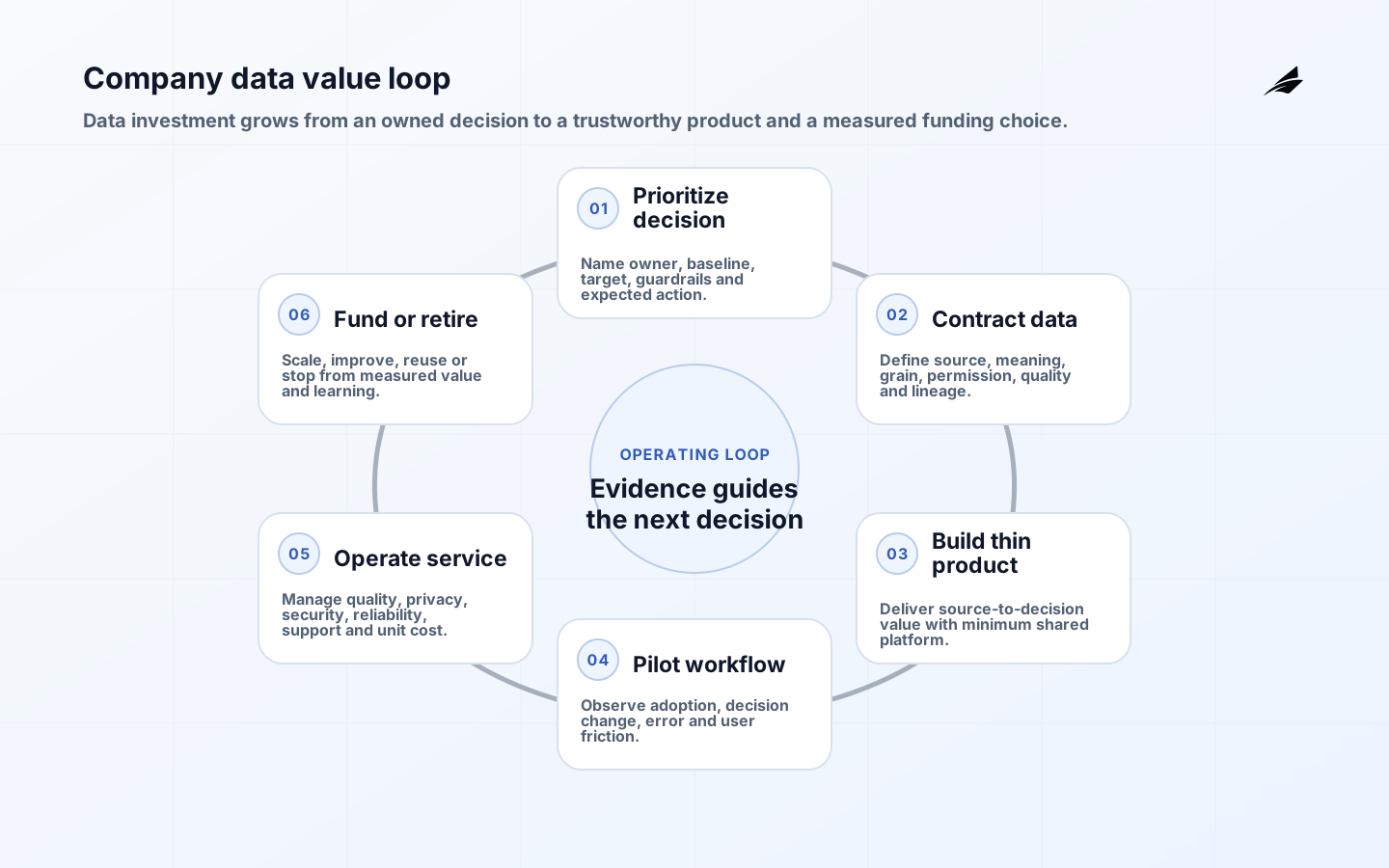
Use a six-stage company data value loop
- Prioritize a recurring business decision with an owner, baseline, target and guardrails.
- Contract the minimum source data, definitions, permissions, quality and lineage.
- Build a thin data product and only the shared platform capability it requires.
- Pilot inside the real workflow and measure adoption, decision change and errors.
- Operate quality, security, privacy, reliability, support and unit economics.
- Fund, improve, scale or retire from observed value and reusable learning.

Create governance that resolves real delivery decisions
Governance should have a small number of forums with authority. A domain product forum owns definitions, access, quality priorities and consumer commitments. A cross-domain council resolves shared identifiers, interoperability, privacy and platform standards. An executive portfolio review funds outcomes and stops low-value work. Publish decision records, owners and due dates. A catalog of policies without a route to settle conflicting definitions will not improve delivery.
Tier products by consequence and reuse. A regulatory report, customer entitlement feed or pricing model needs stronger change approval, reconciliation, recovery and evidence than an exploratory team dashboard. Set minimum controls by tier and allow domains to add more. Review access, quality objectives, source changes, incidents, consumer adoption and deprecation on a predictable cadence. Exceptions need a reason, compensating control, owner and expiration rather than permanent spreadsheet status.
Design adoption into the business workflow
Data products fail when the technically correct output arrives outside the moment of action. Integrate the result into planning, CRM, service or operational systems where users already decide, or make the handoff explicit. Update procedures, incentives and authority so staff know when to rely on the product and when to challenge it. Identify champions and skeptical users during the pilot. Support should distinguish data defects, definition questions, access requests and feature needs, then route each to an accountable owner.
Measure active use and decision effect, but do not punish teams for questioning data. Corrections are valuable product feedback. Publish definitions and limitations near the result, communicate breaking changes in advance and maintain a migration window for consumers. Retire duplicate reports with owners and dates; leaving every old metric available preserves conflict and raises support cost. Adoption is complete only when the new information changes a real workflow and the obsolete path is deliberately closed.
Key takeaways
- Scope decisions and outcomes before architecture and platform.
- Give every data product business meaning, technical operation and consumer ownership.
- Estimate integration, remediation, people, controls and adoption as well as cloud spend.
- Treat quality, privacy, security and operating support as product features.
- Scale through evidence from thin end-to-end products, not a company-wide big bang.
Frequently asked questions
Should a company build a data platform first?
Usually build the minimum platform alongside a high-value product. This reveals real requirements and creates an internal customer for shared capabilities. A larger foundation may be justified by urgent regulatory control or multiple committed products, but it still needs named consumers and measurable outcomes.
How quickly should a data program show ROI?
A thin product should show leading evidence within one or two delivery increments: user adoption, reduced cycle time, better reconciliation or improved forecast. Financial impact may take longer and should reflect attribution limits. Set a decision date and stop funding work that cannot connect platform progress to credible product value.
Conclusion
A company makes data useful by connecting trustworthy products to owned decisions. Scope value, distribute ownership, build only the foundation required, expose full lifecycle cost and operate quality and privacy continuously. Small end-to-end evidence makes the next investment decision clearer and provides a safer route to scale.