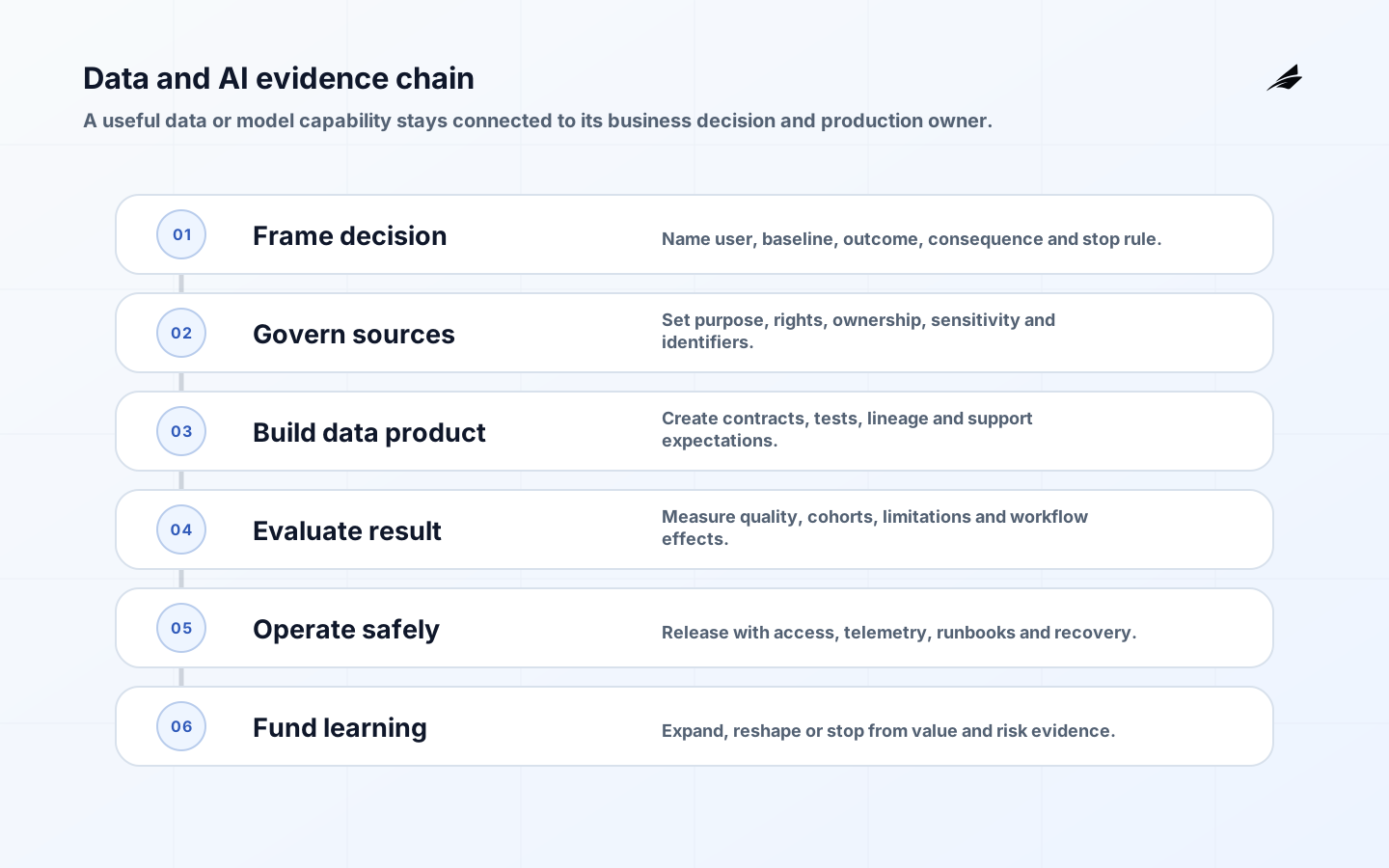
Data and AI services combine several kinds of work that should not be purchased as one vague promise. A useful engagement may include data discovery, integration, quality, governance, analytics, model development, generative AI, deployment and ongoing operation. These capabilities depend on one another, but they produce different deliverables and risks. The central question is which business decision or workflow should improve, what evidence proves improvement, and which data and operational foundations are necessary. Starting with a platform or model before settling that question often creates an expensive demonstration that no team can safely own.
This FAQ helps sponsors, data leaders and engineering teams define a practical engagement. For a detailed sequence, use the data and AI services implementation checklist with the governed data-to-decision guide. The answers distinguish analytics from automated decisions, explain what a provider should hand over and show why production operation deserves equal attention with model selection. The NIST AI RMF functions of Govern, Map, Measure and Manage provide a useful organizing frame, while privacy and sector obligations still need specific interpretation.
What should data and AI services include?
Scope should name an outcome, users, decisions, source systems, output, operating owner and acceptance evidence. A customer-retention engagement might unify product events and account data, define churn indicators, build an analyst view, evaluate a risk model and create a governed intervention queue. “Build a data lake and AI model” is not comparable because it does not state who will use the result or how a correct decision is recognized. Separate discovery, foundation, use-case delivery and operation so early evidence can change later investment without disguising a scope change.
Ask for explicit exclusions and dependencies. Historical data may not contain the outcome label a predictive model requires. An integration may need commercial rights or a stable API. A workflow may require an administrative interface and change management, not just a dashboard. The provider should identify assumptions about data volume, latency, quality, access and review capacity. Acceptance should cover the complete path: a trusted source event reaches a governed dataset, the analysis or model produces a reproducible result, an authorized user acts, and the effect is measured.
| Service layer | Useful deliverable | Acceptance question |
|---|---|---|
| Discovery | Decision map, inventory, baseline and risk register | Is the use case valuable and feasible? |
| Data foundation | Owned datasets, contracts, quality tests and lineage | Can important values be traced and repaired? |
| Analytics or AI | Evaluated product with limitations and user workflow | Does it improve the target decision safely? |
| Production operation | Release path, telemetry, runbook and review cadence | Can a named team detect, recover and improve it? |
Do we need a new data platform before starting AI?
Not necessarily. Begin with the minimum trustworthy data path for one use case. Reuse existing storage and transformation where ownership, security and reliability are adequate. A new platform is justified when repeated problems such as inaccessible sources, conflicting definitions, fragile pipelines or missing governance block several valuable decisions. Even then, deliver a vertical slice early rather than spending a year on generalized infrastructure. A platform becomes useful through supported data products and operating practices, not through the number of technologies installed.
Define datasets as products with purpose, owner, schema, freshness, quality expectations, access policy and lifecycle. Use stable identifiers and shared definitions for material metrics. Catalog metadata in a portable way; W3C DCAT offers a standard vocabulary for describing datasets and data services. Capture lineage for consequential transformations and model inputs. OpenLineage's object model illustrates how jobs, runs and datasets can form an operational lineage record. Tools help, but ownership still requires people who can investigate a failed quality check and decide whether downstream publication must stop.
How much governance is appropriate?
Governance should be proportionate to use and consequence. A descriptive internal report, a staff recommendation and an automated customer decision need different review, evidence and authority. Classify data sensitivity, affected users, reversibility, materiality and dependency. Record who approves purpose, access, definitions, model use and production change. Minimize personal data and define retention. NIST's Privacy Framework can help connect data processing to privacy risk, while the AI RMF helps organize accountability and measurement for AI behavior. Neither replaces domain law or the organization's own risk decisions.
Make governance executable. Access policy should appear in identity configuration; quality expectations should run as tests; approved model and dataset versions should be in release metadata; exceptions should have expiry and owner. Review boards that only receive presentations often discover problems too late. Place review at material decisions: approving a use case, granting sensitive access, accepting evaluation results, expanding authority or responding to a serious incident. Preserve decision records so a later team understands why a threshold or exclusion exists.
How should analytics and AI quality be evaluated?
Start with a baseline that represents the present decision, including its cost and errors. Split evaluation from development, prevent time or label leakage and include rare but consequential cases. For analytics, verify definitions, completeness, timeliness and reconciliation with authoritative totals. For predictive models, evaluate errors by affected cohort and decision threshold, not only aggregate accuracy. For generative systems, test factuality, grounding, refusals, unsafe instructions, sensitive-data handling and the complete task outcome. Human review is part of the system and should be evaluated for workload, consistency and automation bias.
Define acceptance before seeing the final score. State the minimum improvement, maximum harmful error, exception capacity and stop condition. Evaluate under realistic latency and cost constraints. Shadow or parallel operation is useful when decisions are consequential, because it exposes data and workflow behavior without granting authority. Continue to measure after release as source systems, users and models change. Monitor input drift, quality failures, missing cohorts, override reasons, downstream corrections and user outcomes. A stable technical metric can coexist with declining business value if the workflow around it changes.
| Evidence area | Example measure | Decision supported |
|---|---|---|
| Data | Freshness, completeness, reconciliation and lineage coverage | Whether the result can be trusted |
| Model | Cohort errors, calibration, unsupported output and refusal | Whether behavior meets the bounded use |
| Workflow | Completion, override, queue age and correction rate | Whether people can operate the result |
| Value | Cycle time, loss avoided or decision quality versus baseline | Whether continued investment is justified |
| Risk | Privacy event, access exception and high-impact error | Whether to pause or reduce authority |
Who owns the system after launch?
Name owners for the business outcome, data products, model, application, infrastructure, security and privacy. One person may hold several roles in a small team, but the decisions must remain clear. Define service targets for the full workflow, not just an endpoint. A model can be available while its input dataset is stale or its recommendations accumulate in an unowned queue. Build actionable alerts, correlation identifiers, runbooks and a support view that explains current state. Rehearse source failure, provider timeout, bad deployment and suspected data exposure.
Require a handover that can be exercised: source code, infrastructure definitions, schemas, contracts, lineage, model and prompt versions, evaluation corpus, test results, architecture decisions, access under customer control, licenses, runbooks, dashboards and known limitations. The receiving team should deploy a change, investigate a failed data job and restore service while the provider is available. If managed operation continues, define service boundaries, change approval, incident authority, evidence, cost, subcontractors and exit. Ownership cannot be demonstrated by receiving a folder of documents on the final day.
How should cost and value be planned?
Separate one-time discovery and build from recurring ingestion, storage, compute, model use, observability, support, assurance and improvement. Estimate cost using workload units such as records, documents, tokens, training runs and active users, then include peak and failure behavior. Managed services can reduce internal work but do not remove ownership. Avoid precise savings based only on minutes in a workshop. Establish a baseline, observe actual adoption and record whether time disappears, moves to exception handling or becomes higher-value work.
Use funding gates. Discovery should prove decision value and data feasibility. A production slice should prove technical and operating viability. Expansion should depend on measured outcomes and acceptable guardrails. Stop or redesign when a model does not outperform a simpler rule, required data cannot be used responsibly, review cost overwhelms value, or adoption remains low after workflow issues are addressed. A disciplined stop decision is a successful result when it prevents a larger unsupported platform or model investment.
Questions to ask a data and AI provider
- Which user decision changes, and what baseline will be measured?
- Which datasets are authoritative, and who owns quality and access?
- How are evaluation cases separated from development and sliced by risk?
- What deterministic controls bound model output and production authority?
- Which team receives code, evidence, operating access and decision history?
- How can the customer pause, substitute or exit the service without losing records?

Key takeaways
- Buy an improved decision path, not an undefined collection of technologies.
- Build the minimum trusted data foundation for a bounded use case.
- Turn governance into access, tests, release evidence and owned exceptions.
- Evaluate the complete human and software workflow against a baseline.
- Treat operation, handover and exit as core service deliverables.
Frequently asked questions
How long should a pilot last?
Long enough to observe representative inputs and one complete business cycle, but short enough to support a decision. Define evidence and a stop date before starting. A pilot without production-like data rights, users and workflow may test technology while leaving feasibility unanswered.
Should we use a managed model or build our own?
Use the simplest option that meets quality, privacy, control, latency, cost and continuity requirements. Managed models reduce infrastructure work; specialized models may improve control or domain performance. Test both within the actual task and retain an exit plan for data, evaluation and integration.
Is a dashboard a data product?
It can be, when it has defined users, owned data, quality expectations, support and a decision purpose. A visual layer over disputed metrics is not a dependable product. The underlying definitions, lineage, refresh and correction process matter as much as presentation.
Conclusion
Effective data and AI services connect trusted records to a decision that people can operate and improve. Define the outcome, build a traceable data path, evaluate real failure modes and assign production ownership before expanding. The result should make evidence easier to use and challenge, not add another opaque system between the organization and its decisions.