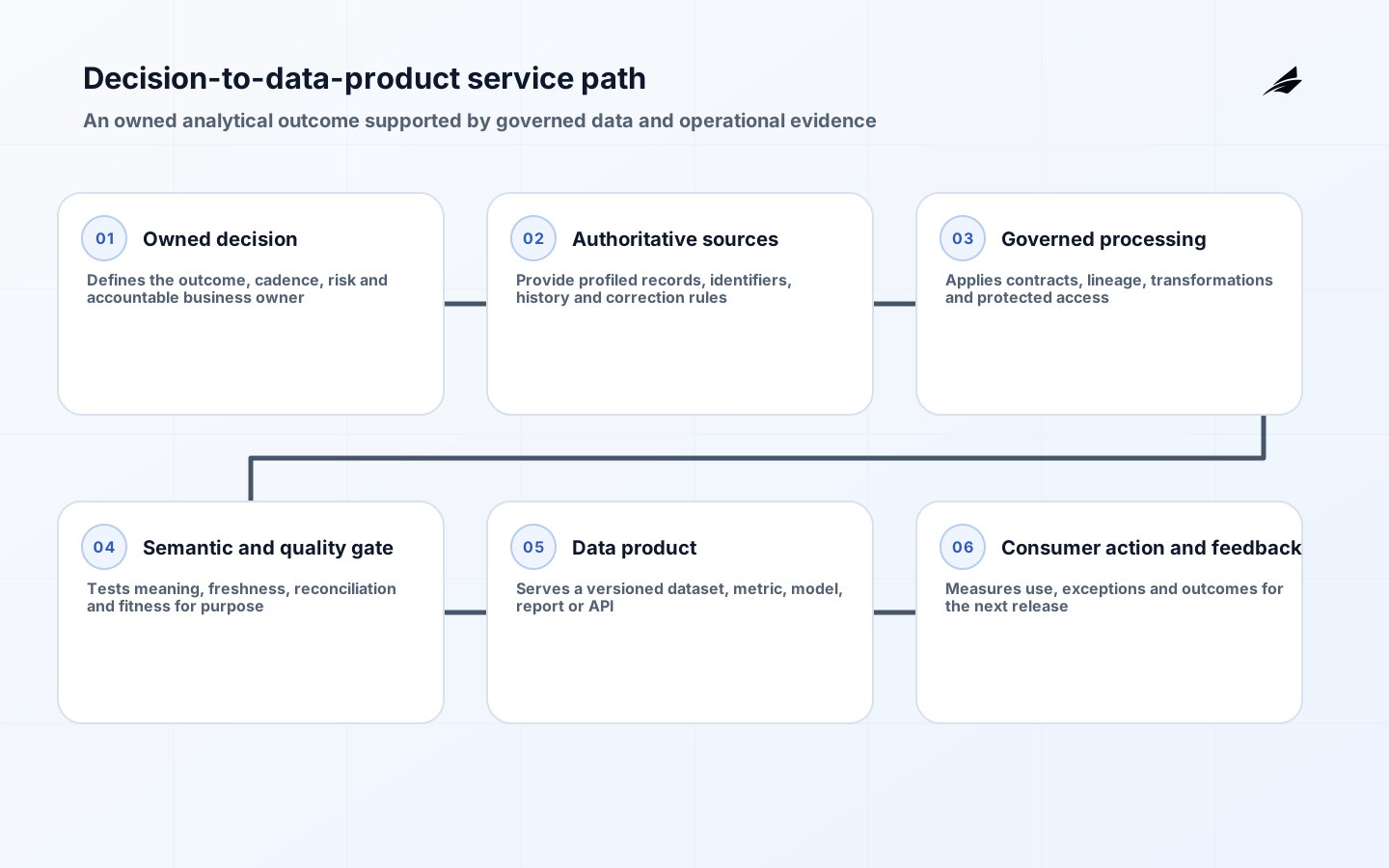
Data and analytics services should make important decisions faster and more dependable, not merely deliver a warehouse and a collection of dashboards. A serious engagement begins by identifying the decisions, reports or operational actions that are currently slow, disputed or poorly evidenced. It then traces the data, definitions, people and controls required to improve them. This framing separates a useful data product from a technically impressive platform that nobody trusts. It also makes scope, cost and acceptance criteria concrete enough for business, data, security and engineering leaders to govern together.
Scope the service from decisions and data products
Start with a bounded decision such as replenishment, revenue forecasting, support staffing or customer-retention review. Name the decision owner, cadence, inputs, acceptable freshness and consequence of error. Then define the data product that serves it: a governed dataset, metric set, model, report or API with an owner and service expectations. The scope must include source acquisition, transformations, semantic definitions, access, quality monitoring, consumption and incident handling. A dashboard without those upstream and operational responsibilities is not a complete analytical service.

Inventory representative source records before promising architecture or dates. Examine keys, history, late-arriving events, corrections, deletion behavior, time zones and access restrictions. Interview both producers and consumers because a field name rarely explains its real business meaning. Identify which system is authoritative for each fact and where reconciliation is required. W3C's quality vocabulary is useful here because it distinguishes dimensions and measurable observations while leaving fitness for purpose to the consumer context. Completeness may matter for one use; currentness or consistency may dominate another.
| Scope layer | Decision to make | Acceptance evidence |
|---|---|---|
| Business outcome | Which decision or action should improve? | Named owner, baseline, cadence and target behavior |
| Data product | What reusable analytical output will serve it? | Contract, consumers, owner and service expectations |
| Sources | Which records are authoritative and how do they change? | Profiles, keys, history and correction rules |
| Semantics | How are measures, dimensions and time defined? | Reviewed definitions and worked examples |
| Controls | Who may access, alter and publish the product? | Role mapping, tests, logs and approvals |
| Operations | How are freshness, quality and incidents handled? | Dashboard, runbook, alert ownership and recovery test |
Design an architecture that preserves meaning and evidence
A common service path includes source systems, ingestion, durable raw history, transformation, governed serving models and consumption tools. The exact technologies matter less than explicit contracts between those stages. Batch, streaming and change-data-capture patterns should be chosen according to decision latency, source capability, recovery needs and cost, not fashion. Retain enough immutable source context to investigate changes, but do not duplicate sensitive data without a purpose and retention rule. Separate development, test and production, and use representative synthetic or protected test data.
Lineage must connect a visible number back to code, source fields, transformation runs and release versions. W3C PROV-O describes provenance through entities, activities and agents; a practical implementation can express the same idea through catalog metadata and orchestrator records. Lineage is valuable only when responders can use it during a broken report or disputed figure. Capture ownership, run identifiers, input versions and deployment information automatically where possible. Pair technical lineage with business definitions because a perfect column graph does not explain why net revenue excludes a particular adjustment.
Build quality, security and privacy into the product contract
Define quality checks from the decision risk. Schema and null checks catch structural failures, but business tests should also cover valid ranges, referential integrity, reconciliation totals, duplicate events and freshness. Publish thresholds with the product contract and distinguish blocking failures from warnings. Record the quality measurement's scope and time so users do not interpret an old passing result as current assurance. Route failures to an owner with enough context to act, and maintain a controlled exception process for legitimate source anomalies.
Classify fields and purposes before granting broad analyst access. Use least privilege, group-based roles, protected service identities, encryption, secret management and reviewable changes. Apply masking or de-identification only after assessing re-identification and linkage risk; transformed data can remain sensitive. The NIST Privacy Framework helps teams examine how data is processed and the risks to people, while the Cybersecurity Framework supplies complementary governance and protection outcomes. Log access and high-impact exports without turning logs into an uncontrolled duplicate of sensitive content.
| Risk | Leading signal | Control and response |
|---|---|---|
| Definition drift | Teams calculate the same measure differently | Version metric definitions; review changes with owners and consumers |
| Stale data | Freshness exceeds the decision window | Monitor source and product timestamps; expose status to users |
| Silent source change | Volume or schema shifts after a source release | Contract tests, anomaly checks and producer change notice |
| Excess access | Users retain broad or inherited permissions | Group-based grants, periodic review and export monitoring |
| Pipeline replay error | Recovery duplicates or omits records | Idempotent loads, checkpoints and reconciliation |
| Low adoption | Users export to private spreadsheets | Observe workflows, simplify delivery and close definition gaps |
Estimate cost across delivery and operation
There is no responsible fixed price for data and analytics services without discovery. Cost depends on source count and condition, historical volume, latency, transformation complexity, semantic disagreement, privacy obligations, environments, user concurrency, retention and support expectations. Estimate from sampled sources and representative products. Keep one-time migration and build costs separate from recurring compute, storage, licenses, observability, support and governance. Model cost by workload, not only by platform, so teams can see which refresh patterns, queries or retained copies drive consumption.
A commercial statement of work should name deliverables and evidence: source profiles, contracts, models, quality tests, dashboards, operating runbooks and knowledge transfer. Clarify who obtains access, resolves source defects, approves definitions and supports production. Avoid tying completion only to dashboard count; that rewards surface area rather than trust or use. Use ranges until source access and profiling reduce uncertainty, and reserve contingency for named risks. Exit terms should cover export formats, metadata, code, credentials, retained copies and provider deletion evidence.
Deliver one vertical slice before building the estate
Frame the first slice around one decision and a small set of representative sources. Discover data behavior and definitions, design the contract and controls, then build the full path from acquisition to a real consumer. Run it at production-like scale and cadence. Validate numbers with source owners, exercise a failed load, confirm access and observe whether users act differently. A vertical slice exposes semantic, operational and organizational friction earlier than building all ingestion first and postponing consumption until the end.
- Frame: agree the decision, owner, baseline, risk and product boundary.
- Discover: profile sources, map authority, classify data and resolve critical definitions.
- Prove: build a production-like end-to-end slice with lineage, tests and access controls.
- Pilot: serve a limited user group while reconciling against the existing method.
- Scale: add products or sources only when ownership and operating evidence remain healthy.
- Retire: remove duplicate reports, credentials and pipelines after consumers and retention duties are verified.
Acceptance should combine correctness, usefulness and operability. Reconcile totals and sampled records; verify freshness and recovery; test authorization; confirm lineage; and observe the decision workflow. Track adoption cautiously: logins alone do not prove value. Better evidence includes reduced manual reconciliation, fewer disputed definitions, faster decision preparation and consistent use in the intended meeting or operational process. Targets must come from an observed baseline rather than an invented benchmark. Review them with the people accountable for the business outcome.
Operate analytics as a portfolio of owned products
After launch, assign a business owner, technical owner and support route to each important product. Publish status, freshness, known limitations and change notes. Use service objectives that reflect consumer needs, such as data available before a daily decision cutoff, rather than copying application uptime measures. Review incidents for upstream causes and consumer impact. Manage semantic and schema changes through versioned contracts, compatibility checks and notice periods. Archive or retire products that have no accountable consumer instead of allowing a catalog of apparently valid but abandoned assets to grow.
Key takeaways
- Begin with an owned decision and a bounded data product, not a platform shopping list.
- Make source authority, semantics, lineage, quality and access part of the product contract.
- Estimate migration, governance and steady-state operation alongside engineering build cost.
- Prove the complete path with representative data before scaling sources or dashboards.
- Measure trust through reconciliation, freshness, use and operational response, not output volume.
Frequently asked questions
Do we need a new data platform before improving analytics?
Not necessarily. First isolate whether the constraint is source quality, definitions, access, workflow, skills or platform capability. A narrow product slice can often improve a decision on the current estate and generate evidence for a larger platform change. Replace technology when measured requirements and lifecycle cost justify it.
How long should discovery take?
Discovery should be time-boxed but evidence-led. It is complete enough for a first slice when the team has sampled real sources, identified authority and sensitive fields, agreed core definitions, mapped consumers and exposed the largest delivery risks. Unknowns should remain visible assumptions rather than being hidden inside a confident schedule.
Should data ownership be centralized?
Central teams can provide platforms, standards and specialist support, while domain owners usually retain the context and authority needed for important definitions and source behavior. The useful design makes decision rights explicit. It does not confuse distributed contribution with absent accountability.
What proves that the engagement succeeded?
Use evidence tied to the initial decision: reconciled accuracy, availability within the decision window, controlled access, lower preparation or correction effort, adoption in the real workflow and successful recovery from a representative failure. A delivered dashboard or migrated table is an output, not proof of the outcome.
Conclusion
A dependable data and analytics service joins business meaning to technical and operational evidence. It scopes a real decision, establishes authoritative inputs and definitions, protects data, records lineage, measures fitness for purpose and gives failures an owner. The safest delivery path is a narrow vertical slice that can be reconciled and operated before the estate expands. That discipline creates credible cost estimates, exposes risk early and leaves the organization with data products people can understand, use and improve rather than another layer of unexplained numbers.