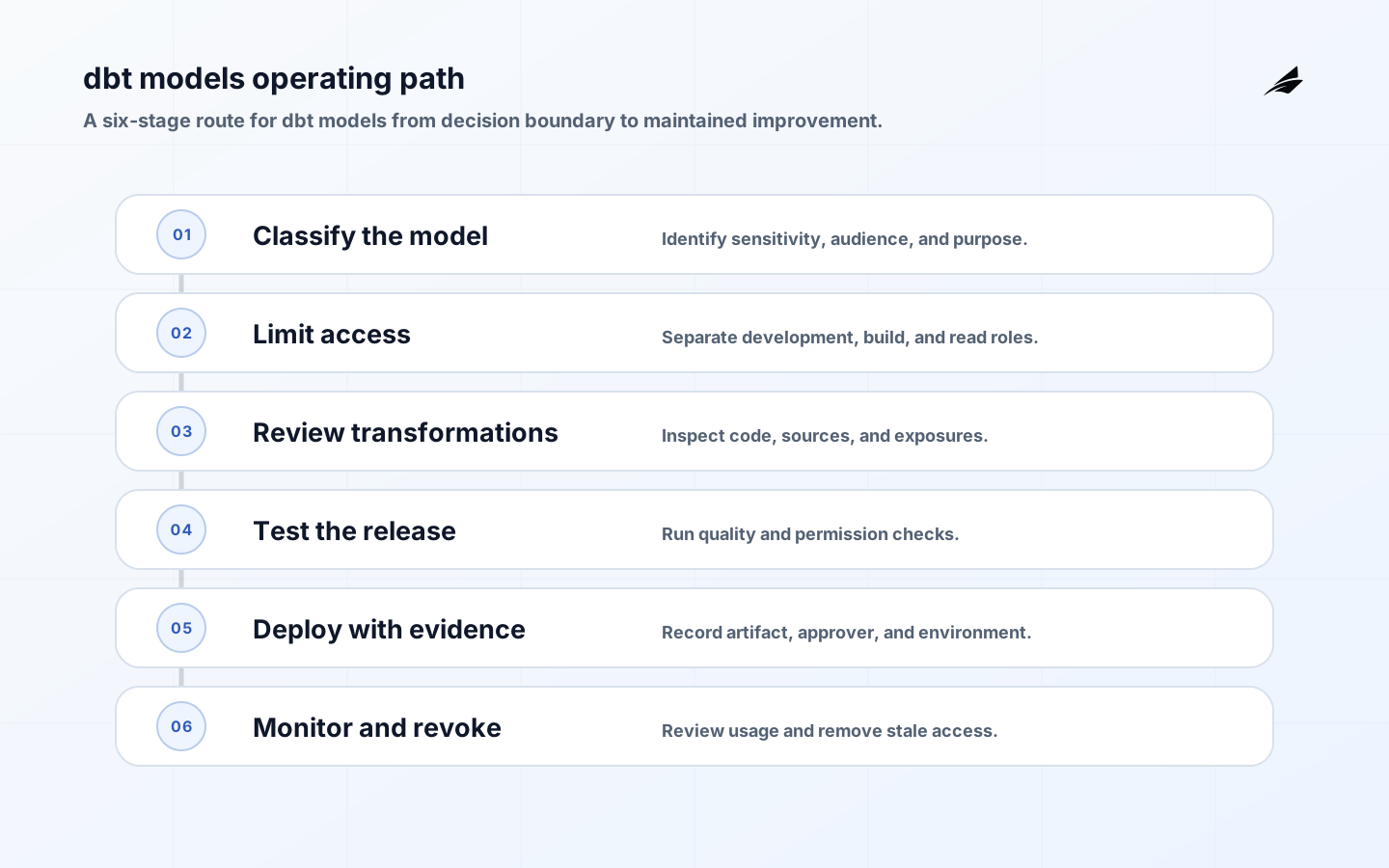
A dbt model practice is not a purchase decision or a document that can be completed once. For engineering teams, they are a way to make transformations reviewable, testable, and appropriately protected from development through production. The useful starting point is a governed transformation release: a bounded thing with a named owner, a clear promise to its reader, and evidence for when it should or should not be trusted. A model may correctly restrict a sensitive source table yet publish a derived column to a broadly shared schema. Review has to follow the data through transformations and the environments that build them. Use the data-operations guide, dbt planning reference, and finance reporting guide for adjacent decisions. For dbt models, dbt Cloud user access documentation details access concepts, while NIST SP 800-53 Rev. 5 offers a broader control reference.
Follow a model from source permission to reader exposure
Plain language matters because teams often give a dbt model a broad label and then make incompatible assumptions about its job. Here, dbt models refer to a governed transformation release designed to serve a known decision or operational need. Its accountable owner is the model owner, repository maintainer, and platform access owner. Its working inputs are source declarations, SQL logic, tests, documentation, environment permissions, and deployment evidence. That definition is deliberately narrower than “all available data.” It gives a team something it can review, test, and improve Security review cannot stop at a warehouse role: credentials, pull requests, build artifacts, and downstream exposures also need control. The dbt models documentation provides implementation context, while dbt data tests documentation helps frame provenance, accessibility, and contract evidence that readers may need. dbt models documentation and dbt data tests documentation provide implementation context for model structure and expected checks.
- Name the decision, the person who makes it, and the deadline before choosing tools or visuals.
- Write the unit of analysis and the boundary: what is included, excluded, estimated, or still pending
- Give the reader a visible freshness, completeness, or release state rather than implying certainty.
- Keep an owner and a recovery route beside the definition so questions do not become anonymous support work
Limit the security boundary before adding consumers
A small boundary makes the trade-offs visible. Begin with one audience, one decision cadence, and one source-to-consumer path. Then ask what can go wrong at each point: a late source, a changed definition, a denied permission, a partial rerun, or an action that is not recorded The answer does not need to be elaborate; it needs to be operational. For dbt models, the essential components are least-privilege access, reviewed code, data classification, tests, protected deployment, and observable artifacts. A team should be able to point to the owner for each component and show where its current state is recorded That is more useful than declaring a platform “trusted” without a way to inspect its behavior.
| Boundary question | Concrete answer to record | Why it changes decisions |
|---|---|---|
| Reader and action | Which engineering team member uses a dbt model, and what action follows? | Prevents a general-purpose artifact from becoming an unowned report. |
| Meaning and grain | What does one record, value, or result represent? | In dbt security reviews, stops apparently similar totals from being compared as if they were equivalent. |
| Timing promise | What cut-off, lateness window, or release cadence applies? | Lets readers distinguish current signals from settled results. |
| Failure route | Who investigates an unexpected, late, or unavailable result? | Turns uncertainty into a controlled operational response. |
Make safe use easier than accidental exposure
Design choices should make correct use easier than accidental misuse. Put scope and status close to the result, then offer detail only where it supports investigation. Separate business meaning from implementation mechanics but connect them through stable identifiers and links This is especially important when the same output reaches different teams or tools. The dbt Cloud user access documentation is a useful reference for recording lineage and operational context; the NIST SP 800-53 Rev. 5 provides a control-oriented lens for access, change, and recovery. Neither replaces local decisions about who may use the result and what evidence they need.

- Make the default view answer one named question; use drill-down for diagnosis rather than placing every field on the first screen
- Expose source or model status where a reader can see it before acting on an incomplete result.
- Treat identifiers, classifications, and access rules as part of the design, not post-launch administration
- Keep release notes short and decision-focused: what changed, when it takes effect, who is affected, and where to ask questions
| Design choice | Good operational behavior | Failure it avoids |
|---|---|---|
| Explicit status | Show the stated timing promise for a governed transformation release. | A reader mistakes an in-progress result for a final one. |
| Named ownership | Display or link to the model owner, repository maintainer, and platform access owner. | A question waits while teams debate who should respond. |
| Traceable change | Link release, source, or transformation evidence. | A changed number becomes impossible to explain after the fact. |
| Proportionate access | Give each role only the detail required for its decision. | Sensitive data spreads through convenient exports or broad workspaces. |
Exercise the release path with sensitive examples
For dbt Model Security Review: A Practical Guide, prove the promised behavior on one representative path before expanding coverage, then exercise its first credible failure. Review a change from source declaration through generated relation, role grants, documentation, and query exposure in the target environment. Keep the test data and expected outcome available for future change review. A successful run is not the same as a useful result: the acceptance check should include data outcome, timing, permissions, documentation, and the reader's ability to act This sequence also reveals whether an upstream agreement or a business definition needs work before the design is replicated elsewhere
Review access and lineage as the model changes
After release, use real operating evidence to decide what deserves improvement. Revisit access and exposure when teams, schemas, packages, or regulated data classifications change. Record incidents in terms readers can understand: which decision product was affected, what promise was missed, what scope changed, and how the result was corrected. Pair that record with technical signals such as freshness, job state, contract violations, test results, or access events The point is not to create an endless dashboard about dashboards; it is to make it possible for the responsible person to see risk early and choose an appropriate response
Security review is stronger when it follows an example record through each exposure point: source declaration, development query, compiled artifact, built relation, documentation site, and downstream grant. For sensitive data, decide where masking, aggregation, or exclusion belongs before reviewers approve the model. This produces a concrete record of intended use and makes later access reviews faster than reconstructing permission logic from warehouse roles alone.
Security takeaways worth retaining
- dbt models earn trust through a clear decision boundary, not through volume or visual polish.
- A named owner, visible timing promise, and tested failure route make the output usable when conditions change
- Test accepted examples and degraded paths before scaling to more teams, consumers, or source systems
- Treat every material definition or access change as a release that affected readers can understand.
Security questions before a model reaches more readers
When is dbt models ready for wider use? In dbt security reviews, it is ready when a real reader can explain its purpose, scope, timing, owner, and action route, and the team has tested a credible failure scenario. Does a tool create dbt models by itself? No. Tools can enforce structure or expose evidence, but the organization still has to choose meaning, ownership, and the decision promise How much documentation is enough? Enough for the intended reader to use the result safely and for a responder to investigate a change; link to deeper technical material instead of forcing every detail into one page What should change first after an incident? In dbt security reviews, repair the immediate decision risk, then update the definition, control, test, or runbook that would have made the failure visible earlier
Conclusion: make the transformation defensible
The durable version of dbt models is a maintained agreement between people, data, and a decision. Start with the narrowest valuable use, make its meaning and timing visible, give it an owner, and rehearse how it behaves when the inputs are imperfect That approach creates useful evidence for expansion without claiming certainty that the system cannot provide As the workflow grows, preserve the decision boundary and let each material change earn trust again.
A dbt model security review is complete only when it follows an example field from source permission through transformation, artifact, generated relation, documentation, and downstream access. Retain the reviewer, classification, affected audience, test result, and remediation owner. That evidence makes the next access review faster and exposes the difference between protecting a source table and protecting the result that readers actually see.
For the security release, review a sensitive example across development and production, including a denied role, a changed model column, and a downstream export. The decision record should show the control that blocked or exposed the case, the responsible owner, the affected readers, and the repair or rollback action. Widen access only after the evidence covers the path people will actually use.
A dbt model security review should follow sensitive fields from source to compiled SQL, warehouse relation, grants, logs, artifacts, and downstream extracts. Test a prohibited field, an unexpected join, a changed role, and a failed access check. Keep the approval evidence with the model version and name the steward who accepts purpose and audience. Security is stronger when the review can prove both what the model exposes and why that exposure is permitted.