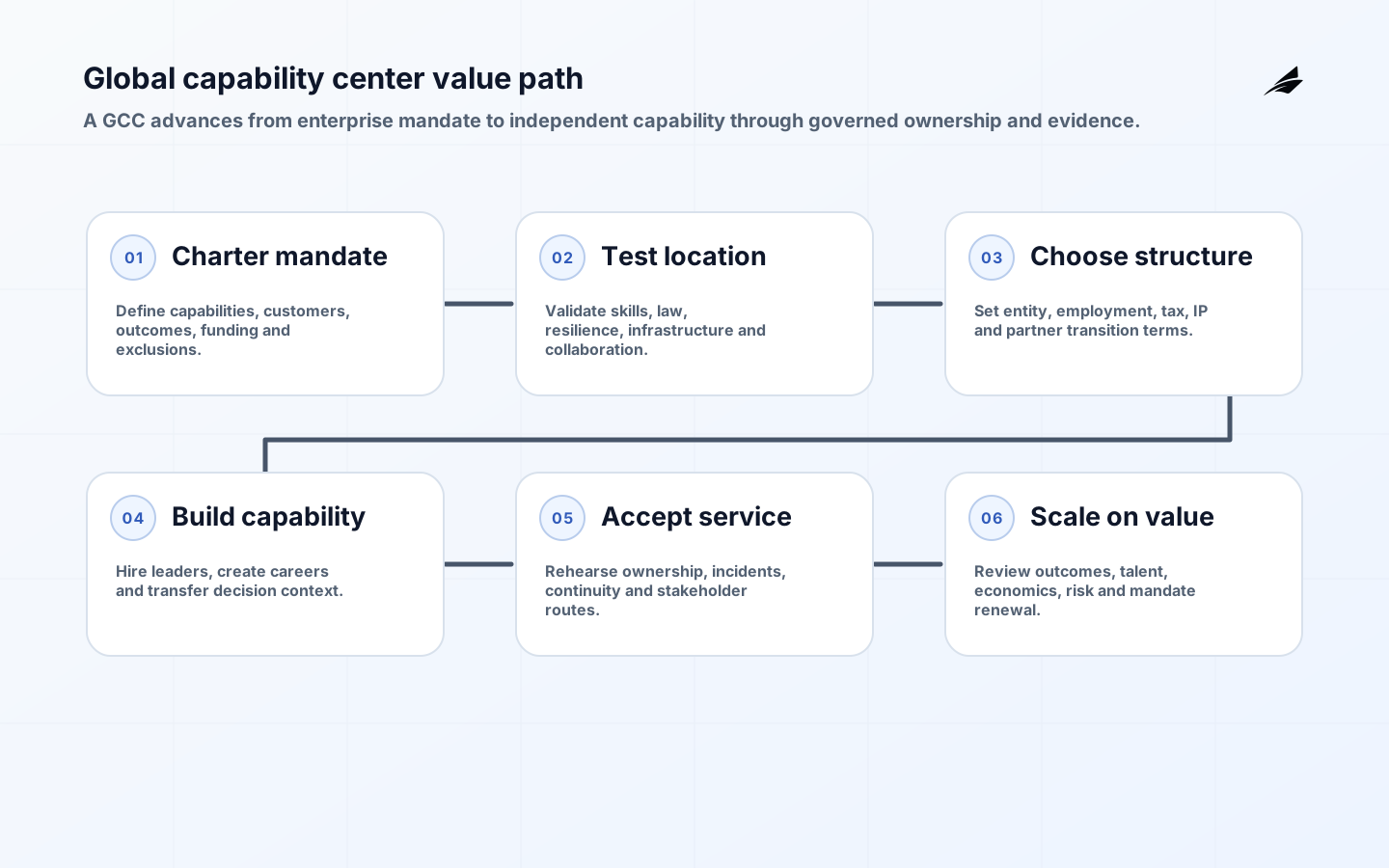
Global capability centers are company-owned operations that concentrate technology, data, finance, engineering, research or business capabilities in one or more locations. They differ from a conventional outsourcing contract because the enterprise retains organizational ownership, employment relationships and long-term capability decisions. This global capability centers FAQ explains how to choose a mandate, location and operating model without reducing the case to labor-cost comparison.
Leaders developing the case can begin with the global capability centers practical guide and then use the GCC implementation checklist. Where the mandate includes analytics or AI, the data and AI services checklist adds lifecycle controls. The answers below apply to captive, hybrid and partner-assisted setup models.
What is a global capability center for?
A GCC should own defined enterprise capabilities and outcomes: product engineering, analytics, cyber operations, finance platforms, customer operations or research, for example. The mandate identifies services, decision rights, customers, value measures, geographic coverage and work that remains elsewhere. Moving fragmented tasks without process authority creates a remote queue. Moving ownership, product context and leadership can create durable capability. Start with business constraints and talent needs, then choose the center form.
India's Economic Survey 2024-25 describes GCCs as evolving strategic hubs and notes India's deep science, technology, engineering and mathematics talent pool. That national view is useful context, not a location decision for every enterprise. A center still needs a company-specific demand forecast, access to relevant skills, infrastructure, leadership pipeline, retention plan and tested ability to collaborate with the functions it serves.
How should leaders select a GCC location?
Compare locations on role-specific talent depth, language, attrition, education, competition, labor rules, immigration, tax, data restrictions, political and climate exposure, infrastructure, travel, time-zone overlap and business continuity. National averages hide city and skill differences. Visit candidate ecosystems, interview employers and educators, test salary data against actual recruiting, and identify critical suppliers. Model a primary city, secondary city and distributed option rather than assuming one large campus is the default.
Evaluate legal entity, branch, employer-of-record, build-operate-transfer and vendor-assisted launch separately. Each allocates employment, intellectual property, tax, control and transition differently. A fast interim model can accelerate hiring but may create later transfer friction. Obtain local legal, tax and employment advice. The OECD transfer-pricing resources explain the international arm's-length framework; actual pricing, documentation and permanent-establishment analysis depend on facts and applicable treaties and law.
| Decision factor | Evidence to collect | Risk if simplified |
|---|---|---|
| Talent | Role-level supply, time to hire, retention and leadership | Headcount grows without capability |
| Entity | Tax, employment, IP, capital and reporting advice | Unexpected liability or trapped transition |
| Location | Infrastructure, travel, climate and concentration scenarios | Single-site operational interruption |
| Data | Purpose, transfer, access and localization requirements | Unlawful or unusable service design |
| Economics | Loaded cost, inflation, productivity and transition | Headline wage saving disappears |
| Culture | Decision rights, overlap and leadership behaviors | Remote execution queue |
Which GCC operating model works best?
Organize around products, platforms or end-to-end services when the work needs persistent context. Transactional shared services may still use standardized process towers. Give each unit an enterprise owner, GCC leader, service or product measures, funding route and escalation. A matrix can connect global standards with local people leadership, but it must resolve who sets priorities and accepts quality. Avoid dual reporting where neither leader can make a timely decision.
Use a capability council to approve mandate changes, investment, architecture, risk and talent priorities. Include headquarters and center leaders as peers. Publish service catalogs and interfaces, but preserve direct collaboration between center specialists and business users. Chargeback can improve transparency if its units reflect controllable demand; arbitrary headcount allocation encourages local optimization. Review work that crosses the center boundary and redesign recurring handoffs, approvals and meetings that add delay without control value.
How should a GCC build and retain talent?
Create role architecture, skill expectations, career paths and pay bands before mass hiring. Recruit an initial leadership and architecture cohort capable of shaping work, not only administering intake. Mix experienced domain hires, technical specialists and early-career talent. Pair people with global product and business leaders, rotate selected roles in both directions and give the center ownership of meaningful decisions. Retention improves when work, growth, management quality and recognition are credible, not merely when compensation matches a survey.
The ILO MNE Declaration provides direct guidance to enterprises on employment, training, conditions of work and industrial relations and was most recently amended in 2022. Apply local labor law and worker consultation directly. Track hiring access, pay equity, promotion, learning application, manager span, regretted attrition, workload and employee voice. Do not label attrition a market issue before examining job design and leadership.
How are data, security and intellectual property governed?
Map every service's data categories, purpose, source, countries, users, transfer route, retention and deletion. Use enterprise identities, managed devices, least privilege, environment separation, approved repositories, secrets management, logging and tested offboarding. Sensitive access should follow role and task, not center membership. India's Digital Personal Data Protection Act 2023 establishes a framework for digital personal data; organizations must track commencement, rules and other applicable sector and foreign laws with counsel.
Apply the NIST Cybersecurity Framework outcomes to the center's full ecosystem: facilities, endpoints, networks, SaaS, cloud, source code, data, suppliers and incident response. Record invention assignment, open-source policy, publication review and confidentiality in employment and project processes. Rehearse insider risk, compromised credentials, unavailable connectivity and a regional incident. Security controls must support collaboration; blocked official paths otherwise create personal messaging, unmanaged copies and shared credentials.
What does a GCC really cost?
Model compensation, benefits, recruiting, training, leadership, facilities, devices, software, cloud, networks, travel, professional advice, entity administration, tax, insurance, security, partner fees, transition, redundancy, inflation and currency. Include enterprise subject-matter time and duplicated operation during migration. Compare scenarios using service units and capability outcomes, not salary per employee alone. A center may be justified by speed, resilience, intellectual property and talent access even when near-term savings are modest.
| Measure | Useful interpretation | Misleading substitute |
|---|---|---|
| Time to productive team | Evidence that hiring and onboarding create capability | Offers accepted |
| Outcome ownership | Business or product result controlled by GCC team | Tasks received |
| Quality | Defects, rework and customer outcome by service | Utilization alone |
| Talent health | Skills demonstrated, mobility and regretted attrition | Training hours |
| Resilience | Critical services meeting tested recovery targets | Number of sites |
| Unit economics | Loaded cost per comparable outcome | Average salary |
How should work transition and scale?
Select a bounded service with stable ownership and enough complexity to test the model. Baseline outcomes, map process and dependencies, identify knowledge holders and define acceptance. Use shadow, reverse-shadow and supervised ownership only where they prove competence; avoid months of observation without decision rights. Transfer records, access, runbooks, architecture and stakeholder relationships. Test incident and continuity before ending prior coverage. Keep client-facing communication clear when service contacts or processing locations change.

Scale in waves after reviewing productivity, quality, security, employee experience and enterprise collaboration. Add leaders before spans become unmanageable. Build platform, finance, HR, legal and facilities capacity ahead of demand. Diversify locations only for a defined talent, market or resilience reason. A second center creates another interface and control environment; it is not automatic continuity. Maintain exit and restructuring plans, including knowledge, records, access, employment duties, supplier commitments and service continuity.
Example: transition a data platform capability
Consider an enterprise that wants a GCC to own analytics platform engineering. Define the mandate as reliable governed data products and self-service tooling, not a target headcount. The first wave could pair a GCC product lead, engineers and reliability specialist with the existing global team on one domain. Baseline onboarding time, data incidents, user effort, platform cost and delivery flow. Transfer architecture decisions, repositories, cloud roles, supplier contacts, runbooks and budget authority alongside technical work. Reverse-shadow an incident and a schema change, then require the new team to lead a recovery exercise.
Acceptance should confirm service objectives, reconciled access, independent stakeholder relationships and a funded roadmap. If the center can close tickets but cannot prioritize platform investment or negotiate source contracts, capability ownership has not moved. Scale the next domain only after the first team's support load, retention risk and collaboration cadence are understood. This preserves knowledge while giving the GCC genuine product accountability rather than permanent dependency on headquarters approval.
Review the wave after one operating quarter. Compare actual loaded cost and hiring time with the business case, examine after-hours work and promotion opportunities, and ask platform users in other regions whether decision speed improved. Correct funding, staffing or authority before adding volume. Early transparency is less costly than allowing a weak interface to harden into the center's normal operating model.
Key takeaways
- Give the GCC end-to-end capability ownership, not disconnected remote tasks.
- Select locations from role, law, resilience and collaboration evidence.
- Build enterprise and center leaders into one decision model.
- Measure complete economics, talent health, quality and business outcomes together.
- Scale through accepted service waves with tested continuity and lawful data use.
Frequently asked questions
Is a GCC the same as outsourcing?
No. A GCC is generally an enterprise-owned capability. Vendors can help establish or operate parts of it, but ownership, employment, control, intellectual property and transition terms distinguish the models.
How large must a GCC be?
There is no universal minimum. The center needs enough leadership, specialist depth and operational support for its mandate. A focused high-skill center can create more value than a large task-based operation.
Conclusion
A global capability center creates value when enterprise ownership, local capability and end-to-end outcomes reinforce one another. Define the mandate, test the location and entity, establish peer leadership, build responsible talent and data practices, and transition through evidence. Cost remains important, but durable capability is the strategic result. Revisit that mandate as enterprise strategy, skills and local conditions change.