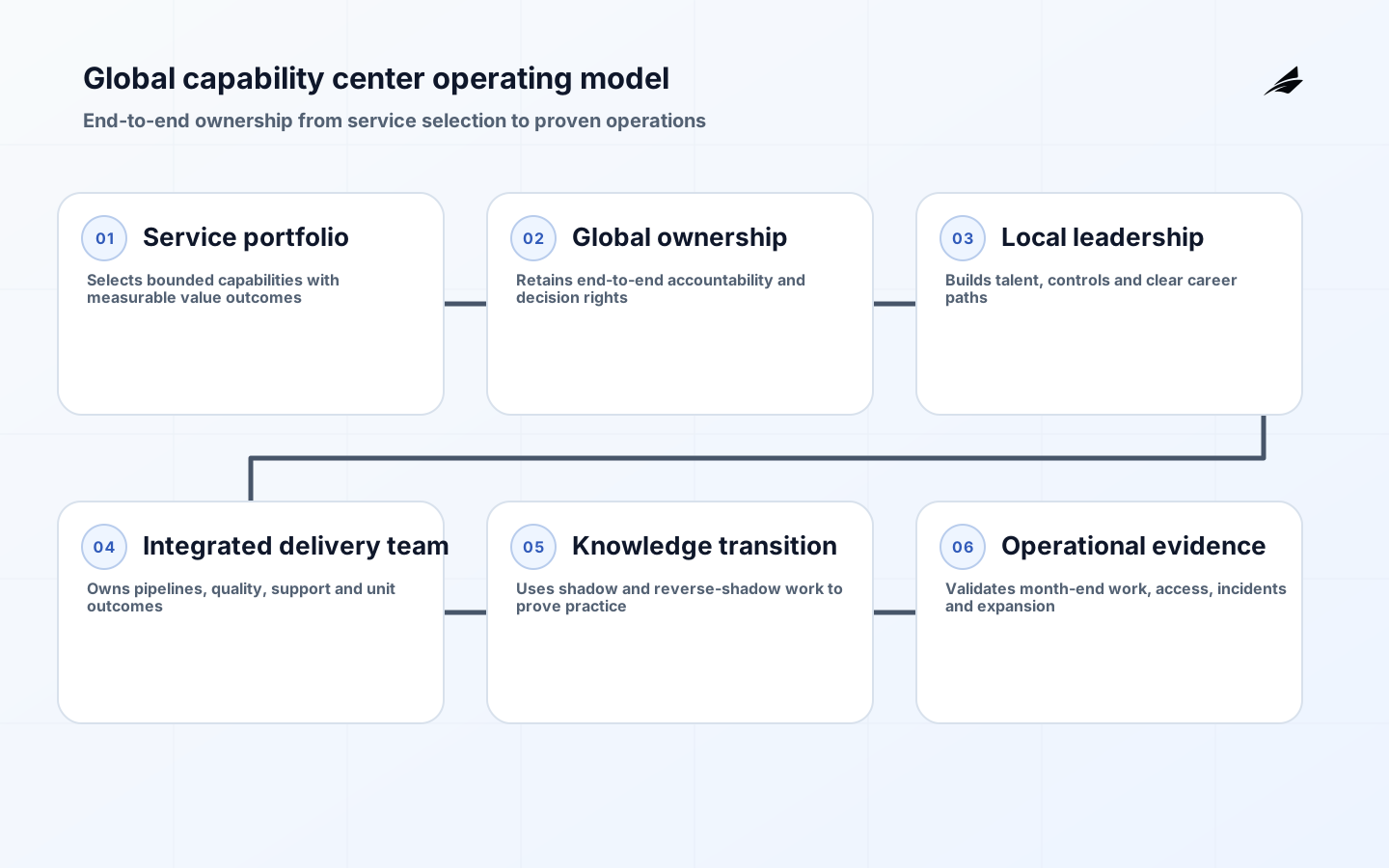
A global capability center should be planned as an operating capability, not a procurement label. The objective is durable business capabilities with accountable global ownership and strong local leadership. A credible initiative connects business ownership, design, controls, people, transition and measures before broad rollout. It also states what will not change, because a clear boundary protects teams from uncontrolled scope and makes acceptance possible.
Define the service and its boundary
Map the end-to-end scope across service portfolio, entity, location, talent, governance, process, technology, data, tax, employment, suppliers, continuity and transition. Start with priority journeys and name the accountable outcome owner. Describe demand, current failure modes, manual work, dependencies and obligations. Validate the inventory with people who perform and support the work; repositories and contracts rarely capture exceptions or informal handoffs.
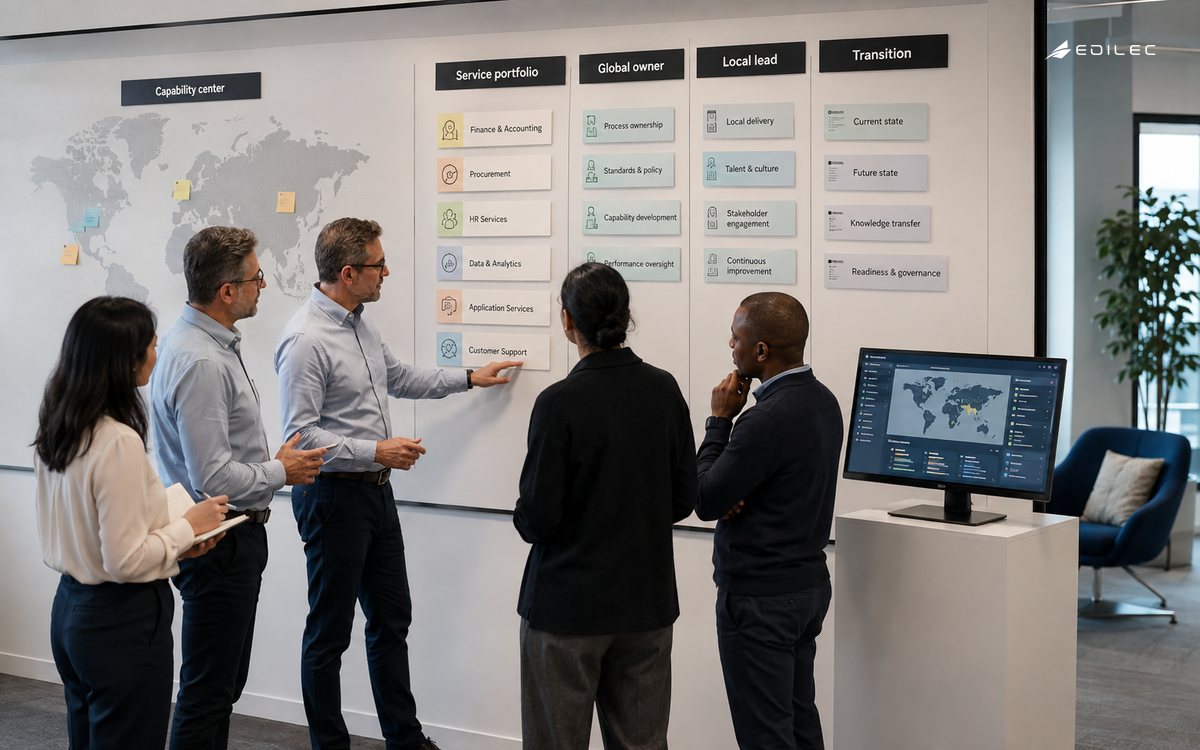
For each capability moving to the center, define the global service owner, local delivery leader, retained-team responsibilities, decision rights, inputs, outputs, controls and service calendar. Identify work that must remain near customers, regulators or source systems. Begin with a coherent product or process whose knowledge transfer and outcomes can be accepted end to end.
| Scope area | Decision | Evidence |
|---|---|---|
| Outcome | What result must improve? | Baseline, owner and acceptance measure |
| Workflow | Which normal and exception paths are included? | Journey and exception map |
| Information | Which records are authoritative and sensitive? | Classification, lineage and retention |
| Technology | Which components and providers participate? | Dependency and interface inventory |
| Controls | Which requirements must remain effective? | Control owner, test and evidence |
| Operation | Who supports, recovers and improves it? | Runbook, roles and service objectives |
Turn requirements into an operable design
Design the center as part of an end-to-end operating model, not a distant task pool. Define decision rights, service ownership, product or process boundaries, funding, demand intake, controls, career paths and retained-team collaboration. Obtain qualified legal, tax, labor and privacy advice.
A global capability center needs operational resilience across locations, people and shared technology. Define coverage during local holidays, network or facility disruption, leadership absence and supplier failure. Apply role-based access, segregate sensitive duties, and provide secure collaboration and alternate work arrangements. Avoid creating a single location that quietly becomes the only holder of critical knowledge.
Build a cost model from measurable drivers
A universal price would be misleading. Material cost drivers include entity setup, facilities, talent, recruiting, compensation, technology, travel, transition, duplicated roles, advisors, compliance, leadership and attrition. Estimate a range from observed scope and expose assumptions. Discovery should reduce the largest uncertainties before a fixed commitment. Compare options across transition and useful operation, not only the implementation quote.
| Cost group | Include | Control question |
|---|---|---|
| Discovery | Observation, inventory and design | Which unknowns change the approach? |
| Delivery | Build, integration and environments | What is reusable or custom? |
| Assurance | Security, testing and remediation | What evidence is required? |
| Transition | Migration, training and parallel work | How long will coexistence last? |
| Operation | Consumption, licenses, people and suppliers | Who owns demand and unit economics? |
| Exit | Export, replacement and decommission | Can continuity survive departure? |
Separate entity and launch costs from recurring compensation, facilities, technology, travel, learning, compliance and leadership. Include retained-team time, duplicate staffing during transition, recruiting lead time, advisors and attrition replacement. Reforecast after the first capability reveals actual role mix, management span, collaboration demand and the time required for independent service ownership.
A bounded example
A company can begin with a finance-data product rather than moving a reporting department. A global owner retains metric accountability; the center forms a team for pipelines, quality and support; source owners stay engaged. A shadow period proves month-end operations, access and incidents before expansion.
Baseline current service quality, cycle time, control performance, stakeholder effort, talent depth and total cost before transition. For the finance-data product, track data freshness, reconciliation exceptions, month-end support, issue resolution and ownership decisions. Compare end-to-end outcomes, because local productivity can improve while global handoffs or retained-team workload deteriorate.
Manage risks as delivery inputs
| Risk | Early signal | Practical treatment |
|---|---|---|
| Cost-only mandate | Savings dominate quality | Set service, talent and value outcomes |
| Fragmented ownership | No end-to-end owner | Assign service ownership |
| Knowledge loss | Documents replace practice | Use shadow and reverse shadow |
| Talent ceiling | Roles lack growth | Build expert and leadership paths |
| Legal or tax error | Model outruns advice | Complete jurisdiction review |
| Cultural distance | Decisions slow | Define rights and collaboration norms |
Assign transition, control, talent, tax, privacy and continuity risks to global and local leaders with authority to act. Use triggers such as failed service cycles, unresolved access conflicts, excessive regretted attrition or persistent retained-team intervention. Pause migration when knowledge or controls are not ready, rather than transferring accountability to meet a staffing date.
A staged implementation plan
- Frame: confirm owner, outcome, boundaries, obligations, risk tolerance and funding.
- Discover: observe work; inventory data, systems, providers, controls, demand and failures.
- Design: select architecture, roles, security, recovery, migration and acceptance together.
- Prove: build a representative slice and test the hardest dependency, control and failure.
- Pilot: limit exposure while increasing monitoring, support and feedback.
- Expand: add waves only while quality, risk, operations and cost remain within thresholds.
- Retire: remove obsolete access, jobs, copies, contracts and procedures after verification.
A capability gate should prove knowledge and ownership, not seat count. Move from observation to shadow delivery, supervised execution and reverse shadowing across representative cycles and exceptions. Expand after service owners accept quality, controls and continuity. Retire duplicate roles or supplier arrangements only when responsibility, records and access have transferred cleanly.
Weight location evidence across talent, language, time zones, infrastructure, resilience, legal fit, leadership, travel and total cost; city conditions matter.
Choose captive, provider, build-operate-transfer or hybrid models by accountability, control, speed and exit, not by label alone.
Capture tacit work through observation, supervised execution and reverse shadowing; accept transition after successful service cycles and exceptions.
Give teams meaningful ownership, customer access and career paths; measure learning and mobility because second-class work design becomes delivery risk.
Location analysis should compare cities using current evidence on skill depth, leadership supply, language, time-zone overlap, infrastructure, resilience, travel, legal fit and total cost. Test hiring assumptions with real role profiles. National averages can conceal the local competition and commute patterns that determine whether a center can retain specialized teams.
Choose captive, provider, build-operate-transfer or hybrid arrangements by the desired control, speed, capability ownership and exit path. Write down which entity employs staff, owns intellectual property, controls data, manages performance and carries service risk. A hybrid model fails when these responsibilities fall between contracts and internal structures.
Transfer pricing, permanent-establishment, employment, privacy and sector rules require qualified jurisdiction-specific advice. Align contracts and operating behavior with the documented model; labels alone do not determine treatment. Review arrangements as the center takes on higher-value decisions, intellectual property or cross-border services because the original analysis may no longer fit.
Career architecture is part of service design. Define expert and leadership paths, learning time, mobility, succession and exposure to global customers and decisions. A center limited to fragmented execution may meet an initial cost case yet struggle to retain people who can own architecture, products or complex business judgment.
Collaboration should be designed around decisions and work artifacts, not continuous meetings. Set overlap hours, asynchronous records, escalation routes and periodic in-person work where it adds value. Measure decision latency and handoff defects. Time-zone distribution can extend coverage, but only when ownership remains clear across the boundary.
Make governance, acceptance and adoption practical
Govern the center through global business owners, local leadership, finance, people, technology, security, privacy, tax and legal specialists. Product and service forums should make day-to-day decisions close to the teams, while enterprise governance resolves portfolio, entity and risk matters. Record decision rights to prevent every issue bouncing between headquarters and the center.
Acceptance requires the center to deliver a complete service cycle, handle exceptions, operate controls, support stakeholders and recover from disruption with reduced supervision. Test month-end, peak demand or another consequential period. Confirm retained teams have stopped performing hidden duplicate work before declaring the capability transferred.
Change affects both sending and receiving organizations. Retained teams need future roles and decision responsibilities; center teams need access to customers, context and career paths. Use observation, paired delivery and reverse shadowing rather than document handoff alone. Monitor meeting load, escalation delay and informal rework as signs that the operating model remains incomplete.
Key takeaways
- Anchor a global capability center in an accountable outcome and bounded first service.
- Map authoritative records, decisions, dependencies and failure behavior first.
- Estimate assurance, transition, operation and exit with implementation.
- Use a representative proof and limited pilot to turn assumptions into evidence.
- Scale through explicit gates while retaining ownership of risk, quality and economics.
Frequently asked questions
Where should planning start?
Start with the business capability portfolio, not a location announcement. Select one coherent service with an accountable global owner, repeatable demand, available subject-matter experts and manageable regulatory constraints. Define why the center should own it and what expertise should deepen locally, then test the model through a complete operating cycle.
How should cost be estimated?
Estimate a global capability center from entity and facility setup, recruiting, compensation, leadership, technology, advisors, travel, learning, transition overlap and continuing compliance. Model role mix and hiring sequence rather than multiplying headcount by an average rate. Reforecast after early hiring and transfer reveal market availability, productivity and retained-team effort.
What should be checked when using a provider?
Evaluate providers or build-operate-transfer partners for hiring quality, employment practices, data and access controls, service governance, subcontractors, knowledge retention, commercial transparency and transfer or exit. Meet the proposed local leaders, inspect delivery conditions and test ownership of a real service slice instead of relying on a polished location presentation.
How long should implementation take?
Timing depends on entity choices, location, leadership hiring, workplace and technology readiness, regulatory review, talent availability and knowledge-transfer cycles. Establishing a team is faster than establishing independent capability. Sequence hiring around experienced leaders and subject experts, and allow at least one representative business cycle before accepting complex operational ownership.
What proves success?
Success means the center owns durable capabilities that improve enterprise outcomes and create a credible talent institution. Track service quality, cycle time, control effectiveness, stakeholder confidence, innovation or improvement, retention, internal mobility, succession, continuity and total cost. Headcount growth and labor-rate difference are inputs, not proof of capability.
Conclusion
A professional plan for a global capability center makes ownership, boundaries, design, controls, economics and transition visible. It replaces broad promises with a representative proof, measurable acceptance and reversible rollout. This exposes uncertainty early enough to make informed decisions while changing direction is still manageable.