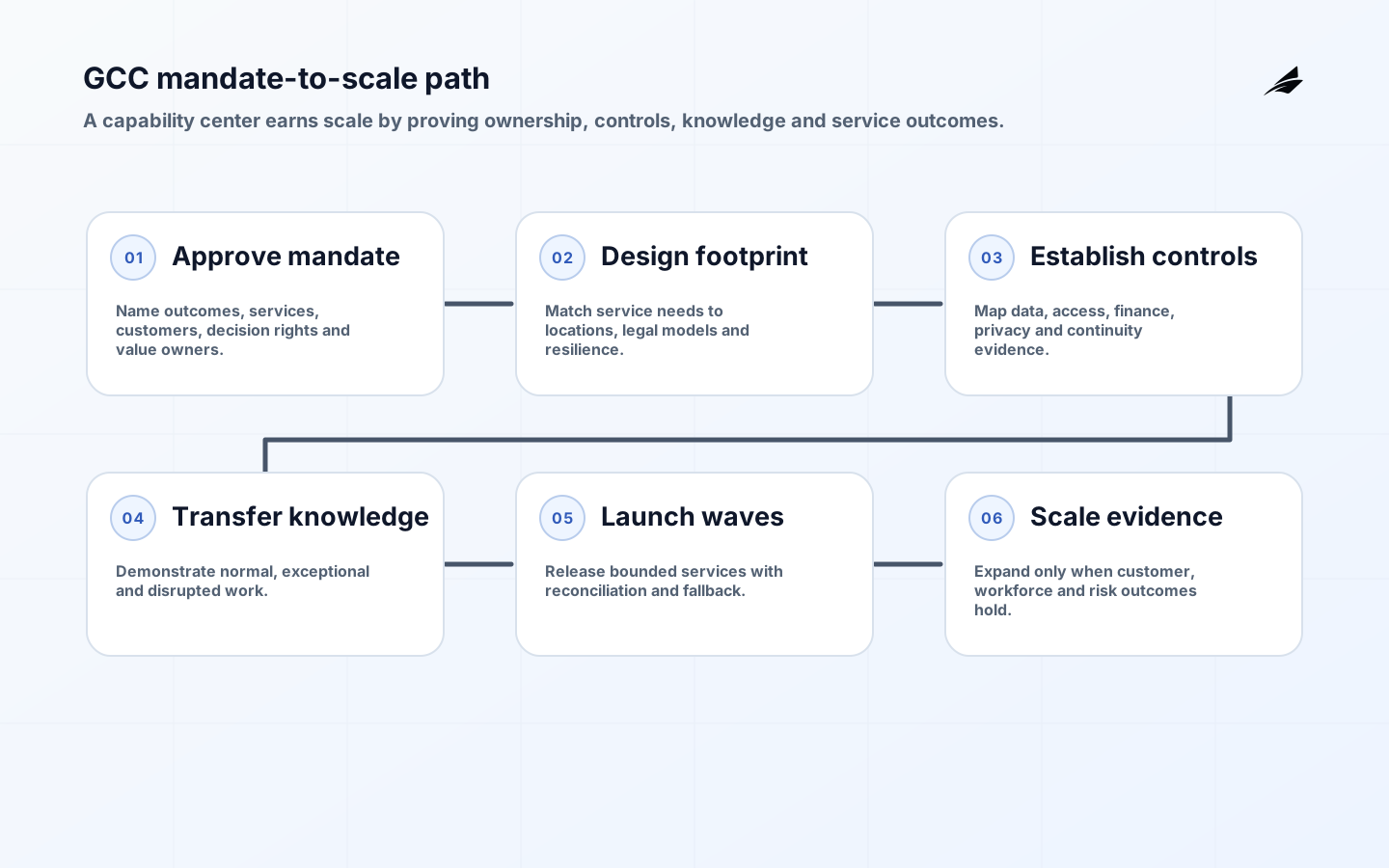
A global capability center implementation checklist should begin with enterprise accountability, not office space or hiring targets. A GCC is a company-owned operation that concentrates capabilities such as engineering, data, finance, procurement, cybersecurity or customer operations in one or more locations. It creates value when the center owns durable outcomes, develops scarce expertise and improves the global operating model. It disappoints when work is transferred without decision rights, process redesign, knowledge continuity or a defensible service relationship.
This checklist turns that distinction into release evidence. It complements the global capability center planning guide, the GCC FAQ and the data and AI services checklist. Tax, employment, privacy, export-control and sector rules vary by country and service, so local specialists must confirm the final design.
1. Approve the GCC mandate and value case
Write a one-page mandate naming the business outcomes, services, customers, geographic coverage and decisions the center will own. Distinguish a cost-focused shared service from a capability hub, product engineering center or global process owner; each needs different leadership and measures. State what remains with business units, what can be standardized and which regulated decisions cannot move. Obtain named executive sponsorship from both the enterprise function and the host location.
Build the value case from a service baseline, not salary comparisons. Include transition overlap, leadership, recruitment, facilities, tooling, connectivity, travel, retention, controls, vendor exits, taxes and currency exposure. Quantify benefits such as faster product delivery, extended service coverage, consolidated controls, better data quality and reduced external dependency. Assign each benefit an owner, baseline, measurement method and date. Scenario-test slower hiring, higher attrition, delayed approvals and demand below plan.
| Mandate decision | Evidence before approval | Owner | Stop condition |
|---|---|---|---|
| Service portfolio | Volume, complexity, controls and dependency map | Global function leader | Work lacks a stable owner or measurable outcome |
| Location | Talent, resilience, legal, tax and infrastructure assessment | Executive sponsor | Critical role supply or continuity is unproven |
| Value case | Fully loaded baseline and three scenarios | Finance partner | Savings require unsafe staffing or hidden costs |
| Governance | Decision rights and escalation charter | GCC leader | Center is accountable without authority |
2. Design services and select locations together
Decompose work into services with consumers, demand units, outcomes, inputs, controls and interfaces. A label such as analytics or application support is too broad for transition planning. For each service, identify judgment intensity, language and time-zone needs, data sensitivity, peak patterns, upstream dependencies and recoverability. Group work where shared expertise or workflow creates a real advantage; do not centralize merely because activities share an organizational chart.
Assess locations against the actual role mix. Compare graduate pipeline and experienced talent, language, labor law, compensation volatility, transport, power and telecom resilience, security, disaster exposure, data-transfer constraints and leadership accessibility. A two-location design can improve resilience but adds duplicated leadership and handoffs. Document whether each site is a primary hub, specialist node or recovery location, and test whether the enterprise can operate if one location is unavailable.
Define the legal and commercial model before transferring work. The OECD transfer-pricing guidance addresses whether an intra-group service was rendered, the benefit received and arm's-length charging; finance and tax teams should document service recipients, cost pools, allocation keys and markups where applicable. Record ownership of intellectual property, inventions, software repositories and work products. Align employment, contractor, immigration and works-council obligations with the staffing model rather than treating them as post-launch paperwork.
3. Establish data, security and operational controls
Classify every service by the data and systems it uses. Map personal, financial, health, customer, employee, source-code and controlled technical data from origin through access, transfer, storage, support and deletion. For India-based operations, determine how the Digital Personal Data Protection Act and applicable rules affect processing roles, notices, safeguards, rights handling and breach response. Other locations require their own analysis. Contract wording does not replace a tested operational flow.

Use the NIST Cybersecurity Framework functions to structure governance, asset understanding, protection, detection, response and recovery. Implement role-based access tied to service assignments, strong authentication, managed endpoints, secrets controls, repository protection, export monitoring and time-bound privileged access. Log sensitive reads and changes without copying unnecessary personal data into telemetry. Exercise account removal, role transfer, emergency access and third-party termination before accepting production work.
Create a service control matrix that connects each obligation to a control owner, procedure, evidence and test frequency. Include financial approvals, segregation of duties, records retention, quality review, continuity, complaints and regulatory reporting as well as cyber controls. The NIST Privacy Framework is useful for linking data processing to organizational privacy risk. Internal audit, legal and business control owners should review the matrix before the first transition wave.
4. Build leadership, talent and knowledge transfer
Hire the leadership spine before volume roles: a center leader, service owners, people leader, finance partner, technology and security leads, and transition authority. Define which leaders report locally, functionally or both, and how conflicts are resolved. Create role families, levels and career paths that allow specialists to progress without becoming managers. Workforce planning should include learning time, leave, attrition buffers, succession and scarce-role concentration, not just productive headcount.
Plan knowledge transfer around demonstrated tasks. Inventory procedures, systems, tacit decisions, contacts, calendars and exception history. Use observe, perform-with-support, perform-independently and teach-back stages. Sample normal cases, month-end peaks, high-risk exceptions and disrupted conditions. Measure accuracy and decision quality rather than training attendance. The International Labour Organization's research on remote service work is also a reminder to assess schedules, voice intensity, surveillance, workload and worker voice as operating-quality concerns.
| Transition gate | Required evidence | Acceptance test | Fallback |
|---|---|---|---|
| Ready to learn | Current process, controls and case inventory | Source and destination agree scope | Keep work at source |
| Ready to shadow | Access, safe test data and trained roles | Representative cases completed together | Extend paired operation |
| Ready to perform | Runbooks, authority and support channels | Independent cases meet quality threshold | Route exceptions to source |
| Ready to own | Stable metrics, reconciliation and continuity test | Service owner signs operational acceptance | Pause volume or reverse wave |
5. Launch in waves and scale from evidence
Sequence waves by dependency and risk, not only by organizational convenience. Start with a coherent service slice whose demand and exceptions are understood. Run parallel controls where errors would affect customers, statutory reporting, payroll, financial close or production systems. Establish a launch command structure, daily review, issue severity definitions and authority to pause. Reconcile queues, balances, permissions and outstanding exceptions at every handoff.
Use a balanced scorecard: customer outcome and satisfaction; cycle time and backlog age; first-time-right quality; control exceptions; employee retention and internal mobility; automation and reuse; cost per demand unit; and continuity performance. Segment by service and cohort. Do not reward ticket closure that shifts effort to customers or source teams. Scale only after performance is stable through a representative peak and critical control evidence is complete.
Readiness review before the next GCC wave
- Review actual cases, queue age, corrections, access exceptions, overtime and unresolved source-team help with customers and both delivery teams. Compare observed demand with staffing, cost and control assumptions; a green status meeting can conceal operational dependence on informal messages.
- Record expand, hold or reverse by service, with named defects, dates and temporary controls. Strong low-risk work must not mask a fragile high-risk transfer. This gives the center a credible route to request investment instead of absorbing work beyond its authority or capacity.
- Ask staff to demonstrate a peak, exception and outage without prompts from the source team. Reconcile records afterward and verify that escalation reaches an accountable decision maker. Repeat the review after material scope, location, supplier or regulatory change.
The readiness pack should include the service catalog, demand forecast, role coverage, control samples, access review, continuity result, customer feedback and financial reconciliation. Keep evidence at service level and identify who accepted each residual issue. This makes a later scale decision reproducible instead of dependent on executive memory.
Key takeaways
- Give the center an explicit enterprise mandate, service outcomes and decision rights.
- Choose locations from the required capabilities, controls and resilience profile, not labor cost alone.
- Document intra-group services, data flows, intellectual property and control evidence before transfer.
- Accept knowledge transfer through observed performance on normal, exceptional and disrupted work.
- Scale by service outcomes, workforce health and control stability rather than headcount milestones.
Frequently asked questions
How large should the first GCC wave be?
Large enough to exercise one end-to-end service, but small enough to retain source-team fallback and close defects quickly. A headcount target is not a safe sizing method. Use transaction volume, case diversity, role coverage, peak demand and exception frequency to define the wave, then set expansion gates.
Should a company use a captive center or a service provider?
A captive model supports direct control, capability building and product ownership but requires management depth and patient investment. Providers can add speed, flexible capacity and established operations. Hybrid arrangements are common. Compare strategic importance, knowledge sensitivity, demand variability, control needs and exit portability service by service.
When is a GCC ready to scale?
When service outcomes and controls remain stable under representative demand, leaders can resolve exceptions without informal source-team intervention, key roles have succession, and the continuity path has been exercised. Savings alone do not establish readiness. The executive sponsor should sign a gate using the evidence defined before transition began.
Conclusion
A global capability center becomes strategic through ownership and repeatable evidence. Approve a clear mandate, design services and locations as one system, establish legal and operational controls, transfer knowledge by demonstration and scale only when customer, workforce and risk outcomes hold. That sequence creates a center that can deepen capability instead of simply moving work.