An edge dashboard places data processing and visualization near the equipment, facility or users that need it. It is useful when a cloud-only screen would be too slow, unavailable during a network interruption, or inappropriate for data that must remain on site. The business case is not simply a faster chart. It is continuity of a defined operational decision while connectivity, bandwidth and device conditions vary.
Enterprise teams should begin with the decision the dashboard supports: acknowledge an alarm, compare a line with its normal range, confirm that a cold room remains compliant, or prioritize maintenance. That decision determines freshness, history, access, retention and failure behavior. A screen that cannot explain whether a value is live, delayed or reconstructed can create more risk than having no screen.
Start with the operating decision
Interview the people who act on the information, including shift supervisors, technicians, quality staff and site IT. Observe the current handoff rather than relying only on a workshop. Record the question asked, evidence consulted, time available, authorized action and escalation path. Separate monitoring from control: a dashboard may show a condition without being permitted to change equipment.
| Decision question | Required context | Design implication |
|---|---|---|
| Is the process within its approved range? | Current value, engineering unit, threshold, asset state and data age | Keep state and freshness visible beside the value; do not encode status by color alone. |
| Which asset needs attention first? | Severity, duration, production context, acknowledgement and ownership | Provide a sortable exception view with stable asset identifiers. |
| Did the condition begin before connectivity failed? | Edge and source timestamps, quality flag and buffered history | Preserve event time and distinguish it from receipt or display time. |
| Can the user act now? | Role, procedure, interlock state and escalation contact | Make authority explicit and keep control functions behind separate safeguards. |
Define success with observable workflow measures, not a count of panels. Useful measures include time from a qualifying condition to acknowledgement, percentage of displayed points with valid quality and freshness, duration of offline visibility, reconciliation exceptions after reconnect, and completion of the intended task. Baseline the current workflow before choosing targets.
Design the edge-to-cloud information path
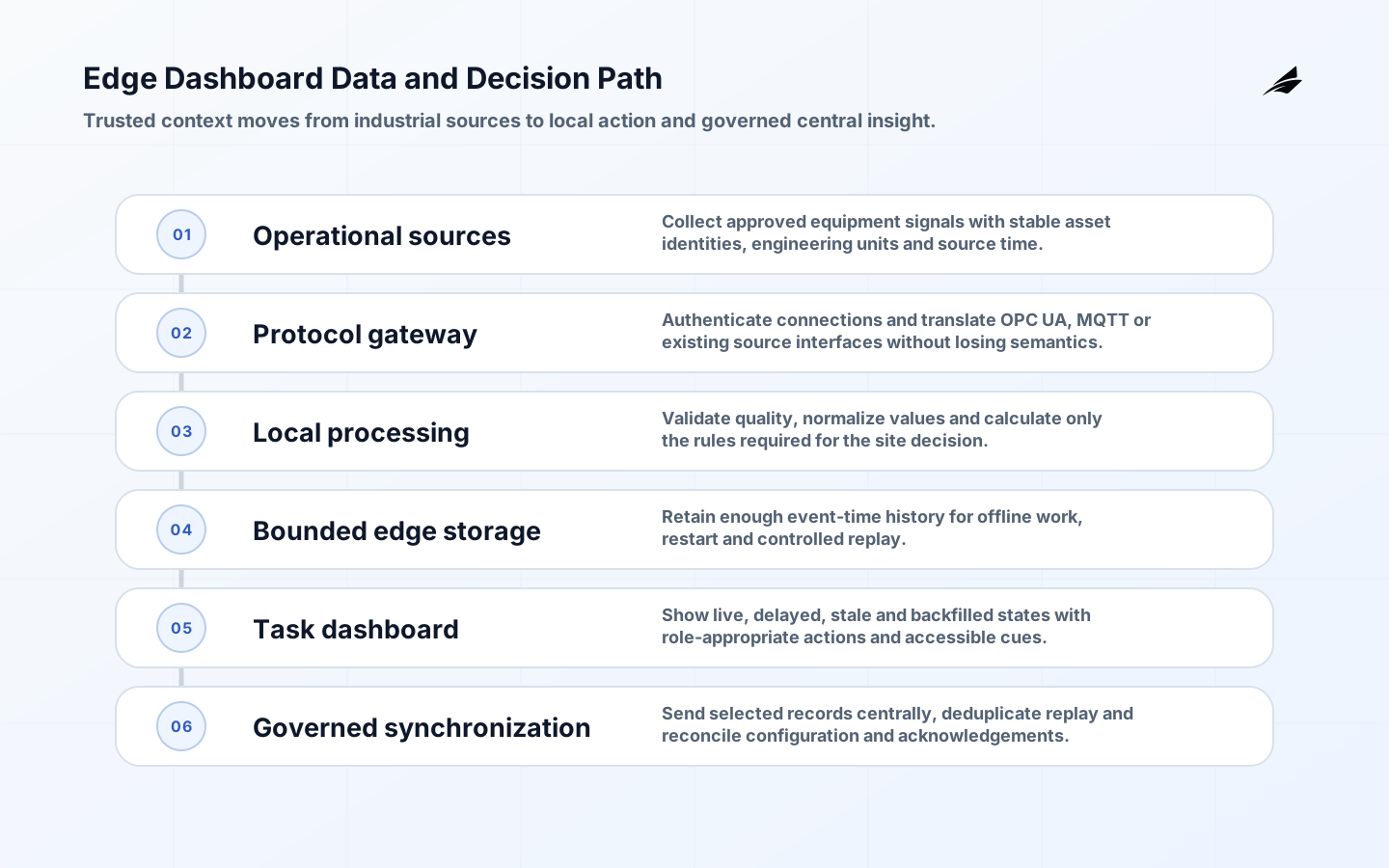
A common path begins with sensors, programmable controllers or existing historians; passes through a protocol adapter or gateway; applies validation, normalization and local calculation; stores a bounded history; and serves a local dashboard. Selected data can then synchronize to central services for fleet analysis and longer retention. OPC UA or MQTT may be appropriate in some environments, but protocol selection must follow the equipment, semantics, security and support model.
Treat timestamps, units and quality as part of the data contract. Source time shows when the equipment observed the event; edge receipt time helps diagnose transport delay; cloud receipt time supports synchronization analysis. A value without its unit, asset identity and quality state is not safely interpretable. Define behavior for out-of-order samples, duplicate messages, clock drift, missing points and recalculated aggregates.
| Layer | Owned decision | Evidence before release |
|---|---|---|
| Source and protocol | Which signals are authoritative and how are they named? | Approved tag map, units, sample behavior and simulated source cases. |
| Edge processing | Which validation, aggregation and rules run locally? | Versioned configuration, resource budget and deterministic test results. |
| Local storage | How much history survives disconnection and restart? | Capacity model, retention rule, disk-pressure behavior and recovery test. |
| Dashboard | Which roles see which sites, assets and actions? | Task-based usability test, accessibility review and authorization tests. |
| Synchronization | What moves centrally, when, and with what conflict rule? | Reconnect rehearsal, deduplication evidence and reconciliation report. |
| Operations | Who patches, monitors, supports and replaces each node? | Inventory, runbook, alert ownership and tested restore procedure. |
Make offline behavior explicit
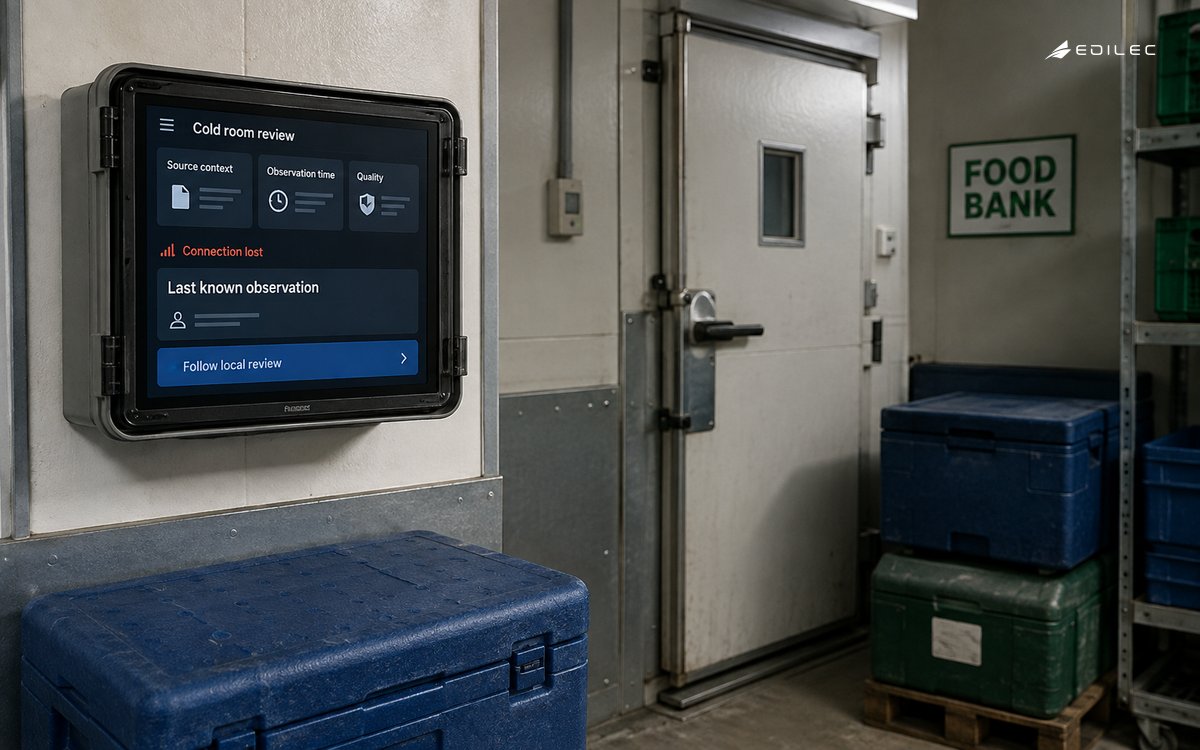
Offline operation is a mode to design, not an edge case. Microsoft documents that IoT Edge can store upstream messages and resynchronize after connectivity returns, but retention still depends on configured time to live and available disk. The dashboard must state which functions continue locally, how long history is retained, what happens under storage pressure and which identity decisions remain valid without contacting a central service.
Choose a deterministic reconnect policy. Buffered records should keep source identity and event time, and replay should not produce duplicate business events. Configuration changes made centrally while a site is disconnected need precedence rules. If a local operator acknowledges an alarm while offline, the system must preserve who acted, when they acted and how that action merges with central state.
Build a calm, task-focused dashboard
Use an overview for orientation, an exception list for prioritization and a detail view for investigation. Keep labels, units, time windows and threshold meanings consistent. Show the normal range and the reason for status, not only a large number. Provide tabular access to the same critical information when a chart is difficult to interpret or export.
WCAG 2.2 applies to dashboards on browsers, tablets and kiosks. Support keyboard operation, visible focus, text alternatives, sufficient contrast, reflow where applicable and status cues beyond color. Test in the actual lighting, distance and input conditions of the site. A design that works on a designer's monitor may fail on a gloved touchscreen beside vibrating equipment.
- Use the minimum refresh rate that supports the decision; faster is not automatically more accurate.
- Label simulated, calculated, estimated and measured values differently.
- Keep alarm acknowledgement separate from equipment control and record the actor.
- Provide a stable asset hierarchy and search terms that match site language.
- Show local time zone, event time and current dashboard time without ambiguity.
- Limit high-cardinality filters and unbounded queries that could exhaust an edge node.
Secure and manage the full node lifecycle
The NIST IoT baseline covers device identification, secure configuration, data protection, logical access to interfaces, secure software update and cybersecurity state awareness. Translate those capabilities into procurement and acceptance criteria. Each node needs an inventory identity, supported operating system, protected secrets, least-privilege service account, signed or otherwise verified updates, audit events and a retirement procedure.
Separate operational technology networks according to the organization's risk design. Do not assume a device is trusted because it is physically inside a facility. Restrict inbound administration, authenticate machine connections, encrypt where supported and monitor configuration drift. Remote support should be time-bounded, attributable and reviewed. Define who can export data and whether exports contain sensitive production or personnel information.
Example: a packaging-line exception dashboard
Consider a packaging site that currently phones a supervisor when repeated seal-temperature deviations occur. The first release need not model the entire plant. It can ingest approved temperature, line-state and product-code signals; calculate a bounded deviation condition locally; show current and recent state to the supervisor; and record acknowledgement. The cloud receives summarized events and configuration versions when connected.
The proof should deliberately disconnect the site, restart the gateway and fill local storage toward its warning threshold. Review whether the screen clearly marks data age, preserves acknowledgements, replays events once, and reconciles the local and central views. The dashboard remains advisory; existing safety and machine control systems retain authority.
Risks and practical controls
| Risk | Control | Early signal |
|---|---|---|
| Incorrect asset mapping | Approve a versioned asset and tag dictionary with site owners | Values appear plausible but disagree with local instruments or historian views. |
| Stale data mistaken for normal operation | Visible freshness states and stale-data alarms | Long display age while status remains reassuring. |
| Edge resource exhaustion | Bound queries, retention and cardinality; monitor disk, memory and queue depth | Growing queues, slow panels or dropped samples. |
| Cross-site access | Site-scoped authorization and negative access tests | A user can enumerate or query an unrelated site. |
| Configuration drift | Signed versioned configuration with fleet inventory and rollback | Sites report different rules without an approved exception. |
| Unsafe coupling to control | Separate dashboard and control authority; require independent safety review | A visualization service credential can write to equipment. |
Roll out through evidence gates
- Frame: name the decision, business owner, site owner, users, data sensitivity and non-goals.
- Discover: map sources, protocols, timestamps, units, quality, network conditions and current escalation.
- Prototype: test information hierarchy with representative users and recorded or simulated data.
- Prove at one site: run offline, reconnect, restart, storage-pressure, authorization and accessibility scenarios.
- Expand by site cohort: standardize deployment while recording approved local differences and support readiness.
- Operate and improve: review freshness, task outcomes, incidents, patch status, resource headroom and reconciliation exceptions.
A site should not enter the next wave merely because installation completed. Require named support ownership, current inventory, tested rollback, local operating instructions, recovery evidence and acceptance by the people who use the dashboard. Keep a route back to the prior workflow until the new path has demonstrated dependable behavior across normal and disrupted conditions.
Key takeaways
- Design an edge dashboard around a time-sensitive operating decision, not around available telemetry.
- Carry asset identity, units, quality and multiple relevant timestamps through the complete data path.
- Treat offline storage, stale states, reconnect and reconciliation as first-class requirements.
- Apply accessibility, least privilege, secure updates and lifecycle ownership to every deployed node.
- Scale site by site only after usability, security, recovery and operational evidence is complete.
Frequently asked questions
Does an edge dashboard replace a cloud dashboard?
Usually not. Local views support immediate site decisions and continuity, while central views support cross-site comparison, governance and longer retention. Define which view is authoritative for each record and how synchronization affects freshness.
How real-time should the dashboard be?
As real-time as the decision requires and the source can truthfully support. Specify an acceptable age and update interval per signal class. A rapidly refreshing display of delayed source data is still delayed.
Should we buy a dashboard product or build one?
Compare protocol support, offline behavior, access control, accessibility, deployment automation, data portability and lifecycle support against the workflow. Custom development is justified only where the decision model or integration cannot be met responsibly through configured products.
How much data should remain at the edge?
Enough to support the offline decision, investigation and reconciliation window, with headroom and defined pressure behavior. Derive capacity from sample rates, record size, outage assumptions and retention policy, then test the calculation under realistic load.
Conclusion
Edge dashboard development succeeds when the enterprise can trust what the screen means during both normal and disrupted operation. A bounded first use case, explicit data semantics, visible freshness, secure lifecycle and site-based evidence gates create a foundation that can expand without turning every facility into a unique software estate.