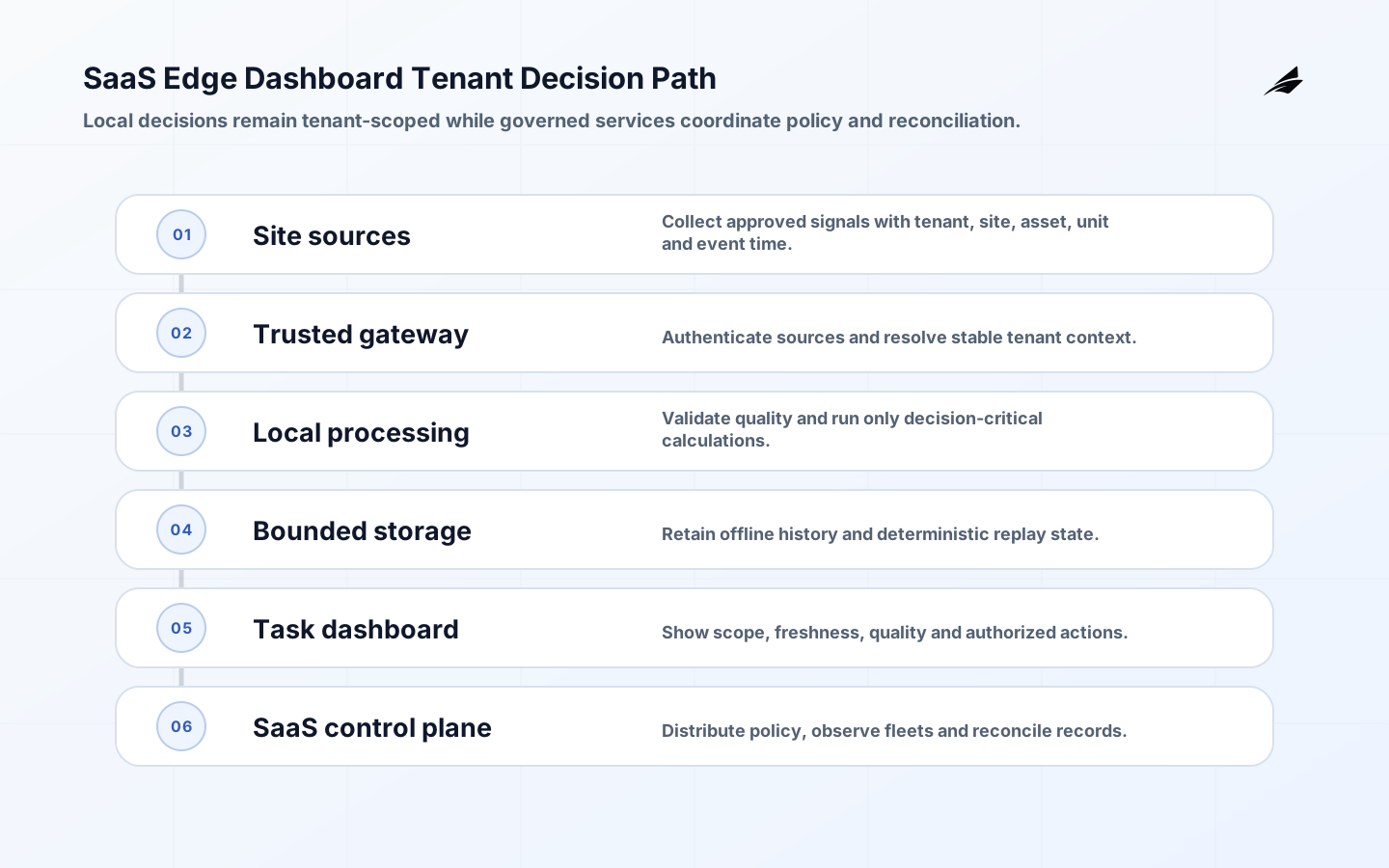
A SaaS edge dashboard is a local or near-source decision surface connected to a centrally operated, multi-tenant product. It can keep a site useful during a network interruption, reduce unnecessary upstream traffic, or expose conditions quickly near equipment and users. The hard part is not drawing charts. It is preserving tenant identity, event time, quality, authorization and support ownership while the same product runs across uneven sites and reconnects to shared services.
This guide treats edge dashboards for saas companies: tenant-aware architecture and delivery guide as a set of decisions that can be reviewed and tested. The aim is not to prescribe one vendor or promise a universal result. It is to help business and technical owners define boundaries, preserve evidence, expose failure behavior and decide when the work is ready to expand.
Define the decision before the display
Name the operator, the decision they must make, the evidence they need, and the maximum acceptable age of that evidence. Separate site operations from SaaS fleet administration so a local user sees only the actions appropriate to that tenant and site.
Approve a short decision contract covering source signals, freshness classes, local actions, escalation, offline duration and the central record that wins after reconciliation.
| Decision question | Required evidence | Acceptance condition |
|---|---|---|
| Can the site act while disconnected? | Local signals, policy cache, identity state and bounded history | The defined task completes and the screen declares offline status. |
| Is a value safe to interpret? | Asset, unit, event time, quality and freshness | Users can identify source context without opening another system. |
| Can central services trust replay? | Event identity, sequence, configuration version and receipt log | Duplicate delivery does not duplicate the business event. |
| Can one tenant affect another? | Isolation design, negative tests and scoped telemetry | Cross-tenant reads, writes and filters are denied and recorded. |
Rehearse the decision with recorded normal, stale, missing and contradictory samples; accept the design only when users can identify both the condition and the trust state.
Turn "Define the decision before the display" into a working control by naming one accountable owner, one maintained artifact and one review forum. The exit standard for this part of edge dashboards for saas companies: tenant-aware architecture and delivery guide is concrete: Rehearse the decision with recorded normal, stale, missing and contradictory samples; accept the design only when users can identify both the condition and the trust state. For this decision boundary, name the accountable owner, supporting evidence, exception route, and next measurable check.
Carry tenant context through the data contract
Treat tenant, site, asset, unit, event time, receipt time, quality and configuration version as inseparable context. A numeric value without these fields can be plausible yet assigned to the wrong customer or interpreted against the wrong threshold.
Define stable identifiers, retention boundaries, aggregation rules and allowed cross-tenant summaries. Resolve tenant context at trusted boundaries instead of accepting an arbitrary tenant value from a browser or device payload.
Use contract tests for unknown tenants, moved assets, delayed events, duplicate replay, clock skew and schema changes; review lineage from a dashboard value back to its approved source.
Turn "Carry tenant context through the data contract" into a working control by naming one accountable owner, one maintained artifact and one review forum. The exit standard for this part of edge dashboards for saas companies: tenant-aware architecture and delivery guide is concrete: Use contract tests for unknown tenants, moved assets, delayed events, duplicate replay, clock skew and schema changes; review lineage from a dashboard value back to its approved source. Within this data handoff, name the accountable owner, supporting evidence, exception route, and next measurable check.
Separate local decision services from the SaaS control plane
Keep acquisition, bounded processing, local storage and the task dashboard close to the site. Keep onboarding, policy distribution, fleet inventory, release coordination and tenant administration in the SaaS control plane, with explicit authenticated exchanges between them.
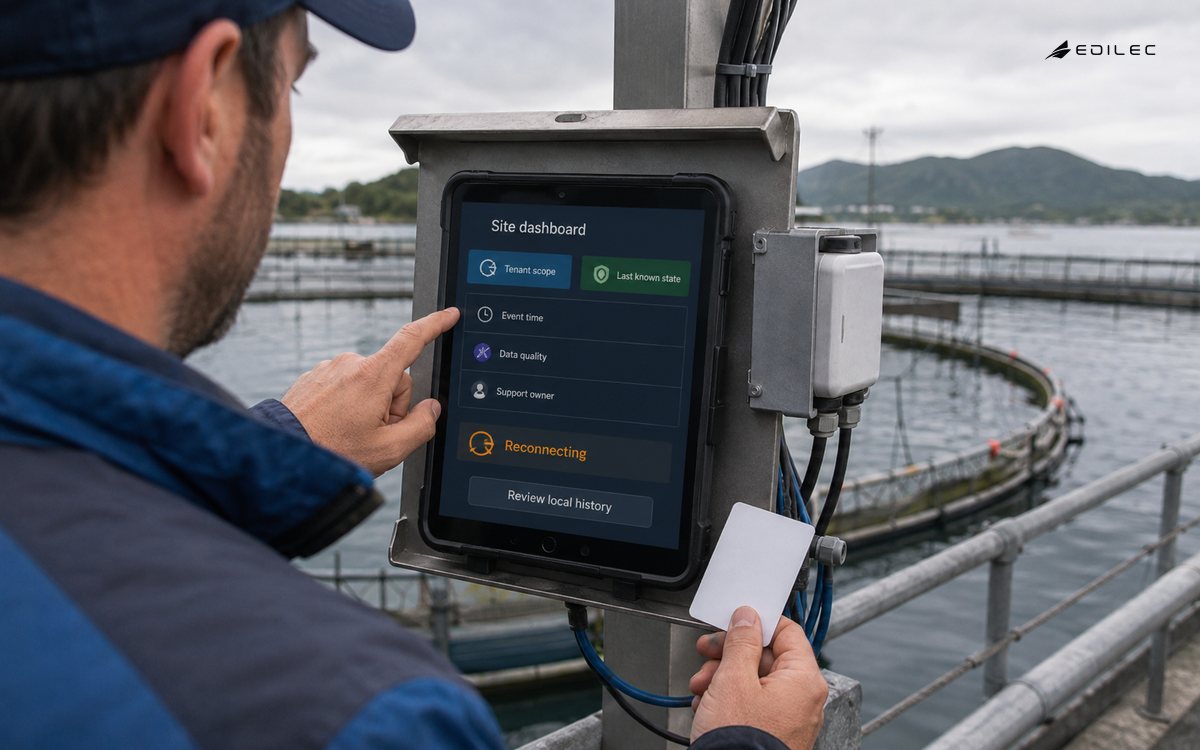
Choose which calculations must continue locally and which can wait for central connectivity. Bound queue depth, local retention, query cost and configuration cache, then specify degraded behavior when any limit is reached.
Turn "Separate local decision services from the SaaS control plane" into a working control by naming one accountable owner, one maintained artifact and one review forum. The exit standard for this part of edge dashboards for saas companies: tenant-aware architecture and delivery guide is concrete: Disconnect the site, restart services, exhaust a test storage allocation and rotate credentials. Evidence should show deterministic status, preserved event time, controlled replay and no accidental tenant crossover. When implementing this control, name the accountable owner, supporting evidence, exception route, and next measurable check.
Make freshness and scope visible in the interface
Display site, tenant, time zone, data age and quality next to the values they qualify. Use live, delayed, stale, unavailable and backfilled states, and never let reassuring color stand in for a current timestamp or a written status.
Organize the interface around overview, exceptions and investigation. Keep controls distinct from monitoring, provide accessible alternatives to charts, and prevent filters from silently broadening a user beyond their authorized tenant or site.
Run keyboard, zoom, contrast, responsive and screen-reader checks alongside task tests. Observe whether users can explain the selected scope, notice stale data and recover from an empty or partially synchronized view.
Turn "Make freshness and scope visible in the interface" into a working control by naming one accountable owner, one maintained artifact and one review forum. The exit standard for this part of edge dashboards for saas companies: tenant-aware architecture and delivery guide is concrete: Run keyboard, zoom, contrast, responsive and screen-reader checks alongside task tests. Observe whether users can explain the selected scope, notice stale data and recover from an empty or partially synchronized view. Before releasing this decision boundary, name the accountable owner, supporting evidence, exception route, and next measurable check.
Deliver one bounded site workflow first
Select a site with representative connectivity and an owner willing to operate the pilot. Begin with a few authoritative signals and one useful decision rather than importing every available tag or reproducing a central business-intelligence estate locally.
Plan discovery, prototype, site proof, limited cohort and expansion as evidence gates. Include deployment automation, inventory, rollback, local support contacts and configuration approval before adding more tenants or locations.
Compare task completion, freshness violations, reconciliation exceptions, support demand and edge resource headroom with the agreed baseline. Expansion requires stable operation across both connected and disconnected periods.
Turn "Deliver one bounded site workflow first" into a working control by naming one accountable owner, one maintained artifact and one review forum. The exit standard for this part of edge dashboards for saas companies: tenant-aware architecture and delivery guide is concrete: Compare task completion, freshness violations, reconciliation exceptions, support demand and edge resource headroom with the agreed baseline. Expansion requires stable operation across both connected and disconnected periods. While operating this workflow step, name the accountable owner, supporting evidence, exception route, and next measurable check.
| Stage | Evidence gate | Owner |
|---|---|---|
| Frame | Decision contract and tenant boundary | Product and site operations |
| Prototype | Task test with delayed and missing data | Design and data engineering |
| Site proof | Disconnect, restart, capacity and authorization results | Platform and security |
| Cohort rollout | Automated deployment, rollback and support readiness | SaaS operations |
| Operate | Freshness, reconciliation and resource review | Service owner |
Control the failure modes unique to edge SaaS
The dangerous failures are quiet ones: a stale value that looks current, an asset mapped to the wrong tenant, a replay counted twice, or a local policy that drifts from the approved version. These deserve product controls rather than informal operator memory.
Assign an owner to identity mapping, local capacity, release policy, cybersecurity, tenant support and reconciliation. Keep write authority separate from visualization unless a separate safety and control review explicitly permits it.
Review negative authorization tests, stale-state alarms, queue growth, rejected mappings, configuration drift and replay deduplication. A healthy dashboard reports its own uncertainty and operating limits.
Turn "Control the failure modes unique to edge SaaS" into a working control by naming one accountable owner, one maintained artifact and one review forum. The exit standard for this part of edge dashboards for saas companies: tenant-aware architecture and delivery guide is concrete: Review negative authorization tests, stale-state alarms, queue growth, rejected mappings, configuration drift and replay deduplication. A healthy dashboard reports its own uncertainty and operating limits. When changing this control, name the accountable owner, supporting evidence, exception route, and next measurable check.
Measure the decision path, not panel traffic
Page views and refresh counts reveal little about operational value. Measure whether intended users notice qualifying conditions, understand data age, take the correct authorized action, and leave an auditable record that survives synchronization.
Define measures with owners and review cadence: decision latency, valid-data coverage, stale display duration, reconciliation exceptions, deployment rollback rate, resource saturation and support cases by site cohort.
Keep tenant-level operational measures isolated while allowing governed fleet summaries. Investigate outliers with context rather than ranking customers on raw consumption that may reflect different contracts or workloads.
Turn "Measure the decision path, not panel traffic" into a working control by naming one accountable owner, one maintained artifact and one review forum. The exit standard for this part of edge dashboards for saas companies: tenant-aware architecture and delivery guide is concrete: Keep tenant-level operational measures isolated while allowing governed fleet summaries. Investigate outliers with context rather than ranking customers on raw consumption that may reflect different contracts or workloads. During support for this evaluation, name the accountable owner, supporting evidence, exception route, and next measurable check.
Key takeaways
- Anchor the dashboard in one local decision with an explicit freshness requirement.
- Preserve tenant and asset context through acquisition, storage, display and replay.
- Separate site decision services from SaaS control-plane administration.
- Test disconnection, restart, capacity pressure and negative tenant access before rollout.
- Scale by evidence-backed site cohorts and keep uncertainty visible to users.
Frequently asked questions
Does an edge dashboard replace central SaaS analytics?
No. The edge view supports a bounded local decision and continuity, while central analytics supports fleet comparison, governance and longer retention. Define which record is authoritative for each use and how synchronization changes its freshness.
How much history belongs at the edge?
Retain enough event-time history for the offline task, local investigation and reconciliation window, plus tested headroom. Capacity should come from measured record size and workload assumptions, with explicit behavior under pressure.
Should every tenant receive the same edge deployment?
Use a standard product baseline, then approve variations for source protocols, data residency, connectivity and support conditions. Variations need versioned configuration and ownership so customization does not become invisible product fragmentation.
Can the dashboard control equipment?
Visualization and control should remain separate by default. Any write path needs its own authorization, interlock, safety, audit and recovery analysis; a dashboard credential should never gain control authority by convenience.
Conclusion
A dependable SaaS edge dashboard is a distributed product boundary, not a small copy of a cloud dashboard. When tenant identity, data semantics, offline behavior and support ownership are designed together, the interface can remain honest during disruption and useful at scale. Start with one decision, prove the unpleasant states, and expand only when the evidence travels cleanly from site to control plane.