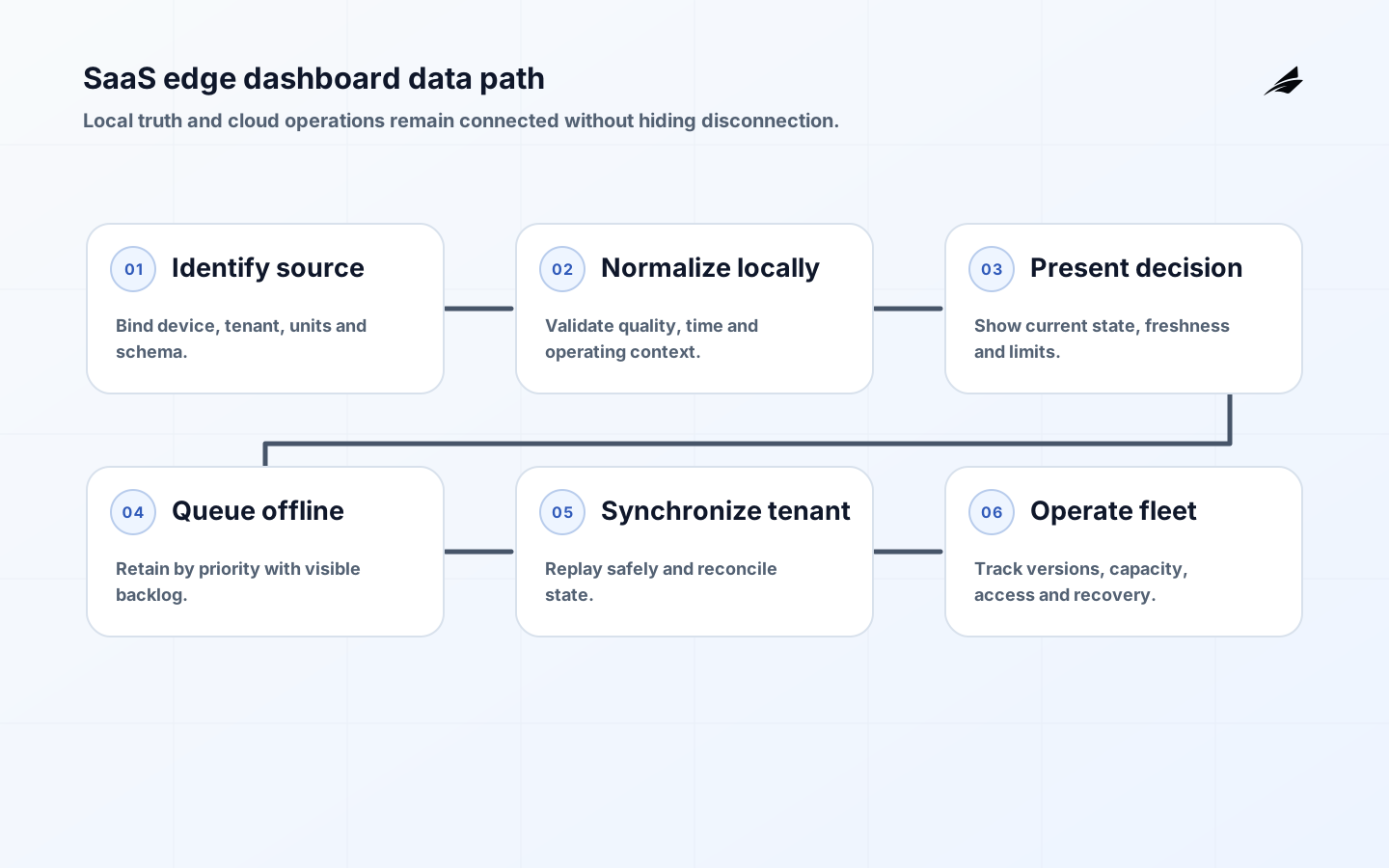
Edge dashboard development for SaaS companies requires two products to behave as one: a local interface that remains useful near devices or operations, and a cloud service that manages tenants, fleet configuration, history and support. The dashboard must tell users what is happening now, how fresh that state is, whether the site is connected and what actions remain safe. A chart rendered at the edge is not enough. Identity, time, data quality, offline storage, synchronization and update control determine whether users can trust the display.
This implementation checklist uses W3C Web of Things architecture for interoperable edge concepts, OASIS MQTT 5.0 for messaging behavior, Microsoft's documented IoT Edge offline model as one practical reference, NIST SP 800-82 Rev. 3 for operational-technology security considerations and WCAG 2.2 for accessible interfaces. The references are technology guidance, not a substitute for site-specific safety engineering. Keep command and control boundaries separate from monitoring unless qualified owners explicitly approve them.
Gate 1: define the local decision and safety boundary
Describe the exact user, location, decision, frequency and consequence of stale or incorrect information. “Help a maintenance lead decide whether to inspect a packaging line after a vibration threshold is exceeded” is clearer than “show machine analytics.” State whether the dashboard is advisory, monitoring-only or able to initiate an action. If it can affect physical operation, involve safety and control-system owners and define interlocks, confirmation and independent protections.
Document what must work during WAN loss and for how long. Identify local users, environmental conditions, device constraints and shift handoffs. Define freshness, latency and history needed for the decision. Assign site, product, data, OT security and support owners. The gate passes when the team has a bounded use case, explicit excluded actions, acceptance scenarios and a fallback that does not depend on an untested cloud connection.
| Decision input | Question to answer | Evidence |
|---|---|---|
| Source identity | Which device, gateway or manual record produced it? | Verified inventory and stable identifier |
| Time | When did the event occur and when was it received? | Clock model and timestamp sample |
| Quality | Is the value valid, stale, missing, corrected or simulated? | State model and interface test |
| Authority | May the dashboard only inform or also command? | Approved safety and authorization boundary |
Gate 2: assign edge and cloud responsibilities
Map acquisition, normalization, rules, local storage, presentation, synchronization, fleet management and analytics. Place each function according to latency, disconnection, privacy, compute capacity and manageability. The W3C WoT architecture offers concepts for Things, descriptions, consumers and intermediaries that can help teams describe heterogeneous devices. In a SaaS product, maintain a tenant-aware control plane without assuming every site is continuously reachable.
Avoid direct browser access to controllers. Use bounded adapters or gateway services to enforce protocol, schema, rate and identity. Separate local operational state from cloud administration. Cache only the policy and identity information needed for approved offline behavior, with expiry and revocation handling. Document trust anchors and bootstrap. A site should not accept a new gateway merely because it presents a familiar network address.
Gate 3: define telemetry contracts and quality
Create a schema for every signal: source, units, range, sampling, event time, quality, sequence and version. Preserve raw value where correction or audit requires it. Distinguish no reading from zero. Do not silently interpolate an operational gap. Derived metrics need owned formulas and input-quality rules. If one sensor is missing, define whether an aggregate is invalid, partial or estimated and show that state in the interface.
Use stable device and tenant identifiers across edge and cloud. Normalize units through versioned mappings. Detect duplicate, late, reordered and implausible events. Define how a restarted device establishes a new sequence. Store source time, gateway time and cloud ingestion time when delay matters. Reconcile fleet records against site inventory so moved or replaced devices do not continue under an incorrect customer or asset.
Gate 4: design messaging, replay and backpressure
MQTT 5.0 provides publish-subscribe transport, sessions, delivery quality and message expiry features, but application correctness still needs explicit identifiers and state. Choose topic structure, retained-message use, session behavior and quality of service according to consequence. A retained last value can help bootstrap a display, but it must not be confused with live state. Include source time and freshness rules. Protect brokers with distinct credentials and tenant-aware authorization.
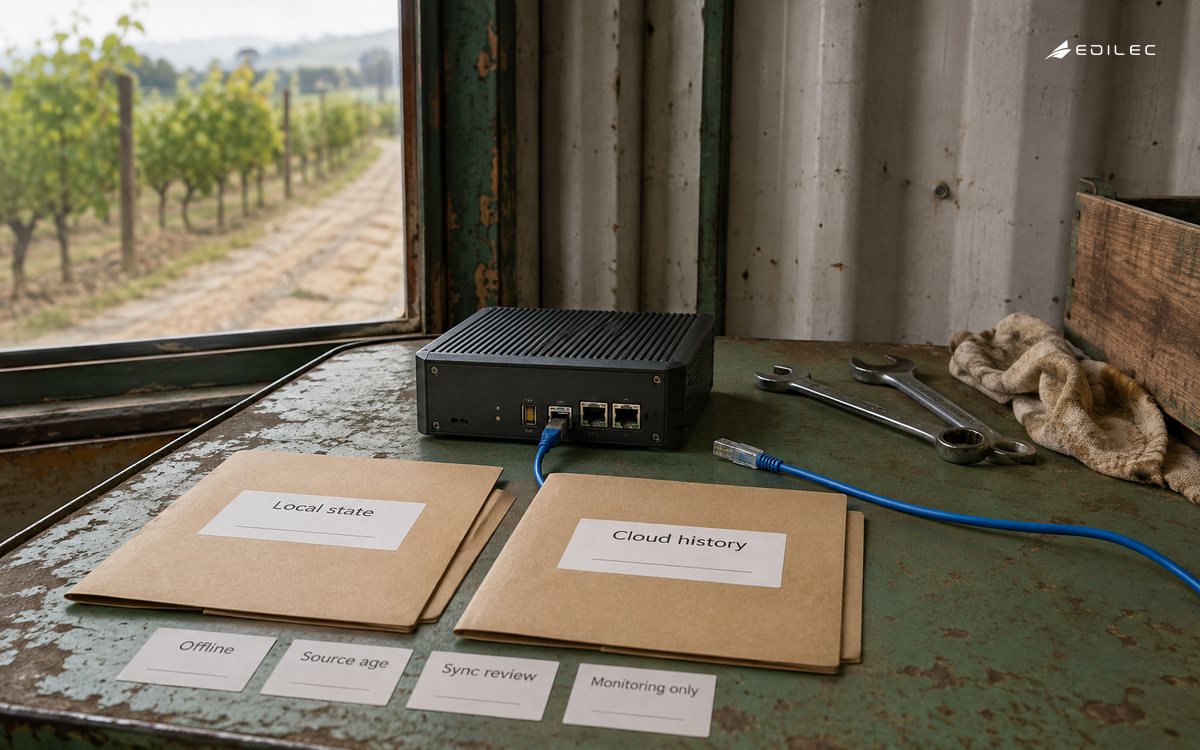
Plan for bursts, slow links and cloud throttling. Bound retries and queue growth. Define priority, expiry and loss policy before storage fills. Apply idempotent processing to uploads and commands. Expose dropped or expired data as an operational event. Test disconnection, duplicate delivery, reordered messages and broker restart. A dashboard should show local source connectivity and cloud synchronization separately; one can be healthy while the other is not.
| Connectivity state | Dashboard behavior | Data handling |
|---|---|---|
| Source connected, cloud connected | Show live state and synchronized history | Stream and acknowledge normally |
| Source connected, cloud offline | Show local state with sync backlog | Store by priority and retention |
| Source offline, cloud connected | Mark values stale by source rule | Do not present cloud reachability as freshness |
| Both offline | Use approved local fallback | Retain bounded evidence and expose limitations |
Gate 5: engineer offline storage and synchronization
Microsoft's IoT Edge documentation illustrates local authentication, message storage and later synchronization, while noting that retention depends on time to live and disk. Build your own capacity model from arrival rate, record size, outage assumption, indexes, logs and safety margin. Reserve storage or priority for critical evidence. Alert before pressure forces loss. Never allow a full disk to make an undocumented retention decision.
On reconnection, synchronize without blocking local decisions. Preserve ordering where required and reconcile desired configuration with reported state. Cloud commands issued while a site was offline need expiry and conflict rules; an old command may be unsafe after conditions changed. Display last successful upload and backlog separately. Test a long outage, repeated reconnect, bandwidth restriction and edge restart with realistic volumes.
Gate 6: make the dashboard accessible and truthful
Organize the screen around decisions and exceptions, not all available telemetry. Show current value, unit, quality, threshold, source and freshness together. Use text and shape in addition to color. Keep a visible distinction between live, stale, simulated, corrected and unavailable state. Provide a short path from an exception to source history and recommended next check. Avoid decorative animation that makes stable values appear active.
Apply WCAG 2.2 to web interfaces: keyboard support, visible focus, semantic structure, sufficient contrast, understandable errors, zoom and reflow. Consider gloves, distance, glare, noise and language at the site. Provide an accessible network interface when constrained hardware cannot support every need. Test small and large displays without hiding freshness or alarms. A responsive layout should prioritize the current operating decision before secondary trends.
Gate 7: protect OT and tenant boundaries
NIST SP 800-82 Rev. 3 emphasizes that OT security must account for safety, reliability and performance. Segment the edge environment, restrict inbound paths and use allowlisted communication where practical. Authenticate devices and modules, protect update signing, isolate secrets and monitor configuration. A SaaS operator should not receive broad control-system access merely to diagnose the dashboard. Define safe support channels and customer approval.
Enforce tenant scope in fleet inventory, configuration, telemetry queries, exports and support tools. Test cross-tenant device identifiers and shared caches. Keep administrative actions attributable and time-bound. Threat-model compromised gateways, malicious payloads, stolen device credentials, unauthorized configuration and supply-chain updates. Prepare a rotation and revocation process that works when the site is intermittently connected.
Gate 8: validate deployment and fleet operations
Pilot at representative sites, not only a lab with stable network and clean data. Test clock drift, source silence, disk pressure, gateway replacement, failed update, rollback and inaccessible cloud service. Validate operator comprehension during an actual shift. Record acceptance per site because power, topology, protocols and users differ. Use staged rollout and signed artifacts with health checks before promoting a fleet release.
Operate the product with dashboards for fleet version, connectivity, backlog, stale data, failed authentication, storage pressure and update status. Avoid treating a cloud portal's last-known green state as proof that the site is online. Assign incident and escalation ownership across SaaS, customer IT and OT teams. Review recurring gaps and capacity. Rehearse export and decommissioning so customer data and credentials are removed from retired hardware.
Key takeaways
An edge dashboard is trustworthy only when it makes local state, quality and connectivity understandable. Design the local decision first, then place responsibilities across device, gateway and cloud. Offline behavior, storage, replay, accessibility, tenant isolation and fleet updates belong in initial scope. Document site-specific exceptions and review them after every material device, network or safety change.
- Define monitoring and command boundaries explicitly.
- Preserve source identity, event time, quality and schema version.
- Show source freshness separately from cloud connectivity.
- Test long outages, disk pressure, replay and stale commands.
- Validate at representative sites and operate the fleet continuously.
Frequently asked questions
Can the dashboard be cloud-only?
Yes when latency and disconnection do not affect the decision. If work must continue locally, provide an approved edge path and make its limitations visible.
Does MQTT guarantee exactly-once business processing?
MQTT delivery quality does not replace application identifiers, idempotency and reconciliation. Design the business operation to handle retries and duplicates.
Should the dashboard control equipment?
Only with explicit safety, authorization and engineering review. Monitoring and control have different consequences and should not be combined casually.
Conclusion
Edge dashboard development for SaaS companies succeeds when the product can explain what each site knows, how current it is and what remains safe during failure. Complete the gates with evidence from real hardware, networks and users. A truthful local interface, bounded data contracts, recoverable synchronization and disciplined fleet operation create more value than a visually impressive dashboard whose state cannot be trusted.