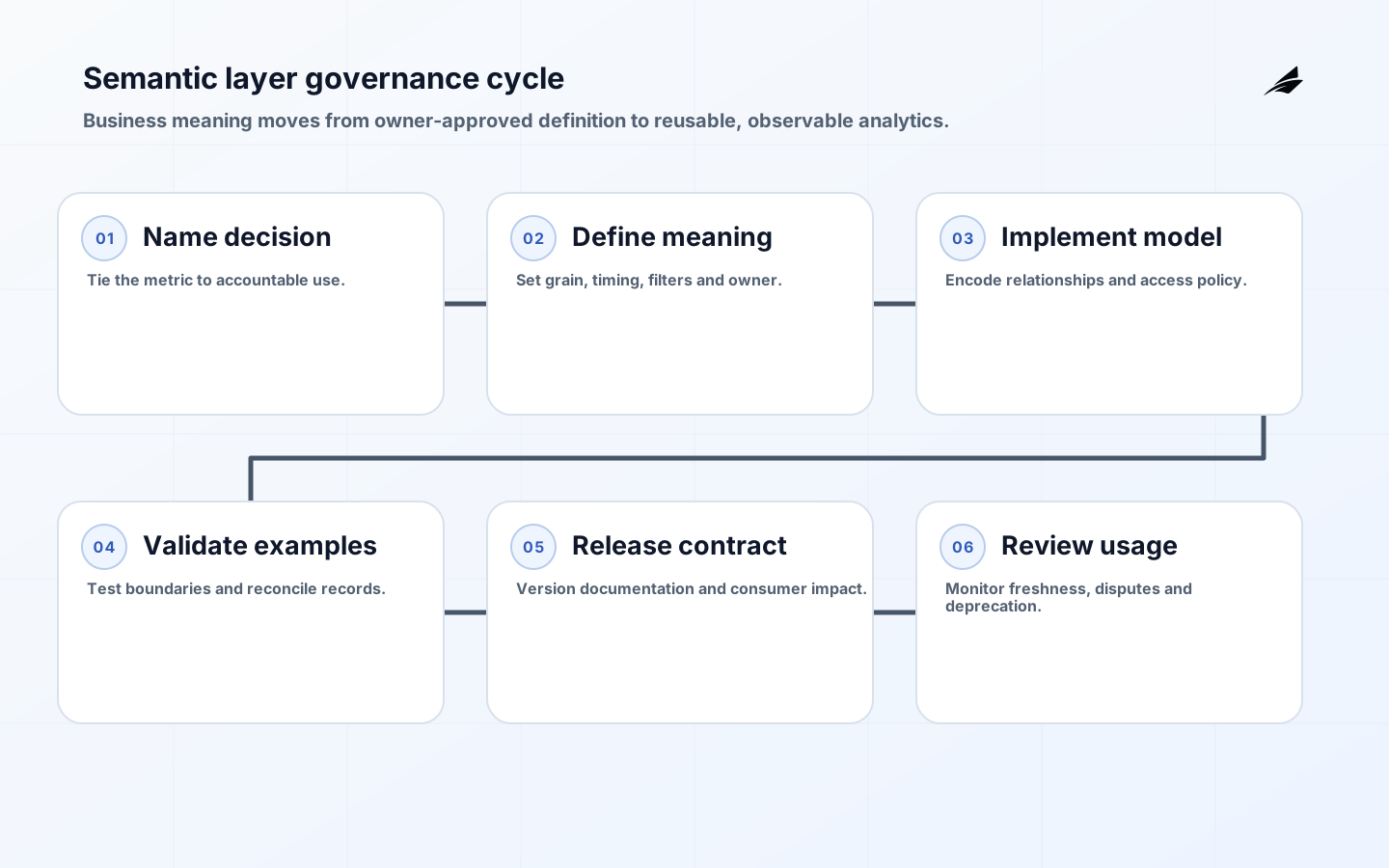
A semantic layer gives analytics consumers a shared, executable vocabulary for measures, dimensions, entities and relationships. It sits between physical data models and dashboards, notebooks, applications or agents. The purpose is not to centralize every query. It is to make important business definitions reusable and testable so revenue, active customer or on-time delivery does not change meaning with each report.
This guide explains how growing data teams can scope, model, govern and operate a semantic layer. dbt's Semantic Layer, LookML and Power BI semantic models illustrate different implementation patterns. W3C PROV and OpenLineage provide useful lineage concepts. The technology choice should follow consumer needs, access controls, query engines and ownership; no platform can resolve an undefined business term automatically.
Start from decisions and disputed definitions
Inventory high-use metrics and the decisions they support. Prioritize measures that appear in several products, create recurring disputes or require nontrivial relationships. Name a business owner and data steward. Define grain, population, filters, timing, currency, status and expected drill dimensions. Include examples that expose boundaries. “Customers with at least one completed paid order in the trailing 30 days” is testable; “active customers” alone is not.
Do not begin by translating every dashboard formula. Some calculations are obsolete or intentionally local. Classify definitions as certified, experimental, regulatory or team-specific. Preserve legitimate variants with clear names rather than forcing false agreement. The first release should cover one domain and several real consumers, proving reuse before the team creates a large abstract ontology.
| Semantic object | Required definition | Example risk |
|---|---|---|
| Entity | Stable key and grain | Customer duplicated across source systems |
| Measure | Aggregation, filter, time and unit | Revenue mixes booked and collected values |
| Dimension | Allowed values and history behavior | Region changes rewrite prior periods |
| Relationship | Cardinality and join behavior | Many-to-many join inflates totals |
Choose the execution and consumption architecture
A semantic layer may execute in a BI tool, a transformation platform, a query service or an application-facing metrics API. Evaluate which consumers need it, where row-level security must run, whether queries can be pushed down, how caches preserve freshness and how definitions are versioned. A BI-native model can be efficient for one platform; an independent service may support several tools but adds operations.
Separate physical storage concerns from business contracts. The semantic model should reference well-tested, documented data products rather than compensate for every raw-source defect. Keep identifiers stable and expose lineage to underlying models. Avoid a universal model that joins every domain; bounded domain models with explicit shared entities are easier to own and evolve.
Model grain, time and relationships explicitly
Every measure has a natural grain. Distinct counts, ratios and semi-additive balances can produce plausible but wrong totals when rolled up incorrectly. Define numerator and denominator separately where useful. State event time, reporting calendar, period closure and timezone. For slowly changing dimensions, decide whether analysis uses current or historical attributes. Document unsupported combinations rather than returning misleading results.
Treat relationships as governed logic. Declare cardinality and test duplicate keys. Many-to-many paths may require bridge tables or pre-aggregation. Create small fixtures for ordinary and difficult cases: duplicate event, missing dimension, reopened order, late correction and cross-period status. Review expected results with business owners and automate them as regression tests.
Apply access policy at the semantic boundary
Metrics can expose sensitive information even when raw rows are hidden. Define who may query measures, dimensions, row scopes and detailed drill paths. Apply policy consistently across dashboards, APIs and AI tools. Test actual roles and combinations, including a user with access to one region but not another. Prevent caches and exports from bypassing row-level rules.
Minimize query logs and examples that contain personal data. Record definition and policy version for consequential results. If the layer serves natural-language interfaces or agents, expose only approved semantic objects and enforce query limits. A model-generated query must not receive broader access than the requesting user.
| Change | Compatibility concern | Required action |
|---|---|---|
| Rename metric | Saved reports and API consumers | Alias, deprecation notice and migration |
| Change formula | Historical comparability | Version, impact analysis and approval |
| Add dimension | Privacy and cardinality | Access review and performance test |
| Change relationship | Aggregation correctness | Fixture, reconciliation and consumer review |
Create a lightweight governance workflow
A proposal should include owner, business meaning, examples, source, affected consumers and acceptance tests. Review meaning with the business owner, data quality with the steward and implementation with the model maintainer. Cross-domain metrics may require a small architecture or finance forum. Keep decisions in version control or another durable system.
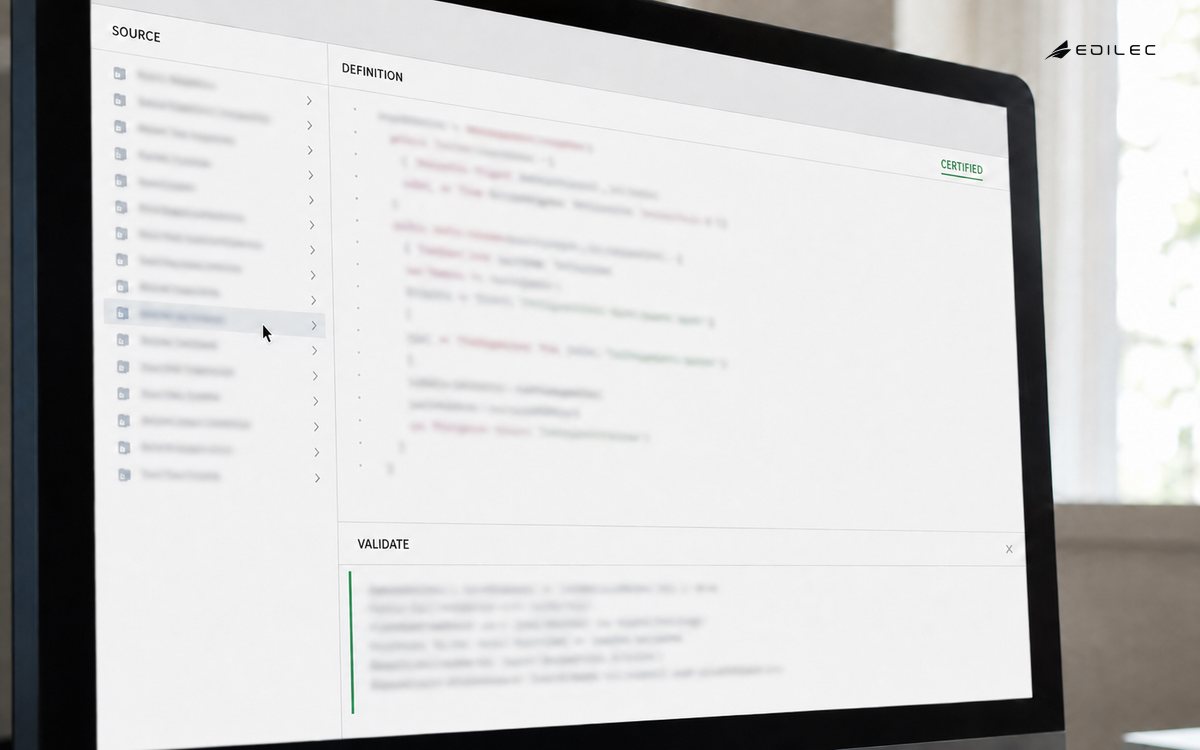
Use states such as proposed, experimental, certified, deprecated and retired. Certification should mean that definition, owner, tests, access and service expectations are known; it should not imply perfect data. Publish change logs and deprecation dates. Avoid a central team becoming the permanent author of every domain definition. Provide contribution templates and automated checks so domain teams can own their metrics.
Validate and reconcile before certification
Run fixture tests at natural grain and supported rollups. Reconcile material measures with authoritative operational or financial records for known periods. Classify differences as timing, scope, mapping, quality or implementation. Set tolerances only where meaning supports them. Check nulls, duplicates, late data, currency and timezone boundaries.
Test consumer behavior as well as SQL. Verify filters, drill paths, labels, formats and performance in each supported interface. Review generated queries where a tool translates semantics. Monitor failed queries, freshness breaches and unusual result shifts. Provide a route for users to dispute a number with metric version and filter context.
Operate the layer as shared infrastructure
Set objectives for query success, latency, freshness and definition availability according to consumer needs. Monitor warehouse cost and cache behavior without hiding staleness. Maintain a consumer inventory so changes can be assessed. Instrument lineage from semantic query to underlying jobs and datasets using OpenLineage or another consistent model.
Review unused metrics, duplicate definitions, failing tests and unresolved disputes. Retire stale objects with a migration path. Reserve capacity for performance, documentation and access changes. A semantic layer that only one specialist can debug becomes a bottleneck; provide runbooks, ownership rotation and observable query plans.
Drive adoption through useful contracts
Migrate a few high-value dashboards and analytical workflows, compare results and explain differences. Give analysts a discovery catalog with definitions, examples, owner and supported dimensions. Provide APIs or tool integrations where they reduce duplicated calculation. Do not force exploratory analysis through certified metrics when discovery needs rawer access; label the distinction.
Measure coverage of priority metrics, duplicate formulas retired, time to resolve disputes, test failures, freshness and active consumers. Avoid measuring success only by object count. The strongest signal is that independent teams obtain the same approved answer and can explain its context.
Scale the semantic layer with the data team
A semantic layer for data teams should reduce coordination cost as the organization grows, not create a new queue for one central specialist. Define domain maintainers who can propose and review metrics within their subject area, while a small platform group owns tooling, compatibility checks and shared entities. Publish templates for definition, grain, ownership, fixtures and consumer impact. Automated linting can catch missing descriptions, duplicate names, unsupported relationships and breaking interface changes before human review. Reserve cross-domain review for definitions that genuinely span finance, product, customer or operations.
Design onboarding around a real contribution. A new analyst should be able to find a certified metric, inspect its lineage, run an approved example, add a test and propose a bounded change. Documentation should be generated or linked from executable objects so it does not drift. Record recurring questions and rejected proposals; they reveal unclear naming, missing dimensions or ownership gaps. Provide office hours for difficult modeling while keeping ordinary contribution asynchronous and reviewable. The layer succeeds when domain knowledge can enter safely without bypassing common contracts.
Plan for multiple environments and releases. Development should use representative, protected data and deterministic fixtures. Staging should test access roles, generated queries, cache behavior and consumer compatibility. Production releases need version, migration notes and rollback. Promote semantic objects independently where the platform supports it, but preserve compatible shared entities. Review the operating model quarterly: contributor count, review time, unresolved disputes, failed changes and concentrated ownership show whether the service is scaling or merely accumulating definitions.
Key takeaways
A semantic layer is executable governance for important analytical meaning. Start with decisions, model grain and relationships carefully, enforce access consistently and manage definitions as versioned contracts. Sustainable ownership matters more than the number of metrics. Favor a smaller catalog whose behavior and owners are known over a broad catalog that reproduces every historical formula without review. Review it regularly with users.
- Prioritize reused or disputed metrics with accountable owners.
- Define grain, time, filters, relationships and unsupported combinations.
- Test fixtures, reconciliation and real access roles.
- Version changes and maintain a consumer-aware deprecation process.
- Operate freshness, query health, cost and lineage as a service.
Frequently asked questions
Is a metric dictionary enough?
A dictionary documents intent but cannot enforce calculation. Pair prose with executable definitions, tests, relationships, access policy and version history.
Must the layer live in the warehouse?
No. Placement depends on consumers, engines and governance. Evaluate portability, policy, latency, cost and operating ownership.
Can an AI assistant query the semantic layer?
Yes, if it receives only approved objects and the user's actual permissions. Preserve query context and do not let generated queries bypass policy.
Conclusion
Semantic layers for growing data teams succeed when shared meaning becomes easier to use and safer to change. Build one domain around real decisions, validate it against authoritative records and support several consumers. Then expand through clear ownership and contribution rules. A well-operated layer reduces argument and duplication without pretending every analytical question has one permanent answer.