A Field Guide to Metric Layers for Growing Teams
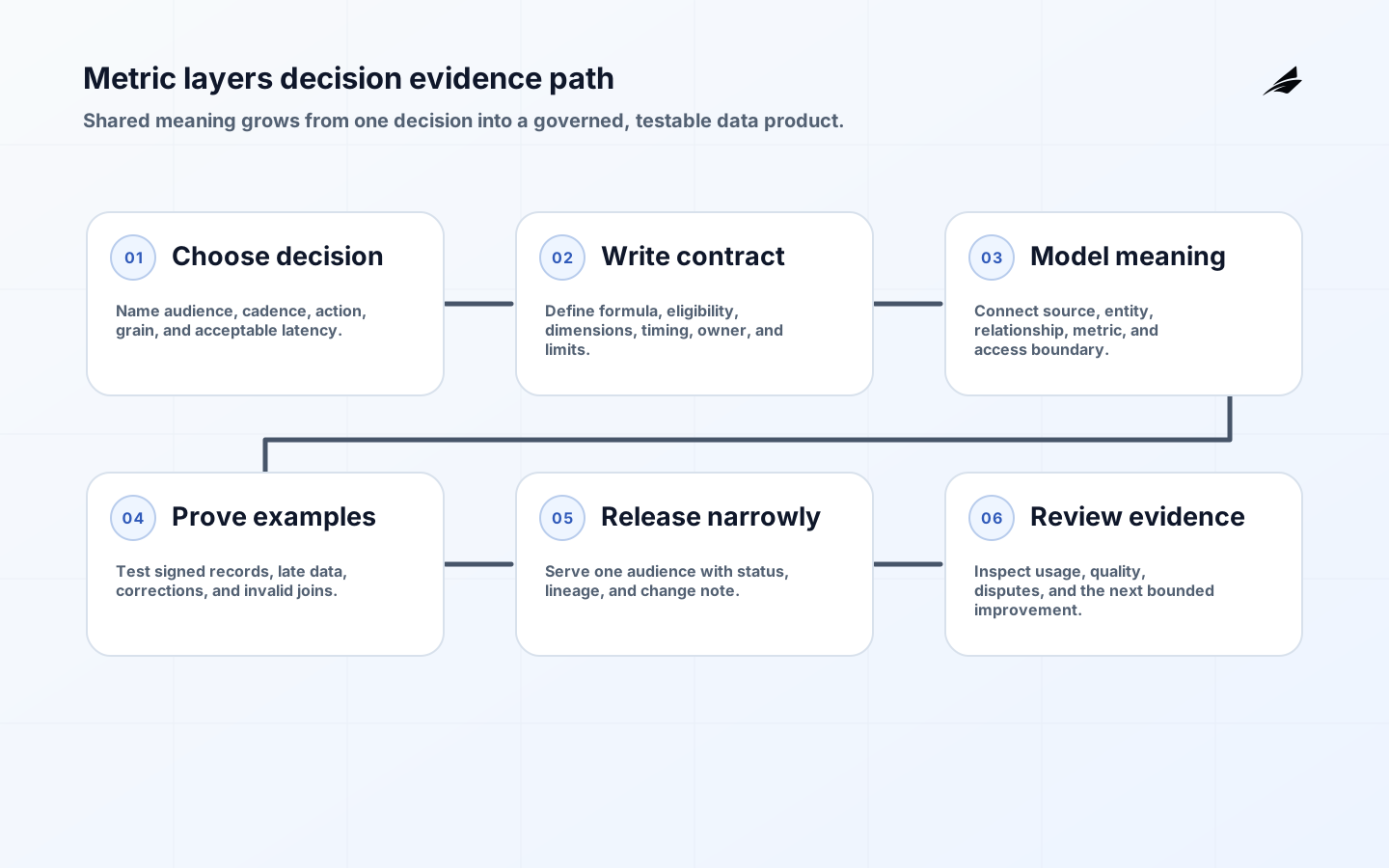
A metric layer is a governed way to define and serve a business measure so that different people can use the same meaning without rebuilding the logic. It is valuable when a growing company has more decisions, tools, and data contributors than one person can keep aligned. The goal is not to create a catalogue of every possible metric. The goal is to make a consequential decision more explainable: which customers count as active, when revenue is recognized for this use case, or whether a renewal cohort is complete enough to guide outreach. Start with the decision, the person accountable for it, and the evidence that would let a colleague challenge the result.
Start With a Decision Worth Making Consistently
Founders often meet the problem as a disagreement rather than as an architecture request. Finance, product, and sales each have an active-customer number, but each number answers a different question. Before choosing a platform, write the decision in one sentence: at a defined cadence, a named user will take a named action using a measure with a stated freshness and confidence. Then collect two ordinary examples and one difficult example, such as a refund after the reporting cutoff, a merged account, or a late event. Those examples expose the boundaries that a short definition tends to hide.
| Decision question | Specification to settle | Evidence to retain |
|---|---|---|
| Who will act? | Name the role, decision, cadence, and consequence of delay. | Decision statement and accountable owner. |
| What is being measured? | Set the entity, grain, formula, filters, and exclusions. | Signed examples with source records. |
| Which time applies? | Choose event time, accounting time, snapshot time, or another basis. | Cutoff rule, timezone, freshness promise, and late-data policy. |
| What happens when evidence is weak? | Define provisional, unavailable, corrected, and blocked states. | Status rule, escalation route, and correction record. |
Turn the Definition Into a Metric Contract
A metric contract is the smallest durable agreement between business meaning, data logic, and a consuming person or system. It should state the metric name, purpose, grain, formula, eligible records, dimensions, time basis, owner, permitted uses, freshness expectation, and known limitations. Include an example that can be calculated by hand. If the measure is net revenue, show how a charge, refund, tax, currency conversion, and cancellation affect the example. If the measure is weekly active users, show the identity rule and the week boundary. Concrete fixtures are more useful than a polished definition that no reader can test.
Keep the contract separate from the dashboard layout. The dbt Semantic Layer and dbt metrics documentation describe implementation patterns for central definitions and semantic models; they do not decide what your company means by active, retained, or recognized. That decision belongs to the accountable domain owner. Technical ownership then makes the contract executable, versioned, tested, and discoverable. A reader should be able to find the definition without asking the person who first wrote the query.
Separate Evidence, Meaning, and Presentation
A useful architecture has a clear path from source evidence to a published metric. Source models preserve identifiers, timestamps, currency, and relevant context. Controlled logic applies joins and calculations at an explicit grain. The metric layer exposes the approved definition, dimensions, status, and lineage. Consumer tools render a table, alert, planning view, or API response without silently changing the calculation. This separation helps a team answer four operational questions: which input is missing, which rule changed, which consumers are affected, and who can approve a correction.

| Layer | Primary responsibility | Useful failure signal |
|---|---|---|
| Source evidence | Preserve source identity, time, context, and raw correction history. | Missing key, unexpected volume, stale source, or duplicate record. |
| Semantic logic | Apply the approved grain, relationships, filters, and formula. | Test failure, join multiplication, reconciliation gap, or version conflict. |
| Metric service | Expose definition, dimensions, freshness, status, and access boundary. | Unexplained shift, hidden limitation, stale status, or access mismatch. |
| Consumer experience | Present the measure with context and preserve the route to its owner. | Copied logic, contradictory label, untraceable export, or repeated dispute. |
Relationships deserve special attention. A customer-to-order join, for example, can multiply revenue when one customer has several account records or when an order has multiple line items. Model the grain before adding a convenient relationship, and test both the expected case and the many-to-many case. Snowflake semantic views and Microsoft’s guidance on understanding relationships in Power BI are useful official references for keeping model relationships explicit. The local contract still decides which path is authoritative.
Pilot One Reconciled Use Case
Choose one decision with a real consumer and a manageable scope. A monthly retention review or a daily expansion-risk queue is a better first use case than an enterprise-wide metric registry because the team can observe the entire path. Build the smallest version that can answer the decision, then reconcile it against a known set of records with a finance, product, or operations partner. Ask a consumer who did not build the model to find the definition, reproduce one example, and explain what a late result means. Their questions are design evidence, not support noise.
- Define one decision, one accountable domain owner, and one technical operator.
- Create signed examples before adding dimensions or widening access.
- Test late records, duplicate identities, missing relationships, corrections, and permission boundaries.
- Publish freshness, definition version, limitations, and a visible status with every important result.
- Record the next change as a bounded hypothesis tied to an observed consumer need.
Make Change and Exceptions Visible
A metric layer becomes risky when a definition changes without telling the people who rely on it. Version the contract when eligibility, grain, time basis, or source logic changes. Identify affected dashboards, exports, alerts, and downstream models. Decide whether history will be restated, whether the new version starts on an effective date, or whether both versions must remain available temporarily. Do not let a renamed metric conceal a changed business rule. A short change note should state the reason, owner, effective time, expected impact, and validation performed.
Status is part of the product. A result may be current, delayed, provisional, corrected, or unavailable, and those states should change what a reader is allowed to conclude. PROV-DM offers a formal way to think about the entities, activities, and agents behind an output. The W3C Data Quality Vocabulary supports describing quality observations in context, while the OpenLineage object model provides lineage terminology for datasets, jobs, runs, and ownership. Use those references to improve traceability, not to replace a plain-language status that a decision-maker can understand.
Operate the Layer as a Shared Data Product
After release, measure whether the layer is reducing work rather than merely accumulating definitions. Useful signals include the share of decisions that cite an approved metric version, time to resolve a definition dispute, repeated copies of the same calculation, reconciliation variance, freshness breaches, and the time required to introduce a reviewed metric. These are diagnostic signals, not universal targets. A fast-growing catalogue with frequent disputes is not healthier than a small catalogue that people can explain and trust.
Set a review rhythm that includes a business owner, a technical operator, and a consumer who did not build the metric. Examine one normal run, one exception, one recent change, and one unanswered question. Check whether the source path, definition, access policy, and presentation still agree. Retire unused metrics and document deliberate exceptions. This keeps governance proportional: a metric that drives pricing or regulatory reporting needs stronger review than an exploratory measure used by one analyst for a week.
Resolve Disputes with Signed Fixtures
When two teams disagree, do not compare their final numbers first. Compare the question, entity grain, time boundary, eligible records, and expected treatment of corrections. Write a signed fixture containing the input identifiers, filters, expected output, and decision supported. The business owner signs the meaning; the technical owner makes the fixture executable; the consumer confirms that the result is understandable in the tool where it will be used. Keep the fixture as a regression case so a future model change cannot quietly reintroduce the dispute.
A fixture also clarifies what the metric layer cannot promise. It may standardize a definition without making the underlying source complete, and it may expose a result consistently without making a forecast correct. State those limits beside the metric. If the evidence is not sufficient for the decision, the correct output can be provisional or unavailable. That is a healthier outcome than presenting false precision and forcing a later investigation to reconstruct what the number meant.
Key Takeaways
- Start with a decision and a named owner, not a platform-wide metric catalogue.
- Treat grain, time basis, eligibility, status, and limitations as part of the metric contract.
- Separate source evidence, semantic logic, published metrics, and presentation so changes remain traceable.
- Use signed examples and difficult cases to make correctness testable before widening adoption.
- Review disputes, freshness, reuse, and corrections as operating signals for the next improvement.
Frequently Asked Questions
- Do we need a large platform first? No. Begin with one important decision, a small contract, and a reconciled example.
- Who owns a metric? The domain owner owns meaning and decision fit; the technical owner operates the data path and change controls.
- How should a source change be handled? Version the definition, test the affected path, identify consumers, and publish the restatement or effective-date choice.
- When is a metric safe to reuse? When a reader can find its meaning and status, reproduce a signed example, trace its evidence, and reach an owner.
Conclusion
Metric layers earn their place when they make a recurring decision more consistent, explainable, and recoverable. Keep the first commitment narrow: one decision, one contract, one accountable owner, and evidence that a different consumer can inspect. The adjacent KPI governance guide, semantic layers guide, and warehouse modeling guide provide useful next steps for governance, semantic design, and source structure.
The practical sign of maturity is not the number of metrics published. It is a reader who can distinguish a settled value from a provisional one, explain why the number changed, and reach the right owner without starting a parallel calculation. Review the layer as the business changes, retire definitions that no longer serve a decision, and expand only after the first use case can survive an exception. Shared meaning is a product; it needs evidence, maintenance, and a clear reason to exist.