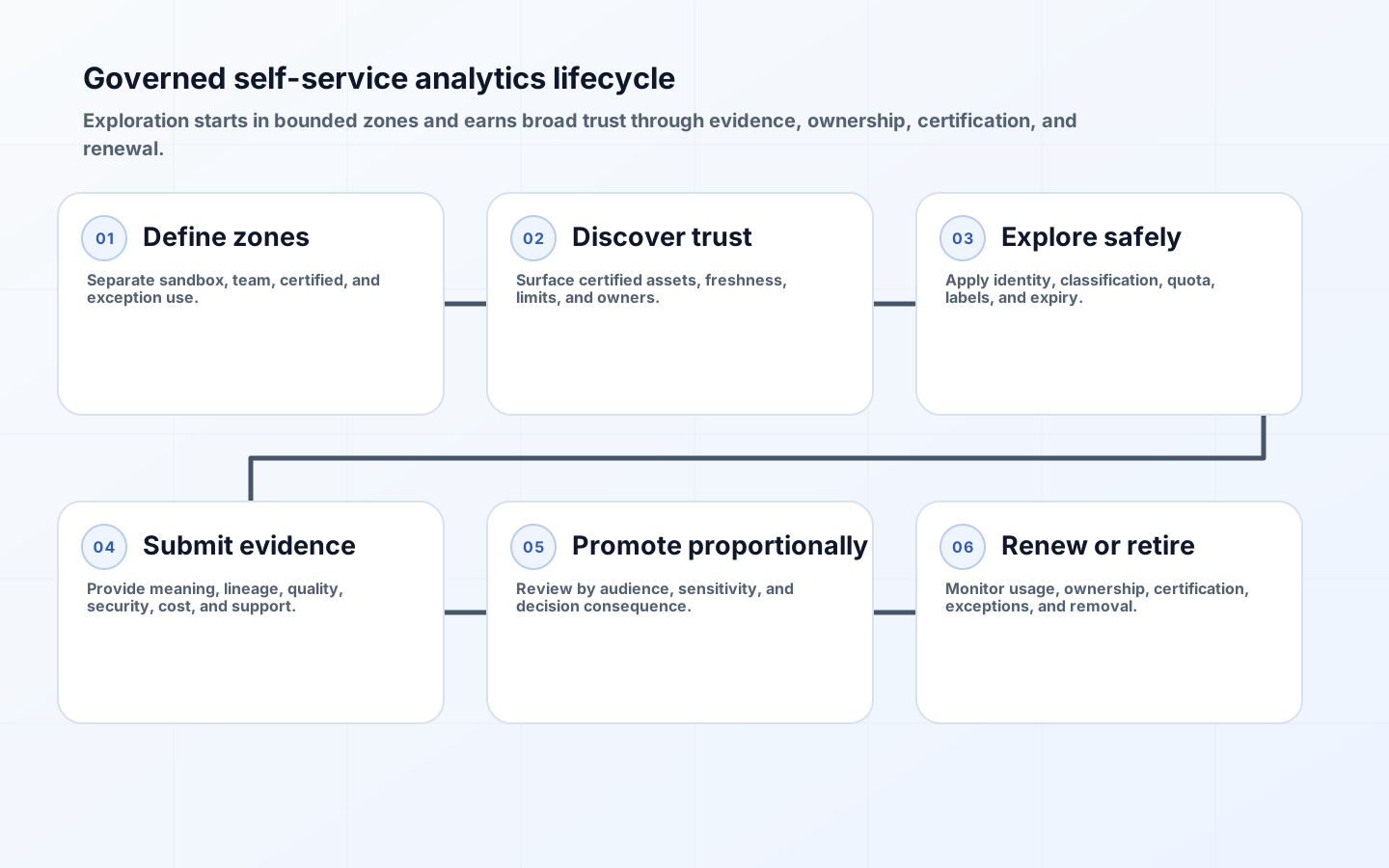
Self-service analytics succeeds when people can answer new questions without waiting for a central report factory and can still recognize which data is trusted for shared decisions. Unrestricted workspaces create duplicate metrics, insecure extracts, abandoned dashboards, and uncertain ownership. Excessive approval sends users back to spreadsheets and private copies. Self-service analytics governance needs a paved path: certified data and metrics for common work, bounded sandboxes for exploration, and a clear promotion process when local analysis becomes shared infrastructure.
Microsoft describes managed self-service BI as discipline at the core and flexibility at the edge, with central experts often maintaining data architecture while departmental creators build reports. Its governance roadmap recommends lightweight, iterative controls that fit normal work. Looker and Power BI expose certification or endorsement signals, but a badge is trustworthy only when the organization defines review criteria, owner obligations, expiry, and revocation. Governance is an operating model around features, not the features themselves.
Separate certified, team, and sandbox zones
Define zones by allowed use and audience. A personal sandbox supports exploration and short-lived analysis. A team zone supports collaboration with named ownership and basic quality controls. A certified zone contains governed semantic models, metrics, and content approved for broad or consequential decisions. Use permissions, naming, visual status, search ranking, and default discovery to make the distinction obvious. Do not rely on a policy document users must remember.

Specify allowed data classifications, sharing scope, refresh, exports, external access, custom code, and retention for each zone. Sandboxes should still enforce row and object security; experimental does not mean exempt from privacy. Restrict sensitive raw data and provide masked or aggregated alternatives. Let users create quickly within quota and policy, then require more evidence as audience, sensitivity, automation, or decision consequence grows.
| Zone | Intended use | Minimum controls | Lifecycle |
|---|---|---|---|
| Personal sandbox | Private exploration and learning | Identity, source policy, quota, label | Short expiry unless used |
| Team workspace | Shared departmental analysis | Owner, description, tested source, access review | Periodic owner attestation |
| Certified data asset | Reusable governed foundation | Contract, lineage, quality, security, support | Versioned and reviewed |
| Certified report | Broad or consequential decision | Metric and UX validation, owner, freshness | Monitored and recertified |
| Exception zone | Time-bound unusual requirement | Risk approval, compensating controls | Explicit end date |
Make trusted assets easy to find and use
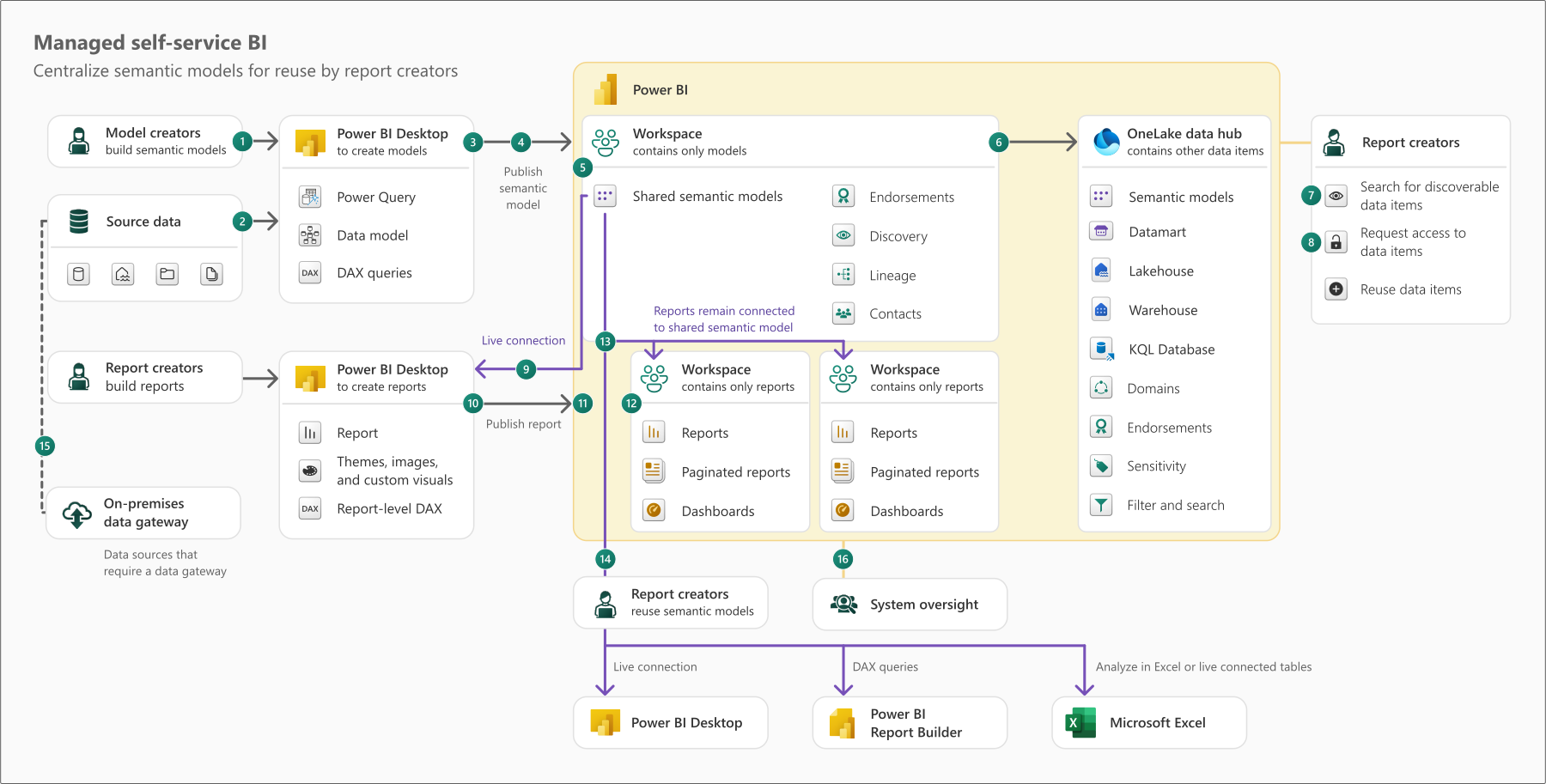
Publish certified semantic models, datasets, metrics, dimensions, and examples through search and the normal authoring workflow. Provide descriptions, owner, grain, source, freshness, access class, supported use, known limitations, and certification date. Power BI endorsement and discoverability can help users locate promoted or certified semantic models; Looker certification can signal reviewed content. Configure these features so certification routes users toward reliable foundations without granting data access automatically.
Track duplicate definitions and search failures. If users repeatedly rebuild customer status, the certified asset may be undiscoverable, too slow, insufficiently dimensional, or semantically wrong for their need. Offer starter templates and office hours. Keep request and correction paths close to the asset. A catalog that only describes data but cannot be reached from the BI tool becomes a second website users stop checking.
Use an evidence-based promotion path
Promote when content gains a broader audience, automates a decision, handles sensitive data, feeds external users, or becomes operationally critical. The creator submits purpose, owner, consumers, source lineage, metric definitions, refresh, security, quality checks, sample results, performance, accessibility where relevant, and support expectation. Reuse evidence already present in version control or platform metadata. Do not make creators retype it into a long form.
Review proportional to risk. A team dashboard built entirely on certified metrics may need owner and UX checks. A new cross-domain metric needs semantic, data-quality, and owner review. A customer export needs security, privacy, and delivery review. Return specific findings with service targets. Certification should be revocable if ownership lapses, freshness fails, a source changes materially, or evidence no longer meets policy.
| Promotion evidence | Reviewer | Pass condition | Automatable check |
|---|---|---|---|
| Metric meaning and grain | Business and analytics owner | No ambiguous or duplicate contract | Definition and reference tests |
| Lineage and source | Data owner | Approved current inputs | Lineage and freshness checks |
| Access and classification | Security or steward | Least privilege and export policy | Persona policy tests |
| Performance and cost | Platform owner | Fits page and query budget | Load and query regression |
| Support and lifecycle | Content owner | Named response and review dates | Owner and expiry validation |
Protect shared metric authority
Let users calculate locally, but reserve certified names and badges for governed definitions. A local ratio can answer a temporary question; it should not be published as official gross margin without population, time, currency, and owner controls. Encourage creators to extend certified metrics with local dimensions rather than copy formula SQL. Where local variants are valid, name them for the decision or cohort so difference is visible.
Maintain a semantic layer or governed model for cross-tool metrics and expose reference examples. Detect near-duplicate metric names, formulas, and descriptions. Route conflicts to business owners, not only platform administrators. If two definitions support distinct decisions, certify both with precise labels. Forcing one metric to serve incompatible grains and calendars creates hidden local workarounds that governance cannot see.
Design safe access and sandbox boundaries
Grant access through groups and roles, not individual ad hoc sharing where possible. Separate ability to view data, build content, publish broadly, certify, administer, and export. Apply row-level and object-level security in the data or semantic layer so copied reports do not remove controls. Limit raw sensitive fields, public sharing, unmanaged connectors, local downloads, and external destinations by classification. Audit privileged and exceptional access.
Give sandboxes quotas for storage, refresh, compute, external sharing, and lifetime. Provide synthetic or masked data for learning. Mark sandbox content clearly in search and embeds. Automatically notify owners before expiry and preserve a simple promotion path. Do not delete active analysis solely because it is old; combine last view, refresh, dependency, schedule, and owner confirmation. A rarely used annual report and an abandoned experiment can have the same last-view date.
Make ownership and expiry executable
Every shared asset needs a person or durable team, business purpose, support tier, audience, certification state, and review date. Integrate ownership with joiner, mover, and leaver processes. When an owner leaves, route to a team or suspend broad distribution after a grace period. Do not allow a generic platform team to become the owner of meaning for thousands of reports.
Use lifecycle states such as draft, team-shared, promoted, certified, deprecated, archived, and removed. Define transitions and visible consequences. Deprecation should identify a replacement and usage owners; archival should preserve metadata and required outputs; removal should revoke schedules, embeds, credentials, and caches. Keep certification history so users can interpret a past decision even after an asset changes.
Use activity and quality signals together
Monitor active creators and consumers, certified-asset reuse, duplicate models, orphaned content, failed refreshes, stale source data, query cost, external shares, exports, unresolved access requests, certification age, and deprecated use. Segment by domain and zone. Usage alone does not prove value or correctness. Combine activity with decision criticality, quality, freshness, owner status, and user feedback.
Turn signals into supportive interventions. Recommend a certified dataset when a creator connects to raw tables. Ask an owner to consolidate high-use duplicates. Offer help when a team repeatedly exceeds query budgets. Escalate sensitive sharing or unowned critical content. Measure time to answer, reuse, incident rate, trust, and governed-path adoption, not just the number of certified badges or blocked actions.
Create transparent exceptions and appeals
Some research, incident, acquisition, or regulatory work will not fit standard controls. Provide a request that states purpose, data, users, duration, risk, and why the paved path fails. Approve at the lowest competent level, add compensating controls, and set an expiry. Make status and rationale visible to the requester. A slow opaque exception process teaches users to hide work.
Review recurring exceptions as product feedback. If many teams need the same connector, dimension, or export, improve the standard platform or state why risk prevents it. If a control generates workarounds without reducing incidents, redesign it. Governance maturity is not more rules; it is a smaller set of effective controls embedded in ordinary creation, publication, discovery, and retirement.
Key takeaways
- Create visible zones for private exploration, team collaboration, and certified decisions.
- Make certified data, metrics, owners, freshness, and limitations discoverable inside authoring.
- Scale promotion evidence with audience, sensitivity, automation, and consequence.
- Keep security in governed data layers and bound sandboxes with quotas and expiry.
- Use executable ownership, certification review, deprecation, archive, and removal states.
- Treat exceptions and repeated workarounds as evidence for improving the paved path.
Frequently asked questions
Should every dashboard be certified?
No. Certification should identify content suitable for broad or consequential use. Personal and team analysis can remain clearly labeled under lighter controls. Certifying everything destroys the signal and creates an unnecessary review queue.
Who can certify content?
Authorize reviewers by domain and risk. Metric meaning needs a business and analytics owner; security and sensitive external delivery may need specialist approval. Platform administrators can manage the feature without owning every certification decision.
How can teams reduce dashboard sprawl?
Improve discovery and reuse, show certified defaults, detect duplicates, require owners for shared content, expire abandoned sandboxes, consolidate with consumers, and retire schedules and embeds. Sprawl is often a symptom of missing trusted assets or slow support, not only careless users.
Conclusion
Governed self-service analytics does not choose between freedom and trust. It gives exploration a safe place, makes reliable foundations easier to use, and raises the evidence bar as analysis becomes shared or consequential. Certified assets, proportional promotion, strong data-layer security, active ownership, lifecycle automation, and responsive exceptions let more people work with data while preserving a clear route to metrics the organization can stand behind.