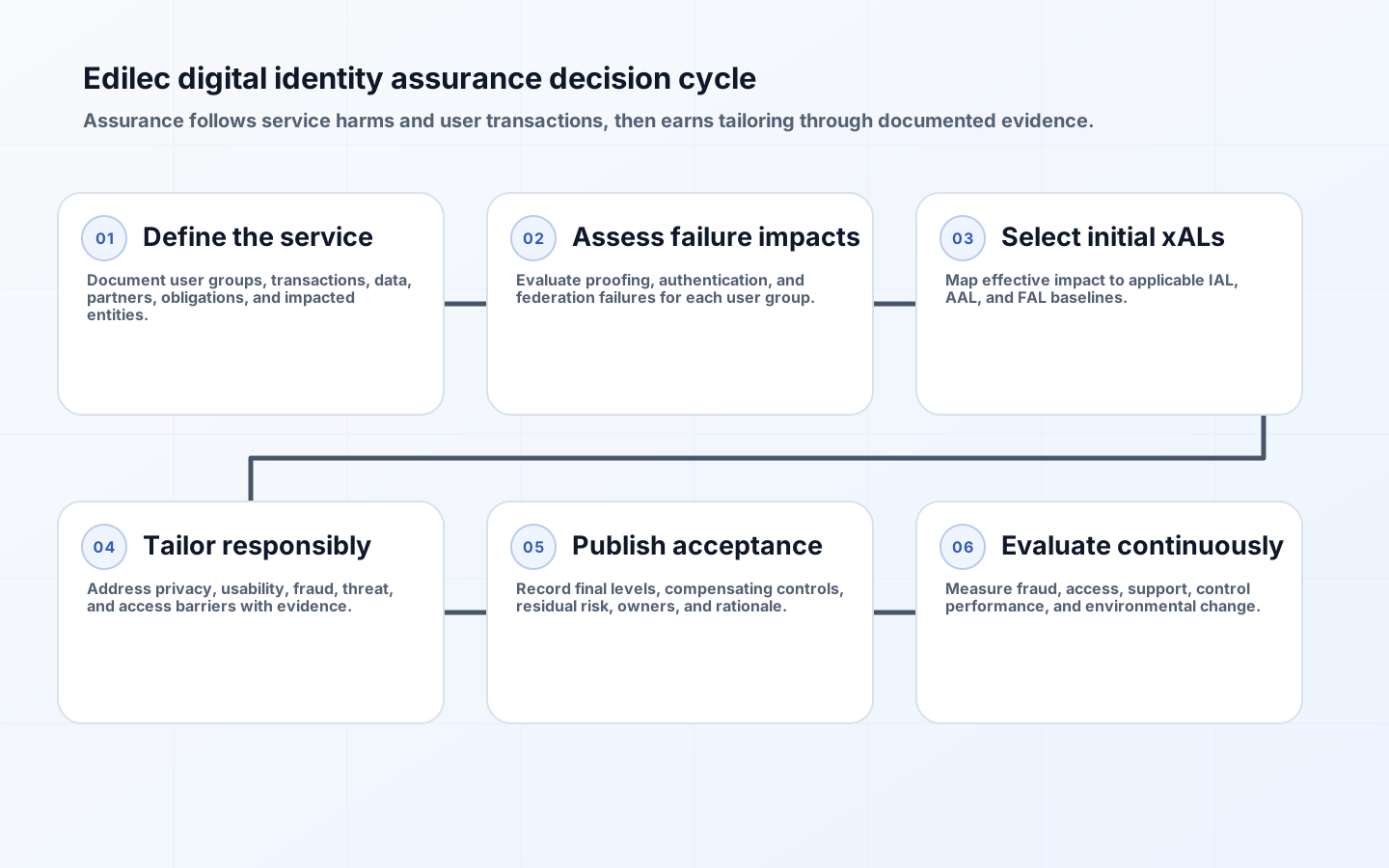
NIST 800-63-4 assurance levels are categories for the robustness of identity proofing, authentication, and federation controls. Applying them is not a matter of labeling an entire application IAL2 or AAL2 from a compliance checklist. Revision 4 starts with the online service, user groups, available transactions, impacted entities, and harms. Teams select initial IAL, AAL, and FAL values where those functions apply, then examine risks introduced by the identity system itself and document tailoring in a Digital Identity Acceptance Statement.
The NIST Digital Identity Risk Management process has five steps: define the service, assess initial impacts, select initial assurance levels, tailor and document, and continuously evaluate. That sequence prevents a common failure: choosing technology first and inventing a risk justification afterward. A practical assessment produces transaction-specific decisions, traceable controls, responsible owners, and measures showing whether security, fraud, privacy, usability, and access outcomes remain acceptable.
Define the online service and its user groups
Write a bounded service description covering mission, business objective, functionality, processed data, legal and contractual duties, partner dependencies, current identity technology, and populations served. Decompose broad labels such as customer portal into transactions: view public guidance, read a personal record, change an address, submit a claim, redirect payment, approve another user's access, and administer the service. The identity consequence differs for each action, so a single undifferentiated user class usually produces either weak protection or unnecessary friction.
For every user group, list privileges and identify all impacted entities, including people who do not directly use the service. A fraudulent benefits claim can harm the person impersonated, the agency, taxpayers, and downstream partners. Record evidence availability and access constraints across populations. Consult representative users as NIST recommends; a design that assumes every applicant owns a modern phone or has conventional credit records can introduce exclusion and privacy risk even when it appears secure on paper.
Assess proofing, authentication, and federation failures
Analyze three distinct failures. Proofing failure lets an imposter obtain an account or credential under another identity. Authentication failure lets a false claimant control an existing account. Federation failure communicates an assertion or attributes to the wrong relying party, accepts the wrong subject, or relies on corrupted upstream information. For each user group, evaluate degradation of mission, damage to trust, unauthorized information access, financial loss or liability, and danger to life, health, safety, or the environment. Add mission-specific categories where needed.
Assign low, moderate, or high impact using documented organizational thresholds and concrete scenarios. Record scale, reversibility, duration, affected entities, and available safeguards. Use one consistent combination method, such as a high-water mark, and retain the underlying judgments. Do not copy the host system's general security impact rating without analysis; digital identity failures can affect transactions differently. An anonymous public lookup may need no proofing while an administrator in the same system can require high proofing, authentication, and federation protection.
Select applicable IAL, AAL, and FAL baselines
IAL concerns confidence that a claimed identity corresponds to the real person. AAL concerns control of authenticators bound to the subscriber account. FAL concerns protection of federated authentication and attribute information between an identity provider and relying party. Select each only when the service uses that function. A service can allow pseudonymous access with no identity proofing while requiring strong authentication. A locally authenticated service has no federation transaction and therefore no FAL. Keeping these axes separate prevents unnecessary collection of identity evidence.

| Journey | Identity failure of concern | Initial xAL direction | Design implication |
|---|---|---|---|
| Read public eligibility rules | No personal identity dependency | No IAL; no account required | Avoid collecting identity data |
| View personal application status | Account takeover exposes personal data | AAL selected; IAL depends on account issuance | Use secure authentication and session controls |
| Submit application for payment | Imposter could obtain benefit | IAL and AAL selected from assessed impact | Proof applicant and bind robust authenticators |
| Change payment destination | Takeover causes direct financial loss | Higher AAL or transaction step-up may be justified | Require fresh strong authentication and notification |
| Employee adjudicates claims through IdP | Wrong subject receives privileged access | AAL plus applicable FAL | Validate upstream assurance and protect assertion |
| Administrator exports case records | Large-scale confidentiality harm | Strongest applicable controls and supplemental policy | Phishing resistance, device context, approval, monitoring |
Use the normative companion volumes for the selected baseline: SP 800-63A-4 for proofing and enrollment, SP 800-63B-4 for authentication and authenticator management, and SP 800-63C-4 for federation and assertions. Build a requirements matrix with source section, applicable journey, implemented control, evidence location, owner, test, and exception. A level label without that traceability is not implementation.
Tailor controls for real-world risk
The initial baseline addresses risk from compromise; tailoring addresses risks and constraints introduced by the identity system. Evaluate privacy, customer experience, usability, equity, threat resistance, fraud, and operational feasibility. Tailoring may change an initially selected level, apply compensating controls, or add supplemental controls, but the decision needs analysis and justification. A compensating control should address the same risk objective, have an accountable owner, be testable, and be revisited. Cost or vendor inconvenience alone is not a security rationale.
Examples include offering multiple proofing pathways when one evidence type excludes a population, adding transaction monitoring where residual fraud remains, requiring phishing-resistant authentication for administrators even when a broader population baseline is lower, or using pairwise identifiers to reduce correlation. Tailoring can also reduce data: if the service needs only eligibility or age, a derived attribute may avoid disclosing a full birth date. Link these decisions to a zero-trust resource view so assurance supports specific access rather than permanent trust.
Write the Digital Identity Acceptance Statement
The acceptance statement is the decision record, not a marketing summary. Include the service and user groups; assessed impacts and combination method; applicable initial and final IAL, AAL, and FAL; baseline requirements; tailoring; compensating and supplemental controls; privacy and customer-experience findings; residual risks; implementation evidence; responsible officials; review triggers; and accepted deviations. Make the statement precise enough that procurement, architecture, testing, authorization, and operations all implement the same decision.
| Decision area | Evidence | Owner | Review trigger |
|---|---|---|---|
| Service scope | Transaction and user-group catalogue | Product owner | New functionality or population |
| Impact assessment | Scenarios, thresholds, entities, ratings, combination logic | Risk owner | Material fraud or harm event |
| Assurance baselines | IAL, AAL, FAL requirements matrix | Identity architect | Standard or architecture change |
| Tailoring | Privacy, usability, threat, fraud analysis and rationale | Authorizing official | Control failure or new threat |
| Implementation | Configuration, test results, supplier evidence, procedures | Control owners | Release or vendor change |
| Performance | Fraud, access, support, error, redress, security measures | Service operator | Threshold breach or scheduled review |
Validate implementation and continuously evaluate
Test complete journeys, not isolated controls. Confirm proofing evidence and applicant binding, authenticator enrollment and recovery, session behavior, assertion validation, account linking, attribute release, administrative access, redress, and exception handling. Verify that the relying party actually receives and enforces upstream context rather than assuming an IdP configuration. The OpenID Connect checklist is useful for protocol mechanics, but assurance review must also cover the upstream processes behind claims.
Operate a measure set for fraud attempts and losses, account takeover, proofing false acceptance and rejection, abandonment, completion by population, recovery outcomes, accessibility issues, help-desk overrides, federation errors, assertion replay defenses, privacy incidents, and redress time. Define thresholds and responsible responses. New transaction types, changed data use, new identity providers, emerging attacks, major incidents, and population impacts should trigger reassessment. Continuous evaluation keeps a justified decision from becoming a stale label.
Govern changes to assurance decisions
Put the acceptance statement under change control and connect it to release governance. A new payment feature, delegated administrator, identity-proofing vendor, authenticator fallback, federation proxy, attribute source, or account-linking rule can change the identity risk even if the application's infrastructure rating remains stable. Require proposed changes to identify affected user groups, xAL requirements, control mappings, privacy impacts, test evidence, and residual risk before release. Maintain a decision history rather than overwriting prior rationale, because investigators and auditors may need to know which policy governed an earlier transaction. Periodic review is still useful, but event-driven reassessment is what keeps implementation aligned with the actual service. Make retired decisions searchable and link each production release to the approved statement version, control evidence, and accountable authorizing official.
NIST assurance level implementation takeaways
- Decompose the service into user groups and transactions before selecting technology.
- Assess proofing, authentication, and federation failures separately for all impacted entities.
- Select only the IAL, AAL, and FAL functions that actually apply.
- Trace every selected baseline requirement to implementation evidence and a test.
- Tailor for privacy, usability, equity, fraud, and threats with documented rationale.
- Maintain a Digital Identity Acceptance Statement and revisit it when service or risk changes.
NIST 800-63-4 assurance levels FAQ
Does every authenticated service need an IAL? No. IAL is about resolving and validating a person's real-world identity. A service can support pseudonymous or self-asserted accounts while still selecting an AAL to protect account access.
Can one service use different assurance levels? Yes. User groups and transactions can create different impacts, and a service can apply stronger controls or step-up for sensitive actions. The assessment and resulting policy must remain understandable and consistently enforced.
Is federation assurance the same as the user's AAL? No. AAL describes authentication robustness; FAL describes protection of the federation transaction. A relying party needs both the relevant upstream authentication information and federation controls appropriate to its risk.
Conclusion
Revision 4 makes assurance a service-risk decision supported by evidence and continuous learning. Teams that define transactions, assess concrete harms, keep IAL, AAL, and FAL distinct, and document tailoring can build identity controls that are strong without being indiscriminate. The enduring deliverable is not an xAL badge; it is a traceable acceptance decision that operations can test and improve.