Zero trust is not a product category and it is not equivalent to removing a VPN. It is a design strategy for access decisions in environments where users, devices, applications and data are distributed across cloud services, corporate networks, partner systems and unmanaged locations. The central idea is straightforward: no request is trusted simply because it originates from a particular network segment. Every request should be evaluated using current evidence about identity, device posture, requested resource, policy and surrounding context.
That principle matters because modern compromise rarely looks like an outsider pounding on a perimeter wall. It often looks like valid credentials, an over-privileged service account, a partner connection with broad reach, or an internal application that trusts the network too much. Zero trust responds by shifting security attention from network location to explicit, resource-centric authorization. The approach has architectural consequences: applications need their own access policies, identity systems need stronger signals, and telemetry must support continuous reassessment rather than one-time admission at the edge.
Start from explicit verification, least privilege and assumed breach
Three ideas anchor zero trust. First, verify explicitly: evaluate each access request using current signals rather than prior network placement. Second, apply least privilege: grant only the actions and data exposure needed for the task, for the shortest sensible duration. Third, assume breach: design as if an attacker may already possess a foothold, a token or a compromised device somewhere in the environment. These principles are mutually reinforcing. Least privilege limits blast radius, explicit verification makes access contingent on present conditions, and assumed breach keeps teams from relying on broad internal trust that an attacker can later exploit.
The practical implication is that zero trust is about protected resources, not abstract infrastructure. Start with the applications, APIs, administrative functions and data paths whose compromise would matter most. Then work backward to the identities, devices, networks and policy services that influence access to those resources. Programs fail when they begin with a universal infrastructure overhaul but never define which decisions and assets the architecture must protect first. A zero trust plan should be able to name the request, the resource and the policy evidence that matters.
Model every protected request as a policy decision
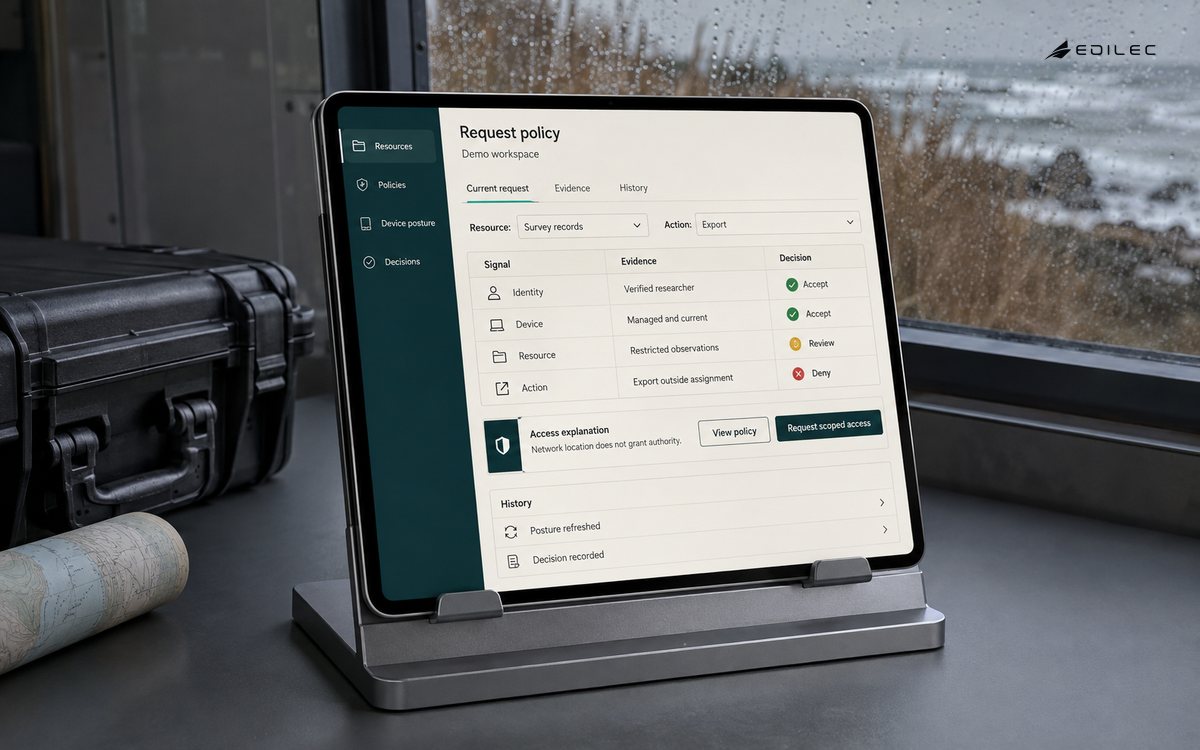
A useful mental model is a policy decision path: a subject requests an action on a resource, a decision point evaluates evidence and policy, an enforcement point allows or denies the action, and telemetry records what happened for later review. NIST describes these roles formally, but the operational value lies in making each step inspectable. Which identity asserted the request? Which device or workload posture contributed context? Which policy determined the permitted action? Which enforcement point actually limited access? If teams cannot answer those questions, they may be implementing strong authentication without implementing zero trust.
This request-centric design also separates authentication from authorization. Authenticating a user or workload tells you who is present. Zero trust then asks whether that actor should perform this action on this resource right now, under these conditions. That distinction is why application-layer access matters so much. Once applications are treated as protected resources instead of mere destinations behind a trusted network, policy can become more precise and less dependent on broad network reach.
| Decision input | What it represents | Why it matters |
|---|---|---|
| Identity | The user, service or workload making the request | Access should map to a specific accountable actor |
| Device or workload posture | Health, management state or runtime confidence | A valid identity on an unsafe device may still be risky |
| Resource sensitivity | The data, function or system being accessed | High-value resources justify stronger controls and logging |
| Requested action | Read, write, administer, export or execute | Least privilege is defined per action, not only per login |
| Environmental context | Location, time, network path or anomalous behavior | Policy can adapt when circumstances change |
| Telemetry history | Previous activity, alerts or session change signals | Access decisions should improve with evidence over time |
Use identity, device, resource and environmental signals together
Single-factor trust decisions create brittle programs. Zero trust works best when several independent signals contribute to the authorization outcome. Strong identity may include phishing-resistant MFA, enterprise-managed accounts and high-confidence lifecycle events. Device or workload signals may include management status, patch level, attestation or the runtime security posture of a workload. Resource signals may express data sensitivity, environment, tenant or administrative importance. Environmental signals can add anomaly detection, impossible travel, time-based restrictions or unusual API behavior. The goal is not to collect every possible signal. It is to combine enough high-value evidence to reduce implicit trust materially.
This also means policy has to stay understandable. If the only way to explain an access decision is to inspect a proprietary risk score after the fact, the organization has traded one opaque trust model for another. Strong zero trust policies are specific enough that operators and auditors can explain them: this actor on this device may perform this action on this resource when these conditions hold. As the program matures, automation can help evaluate more signals and shorten standing access, but the underlying logic should remain reviewable by humans.
Migrate by protecting specific applications and data flows first
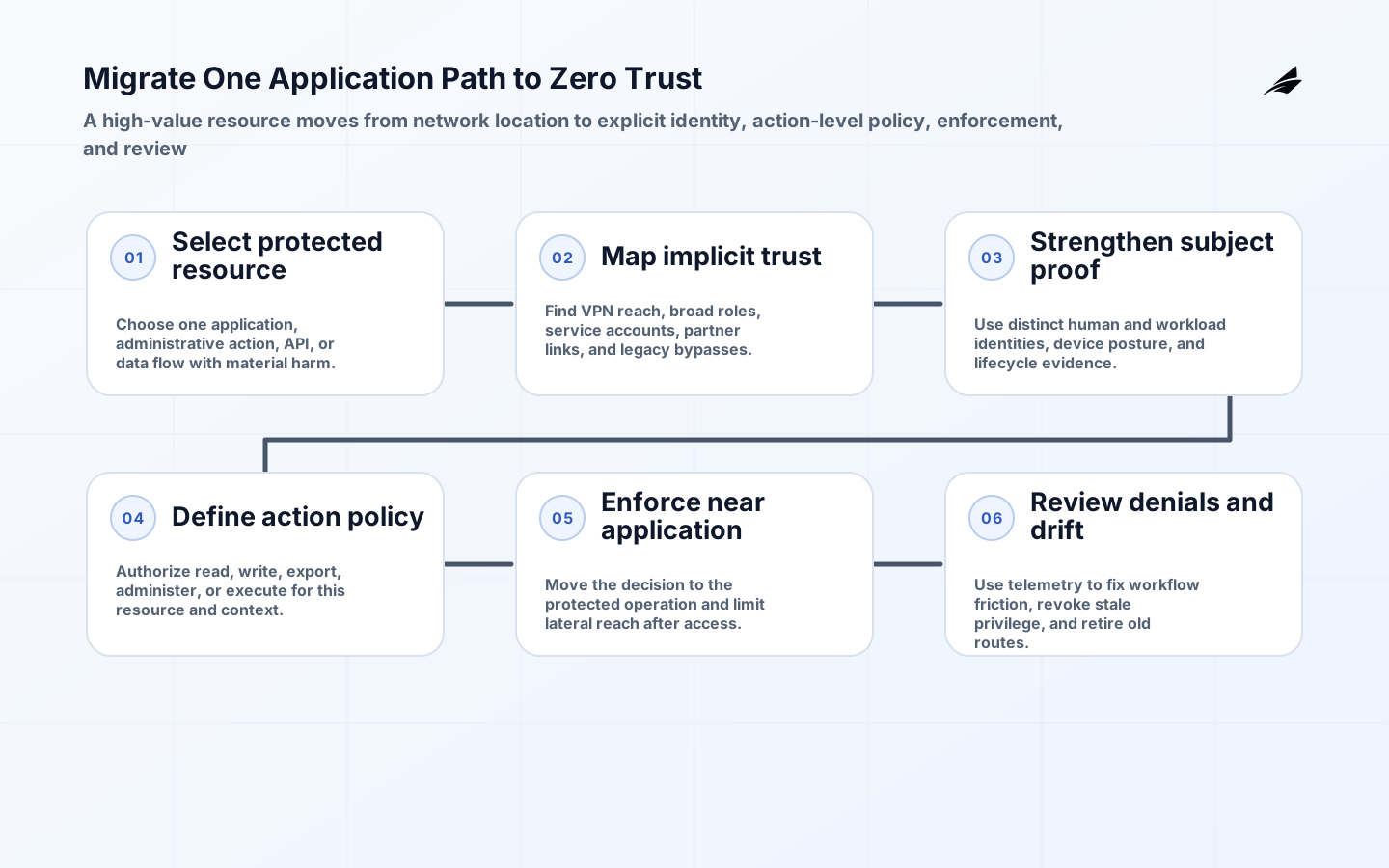
Zero trust implementation is usually a sequence of protected resource migrations, not a single cutover. Choose a high-value application or administrative path, improve identity assurance, move authorization to the application layer, limit lateral reach, tighten logging and then rehearse how support and incident response will work. This is more effective than trying to redesign the entire network and application estate at once. The OMB strategy is useful because it frames the program through complementary identity, device, network, application and data objectives. In practice, those pillars help teams avoid over-investing in one layer while leaving the protected resource model weak.
A phased approach also exposes dependencies. Legacy protocols, hard-coded service accounts, unmanaged devices, embedded partner links and fragile administrative workflows often surface only when a specific access path is tightened. Those findings are valuable. They show where the old trust model was doing hidden work. The implementation goal is not to eliminate every legacy dependency before progress begins. It is to reduce implicit trust in the most consequential paths while building reusable controls and patterns for the next wave.
Operate zero trust with telemetry, review and recovery
Zero trust does not end at the access decision. The organization still needs telemetry, anomaly review, policy maintenance, incident response and recovery planning. Session conditions can change after access begins. Devices drift, credentials are stolen, policies become stale and workloads evolve. Good operations therefore include periodic access review, detection tied to protected resources, logs that explain why access was granted or denied, and practical recovery steps when a misapplied policy blocks legitimate work. Security that cannot be recovered from safely becomes a business outage source.
This operational view is why zero trust should be evaluated with both security and usability evidence. If legitimate users constantly escalate around policy, if applications cannot express fine-grained authorization cleanly, or if support teams cannot diagnose denials quickly, the program will create pressure for broad exceptions. Those exceptions slowly rebuild implicit trust. Mature programs monitor where policy friction appears, decide whether the friction is justified, and improve the identity, application or workflow design accordingly.
Avoid common implementation failures
The most common failures are architectural, not philosophical. Teams authenticate strongly but still authorize broadly at the network layer. They deploy a broker or gateway yet leave applications unable to enforce their own action-level rules. They gather posture signals but never connect them to resource sensitivity. They centralize policy but cannot explain the reason for a deny result to a support team. Or they treat zero trust as an infrastructure project without involving application owners, data owners and operations leads whose workflows will change most.
| Failure mode | Early signal | Practical treatment |
|---|---|---|
| Network trust still dominates | Users gain broad access after one successful login | Move authorization to application and resource actions |
| Identity is strong but privilege is broad | Compromised accounts can still reach too much | Shorten standing access and redesign roles by task |
| Policy cannot be explained | Support teams cannot diagnose a deny event | Capture decision evidence and simplify policy logic |
| Legacy paths remain implicit | Critical workflows bypass the new control model | Map exceptions, prioritize them and retire them deliberately |
| Telemetry is incomplete | Access changes cannot be reconstructed later | Log decision inputs, outcomes and protected resource context |
| Usability backlash grows | Teams demand blanket exceptions to stay productive | Fix workflow design and target friction with evidence |
Key takeaways
- Zero trust is a request-centric design strategy, not a single tool or gateway.
- Protect resources by combining explicit verification, least privilege and assumed breach.
- Model each protected request through identity, posture, resource, action and context.
- Migrate by hardening important application and data paths first.
- Operate zero trust with reviewable telemetry, policy maintenance and recovery plans.
- Avoid rebuilding implicit trust through broad exceptions and network-centric shortcuts.
Frequently asked questions
Does zero trust mean removing the VPN?
Not necessarily. Some organizations reduce or replace VPN use, but the more important change is shifting trust decisions toward protected resources and application-layer authorization. A VPN can coexist with zero trust if it is not treated as the primary trust boundary.
Is phishing-resistant MFA enough to claim zero trust?
No. Strong MFA is foundational, but zero trust also requires least privilege, resource-aware authorization, supporting telemetry and continuous reassessment. A well-authenticated user can still be over-authorized or operating from an unsafe device or workload.
Where should a zero trust program start?
Start with a high-value application, administrative path or data flow whose compromise would matter, then redesign that path around explicit policy, stronger identity signals and clear telemetry. This reveals hidden trust assumptions and creates reusable patterns for broader rollout.
How do you know a zero trust implementation is working?
Useful signs include narrower blast radius, more reviewable access decisions, faster diagnosis of access issues, fewer broad standing privileges and better alignment between application policy and business role. Tool deployment or gateway traffic alone is not sufficient proof.
Conclusion
Zero trust becomes practical when every protected request is treated as a policy decision backed by current evidence. That design reduces reliance on network location and makes access easier to inspect, narrow and adapt as conditions change. The organizations that benefit most are not the ones that buy the most zero trust products. They are the ones that translate the principle into clear resource boundaries, reviewable policy and operationally credible recovery.