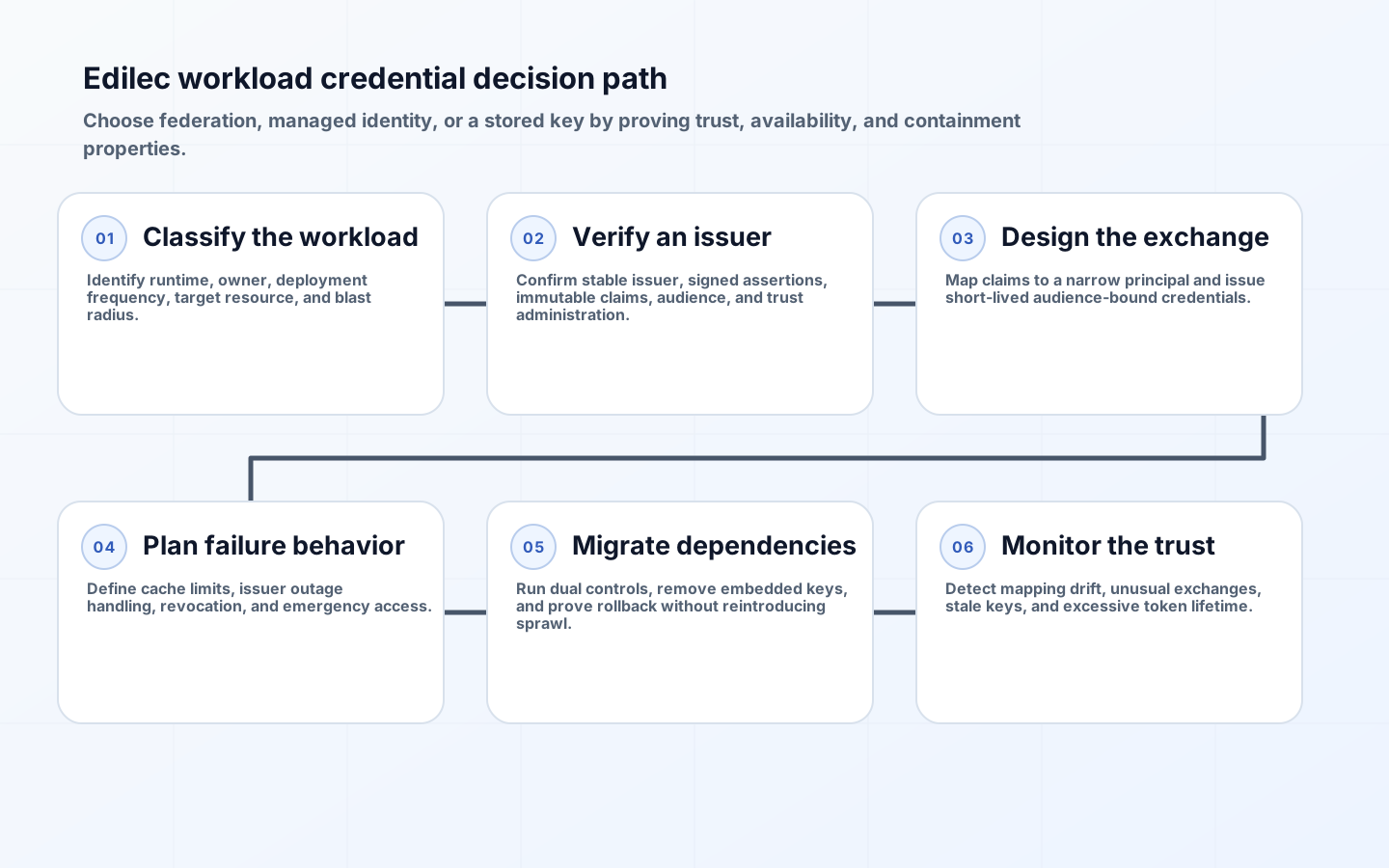
Workload identity federation vs service account keys is a choice between exchanging verifiable runtime evidence for short-lived target credentials and distributing a long-lived credential that a workload presents directly. Federation usually reduces secret copies, rotation burden, and exposure duration, but it adds trust configuration and dependency on an issuer and security-token service. Stored keys remain necessary in some disconnected or legacy environments. The safer choice follows a documented threat model, availability design, and ability to authenticate the workload's origin.
OAuth token exchange defines a security-token service that validates one token and issues another, including delegation and impersonation scenarios. RFC 8693 also makes clear that the protocol does not define a deployment's trust model and that input-token revocation does not automatically propagate. Cloud federation profiles build policy around issuer, subject, audience, and claims. Teams must design those mappings narrowly; replacing a JSON key with an assertion accepted from any repository or branch can increase privilege rather than reduce it.
Define the workload and target relationship
Record runtime location, orchestration platform, deployment owner, target cloud or SaaS resource, actions, data sensitivity, frequency, interactive or batch behavior, and consequence of compromise. Determine whether the workload already receives a signed platform identity such as a cloud instance identity, Kubernetes projected service-account token, CI job token, or SPIFFE SVID. The issuer must be administratively trustworthy, and claims must distinguish the intended workload using properties an attacker cannot freely choose.
Map every trust boundary: external issuer, token endpoint, network path, target authorization service, workload runtime, deployment control plane, and policy administration. Decide whether the workload acts as itself or on behalf of a user. The OAuth security architecture guide helps separate client, authorization server, resource, audience, and token boundaries. Do not use a human refresh token as a convenient machine credential; its lifecycle and accountability do not match unattended execution.
Compare federation, managed identity, and stored keys
| Property | Federated workload identity | Platform-managed identity | Stored service account key |
|---|---|---|---|
| Bootstrap | Trust external signed assertion and claims | Trust local platform workload attachment | Securely distribute secret material |
| Credential lifetime | Short-lived exchanged token | Short-lived platform token | Often long-lived until rotated |
| Secret copies | No target key in workload | No exported target key | Copies may exist in CI, vaults, files and backups |
| Portability | Cross-platform with profile and claim mapping | Strongest inside one platform | Broad legacy compatibility |
| Availability dependency | Issuer plus token exchange service | Platform metadata and IAM services | Local key works until rejected or expired |
| Primary failure | Overbroad trust or claim mapping | Compromised platform attachment | Theft, leakage, stale copies, rotation failure |

Prefer a platform-managed identity when the workload and target share a platform that can attach identity without exported secrets. Prefer federation when a trustworthy external runtime assertion can be exchanged for narrow target access. Use a stored key only when no acceptable workload identity or exchange exists, connectivity or platform constraints make federation infeasible, and the business need justifies custody. Even then, use a dedicated principal, least privilege, protected storage, automated rotation, distribution tracking, monitoring, and an expiry-backed migration plan.
Design issuer trust and claim mapping
Allowlist exact issuer identifiers and validate signatures through authenticated metadata or controlled keys. Require the expected audience and token type. Map immutable, platform-controlled claims such as organization, repository ID, branch or environment protection, namespace, service account, and job identity to a target principal. Avoid mutable repository names, unprotected branch strings, user-supplied labels, or wildcard subjects. Separate production and non-production trust. A token from a fork, pull request, test namespace, or personal project must not satisfy production policy.
Google documents exchanging external credentials through Workload Identity Federation, while AWS documents trusting OIDC providers for role access in its IAM OIDC federation guidance. Treat provider examples as implementations, not universal policy. Test issuer confusion, audience substitution, subject mutation, unprotected environments, forked workloads, stale keys, and excessive role chaining. Configuration review should show exactly which assertion can obtain which target role.
Constrain exchanged credentials
Issue credentials for one target audience and the smallest resource and action set the workload needs. Keep lifetime short enough to limit theft but long enough for expected jobs and bounded retry. Avoid refresh tokens for routine workload exchanges where fresh platform evidence is available. Bind session names and audit context to workload identifiers. If delegation is used, preserve actor and subject rather than collapsing both into an indistinguishable service account. Resource servers must validate issuer, audience, expiry, and authorization on every request.
Protect the exchange endpoint against replay, excessive token minting, and policy enumeration. Rate-limit thoughtfully, log safe token identifiers rather than raw tokens, and alert on new subjects, unusual audiences, high exchange volume, long lifetimes, and access outside expected deployment windows. NIST's cloud-native zero-trust guidance emphasizes service identity and granular application policy; short-lived authentication evidence is useful only when the target still enforces resource-level authorization.
Plan outages, revocation, and emergency access
Model failure of the external issuer, DNS, metadata discovery, token exchange service, target IAM control plane, and local network. Decide whether current tokens may run to expiry, whether a tightly bounded cache is acceptable, and which workloads fail closed or queue work. Never cache an exchange token beyond its validity or turn an outage into an automatic long-lived key fallback. For safety-critical continuity, provision a separate emergency path with narrow scope, protected custody, approval, monitoring, and rehearsal.
Revocation in federation is often policy and time based. Remove or change the trust mapping, disable the target principal, invalidate platform issuance, or wait for short token expiry as risk requires. RFC 8693 notes revocation propagation is deployment-specific, so test it. Stored keys require locating and invalidating every copy; the secrets-rotation guide explains why issuance, consumer rollout, verification, and old-secret revocation must form one coordinated change.
Migrate from service account keys safely
| Gate | Required work | Evidence | Rollback boundary |
|---|---|---|---|
| Inventory | Find principal, key copies, consumers, access and owner | Reconciled credential and usage records | No key revoked before consumers known |
| Trust | Create issuer, audience, subject and claim mapping | Negative and positive assertion tests | Federated role initially limited |
| Dual run | Enable exchange while key remains monitored | Equivalent job outcomes and audit attribution | Return to key only for defined defects |
| Constrain | Reduce scopes, token lifetime and role chaining | Authorization test suite | No broad temporary production role |
| Revoke | Remove key from stores, files, CI and backups where feasible | Revocation and failed-use evidence | Emergency identity remains separate |
| Close | Delete obsolete secret paths and document operations | No key use; alerts and owner sign-off | Reissue requires new approval |
During dual run, compare output, latency, token-exchange availability, audit identity, and failure behavior. Alert on any continued key use and identify the consumer before revocation. Remove keys from CI variables, images, configuration, developer machines, vault paths, and recovery documentation; assume source history and backups may require separate exposure handling. Update runbooks so operators do not recreate the key during the first outage. Close the migration only after denied old-key use and successful fresh federation are observed.
Audit and monitor federation operations
Retain safe, correlatable records for issuer, subject, audience, requested and issued scope, target principal, token lifetime, policy version, workload deployment, exchange result, and downstream authorization decision. Never store raw bearer tokens. Join control-plane changes to runtime activity so an investigator can answer when a trust mapping broadened and which workloads used it. Alert on previously unseen subjects, production exchange from non-production environments, unusual token lifetime, unexpected audiences, excessive failures, dormant principals returning, and key use after migration. Periodically reconcile configured trust against observed issuers and repositories; remove mappings with no current owner or business use.
Also assess administrative concentration. A person able to modify both the external workload definition and the target claim mapping may be able to manufacture an assertion that receives production access. Separate those duties for sensitive roles, protect environment and branch rules, require review for trust-policy changes, and monitor emergency overrides. Document provider quotas and token-service capacity, because operational pressure can tempt teams to cache credentials too long. A successful federation program makes exchange behavior predictable enough that deviations stand out and failures do not encourage engineers to recreate the exported keys they worked to remove.
Workload identity federation takeaways
- Choose credential design from workload, target, trust, outage, and compromise requirements.
- Prefer managed or federated short-lived identity when a trustworthy runtime assertion exists.
- Allowlist exact issuers and map immutable platform claims to narrow target principals.
- Constrain audience, resource, scope, lifetime, chaining, and delegated subject or actor semantics.
- Design issuer and exchange outages without silently restoring long-lived keys.
- Migrate with inventory, negative trust tests, dual run, observed revocation, and updated operations.
Workload identity federation FAQ
Is workload federation secretless? It removes the target service-account key from the workload, but trust still depends on signing keys, platform credentials, token handling, and policy. Secretless is useful shorthand, not absence of cryptographic secrets.
Is federation always safer than a key? No. An overbroad issuer or subject mapping can let many workloads mint privileged tokens. Federation is safer when the external identity is trustworthy, mappings are narrow, tokens are constrained, and operations are monitored.
What if the token service is unavailable? Use a predesigned failure mode based on transaction harm: allow valid tokens to expire, queue work, fail closed, or invoke a separately governed emergency path. Do not improvise an unrestricted key.
Conclusion
Workload federation replaces secret distribution with an explicit trust exchange. That is usually a strong trade when the runtime can present verifiable identity and the target can issue short-lived, audience-bound access. Its security comes from narrow issuer and claim policy, bounded credentials, safe failure behavior, and monitored migration. Where a stored key remains, treat it as a documented exception with rigorous custody and an exit condition.