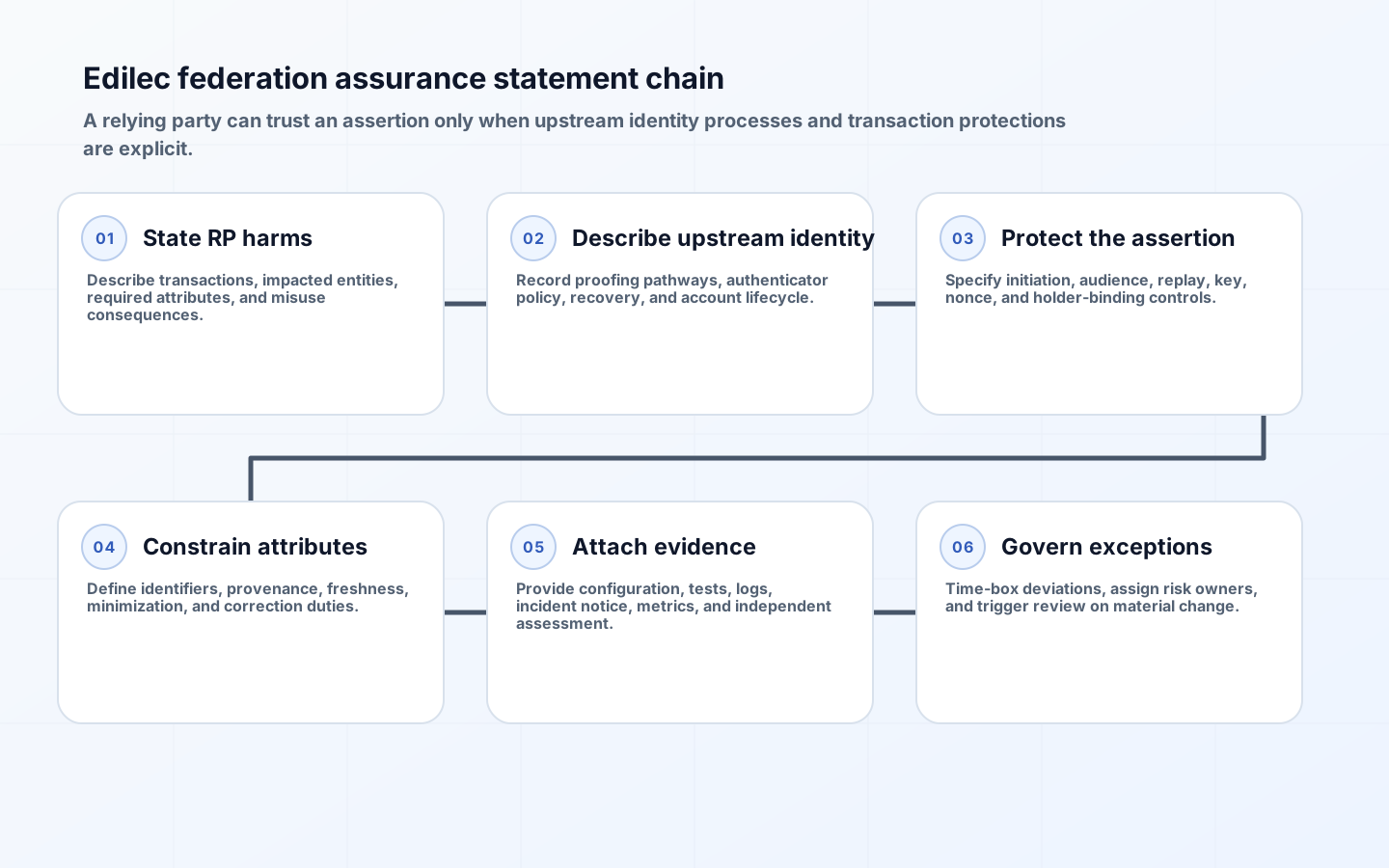
A federation assurance statement is a relying-party decision record describing what an identity provider establishes, how it establishes it, how the federation transaction is protected, and which exceptions or residual risks remain. Protocol conformance alone cannot answer those questions. A correctly signed OpenID Connect ID token may identify the wrong person because of weak upstream recovery, stale attributes, unsafe account linking, or inadequate proofing. The statement connects claims received by the relying party to the identity processes and evidence that make those claims dependable.
NIST SP 800-63C-4 defines federation assurance levels for protecting assertions and federation transactions. FAL1 requires audience and replay protections; FAL2 adds stronger assertion-injection defenses, RP initiation, a single audience, and a pre-established trust agreement; FAL3 adds subscriber-controlled authenticator protection at the RP. An assurance statement should translate the applicable baseline and tailoring into terms procurement, architecture, operations, audit, and incident response can verify.
Start with relying-party transactions and harms
Describe the relying party, user groups, transactions, data, privileges, and impacted entities. Separate ordinary sign-in from payment changes, delegated administration, bulk export, and production access. Assess what happens if the wrong subject signs in, an assertion is injected or replayed, attributes are false, an identifier is reassigned, or an assertion reaches the wrong RP. The NIST risk-management process selects initial assurance from those service impacts rather than from the IdP's strongest advertised capability.
List exactly which claims drive authorization or account resolution. A stable subject identifier, authentication time, authentication context, tenant, employment status, group, age-derived value, and email address have different provenance and change behavior. Mark claims used only for display separately from claims that grant access. Minimize requested attributes and prefer pairwise identifiers where appropriate. If the RP cannot explain the decision a claim supports, it should not collect or trust that claim by default.
Map the upstream identity processes

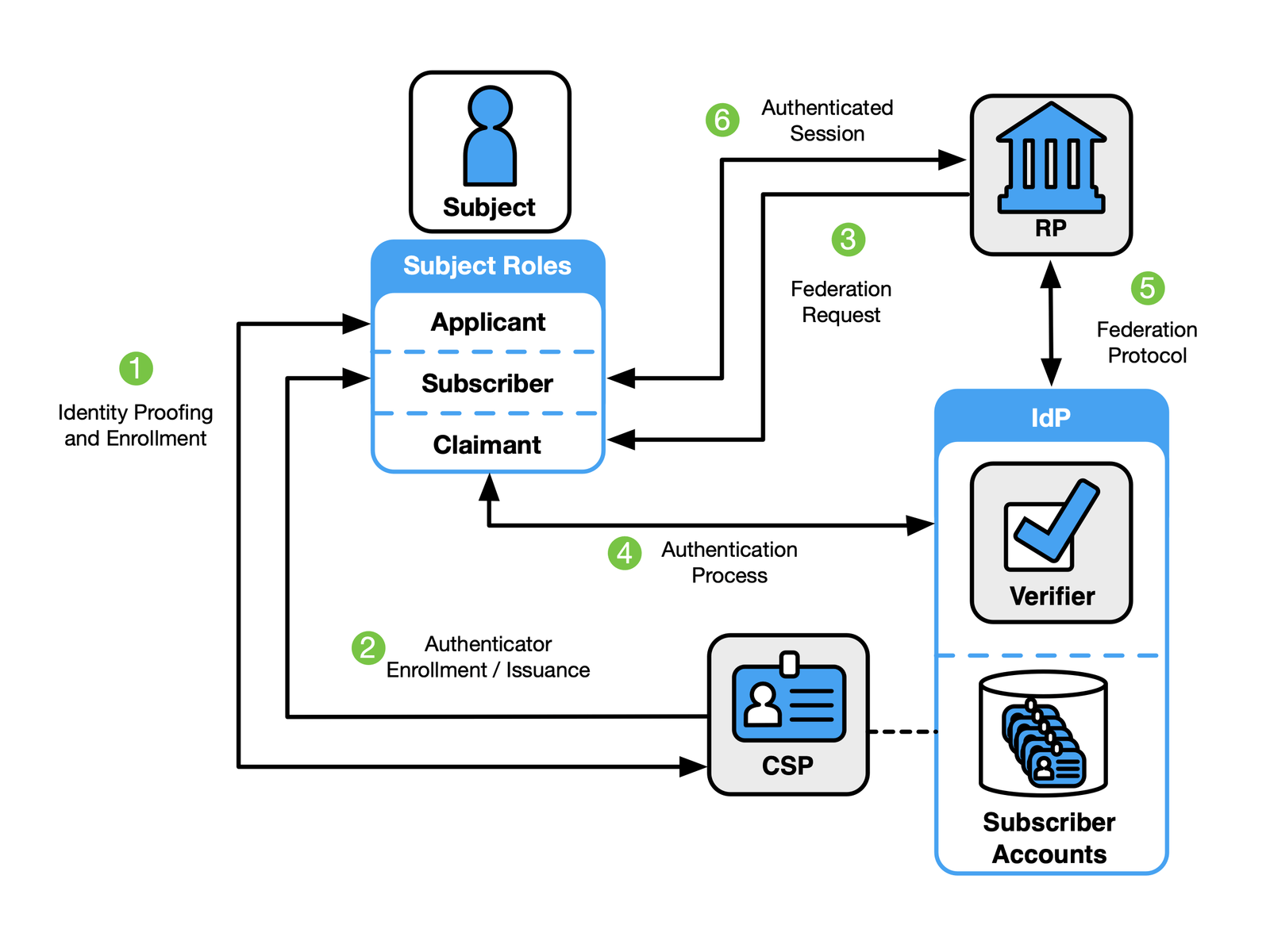
Document account issuance, identity proofing pathways, evidence validation, subject verification, authenticator policy, enrollment, recovery, suspension, termination, duplicate handling, and attribute maintenance. State supported IAL and AAL outcomes with evidence and deviations. A relying party that requires phishing-resistant authentication needs to know whether every relevant route provides it, whether a password can bypass it, and how a recovered account regains that status. Reference the IdP's acceptance statement or equivalent controlled document rather than copying unsupported labels.
Record authoritative sources for each material attribute, validation timing, freshness, update cadence, correction process, and failure behavior. Explain identifier uniqueness, persistence, reassignment prohibition, and tenant scope. If the IdP obtains attributes from another broker or upstream IdP, show the complete chain and the weakest effective assurance. NIST notes that federation through a proxy does not become stronger than its lower-assurance segment. Supplier chains need visible boundaries, incident duties, and change notification.
Document the federation assurance statement
Use a controlled structure: parties and roles; service scope; user groups; required IAL, AAL, and FAL; supported protocols and profiles; trust establishment; upstream proofing and authentication; identifiers and attributes; assertion protection; key management; account linking; sessions and logout; privacy; operational evidence; incident response; deviations; residual risk; owners; review triggers; and approval. Version the statement and bind it to contracts and technical configuration. The RP should be able to detect when reality no longer matches the accepted version.
| Section | Question answered | Evidence | RP validation |
|---|---|---|---|
| Identity process | How was the subject and account established? | Proofing, enrollment, recovery, lifecycle procedures | Trace required assurance to pathways |
| Authentication | How did the subscriber authenticate? | Authenticator policy and context values | Reject insufficient or absent context |
| Assertion protection | Why is this token authentic and intended here? | Issuer, signature, audience, nonce, time, replay controls | Execute positive and negative protocol tests |
| Attributes | Where did decision-driving claims come from? | Source, freshness, semantics, correction and release policy | Authorize only on understood claims |
| Operations | Can the dependency be monitored and investigated? | Logs, metrics, key events, incident notice | Reconcile RP and IdP evidence |
| Exceptions | What differs from baseline and who accepts it? | Rationale, compensating controls, owner, expiry | Block unapproved or expired deviation |
Specify assertion and protocol protections
For OpenID Connect, identify issuer, discovery metadata, client registration, redirect URIs, response flow, signing algorithms, key distribution and rotation, subject type, requested scopes and claims, authentication context, maximum age, nonce and state handling, session behavior, and logout. The OpenID Connect Core specification defines ID-token validation, including issuer, audience, signature, and time checks. The RP must still implement those checks and bind the result to the correct transaction.
Require RP-initiated flow and injection protections where the selected FAL calls for them. Validate audience exactly, enforce replay defenses, constrain algorithms, protect authorization codes, and prevent mix-up among multiple issuers. Manage signing keys through authenticated metadata with rotation overlap and alerts for unexpected change. Do not accept tokens intended for another client or treat access tokens as identity assertions. The OIDC implementation checklist provides detailed mechanics that should be linked to assurance evidence.
Govern account linking and attribute use
Account linking can defeat sound federation if an RP joins identities using a mutable email address or an attacker-controlled session. Define whether linking is administrative, user-initiated, or automatic; which stable identifiers participate; what fresh authentication is required; how conflicts are resolved; and how links are reviewed and removed. Never use email alone as a globally unique, immutable subject key. Preserve the issuer and subject pair so identical subject strings from different issuers do not collide.
At authorization time, distinguish identity, entitlement, and context. The IdP may assert who authenticated and selected attributes; the RP remains accountable for deciding what that subject may do. Validate attribute semantics and freshness, and fail safely when a mandatory claim is missing or malformed. Avoid mapping broad IdP groups directly to high privilege without governance. The OAuth and OIDC product guide helps teams separate identity claims from API authorization.
Require operational evidence and incident duties
Define events both parties retain: federation request and result, issuer, subject pseudonym, client, authentication time and context, assertion identifier or safe correlation value, claim-release policy, linking action, administrative configuration, signing-key lifecycle, recovery event, and risk decision. Avoid logging raw tokens or unnecessary attributes. Agree time synchronization, retention, access, integrity, and correlation. The audit-log architecture guide helps turn these records into investigation evidence rather than a sensitive data dump.
Set notice windows for signing-key compromise, issuer compromise, proofing or recovery control failure, material fraud, attribute-source corruption, identifier collision, unauthorized configuration, and relevant service outage. Define containment: reject an issuer or key, force reauthentication, invalidate RP sessions, suspend risky transactions, or use a tested alternative. Include evidence access and joint investigation duties in the agreement. Tabletop compromise of the IdP; federation centralizes convenience and can centralize blast radius.
Review and accept identity-provider assurance
| Finding | Risk | Possible response | Acceptance evidence |
|---|---|---|---|
| Required AAL is not present in assertion context | RP cannot enforce authentication strength | Add trustworthy context or perform RP step-up | Negative test and configuration |
| Recovery can restore weak factor | Upstream account takeover bypasses strong sign-in | Strengthen recovery or restrict transactions | Recovery test and policy |
| Email is account-linking key | Reassignment or takeover can merge accounts | Use issuer-subject identifier and verified migration | Linking test and data model |
| FAL2 journey allows IdP initiation | Greater assertion-injection exposure | Require RP initiation | Flow capture and rejection test |
| Signing-key change is unmonitored | Compromise or outage may go unnoticed | Add metadata validation, overlap, and alerts | Rotation exercise |
| Deviation has no owner or expiry | Temporary weakness becomes permanent | Reject or create governed exception | Signed acceptance and review date |
Run protocol tests, configuration review, sample evidence review, recovery exercises, account-linking tests, key-rotation exercises, and incident tabletop sessions. Accept residual risks at the authority level appropriate to service harm. Schedule review and trigger it on new transactions, changed user populations, upstream supplier changes, material incidents, new protocols, control degradation, or standard revision. A certificate or audit report can support the statement, but it cannot replace RP-specific analysis of claims and transactions.
Assign ownership across the federation relationship
Name owners for trust configuration, upstream identity policy, RP claim mapping, signing keys, privacy, supplier management, incident response, and final risk acceptance. Define who can approve a new client, change redirect URIs, broaden released attributes, alter authentication context, or accept a temporary deviation. Maintain contacts that work outside the federated login path so an IdP outage or compromise does not block coordination. Review access to both parties' administrative consoles and test an emergency trust shutdown. Clear ownership matters because federation failures often cross organizational boundaries; without a pre-agreed decision structure, each party may wait for the other while unsafe assertions and active RP sessions remain usable.
Federation assurance statement takeaways
- Start from relying-party harms, transactions, and decision-driving claims.
- Document upstream proofing, authentication, recovery, lifecycle, and attribute provenance.
- Map the selected FAL to concrete assertion, trust, replay, audience, and key controls.
- Keep issuer-subject identity separate from mutable display attributes and local authorization.
- Contract for operational evidence, incident notice, containment, and material-change review.
- Time-box deviations and require RP-specific acceptance rather than relying on vendor labels.
Federation assurance statement FAQ
Is an OIDC discovery document an assurance statement? No. It describes endpoints and protocol capabilities. It does not document proofing, recovery, attribute provenance, operational controls, exceptions, or the RP's risk acceptance.
Does FAL2 mean the user authenticated at AAL2? No. FAL and AAL protect different functions. The RP must require and validate the authentication assurance it needs in addition to selecting federation protections.
Can an audit report replace due diligence? It can supply useful evidence, but the RP still needs to map scope and findings to its transactions, claims, required assurance, technical configuration, and residual risks.
Conclusion
Federation shifts identity work upstream but does not shift accountability for relying-party access. A useful assurance statement makes the entire dependency legible: what was proved, how the subscriber authenticated, why the assertion belongs to this transaction, where attributes came from, and what happens when controls fail. With that record, federation becomes a governed trust relationship rather than a signed-token assumption.