Enterprise Security Solutions: Scope, Architecture, Cost Drivers and Delivery Plan is for security leaders, enterprise architects, system owners, procurement teams and operations groups selecting or integrating security capabilities. The aim is to reduce material business risk through controls that have owners, integration paths, measurable coverage and exercised response. That changes the planning question from “which tool or supplier looks impressive?” to “what operating result must be true, which boundaries carry risk, and what evidence will let accountable owners approve the next step?” A useful plan makes those choices inspectable before implementation and keeps them visible through release.
Estimate an enterprise security solution program from the work that creates uncertainty: priority business services, asset and identity coverage, integration effort, telemetry quality, response staffing, recovery exercises and replacement of overlapping controls. Use ranges tied to assumptions and narrow them with targeted evidence; a generic schedule or price would conceal the very conditions the plan needs to test.
1. Define the outcome and a decision-ready scope
The scope boundary should include business services and risk appetite, asset and identity populations, data flows, control owners, current capability, regulatory obligations, supplier interfaces and incident responsibilities. Write the boundary in operational language: who performs the work, what triggers it, which record is authoritative, what can fail, who handles an exception and what proves completion. This prevents a feature list from hiding the data, authorization, integration and support work that usually determines whether a system can be trusted.
Executives set risk priorities; business service owners accept consequences; security architecture defines control outcomes; platform and application teams implement them; operations owns detection, containment and recovery workflows. Record that division in decision and responsibility maps. A boundary is not truly out of scope until its owner accepts the dependency and the evidence expected from it.
- Record the current baseline and the desired behavioral change.
- Identify the first representative users, systems and data.
- Separate known constraints from assumptions that require testing.
- Define acceptance evidence for functional and nonfunctional behavior.
- Set a decision forum, escalation path and expiry date for unresolved risks.
2. Make architecture and data contracts reviewable
Start from business services and map identities, devices, applications, data, suppliers and administrative paths. Place preventive and detective controls where decisions occur, then show how evidence reaches triage and response. Annotate ownership, failure behavior and retained evidence at each boundary so reviewers can reason about operation rather than merely recognize product icons.
| Decision area | What must be explicit | Minimum evidence |
|---|---|---|
| Outcome | Risk scenario and business consequence | Executive-approved priority |
| Coverage | Users, assets, data and environments in scope | Authoritative inventories |
| Architecture | Preventive, detective and responsive control points | Data and trust-boundary map |
| Integration | Identity, ticketing, telemetry and workflow contracts | End-to-end use-case test |
| Operation | Triage, escalation, containment and recovery | Exercise and improvement record |
Choose one material scenario, such as privileged account misuse or exposed customer data, and trace prevention, detection, investigation, containment and recovery across real systems. Record coverage gaps rather than hiding them behind licensed products. Write the question and acceptance condition before building the proof, then preserve the result and changed decision. This keeps experimentation from turning into an unreviewed production component.
3. Build controls into the working path
A control is operational only when the intended population is enrolled, policy is healthy, alerts reach an owner and response can be exercised. License counts or deployed agents do not establish risk reduction. For every important risk, identify prevention, detection, response and the safe route for a legitimate exception; a policy statement alone cannot enforce or recover the workflow.

- Organize work around business services and risk scenarios
- Verify identity and resource context for every sensitive access
- Make asset, software and data inventories operational inputs
- Route high-confidence detections into owned response workflows
- Protect security telemetry from tampering and unnecessary sensitive content
- Exercise recovery and emergency access under realistic constraints
Apply strong authentication, device and context checks to sensitive resources, isolate administrative roles, review service accounts and protect emergency credentials. Vendor support access belongs in the same governance process. Retain only the diagnostic evidence needed for support, assurance or investigation, protect it as sensitive data and verify both routine and emergency paths.
4. Deliver through evidence gates
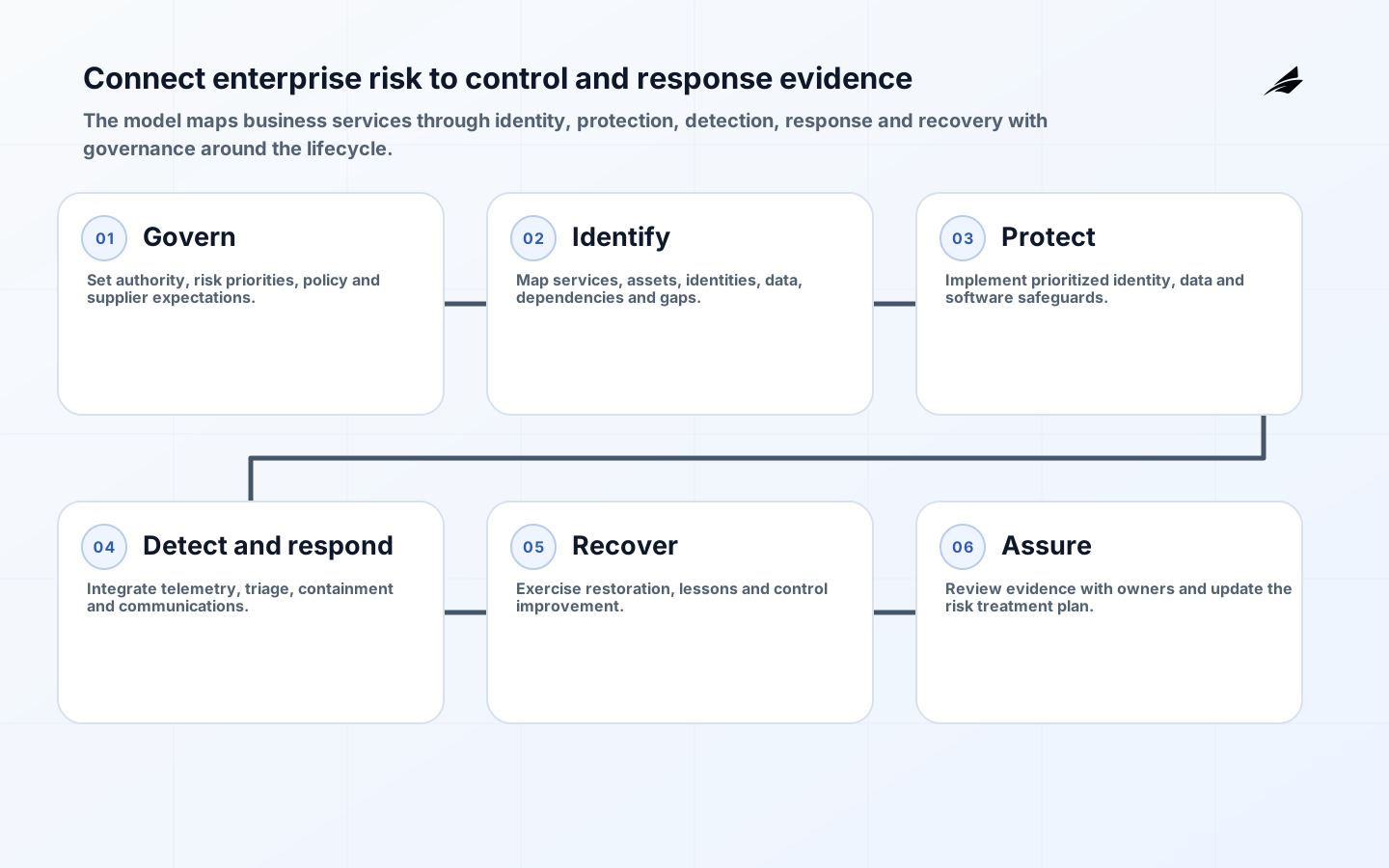
Prioritize scenarios using business consequence, establish inventory and governance, implement high-value safeguards, connect detection to response, then exercise recovery and improve gaps before broad tool expansion. Each gate should name its decision owner, evidence, tolerated exceptions, stop condition and next reversible commitment, making progress depend on reduced uncertainty rather than completed components.
| Stage | Decision and evidence |
|---|---|
| Govern | Set authority, risk priorities, policy and supplier expectations. |
| Identify | Map services, assets, identities, data, dependencies and gaps. |
| Protect | Implement prioritized identity, data and software safeguards. |
| Detect and respond | Integrate telemetry, triage, containment and communications. |
| Recover | Exercise restoration, lessons and control improvement. |
Introduce policy by service or identity cohort with exception ownership and support readiness. For disruptive controls, observe detections before enforcement, then tighten deliberately while measuring bypasses and business impact. Wider exposure should follow observed evidence, not calendar confidence. Define who can stop expansion, what state must survive reversal and how affected users will be informed.
5. Explain cost through drivers and assumptions
Include licenses, integration, data ingestion, retention, tuning, response staffing, exercises and decommissioning. Overlapping products can add cost and inconsistent policy without improving scenario coverage. State the unit or population behind variable charges and identify the evidence that would tighten uncertain ranges. This makes tradeoffs visible without inventing a universal budget.
Evaluate suppliers on secure defaults, integration evidence, vulnerability response, data handling and exit support. Milestones should prove healthy coverage and an exercised use case, not merely installation. Document assumptions about access, data, reviewers and third parties. When they fail, choose explicitly among scope, cost and timing instead of silently discarding testing or operational readiness.
6. Measure the system as an operated service
Track priority-service coverage, privileged reviews, tested detections, triage and containment time, recovery results, unowned assets and repeat incidents. Avoid one composite score that obscures a critical gap. Define source, population, unit, exclusions, review cadence and the action attached to each threshold so the reporting supports a real operating decision.
| Signal to review | Decision it should support |
|---|---|
| priority-service control coverage | For this evaluation, name the accountable owner, supporting evidence, exception route, and next measurable check. |
| privileged-access review completion | Within this evaluation, name the accountable owner, supporting evidence, exception route, and next measurable check. |
| critical detection-to-triage time | When implementing this evaluation, name the accountable owner, supporting evidence, exception route, and next measurable check. |
| containment and recovery exercise outcomes | Before releasing this evaluation, name the accountable owner, supporting evidence, exception route, and next measurable check. |
| unowned assets and findings | While operating this evaluation, name the accountable owner, supporting evidence, exception route, and next measurable check. |
| repeat incidents tied to unresolved causes | When changing this evaluation, name the accountable owner, supporting evidence, exception route, and next measurable check. |
Security runbooks should join technical containment with service continuity, legal and customer communication, evidence handling and restoration. Exercise them with the actual identity, endpoint, cloud and application owners. Confirm recovery against user-visible behavior and authoritative records; a successful automation job or green infrastructure chart does not by itself prove the service is correct.
7. Expose common failure modes early
| Failure mode | Practical response |
|---|---|
| Buying a disconnected tool | Require an owned workflow and integration evidence. |
| Coverage claimed from licenses | Measure enrolled, healthy and policy-compliant assets. |
| Alert volume replaces detection quality | Test scenarios and track actionable outcomes. |
| Zero trust becomes a network project | Center decisions on identities, devices and resources. |
| Recovery remains assumed | Restore services and validate business data in exercises. |
Maintain gaps by business scenario: unknown assets, stale privileges, missing logs, noisy detections, unsupported systems and untested recovery. A red dashboard item without an owner and response date is not governance. Keep these entries connected to architecture decisions, backlog work, tests and operating signals. Close them with evidence or carry them visibly with an accountable acceptance decision.
Key takeaways
- Start with the operating result: reduce material business risk through controls that have owners, integration paths, measurable coverage and exercised response.
- Define architecture through identity, data, trust, failure and ownership boundaries.
- Place controls where they can enforce a decision and retain proportionate evidence.
- Estimate from explicit drivers and assumptions; avoid universal price or schedule claims.
- Expand through bounded cohorts and prove that receiving teams can operate and recover.
Frequently asked questions
What should the first deliverable be?
The first deliverable is a current-state profile linking critical services and credible scenarios to assets, identities, data, controls, evidence and owners. Use it to select one end-to-end improvement. Keep it concise enough to review and specific enough to reject a weak option. The next artifact should be the smallest proof capable of changing the decision.
Should the team select tools before architecture?
Select products after defining scenario, population and workflow requirements. Prefer controls that integrate with authoritative identity, inventory and response systems and expose health data the enterprise can retain. Compare candidates through a realistic path and inspect limits, failure behavior, portability and ownership; product selection cannot repair an undefined operating model.
When should security and operations join?
Security leads the program but cannot operate it alone. Service owners, platform teams, application engineers and continuity leaders should design and exercise controls from the beginning. Early participation should produce concrete requirements and tests, not a late request for policy approval after expensive boundaries have hardened.
How does the team know it is ready to scale?
Expand when the first priority scenario has measured coverage, detections are actionable, containment and recovery have been exercised, exceptions are owned and new scope will not exceed response capacity. Require that evidence across the whole workflow, including exceptions and recovery, rather than treating one successful demonstration or a quiet pilot as proof of readiness.
Conclusion
Enterprise Security Solutions: Scope, Architecture, Cost Drivers and Delivery Plan should end in an operable decision system: clear authority, bounded architecture, enforceable controls, staged evidence and measurable service ownership. That foundation lets teams move quickly without hiding uncertainty. It also makes a stop, redesign or narrower release a legitimate outcome when evidence does not support expansion. The durable result is not merely delivered technology, but an organization that can explain, operate and improve it.