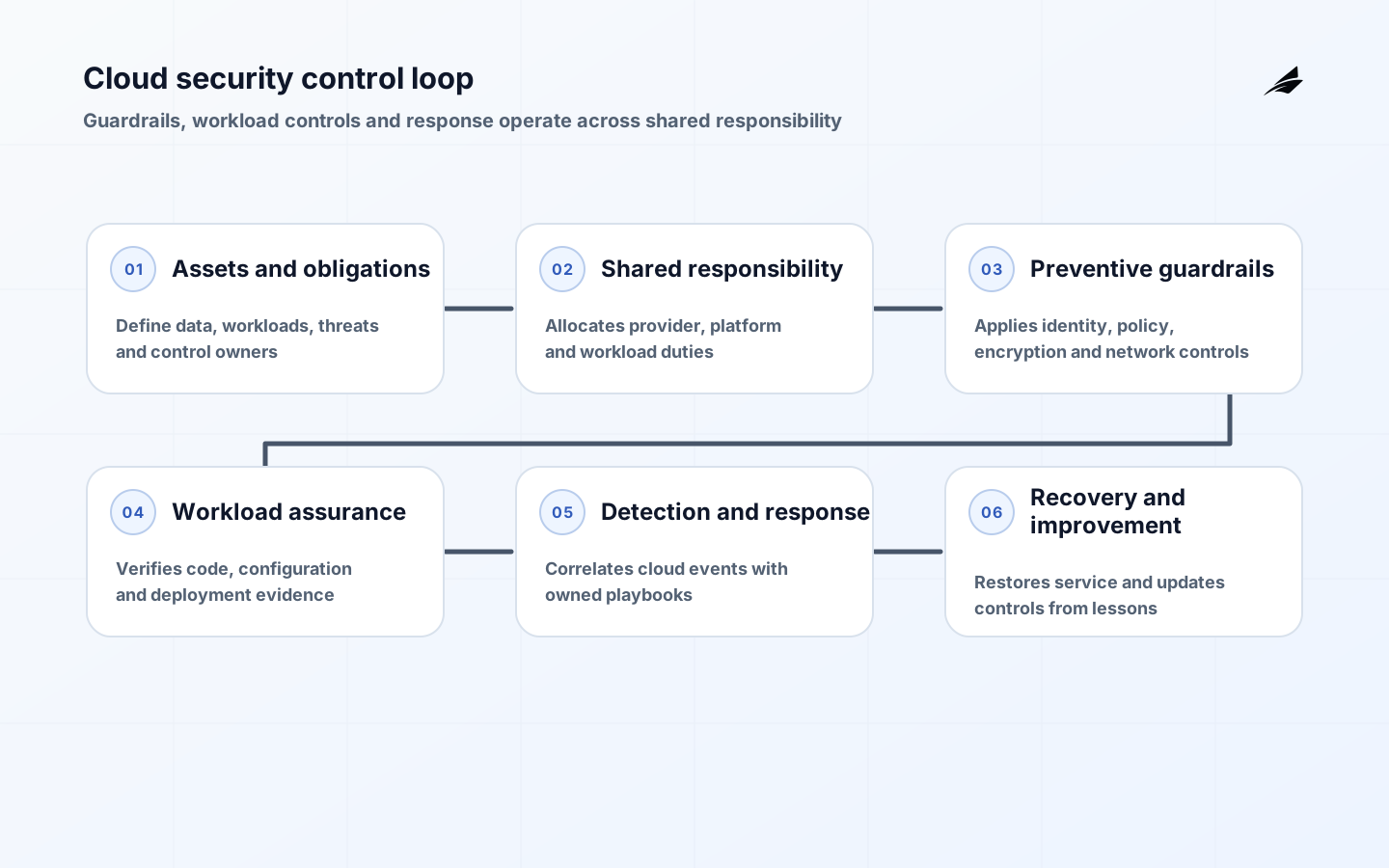
Cloud security services become useful when they turn abstract concern into owned controls, repeatable evidence and practiced response. Buying more scanners, dashboards or managed alerts is not enough if the organization still cannot say who owns a risky identity, which workload is exposed, what guardrail should have stopped the issue, and how recovery will work when prevention fails. A mature service program therefore starts by allocating responsibility and then building the preventive, detective and corrective loops that correspond to that allocation.
This is why cloud security should be scoped as an operating capability rather than a tool deployment. The shared-responsibility boundary, the cloud platform foundations, the workload architecture and the incident model all influence one another. NIST's Cybersecurity Framework is helpful because it keeps governance, protection, detection, response and recovery in one conversation. Provider responsibility guidance and Cloud Security Alliance materials then add the implementation detail needed to make that conversation concrete for cloud services buyers and delivery teams.
Start with shared responsibility and control ownership
The most common cloud security failure is not missing technology. It is unclear ownership. Teams assume the provider secures more than it actually does, or they centralize cloud security in a platform team that lacks authority over application data, business process and incident consequence. Begin by listing the workloads, data classes, identities, integrations and regulatory or contractual obligations in scope. Then assign the control owner for each layer: provider, customer platform team, workload team, managed service provider or shared arrangement. Write the handoffs down. Cloud security services should make those handoffs easier to govern, not blur them further.
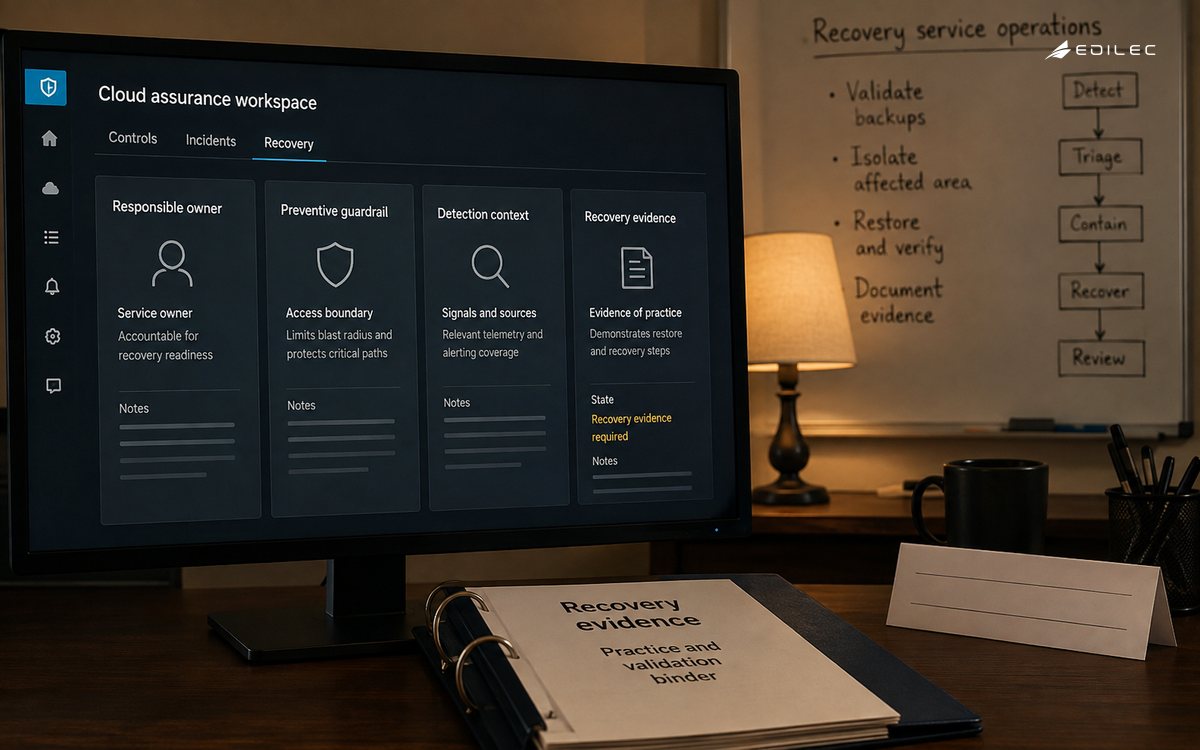
Control ownership also needs an incident perspective. The team that receives the alert should know which service owner can authorize containment, which records are authoritative during triage, which logs are retained, which accounts can be disabled and how recovery evidence will be captured. Zero-trust thinking helps here because it keeps attention on resource-centric access and continuous verification rather than on broad network trust. In practice, the service scope should identify the assets that matter most, the actors that may touch them and the proof required before those actors are trusted.
| Control area | Primary owner question | Acceptance signal |
|---|---|---|
| Identity | Who approves human, service and emergency access | Reviewable role model and privileged access workflow |
| Platform guardrails | Who enforces baseline policy across accounts or subscriptions | Automated preventive and detective controls with exceptions tracked |
| Workload security | Who secures application code, configuration and secrets | Documented release checks and remediation ownership |
| Telemetry | Who ensures logs and alerts reach accountable responders | Critical signals retained, routed and tested |
| Response | Who may contain, restore and communicate during incidents | Runbook with authority, timing and evidence paths |
| Recovery | Who proves data and service can be restored safely | Tested backup, failover and reconciliation procedure |
Build preventive guardrails into the platform path
Preventive controls should be part of the normal provisioning and deployment path, not optional hardening tasks. Identity federation, least privilege, strong administrative protections, network segmentation, encryption defaults, secure images, secrets management and policy-as-code all belong in the platform path before application teams scale on top of it. Enterprise foundation guidance is useful because it shows how preventive and detective controls can be designed as reusable layers instead of bespoke project work. The service provider should be able to explain which guardrails are mandatory, which are tunable and how exceptions are reviewed and expired.
Guardrails still need workload awareness. A static website, a data pipeline, a regulated SaaS product and an internal admin application expose different data flows and failure impacts. Cloud security services should therefore pair platform baselines with workload-specific threat modeling and release criteria. That includes container image handling, service-to-service identity, exposed endpoints, key and secret rotation, dependency review and data-path segmentation. If the guardrail model cannot adapt to workload risk without becoming a ticket-driven bottleneck, it will either be bypassed or weaken under pressure.
Assure the workload, not only the account baseline
A secure landing zone does not guarantee a secure workload. Application identities may still be over-privileged, deployment pipelines may leak credentials, storage buckets may expose data through workload behavior, or runtime dependencies may create exploitable paths. Cloud security services should therefore define assurance evidence at the workload layer: image or package review, configuration validation, secret use patterns, security-relevant infrastructure diffs, internet exposure review, backup integrity and recovery rehearsal. The buyer should ask which checks run continuously, which run pre-release and which require human sign-off.
Assurance also includes how the service handles change. New regions, new integration patterns, new workload classes and new outsourcing arrangements change the risk model even if the tool stack stays the same. A strong services provider will treat those as governed changes to the security architecture, not as routine backlog items. That behavior matters because many cloud incidents are change-management failures disguised as technical surprises.
| Assurance topic | What to verify | Why it matters |
|---|---|---|
| Identity paths | Service accounts, privilege boundaries and emergency access | Most material cloud failures involve access misuse or excessive privilege |
| Configuration drift | Whether deployed settings still match approved baseline | Unreviewed exceptions quietly become the real architecture |
| Exposure surface | Internet reachability, trust boundaries and third-party connections | Attack paths often emerge at integration edges |
| Data protection | Encryption use, backup behavior and retention handling | Recovery and confidentiality depend on practical data controls |
| Pipeline security | How build and deploy systems handle secrets and approvals | A strong runtime posture can still be undermined upstream |
| Recovery readiness | Whether the workload can be restored to trusted state | Containment without reliable recovery only delays business harm |
Design detection and response around real workloads
Detection quality depends on context. A high-volume alert stream without workload identity, owner mapping and business impact quickly becomes background noise. Cloud security services should therefore define which control failures matter most, where the necessary telemetry comes from, how it is correlated and which responder can act on it. That usually includes identity anomalies, privileged changes, suspicious network patterns, storage access issues, workload integrity signals and backup or recovery failures. The design should support both technical triage and business decision-making under pressure.
Response is where many security services reveal whether they are operationally mature. Ask how containment decisions are authorized, how customer teams are engaged, how evidence is preserved and how the service avoids causing new business harm through blunt automation. Automated quarantine or credential revocation can be powerful, but only when the business consequences are understood and rehearsed. Recovery should feed directly back into prevention and detection rules. Otherwise incidents are closed procedurally while the underlying control gap remains in place.
Model the cost of prevention, detection and recovery together
Cloud security services are often mispriced because proposals overemphasize tooling and understate integration, tuning, review and incident labor. Cost depends on account count, workload diversity, service hours, regulatory expectations, log volume, response depth, recovery testing and the maturity of the client's existing platform controls. Separate the cost of establishing foundations from the cost of operating them. A client with fragmented identities and little logging will spend more to reach a stable baseline than a client with mature platform engineering and clear ownership.
Commercial statements should also explain what is not covered. Are code-level fixes included? Does the provider only alert, or also contain? Are backup recovery drills part of the service? Who pays for log retention growth caused by new detection rules? Which cloud accounts remain client-operated? Those details change total cost materially. They also affect whether the service is helping the organization reduce risk or merely adding another layer of reporting about risk it still cannot act on.
| Cost layer | What usually drives it | Evidence to inspect |
|---|---|---|
| Foundation | Identity cleanup, policy automation and telemetry setup | Current account structure, baseline gaps and target controls |
| Assurance | Workload validation, threat modeling and release checks | Application inventory, change cadence and control requirements |
| Detection | Log volume, correlation depth, tuning and analyst review | Critical signals, retention plans and escalation routes |
| Response | Coverage hours, containment scope and communication duties | Runbooks, approval model and incident history |
| Recovery | Backup testing, data restoration and reconciliation effort | Recovery objectives and existing drill maturity |
| Improvement | Rule updates, exception review and control redesign | Governance cadence and planned workload changes |
Review the supplier on operating judgment, not only tools
Ask potential providers to walk through one realistic incident path from detection to containment to recovery. Strong teams talk clearly about ownership, evidence, approval boundaries, workload nuance and after-action learning. Weak teams retreat to platform brand names, scanner coverage and generic severity matrices. Request examples of runbooks, control-exception reviews, recovery-test outputs and governance reports that changed a client decision. Meet the responders and architects, not just the pre-sales team. Cloud security services succeed through judgment under uncertainty as much as through technology coverage.
Contracts should clarify data handling, log access, support hours, containment authority, evidence retention, subcontractor boundaries, client responsibilities and exit support. If the provider's role during a material incident is ambiguous, the service is under-specified. The same is true if the client cannot regain direct operation of critical controls and telemetry after transition. Security capability that cannot be inspected or transferred becomes dependency risk in its own right.
Use staged delivery with tested recovery gates
- Frame: define the cloud assets, obligations, control owners and risk tolerance in scope.
- Baseline: inspect identities, accounts, logging, workload exposure and existing response capability.
- Build guardrails: implement mandatory preventive and detective controls in the platform path.
- Assure workloads: verify representative applications, data paths and deployment pipelines against the target model.
- Exercise response: test alert routing, authority, containment and evidence capture on realistic scenarios.
- Exercise recovery: restore representative workloads and reconcile to trusted state before broad rollout.
- Operate and improve: review incidents, exceptions, drift and recovery results on a fixed governance cadence.
A stage is complete only when responders can explain what would happen if a control failed tonight. That standard is stricter than showing a dashboard or a compliance matrix, but it is the right one. Cloud security services should reduce uncertainty at the exact moment the organization needs confidence most.
Key takeaways
- Begin cloud security services with explicit shared-responsibility and incident ownership mapping.
- Embed preventive guardrails in provisioning and deployment paths.
- Assure workloads directly; a secure landing zone alone is insufficient.
- Design detection and response with workload context and recovery authority.
- Model cost across prevention, detection, response and restoration.
- Evaluate providers on operating judgment, control transfer and tested recovery.
Frequently asked questions
Is the cloud provider's native security enough?
Provider controls are essential, but they do not replace customer responsibility for identity, workload configuration, data handling, release discipline and incident response. Shared responsibility means some controls are inherited and some remain yours. A cloud security service should make that boundary explicit and enforceable.
How are cloud security services different from buying CSPM or SIEM tooling?
Tools provide visibility or control mechanisms. Services define ownership, tune detections, manage exceptions, exercise response and connect alerts to real workloads and decision makers. A tool without an operating model usually becomes another noisy feed. A service without technical enforcement becomes advisory theater.
What should the first pilot include?
Choose one representative cloud environment or workload family, then include identity paths, baseline policy, critical telemetry, one realistic incident exercise and one recovery drill. That scope is large enough to test the operating model without pretending the whole estate can be transformed in one wave.
What proves a cloud security service is working?
Useful proof includes reduced drift, faster and clearer response, reliable recovery tests, understood privilege boundaries, and governance decisions supported by timely evidence. Tool deployment or alert volume alone does not prove risk is better managed.
Conclusion
Cloud security services are effective when they connect responsibility, guardrails, workload assurance, response and recovery into one accountable control loop. Scope from real obligations, insist on tested recovery and make every important signal route to a named decision maker. That is how cloud security becomes an operational capability instead of an expanding pile of findings.