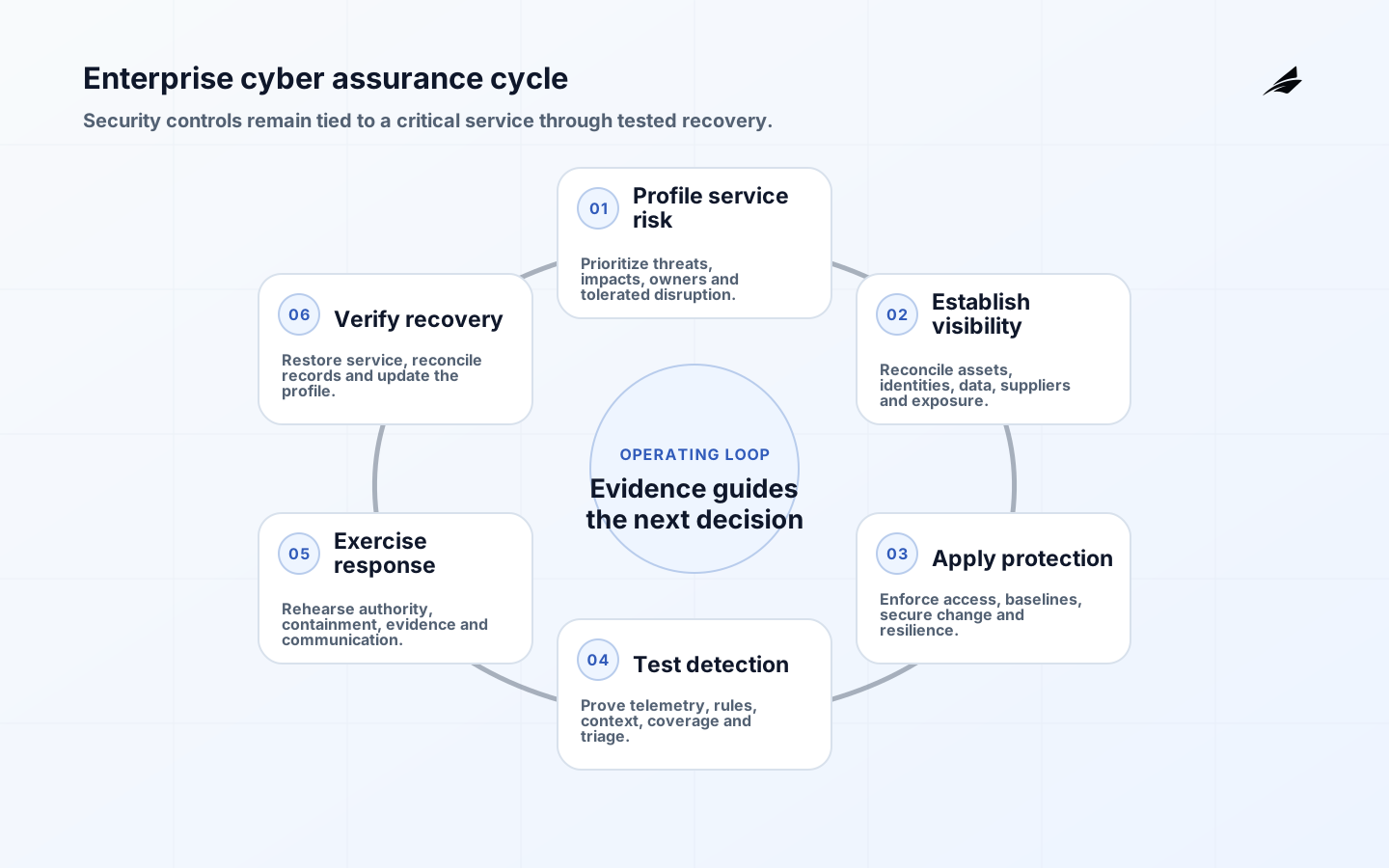
Enterprise cybersecurity solutions are the people, processes and technologies used to reduce cyber risk across business services. A solution may include identity, endpoint, network, cloud, data, application, detection, incident response and resilience controls. Buying more products does not create an architecture. The portfolio must connect material risks to owned controls, observable events and practiced recovery.
Use this guide with the enterprise cybersecurity implementation checklist and the broader cybersecurity services delivery plan. The security and protection solutions guide provides a complementary control-lifecycle view.
Scope enterprise cybersecurity solutions around services
Identify critical services, owners, users, data, legal or contractual obligations and tolerated disruption. Map the assets, identities, applications, suppliers, facilities and operational technology on which each service depends. Then describe credible threat events and business consequences. This keeps a phishing control, cloud posture tool or backup program tied to a business outcome rather than a disconnected product category.
NIST Cybersecurity Framework 2.0 organizes outcomes under Govern, Identify, Protect, Detect, Respond and Recover. Use current and target Profiles to expose gaps and priorities. The framework is not a prescribed technology stack; enterprise leadership still sets risk tolerance, resources and accountability.
| Capability | Control outcome | Evidence | Common gap |
|---|---|---|---|
| Identity | Only authorized subjects receive necessary access | Authentication, policy decisions, reviews and revocations | Standing privilege and unmanaged service accounts |
| Asset and exposure | In-scope assets and external paths are known | Reconciled inventory, ownership and remediation | Tool inventory not tied to business service |
| Detection | Material events create timely, useful decisions | Telemetry coverage, tested rules and triage records | Alert volume without coverage measures |
| Response | Authority and actions are practiced | Exercise, incident timeline and corrective work | Provider assumed to make business decisions |
| Recovery | Service and data return within objectives | Restore, failover and reconciliation tests | Successful backup jobs without restore proof |
Build a prioritized security baseline
Start with controls that reduce broad, likely harm: multifactor authentication, secure configuration, vulnerability remediation, tested backups, logging, incident contacts, email protections, endpoint coverage and vendor access control. CISA's Cross-Sector Cybersecurity Performance Goals offer a voluntary baseline intended to address common risks. Tailor it to sector, architecture and service impact.
The CIS Controls v8.1 provide prioritized safeguards and implementation groups. Map chosen safeguards to the authoritative control catalog and customer obligations rather than operating several duplicate checklists. NIST SP 800-53 Revision 5 supplies a comprehensive catalog for organizations that need deeper control selection and assessment.
Design an enterprise cyber assurance cycle
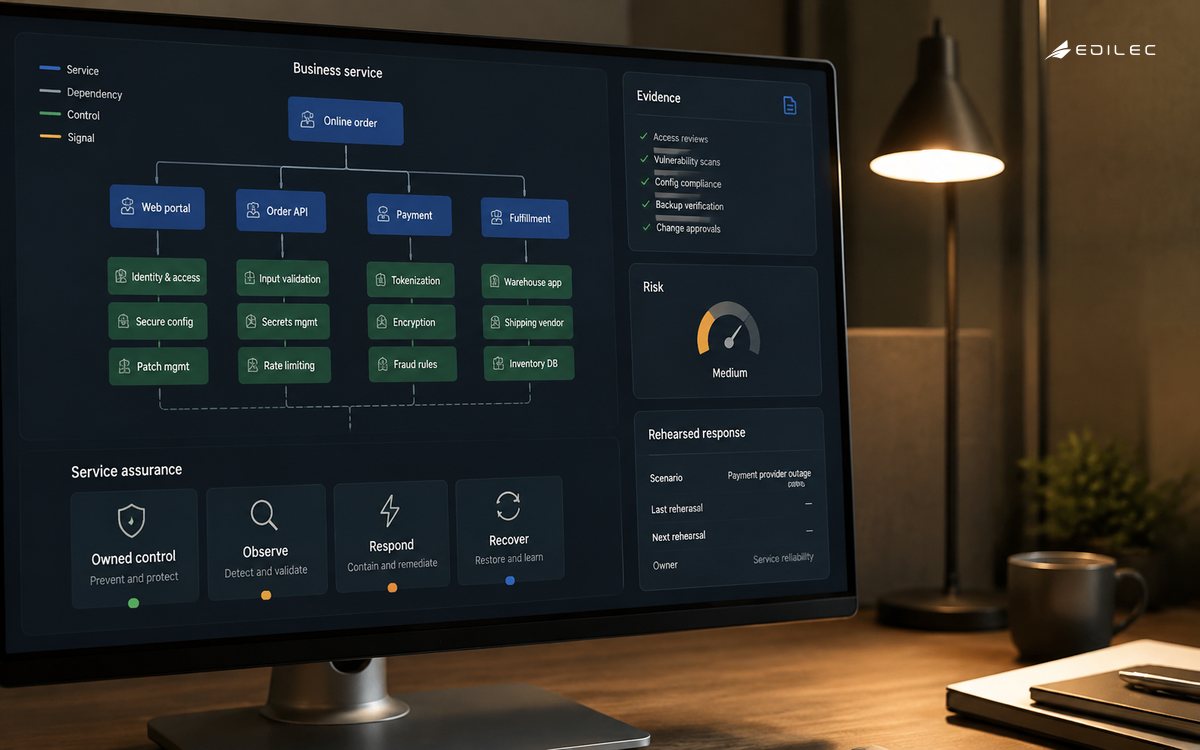
Architecture should show trust boundaries, identity flows, administrative paths, data movement, telemetry and recovery dependencies. NIST Zero Trust Architecture removes implicit trust based solely on network location and focuses on protecting resources through explicit policy decisions. Implement it as a set of verifiable access decisions, not a product label.
Separate control plane and data plane access, use attributable privileged identities, require strong authentication and time-bounded elevation, and record administrative actions. Protect security tools themselves: identity providers, endpoint consoles, backup control planes, code repositories and log platforms are high-value targets. Define break-glass access and test revocation without making emergency accounts permanent shortcuts.
Make detection coverage measurable
Collect signals that support named detections and investigations. Prioritize identity changes, privileged use, disabled controls, external exposure, endpoint execution, cloud control-plane actions, data movement, backup changes and critical application events. Record expected fields, source owner, retention, timestamp quality and failure alert. A connected source that silently stops sending is a detection gap.
Test rules with authorized simulations and known events. Measure source coverage, rule execution, triage time, false-positive burden and missed scenarios. Keep detection logic versioned and link changes to threat or incident evidence. Give analysts context about asset criticality and identity so they can make decisions instead of manually joining basic inventory during every alert.
Pre-authorize incident response and recovery
NIST SP 800-61 Revision 3 integrates incident response across CSF 2.0 outcomes. Define incident leadership, technical containment, legal and privacy input, communications, evidence handling, supplier escalation and executive decisions before an event. Providers may detect and recommend; the customer must know who can isolate a revenue service, notify affected parties or authorize recovery.
Create playbooks for likely scenarios, then exercise decisions and technical actions. Test compromised identity, ransomware, exposed cloud credentials, vulnerable internet service, supplier incident and data exfiltration. Verify logs are available, tokens can be revoked, systems can be isolated, clean assets can be restored and data can be reconciled. Track corrective actions through ordinary ownership and due dates.
| Measure | Precise definition | Decision |
|---|---|---|
| Control coverage | In-scope assets or identities meeting an applicable control | Where exposure remains |
| Detection coverage | Named threat behaviors with tested, supported telemetry | Which gaps need engineering |
| Triage time | Alert availability to documented severity and owner | Whether analysis capacity is adequate |
| Containment time | Authorized decision to verified containment | Whether actions and access work |
| Recovery proof | Critical scenarios restored and reconciled within objectives | Whether resilience claims are credible |
| Exception age | Open risk exceptions by expiry and service impact | Where temporary risk became permanent |
Control suppliers and concentration risk
Inventory security providers, cloud platforms, managed services, software manufacturers and critical fourth parties. Review the exact service's access, data locations, subcontractors, incident terms, continuity, vulnerability process and independent assurance. Corporate certification does not prove that a specific managed detection rule or backup restore is effective. Require evidence mapped to the contracted outcome.
Limit provider privileges and monitor their use. Define notice for material control, model, region or subcontractor changes. Preserve exportable configurations, detections, cases and logs. Exercise provider outage and exit. Concentrating identity, endpoint, logging and response in one provider can simplify integration but creates correlated operational and commercial failure.
Estimate cost by capability and operating load
Cost drivers include users, devices, workloads, applications, log volume and retention, vulnerability surface, support hours, regions, compliance depth, response authority and professional services. Include integration, data normalization, content engineering, training, tuning, exercises and decommissioning. License price is often smaller than the labor required to make a control effective.
Normalize proposals against the same inventory and responsibilities. Separate one-time assessment and onboarding, recurring operation, incident retainers and variable consumption. Define service-level clocks and customer dependencies. Pair speed with quality: rapid alert acknowledgment is weak if classification is wrong or containment authority is unavailable.
A staged enterprise security delivery plan
- Govern: approve critical services, risk owners, target outcomes, obligations and investment priorities.
- Discover: reconcile assets, identities, data, suppliers, exposures and current control evidence.
- Design: map controls and trust boundaries; assign performers, approvers, evidence and exceptions.
- Pilot: implement a bounded service, test telemetry, access, response and recovery under real workflows.
- Transition: train operators, accept runbooks, close critical gaps and establish service review.
- Assure: measure coverage and outcomes, exercise scenarios, review suppliers and update the risk profile.
Example: protecting a customer billing service
Treat billing as a business service, not one application. Map customer portal, workforce identity, billing engine, payment provider, cloud accounts, data warehouse, support tools and backup platform. Prioritize account takeover, privileged misuse, exposed credentials, invoice manipulation, data exfiltration and destructive ransomware. Assign service, data, platform, security and supplier owners. Define tolerated outage and data loss separately for invoice creation, payment status and historical records.
The first control increment might enforce phishing-resistant authentication for administrators, remove standing cloud privilege, reconcile service accounts, protect code and deployment credentials, centralize critical control-plane logs and isolate immutable recovery copies. Each control gets coverage evidence: administrators enrolled, privileged sessions recorded, repositories protected, log sources current and backups restorable. Known exceptions have business owners and expiry.
Build detections for new privileged grants, disabled logging, anomalous invoice export, payment webhook changes and backup deletion. Run authorized simulations and confirm the analyst receives asset criticality, identity and recent change context. Measure the time from event availability to a documented decision. A rule that fires without the fields needed to distinguish maintenance from attack is not accepted.
Exercise a compromised administrator. Revoke sessions and tokens, suspend unsafe deployment, preserve evidence, engage cloud and payment providers, decide whether billing can continue in degraded mode and restore a clean management path. Reconcile invoices and payment events before declaring recovery. Record who can authorize each disruptive action and how customers or regulators would be notified if required.
Finally, test supplier outage and contract exit. Export detection logic, cases, asset mappings and retained logs; establish a replacement administrative route; and verify the customer can operate recovery without the managed provider. Review cost by protected service, including log volume, response hours and engineering maintenance. This scenario demonstrates assurance: architecture, control operation, detection, decision and recovery all connect to one enterprise outcome.
Repeat the exercise after major identity, cloud, billing or provider change. Compare expected and observed decisions, then update the service map, detection assumptions and recovery runbook. A control remains trustworthy only while its operating context and evidence remain current.
Key takeaways
- Anchor enterprise cybersecurity solutions to critical services and risk consequences.
- Use frameworks to organize outcomes, then assign concrete controls and evidence.
- Measure visibility and detection coverage rather than product deployment alone.
- Pre-authorize response and prove recovery through exercises and reconciliation.
- Include operating labor, suppliers, consumption and exit in cost and architecture.
Frequently asked questions
Should the enterprise consolidate security tools?
Consolidate when it improves coverage, integration, analyst work and total cost without unacceptable concentration. Preserve open interfaces and export. Remove a tool only after its control outcome and historical evidence are replaced.
Does compliance prove enterprise security?
No. Compliance can establish required controls and assurance, but attackers and service failures do not follow audit boundaries. Connect obligations to the risk model, test actual operation and preserve evidence. Treat findings as inputs to improvement, not the whole security strategy.
Conclusion
Enterprise cybersecurity solutions become defensible when every material control has a business reason, an owner, observable evidence and a tested failure path. Build the baseline first, integrate identity and telemetry, practice response and recovery, and challenge supplier assumptions. Security then becomes a maintained enterprise capability rather than a growing shelf of products.