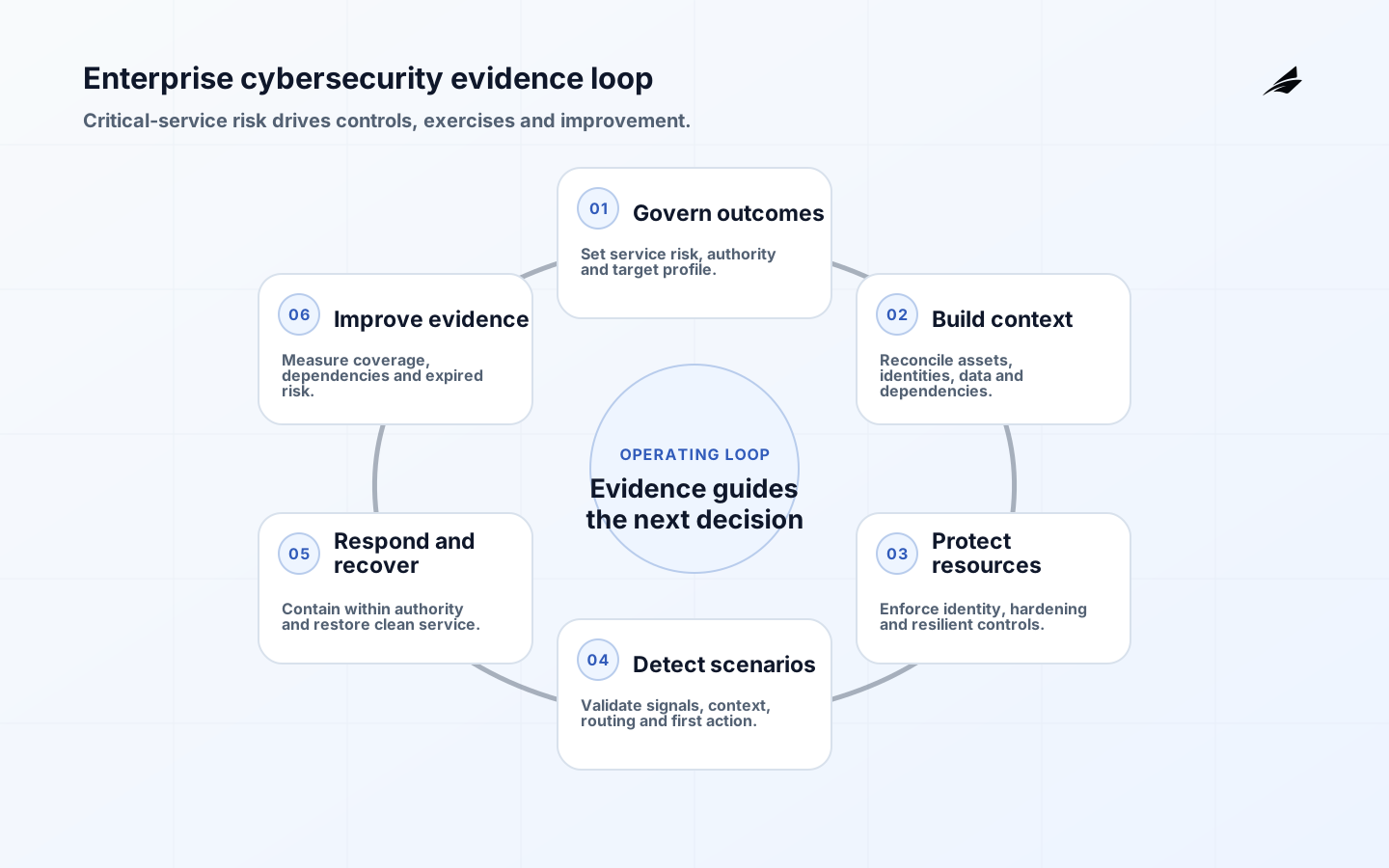
Enterprise cybersecurity solutions implementation should begin with critical business services, credible loss and accountable governance, not a product catalog. Identity, endpoint, network, cloud, application, data and detection technologies reduce risk only when they cover known assets, exchange usable context and lead to an authorized response. The implementation test is whether the organization can prevent, detect, contain and recover a plausible attack path.
Leaders who have chosen a cybersecurity direction need an ordered implementation checklist. NIST Cybersecurity Framework 2.0 organizes outcomes through Govern, Identify, Protect, Detect, Respond and Recover; use those functions as common language rather than a certification claim. The enterprise cybersecurity scope guide covers the preceding procurement decisions.
1. Establish governance and target outcomes
Name executive accountability, security leadership, business-service owners, system and data owners, incident authority and risk acceptance. Express risk appetite through consequences: intolerable data use, maximum disruption, transaction exposure, safety impact and required restoration. Map legal, contractual and sector obligations to owned policy. Fund protective controls, detection, response and recovery together; prevention without staffed response leaves the enterprise unable to manage what passes through.
Create a current and target CSF profile for the services in scope. Prioritize gaps by threat, consequence, dependency and existing control strength instead of a universal maturity score. Document accepted risk with scope, compensating control, owner and expiry. Use CISA's Cross-Sector Cybersecurity Performance Goals as one source of high-impact baseline practices, then tailor to the organization's sector, architecture and obligations.
| Governance record | Minimum content | Decision enabled | Review trigger |
|---|---|---|---|
| Service risk profile | Mission, data, threats, consequences and dependencies | Prioritize target outcomes | Material service or threat change |
| Responsibility model | Business, technology, security and supplier authority | Act without role ambiguity | Organization or contract change |
| Control objective | Outcome, scope, implementation and evidence | Select proportionate safeguards | Architecture or obligation change |
| Exception | Reason, residual risk, owner and expiry | Authorize bounded deviation | Expiry or incident |
| Incident authority | Severity, command and containment limits | Respond at operational speed | Exercise or leadership change |
| Recovery objective | Minimum service, time, data and reconciliation | Fund resilience and sequence recovery | Business impact review |
2. Build authoritative asset, identity and data context
Reconcile workforce and workload identities, endpoints, servers, cloud resources, applications, repositories, SaaS tenants, data stores, networks and operational technology where applicable. No single discovery source sees everything, so compare provider inventories, identity systems, endpoint tools, network evidence, code and financial records. Assign owner, service, criticality, exposure, data classification, environment and support status. Escalate unknown internet-facing assets and unowned privileged identities.
Map service dependencies including identity provider, DNS, certificate authority, keys, build system, telemetry, backup and suppliers. Trace sensitive data through collection, use, transfer, retention and deletion. Responders need relationships, not just asset counts: what an asset does, which service fails with it, who can isolate it and whether recovery depends on the suspected identity plane. Keep source and last-verified time so confidence is visible during an incident.
3. Implement identity-first protective architecture
Use unique identities, phishing-resistant authentication where risk warrants it, least privilege, separation of duties and prompt joiner, mover and leaver processes. Replace routine standing administration with time-bounded elevation and protect an independently recoverable emergency path. NIST SP 800-207 rejects implicit trust based solely on network location and focuses access decisions on users, assets and resources. Enforce authorization at the resource and test lateral and privilege-boundary attacks.
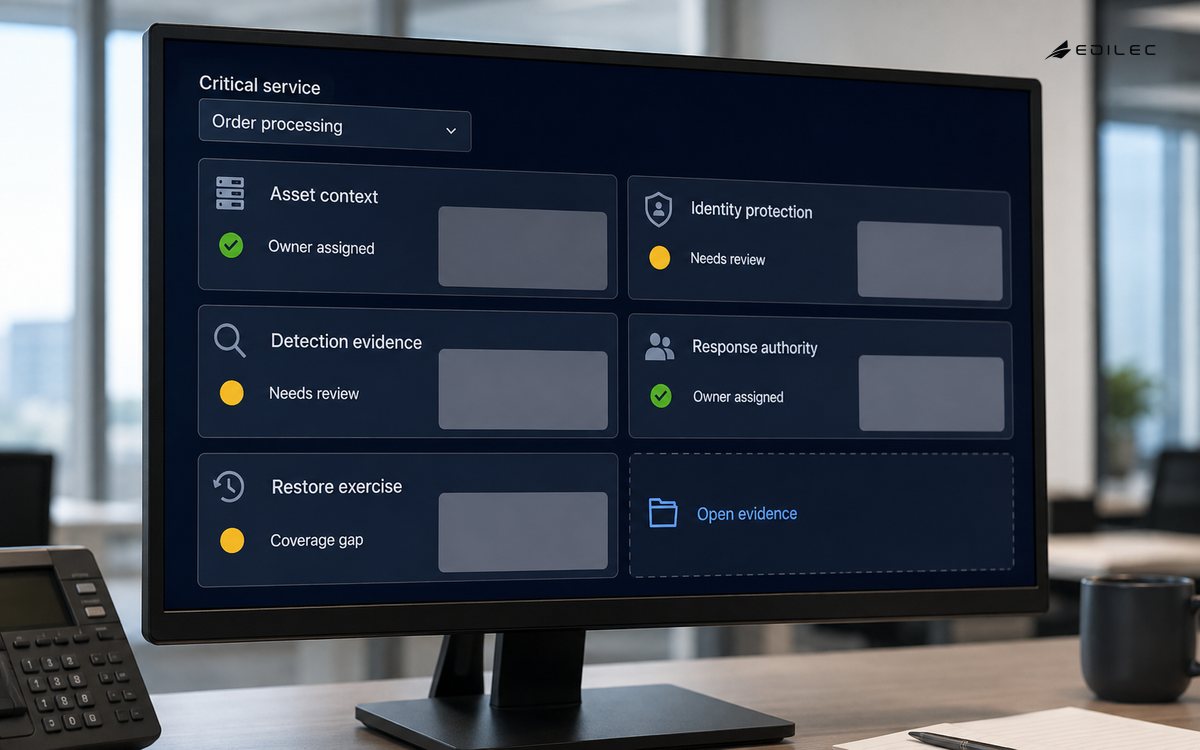
Harden systems through managed configuration, secure defaults, patch and vulnerability processes, segmentation, encryption, resilient backups and controlled egress. Protect administrative and software-delivery planes more strongly than ordinary workloads. CISA's Secure by Design guidance asks technology manufacturers to take ownership of customer security outcomes. Procurement should therefore examine secure defaults, multifactor support, logging, vulnerability disclosure and security-feature availability, not only feature fit.
4. Engineer and validate detection
Begin with prioritized attack and misuse scenarios. Identify required events across identity, endpoint, network, cloud control plane, application, data and suppliers. For each analytic, define fields, expected volume, owner, severity and response. Validate time, identifiers and service context at ingestion. More logs are not automatically better; unused high-volume data increases cost and privacy exposure while making investigation slower.
Run controlled simulations and known-bad patterns to verify that signals arrive and produce an actionable alert. Measure whether the analyst can identify the affected service, identity, likely scope and first safe action. Tune false positives, then search for false negatives through exercises and incident review. Preserve evidence according to response, legal and privacy needs. A dashboard without after-hours routing and containment authority is observation, not a detection capability.
5. Prepare response authority and communications
Define incident categories, severity, command, technical leads, business representation, legal and privacy coordination, supplier contacts and executive decisions. NIST SP 800-61 Rev. 3 integrates incident response throughout CSF 2.0 risk management. Build adaptable playbooks for identity compromise, ransomware, cloud credential abuse, data exposure, vulnerable software and supplier incidents rather than scripts that assume perfect evidence.
Pre-authorize bounded actions such as revoking sessions, disabling keys, isolating endpoints, blocking destinations or pausing a service. Preserve a timeline and decision log. Prepare internal, customer, regulator and law-enforcement communication routes without predetermining facts. Exercise unavailable leaders, compromised collaboration tools and conflicting business pressure. Verify that security, technology, operations and communications use the same severity and service-impact language.
| Assurance gate | Proof required | Common dependency failure | Required response |
|---|---|---|---|
| Protect | Configuration and access tests | Recovery path bypasses strong authentication | Repair recovery and retest |
| Detect | Scenario produces contextual alert | Asset and identity records do not join | Fix telemetry context |
| Respond | Team contains within authorized limit | Supplier or leader unavailable | Invoke alternate authority |
| Recover | Clean service meets measured objectives | Identity or keys remain compromised | Use independent recovery plane |
| Communicate | Approved routes work under degraded tools | Contacts or facts cannot be verified | Switch channel and preserve uncertainty |
| Improve | Gap becomes owned engineering work | Exception remains open without expiry | Escalate risk decision |
6. Prove clean service recovery
Set recovery time and recovery point objectives from business impact, then define minimum viable service and restoration order. Protect backups through isolated administration, monitoring and deletion resistance. Restore into a clean environment and verify applications, identity, integrations, configuration, keys and data consistency. A successful storage job does not prove a business service can operate. Measure actual restoration and data loss rather than recording a binary pass.
Reconcile transactions completed through manual or alternate channels and communicate prolonged degradation. Eradicate persistence and unsafe configuration before reconnecting. Exercise compromise of the identity provider, endpoint console, cloud control plane or backup administrator because control concentration can defeat otherwise sound plans. Keep recovery material, investigation channels and emergency credentials outside the same administrative failure boundary.
7. Measure coverage, effectiveness and concentration
Use measures that answer coverage and effect: privileged identities reviewed, critical assets logging, phishing-resistant authentication coverage, exploitable vulnerabilities within target, detections tested, containment actions exercised and services restored. Segment by critical service; an enterprise average can conceal an uncovered high-consequence system. Trace measures to sources and sample evidence independently. Event counts or blocked attacks do not quantify risk reduction without understanding exposure and missed paths.
Map control dependencies. Multifactor authentication can fail through weak recovery; endpoint isolation can fail through missing authority; logging can fail through unresolved identities; backups can fail when one administrator controls production and recovery. The NIST SP 800-53 control catalog can support detailed control selection where appropriate, but each implemented control still needs an owner, scope, test and operational response.
8. Roll out by critical service and attack path
Implement complete service slices rather than deploying one product everywhere before integration. For a selected service, establish context, protective controls, telemetry, response, recovery and evidence, then test a cross-control scenario. Carry unresolved gaps in an acceptance ledger with severity, owner and date. Expand to the next service from observed patterns and avoid declaring enterprise coverage from license counts or agent installation alone.
Require suppliers to transfer configuration, architecture decisions, runbooks, evidence access, administrative rights and dependency inventories. Revoke implementation access and have permanent teams run the scenario. The enterprise cybersecurity FAQ supports continuing decisions, while the enterprise cybersecurity services guide helps compare ongoing service models. Cloud-heavy programs can also use the enterprise cloud cybersecurity checklist.
Key takeaways
- Prioritize critical services and credible consequences before selecting controls.
- Make assets, identities, data and dependencies authoritative enough for response.
- Protect resources and administrative planes with explicit identity and authorization.
- Validate detections through scenarios and connect every alert to an owned action.
- Prove clean business-service recovery, including identity and transaction reconciliation.
- Measure critical-service coverage and control dependencies, not product deployment counts.
Enterprise cybersecurity implementation FAQ
Does adopting NIST CSF 2.0 certify security? No. It is a voluntary framework of outcomes and common language. Assurance comes from evidence that selected controls operate effectively in the organization's context.
Is zero trust a product? No. It is an architectural approach that removes implicit trust based on network location. Products can support identity, policy and enforcement, but the organization owns the operating design.
How many security tools should an enterprise use? There is no universal number. Select capabilities from risk and coverage, then assess integration, staffing, evidence, concentration and response. Consolidate when it improves the whole system.
What should be implemented first? Choose a critical but recoverable business service and complete its governance, context, protection, detection, response and recovery loop. That reveals cross-control gaps earlier than a broad product rollout.
Conclusion: accept an operated defense system
Enterprise cybersecurity solutions become a defense capability only when governance, context, safeguards, detection, response and recovery share evidence and authority. Implement by business service, test plausible attack paths, exercise independent recovery and transfer operation to permanent teams. Product deployment is an intermediate result; the acceptance question is whether the enterprise can limit loss and restore trusted service when controls are under pressure.