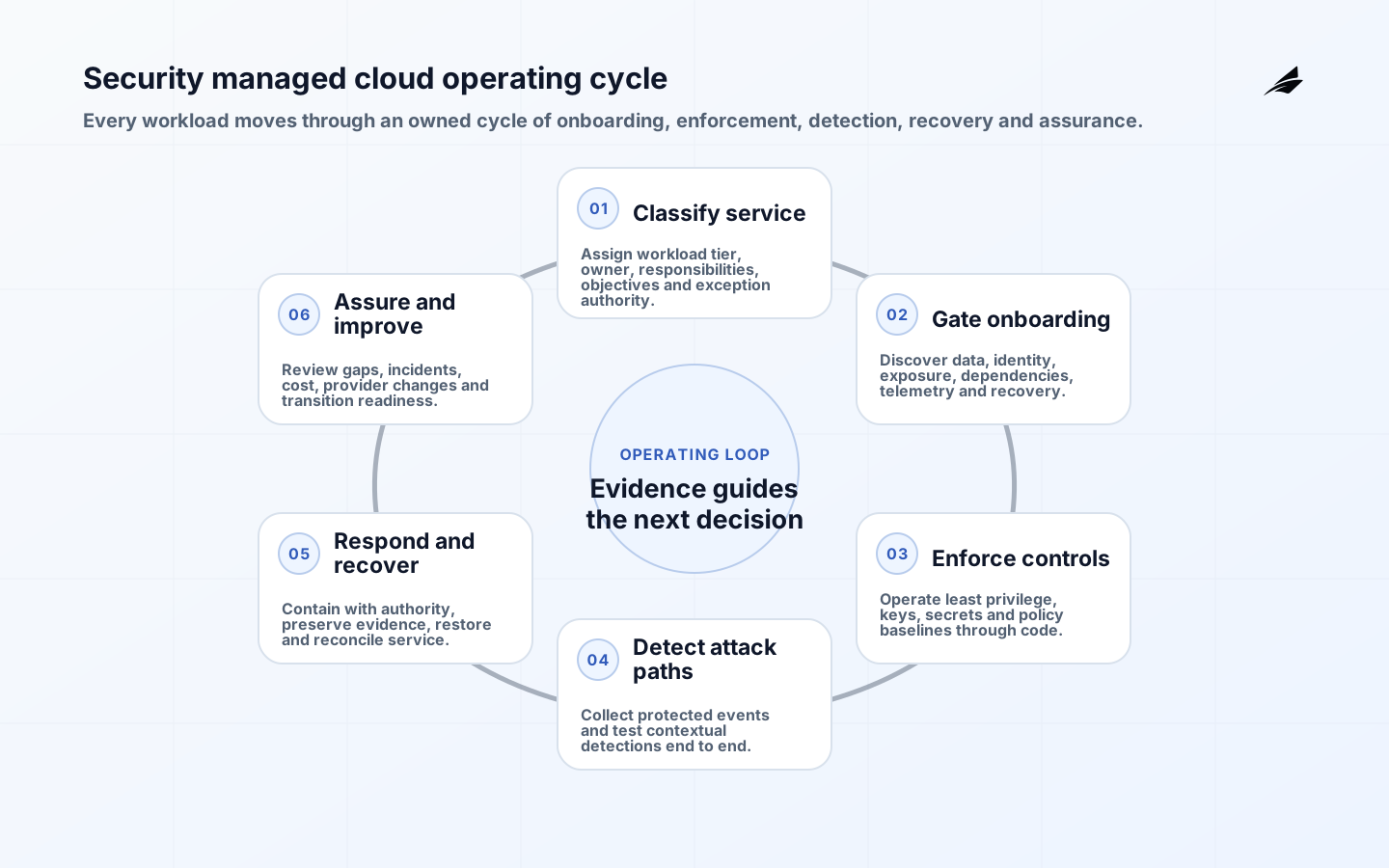
Security managed cloud is an operating model in which cloud platform and security work are delivered as a governed service. It joins onboarding, identity, configuration, vulnerability handling, detection, incident response, recovery and assurance. The central challenge is not installing another tool; it is maintaining known workload state and clear authority as accounts, services and threats change. This checklist focuses on operating the service after commercial scope is agreed.
Use the security managed cloud delivery plan and security managed cloud FAQ for selection decisions. Compare global requirements in worldwide managed cloud security. The customer remains accountable for risk and data even when specialists perform daily controls.
Create a service catalog and decision model
Define eligible clouds, accounts, workload tiers, data classes, regions and supported controls. Publish standard onboarding, exceptions, request routes, service hours and responsibilities. Name service owner, cloud owner, security operations lead, identity owner, incident commander and workload owner. For every activity, identify who requests, approves, performs, verifies and receives evidence. This prevents a provider ticket queue from becoming an accidental risk authority.
Use NIST CSF 2.0 to connect governance, identification, protection, detection, response and recovery. Build a target profile for each workload tier and map service capabilities to outcomes. Track residual risk and exceptions separately from normal requests. Leadership reviews should decide priorities and tolerance, not merely receive operational statistics.
| Workload tier | Onboarding proof | Operating expectation | Exception authority |
|---|---|---|---|
| Critical | Threat, recovery and dependency review | Continuous coverage and exercised response | Business and security executives |
| High | Data, identity, exposure and owner checks | Defined SLO and quarterly assurance | Service and risk owners |
| Standard | Automated baseline and ownership | Central monitoring and patch policy | Cloud security owner |
| Sandbox | Identity, budget, expiry and no restricted data | Limited telemetry and automatic cleanup | Platform owner |
| Unsupported | Documented reason and migration date | Compensating controls | Formal risk acceptance |
Onboard workloads through an evidence gate
Discover accounts, resources, identities, data, ingress, egress, dependencies, backup and ownership. Assign criticality and connect repositories, deployment pipelines and service records. Apply approved landing-zone configuration and verify it after deployment. Reject orphan resources and unknown public exposure. Time-limit sandboxes and acquisition accounts so inventory remains a control rather than a historical list.
Capture workload-specific recovery and incident contacts before production. Run a known-event test and a restore sample. Verify that the provider can access only agreed resources using customer-controlled identities. Document gaps with an owner and date. Onboarding completes when control and operational evidence exists, not when an agent reports installed.
Operate identity, keys and secrets continuously
Federate people, require strong authentication and use time-bound elevation. Review effective privilege and cross-account trust. NIST SP 800-207 rejects implicit trust from network location; evaluate subjects and resources for every access decision. Separate support, security and deployment roles. Alert on emergency access and review each use.
Inventory workload identities, keys, certificates and secrets with owners and rotation. Prefer short-lived credentials and managed identity. Detect credentials in source and logs, and rotate exposures immediately. Test revocation and expired-certificate behavior. Cryptographic controls need backup, recovery and algorithm-change plans; encryption is not complete when keys are inaccessible during restoration.
Maintain baseline posture without alert fatigue
Express network, storage, logging, encryption, region, backup and tagging rules as code. Prevent dangerous states and route lower-risk deviations into accountable remediation. Prioritize by exposure, exploitability, data and business impact. Recheck after change and close findings only after verification. Automate repetitive correction when it is safe, reversible and tested; preserve approval for changes that may interrupt service.
CISA’s Cloud Security Technical Reference Architecture describes cloud security posture management alongside shared services and migration. Build posture coverage against an asset denominator and record unsupported services. A perfect score can hide missing accounts or disabled collection, so alert on discovery and telemetry gaps.
Engineer detections around cloud attack paths
Collect identity, administrative API, network, workload, key, storage and data-service events to protected storage. Define schemas, latency, retention and failure monitoring. Build detections for credential abuse, privilege escalation, policy weakening, unusual data access, persistence, defense evasion and malicious workloads according to threat modeling. Each detection needs rationale, data dependencies, test, severity, owner, runbook and review date.

Test rules with approved simulations and confirm end-to-end routing. Measure coverage, precision, detection delay and responder outcome. Tune with incident and false-positive evidence, not a blanket desire for fewer alerts. Preserve raw context for investigation and control high-cardinality cost. NIST’s cloud publication index provides detailed cloud-native guidance that can inform service-specific control design.
| Operating signal | Measure | Healthy evidence | Immediate escalation |
|---|---|---|---|
| Inventory | Known resources with owner and tier | Continuous discovery reconciles | Critical orphan or unknown account |
| Posture | Risk-weighted overdue findings | Verified remediation trend | Public sensitive data or disabled audit |
| Detection | Tested techniques and alert precision | Known events route correctly | Silent pipeline or missed critical simulation |
| Response | Containment and communication time | Authority works in exercise | No reachable owner |
| Recovery | Restore and reconciliation result | Objective met with controls intact | Backup cannot produce accepted service |
Exercise response, recovery and evidence handling
Create joint playbooks for compromised identities, exposed data, malicious compute, ransomware, provider outage and monitoring failure. Pre-authorize reversible containment. Define evidence capture, legal assessment and customer communication. The incident commander decides when business impact outweighs containment benefit. Record a timeline of observations, decisions, commands and outcomes.
Restore into isolation, validate integrity, reconcile business records, rotate credentials and verify telemetry before reopening. Test dependencies and operator access under degraded conditions. Compare achieved recovery with objectives and fund corrections. A backup dashboard and incident closure count are weak evidence without a successful service-owner acceptance exercise.
Run continuous assurance and service improvement
Review access, coverage, exceptions, vulnerabilities, detections, incidents, recovery, provider changes and cost. Sample evidence directly. Audit configuration history and subcontractor access according to risk. Track recurring manual work and remove root causes. Metrics should support decisions such as changing a baseline, adding coverage, accepting risk or moving a workload.
Keep customer-owned repositories, exports, cases, runbooks and credentials current. Rehearse provider transition on a bounded workload. Validate data return and deletion terms. Security managed cloud is resilient when the service can improve or change providers without losing visibility, recovery capability or ownership of the estate.
Example: onboard an internet-facing analytics workload
An analytics workload receives partner files, processes them in containers and exposes results through an authenticated API. Onboarding identifies sensitive input, partner identities, storage, registry, build pipeline, encryption keys, outbound destinations and recovery owner. The service assigns a high tier because public exposure and data sensitivity combine. Policy blocks public buckets, unrestricted egress, unsigned deployment artifacts and missing audit delivery. The workload cannot enter production until each resource appears in inventory with an owner.
Detection tests cover a failed partner login burst, privilege change, unusual object reads, disabled logging and a container attempting an unapproved destination. One test reveals that storage data events are disabled because of cost. Instead of accepting a blind spot silently, the owners scope logging to sensitive prefixes, set volume alerts and document residual coverage. Response automation can revoke a partner token, while isolation of the processing account requires incident commander approval because it may interrupt reporting.
The recovery exercise restores configuration and data to an isolated account, rotates keys, rebuilds containers from approved artifacts and reconciles produced reports against input manifests. Operations discover that a third-party schema reference is unavailable during isolation, so they cache a verified version and add it to dependency inventory. Recovery ends only after the analytics owner validates outputs and the security team confirms telemetry.
At the quarterly review, evidence joins posture, detection precision, response timing, restore performance and cloud cost. The team retires duplicate alerts and fixes the partner onboarding process that causes repeated stale identities. This example shows the complete service loop: security controls change the workload and operating process, while workload incidents and exercises improve the managed baseline.
Service changes follow controlled release. A new cloud region, storage feature or container runtime cannot inherit approval merely because the account is already managed. The workload owner submits the changed boundary, data and dependency information; security updates policy and detection coverage; operations validates capacity and recovery. Low-risk additions can use automated evidence, while changes to exposure, identity or critical data trigger human review. The service catalog records which capabilities remain unsupported.
Measure provider performance with outcomes that the customer can verify: known coverage, tested alerts, risk-weighted remediation, containment authority and accepted restore. Ticket volume, ingested gigabytes and scan counts may explain workload but do not establish security. Sample closed findings against current configuration and sample alerts against raw events. When evidence repeatedly fails, change staffing, tooling, scope or provider rather than normalizing an unreliable control.
Keep a minimum internal capability even under a fully managed arrangement. Customer staff must understand architecture, approve risk, command incidents, access records and operate transition credentials. Rotate these people through exercises and service reviews so knowledge is not concentrated in one contract manager. The provider supplies specialized execution; the customer preserves informed accountability and the ability to challenge conclusions.
Key takeaways
- Publish workload tiers, service responsibilities and decision authority.
- Gate onboarding on ownership, controls, telemetry and recovery evidence.
- Operate identity, posture and detection against known attack paths.
- Exercise containment and business reconciliation, not backups alone.
- Use continuous assurance to improve controls and preserve transition capability.
Frequently asked questions
How is security managed cloud different from a cloud provider?
The cloud provider operates defined underlying services under its shared-responsibility model. A security managed cloud service performs additional customer-side governance and operations. Exact boundaries must be documented for each service and workload.
Should every misconfiguration be fixed automatically?
No. Automate prevention and reversible correction where context and tests are strong. Changes that may interrupt service, destroy evidence or violate business intent need explicit authority and a controlled path.
Conclusion
Security managed cloud works as a continuous operating cycle: classify and onboard, control identity, enforce posture, detect threats, respond and learn. Clear ownership and tested evidence keep automation useful while ensuring business risk decisions remain with accountable people.