A security managed cloud service combines cloud platform operation with security control execution, monitoring and evidence. Its value depends on a precise estate boundary, clear decision rights and tested operational handoffs. “Manage our cloud securely” is not a workable scope: it leaves identity, applications, data, incidents and recovery open to conflicting assumptions. This guide turns the service into measurable work.
Use the plan with the security managed cloud checklist, security managed cloud FAQ and worldwide managed cloud security guide. For the closely related wording, the security managed cloud services scope guide provides another comparison point.
Define the cloud and service boundary
NIST SP 800-145 defines cloud computing through essential characteristics, deployment models and IaaS, PaaS and SaaS service models. Those models shift what a customer can configure and what a provider operates. Inventory organizations, tenants, subscriptions, accounts, regions, networks, workloads, data classes, identities, shared services and interfaces. List explicit exclusions and the process for bringing newly discovered resources into scope.
Separate platform, security and application responsibilities. A provider may manage cloud account baselines and centralized logs while application teams own authorization and data retention. State supported services and configurations; “all native services” is difficult to staff and assure. Tier the estate by criticality, exposure and data sensitivity so response, recovery and change controls can be proportionate.
| Scope unit | Decision to record | Cost or risk effect |
|---|---|---|
| Cloud organization | Accounts, regions, landing zones and onboarding rule | Defines inventory and policy scale |
| Workload tier | Criticality, support window and recovery objective | Drives staffing, testing and resilience |
| Control catalog | Applicable control, performer, cadence and evidence | Prevents omissions and duplicated effort |
| Telemetry | Sources, volume, retention, routing and access | Often a major variable consumption cost |
| Change authority | Preapproved, normal and emergency actions | Determines response speed and business risk |
| Compliance evidence | Framework mapping, frequency and format | Adds assurance and retention workload |
Create a control-level responsibility model
Map the cloud provider, managed operator, customer platform team, application owner, security team and business risk owner. The CSA Cloud Controls Matrix v4.1 provides a current cloud control framework and shared-responsibility material. Tailor it to the actual service. For every shared control, name who performs, approves, monitors, supplies evidence, handles exceptions and accepts residual risk.
Include supplier dependencies. The managed provider may rely on a detection platform, ticketing service or subcontracted operations center. Record where customer data and telemetry travel, who can access them, and how incidents are coordinated. Require notice and review for material subcontractor or control changes. A corporate certification can support assurance, but verify that its scope covers the service locations and activities being purchased.
Design the target control and architecture baseline

Use the CISA Cloud Security Technical Reference Architecture to inform landing zones, shared services, migration and posture management. Define identity federation, privileged access, organization policy, network patterns, encryption and key ownership, logging, workload protection, vulnerability management, backup and recovery. Version the baseline and distinguish mandatory settings from workload-dependent guidance.
Build exceptions into the design. An exception needs affected resources, reason, risk, compensating controls, approver and expiry. Monitor drift from both the baseline and approved exceptions. Avoid auto-remediation for settings where an unreviewed change can interrupt a critical workload; use observation, approval or safe guardrails according to impact. Test changes in representative environments.
Specify daily operations and service levels
Describe operational events from detection to closure. For a public-storage finding, for example, state how resource criticality and policy are checked, who is contacted, whether access can be blocked automatically, how evidence is retained and how recurrence is reviewed. Define coverage hours, priority, acknowledgement, triage, remediation and escalation clocks with pause conditions and customer dependencies.
Use NIST CSF 2.0 as a common outcome language across Govern, Identify, Protect, Detect, Respond and Recover. Metrics should cover service visibility and quality: inventory coverage, required log coverage, baseline compliance, exception age, critical vulnerability exposure, alert precision, containment execution and restore proof. Raw alert volume and number of closed tickets can increase without reducing risk.
| Metric | Definition discipline | Avoid |
|---|---|---|
| Inventory coverage | Observed in-scope resources divided by reconciled authoritative estate | Counting only resources the tool already sees |
| Control compliance | Applicable checks passing with exceptions reported separately | Averaging critical and cosmetic settings |
| Triage time | Alert availability to recorded severity decision | Stopping the clock without defined customer dependency |
| Remediation quality | Verified correction without repeat drift or failed change | Ticket closure as proof of control |
| Recovery readiness | Representative restores meeting business objectives | Backup-job success alone |
Define incident authority and recovery
Establish severity, customer incident commander, provider lead, cloud-provider escalation, legal and communications contacts. Pre-authorize narrow emergency actions for high-confidence cases, such as disabling a compromised provider identity, and define when business approval is required. Specify evidence preservation, investigation access, notification content and timelines. Ensure an out-of-band communication path exists.
NIST SP 800-61 Revision 3 integrates response with broader cybersecurity risk management. Exercise the joint runbook before acceptance. Include failed telemetry, unavailable staff, cross-account compromise and recovery decisions. Verify backups by restoring applications and reconciling data, permissions and integrations. Track exercise findings as service acceptance gaps, not optional future improvements.
Estimate cost from transparent drivers
One-time costs include discovery, estate cleanup, landing-zone or policy remediation, tooling integration, log onboarding, runbook development, migration and knowledge transfer. Recurring cost may be based on accounts, resources, workloads, users, telemetry volume, retention, support hours, control frequency and reporting. Cloud consumption, licenses and incident surge charges should be separated so proposals can be compared.
Create a worked cost model with current estate and growth assumptions. Model normal, high-volume incident and expansion scenarios. The FinOps Framework emphasizes collaboration and operational capabilities around cloud value. Include tagging or allocation quality, anomaly response and unit economics in the service. Security telemetry and retained snapshots can be valuable and expensive; tie retention to investigation, recovery and compliance needs.
Use ranges for uncertain remediation. A fixed transition fee based only on account count can hide legacy policy conflicts and unsupported workloads. State what happens when discovery finds additional resources or a required control cannot be implemented. Keep contingency owned by a decision process, not as an automatic provider allowance.
Control the main delivery risks
Common risks include incomplete inventory, excessive provider privilege, missing application responsibility, noisy detections, unaffordable log volume, untested recovery, provider concentration and lock-in. Treat each with an owner, leading indicator and contingency. For example, reduce operator risk through federated identities, least privilege, just-in-time elevation, session evidence and tested revocation.
Retain portability. Require exports of inventory, policy, configuration, exceptions, cases, detections, runbooks, reports and retained evidence in usable formats. Define data deletion and assistance periods. Customer ownership of cloud tenants and repositories simplifies transition. Test export and credential revocation during the term rather than discovering limitations at renewal or incident time.
Run a phased delivery plan
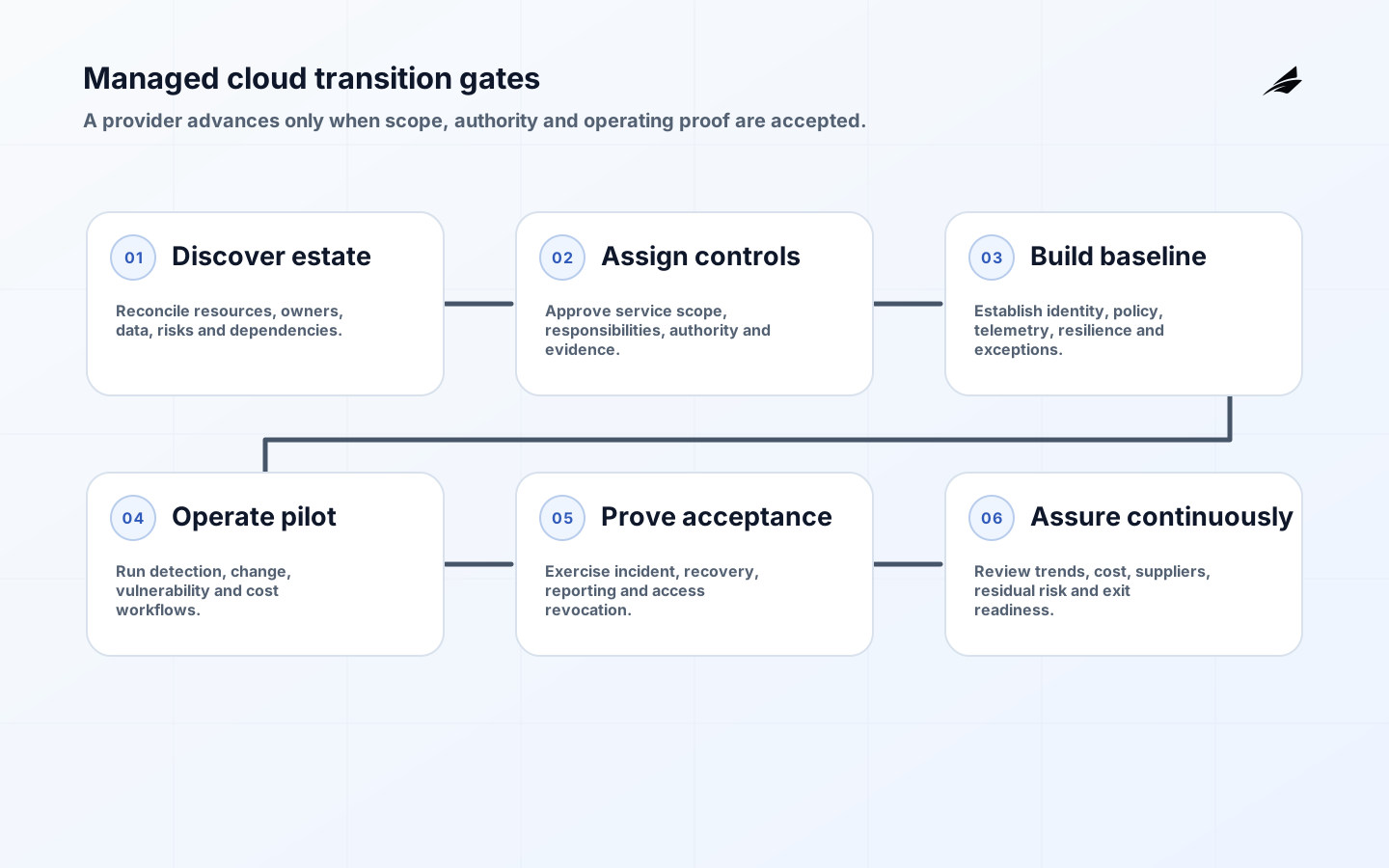
- Discover and reconcile the estate, stakeholders, risks, existing controls and contractual dependencies.
- Approve scope, service catalog, responsibility matrix, baseline, metrics and exception model.
- Onboard a representative pilot with federated access, telemetry, tickets and change controls.
- Exercise detection, remediation, incident escalation, restore and evidence production.
- Accept service only when critical gaps have owners, dates and approved residual risk.
- Expand by workload tier, then review control trends, cost, supplier changes and exit readiness.
Keep go/no-go gates evidence-based. A pilot is not complete because monitoring is connected; it is complete when the provider can detect a test event, make an authorized change, show evidence, restore a representative service and hand an incident to the customer correctly. Expansion should pause if visibility, privilege or recovery gaps exceed agreed thresholds.
Address jurisdiction and data handling explicitly when the service crosses regions. Identify where configuration, logs, cases, backups and support access are stored or viewed. Map transfer, retention, deletion and regulatory constraints to the actual data flows. A follow-the-sun support model can improve coverage while changing access and subcontractor risk. Require approved locations, attributable access and a documented process for emergency cross-border support.
Establish a quarterly service governance review with cloud, application, security, finance and supplier owners. Examine estate growth, control trends, significant changes, incidents, exceptions, cost anomalies, recovery evidence and upcoming deprecations. Decisions should produce named actions and accepted risks, not only presentation slides. Reconcile contract scope to the live estate so commercial assumptions and protection coverage do not drift apart. Sample closed tickets to confirm that reported completion matches resource state and retained evidence.
Key takeaways
- Scope security managed cloud by estate, workload tier, supported services and control outcomes.
- Turn shared responsibility into named performance, approval, evidence and risk roles.
- Model transition, recurring consumption and incident surge costs separately.
- Accept operation only after access, detection, remediation, escalation and recovery are exercised.
- Protect portability through customer control, usable exports and tested provider offboarding.
Frequently asked questions
Is per-resource pricing always best?
No. It is transparent for some controls but may penalize ephemeral architectures or omit telemetry and support complexity. Choose units that reflect real work, and model growth and burst scenarios. Hybrid base-plus-consumption pricing is common when assumptions are explicit.
Must the cloud be remediated before onboarding?
Not completely. Baseline critical access, logging and exposure controls before granting broad provider operation, then maintain a dated remediation backlog. The provider should not inherit unknown risk without scope, priority and acceptance.
Is this the same as an MSSP service?
It may overlap, but a managed security service often centers on detection and response, while security managed cloud can include platform configuration, identity, vulnerability, backup and cloud operations. Compare the control catalog and authority, not the label.
Conclusion
A security managed cloud service is a controlled operating relationship, not a bundle of dashboards. Reconcile the estate, assign every control, price observable drivers and exercise the handoffs that matter. With accepted evidence and an exit path, managed expertise can improve cloud protection without obscuring customer accountability.