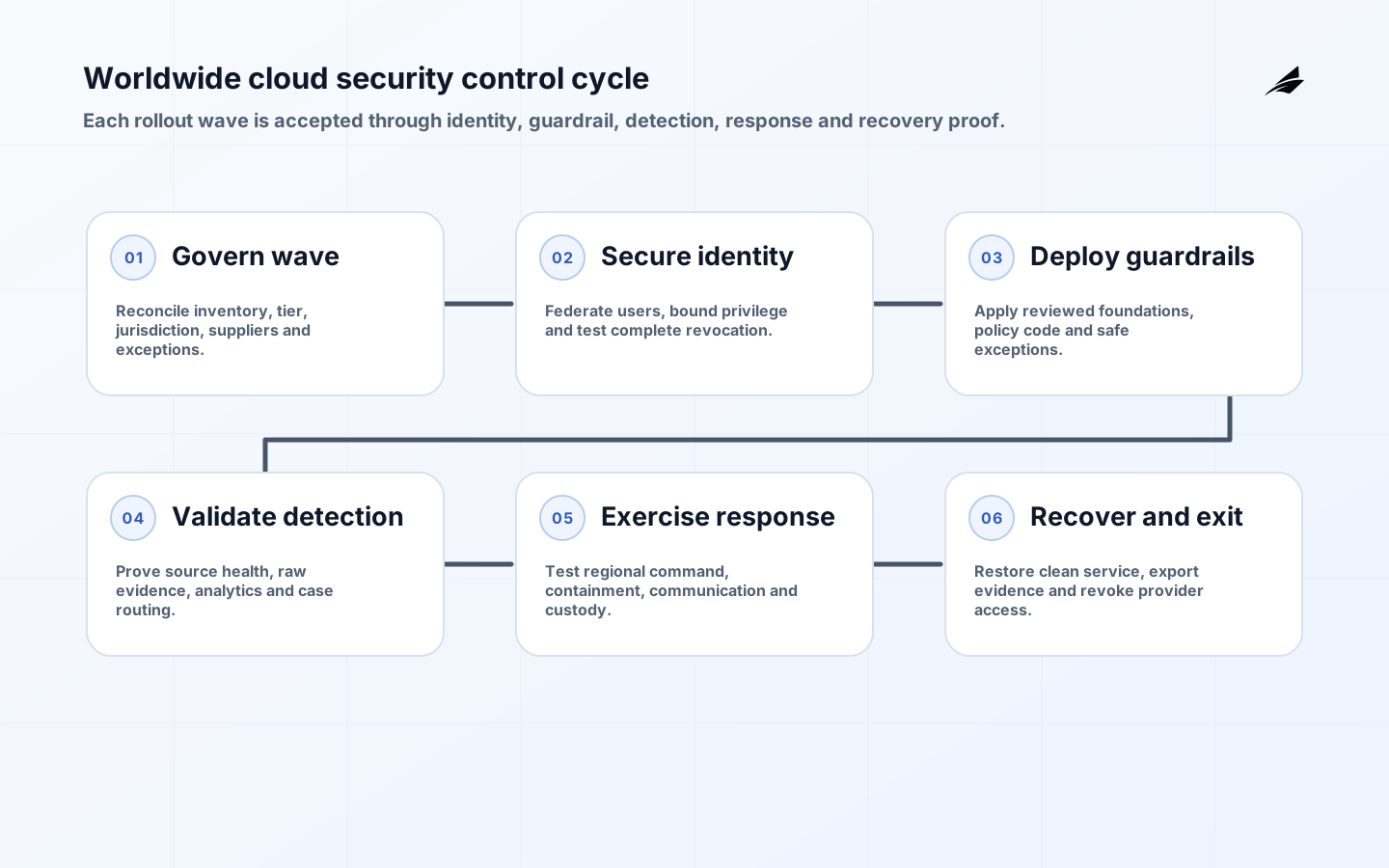
This worldwide managed cloud security implementation checklist turns a global service design into technical and operating evidence. It covers multiple cloud providers, regions and delivery teams without assuming their controls are identical. Complete it per workload tier and jurisdiction. A checked policy statement is not acceptance evidence until configuration, telemetry, authority, response and recovery have been exercised in the environment that will operate.
First establish commercial and geographic boundaries with the worldwide managed cloud security scope plan. Use the managed cloud security services checklist for a narrower single-service rollout and the worldwide FAQ for buyer questions. Retain one acceptance record per rollout wave.
1. Govern the global cloud estate
Create current inventories for organizations, tenants, accounts, subscriptions, projects, regions, services, workloads, owners, data classes and dependencies. Automate discovery, but route unknown assets to accountable resolution rather than assigning a fictional owner. Define workload tiers from consequence, recovery, exposure and legal duty. Record prohibited patterns, minimum outcomes, exception authority and expiry. Map the program to the NIST Cybersecurity Framework functions so technical work remains connected to enterprise risk decisions.
Approve a responsibility matrix for every tier. Include organization policy, identity, network, encryption, key custody, vulnerability, build pipeline, posture, detection, response, backup and recovery. Name who prevents, who monitors, who authorizes change and who supplies evidence. Store contacts and escalation paths outside the cloud identity plane. Validate local counsel and regulator requirements for processing, cross-border access, retention and notification. Document the exact service and framework versions used.
| Governance check | Acceptance evidence | Owner |
|---|---|---|
| Complete scope | Reconciled account and workload inventory | Cloud governance |
| Risk tier | Approved consequence and recovery classification | Business service owner |
| Responsibility | Workload-level RACI exercised in scenario | Security leadership |
| Jurisdiction | Data, access, retention and notice register | Privacy and legal |
| Exception | Compensation, expiry and renewal decision | Risk owner |
| Supplier | Subprocessors, service locations and exit evidence | Procurement |
2. Establish identity and privileged access
Federate workforce identities from a governed directory; prefer phishing-resistant authentication for administrators; use short-lived workload credentials; and prohibit shared users. Separate human, workload, automation and emergency identities. Map groups to bounded roles and conditions rather than accumulating direct grants. Review high-risk entitlements and dormant access. Connect joiner, mover and leaver events to cloud removal and test a departure across all providers, support portals and managed-service consoles.
NIST Zero Trust Architecture rejects implicit trust based only on network location and emphasizes resource-focused authorization. Translate that into policy decisions using identity, device, workload, resource and risk context. Protect federation, privileged access and recovery accounts as tier-zero dependencies. Keep emergency access offline or strongly isolated, alert on every use and rehearse it. Give the managed provider only the standing authority required; make broader incident privilege time-bound and approved.
3. Deploy preventative cloud guardrails
Establish account vending, approved regions, baseline logging, configuration recording, key policy, network patterns, image and artifact sources, secrets management, backup, vulnerability ownership and tagging before workload onboarding. Provider reference architectures such as the AWS Security Reference Architecture, Azure security benchmark and Google Cloud security foundations blueprint are provider-specific inputs. Tailor and test them instead of combining every recommendation into one unmanageable baseline.
Express policy and infrastructure as reviewed code where practical. Validate changes before merge, sign or otherwise protect artifacts, deploy progressively and retain rollback. Use preventative controls for narrow high-confidence prohibitions, detective controls where context is needed, and remediation automation only when blast radius is bounded. Test negative paths: public storage, disabled logging, unrestricted administration, unapproved region and exposed secret. Confirm that emergency exceptions are visible and expire rather than creating hidden permanent bypasses.
4. Build durable telemetry and detections
Define detection use cases from threat and workload consequence, then identify the events required. Collect administrative activity, identity, network, workload, data access, security findings, pipeline and key events with synchronized time and stable account context. Monitor source health, parser quality, delay and volume. Preserve security evidence in a protected account or project with limited deletion authority. CISA's Cloud Security Technical Reference Architecture is useful for shared-service and posture-management design questions.
Write each detection with hypothesis, sources, logic, severity, expected false positives, investigation steps, owner, dependencies and last validation. Generate safe test events and confirm a complete case reaches the expected queue and region. Tune with application owners without suppressing unexplained activity. Correlate native findings but retain links to original evidence. Plan degraded operation when the central analytics service, cross-region transfer or managed provider is unavailable. A detection that cannot be validated should not be counted as coverage.
| Validation scenario | Expected observation | Required action |
|---|---|---|
| New privileged role | Identity and administrative events correlate | Verify approval or revoke |
| Public data endpoint | Configuration and network evidence appear | Contain exposure and assess access |
| Logging disabled | Independent health signal fires | Restore and investigate actor |
| Leaked workload key | Anomalous use and secret context join | Disable, rotate and trace activity |
| Provider region outage | Fallback evidence and contacts remain available | Invoke continuity runbook |
| Malicious pipeline change | Source, build and deployment chain is visible | Block artifact and preserve provenance |
5. Integrate incident response across regions
Create runbooks for compromised workforce and workload identities, public data, malicious deployment, ransomware, cryptomining, control-plane change and lost telemetry. Each runbook names incident command, local contacts, evidence handling, containment authority, cloud escalation, communication, regulatory assessment, recovery and retrospective. Prebuild safe actions such as session revocation, key rotation, workload isolation and policy rollback. Require approval for destructive steps unless a documented emergency threshold is met.
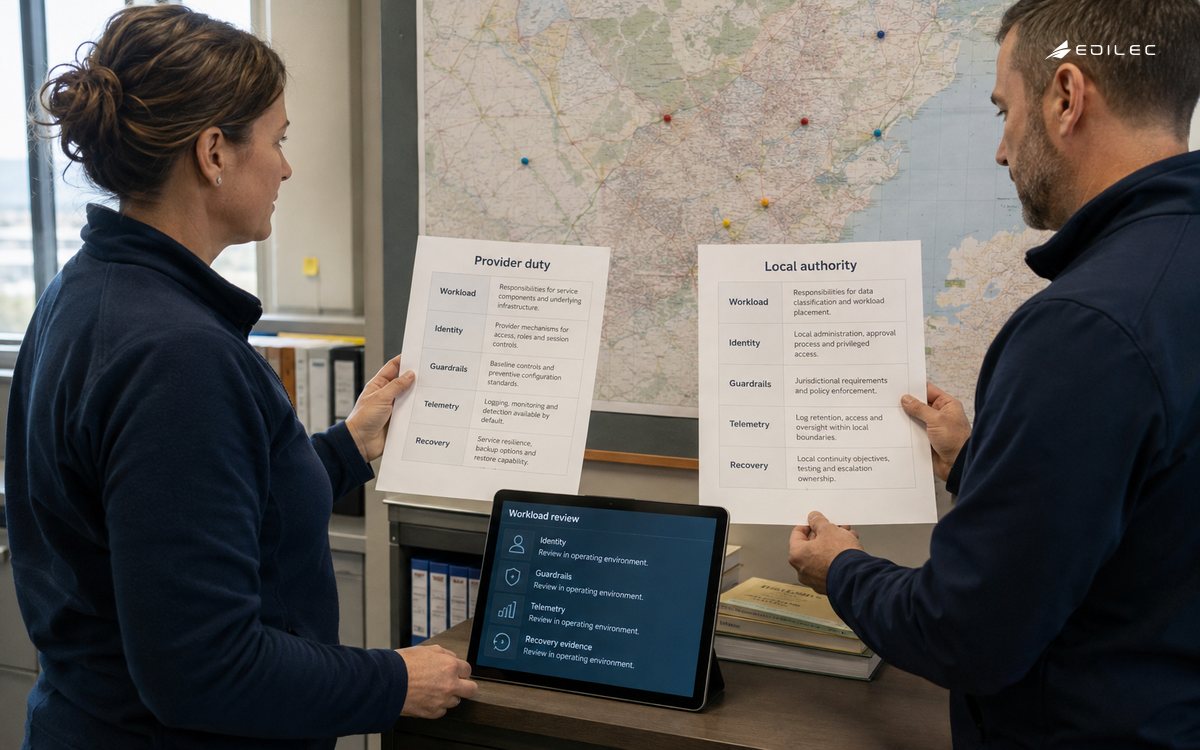
Exercise handoffs across time zones and languages. Start from a realistic provider event, not a prepared ticket, and measure time until detection, investigation, decision, containment and recovery. Include conflicting regional instructions and an unavailable specialist. Verify evidence timestamps, custody and secure communication. After the exercise, update permissions, contacts, rules and architecture. Do not use exercises to score individual analysts; use them to expose system conditions that prevent the team from acting.
6. Prove recovery, operation and exit
Restore a representative workload into a clean boundary using known infrastructure, data, secrets, identity and dependency versions. Validate business records and security state, not only backup completion. Test loss of a region, account, administrative identity and managed provider. Maintain offline or independently protected architecture, inventory and contact evidence. Confirm who can authorize failover and what data loss is acceptable. Record actual recovery time and reconcile it with the business objective.
Operate dashboards for inventory, drift, access, telemetry health, tested detections, incidents, recovery, exception age and unit cost. Sample cases for investigation quality and review automation changes. Export rules, cases, evidence maps, asset ownership and runbooks periodically to prove portability. Revoke provider access and verify deletion in an exit rehearsal. Renew the service only after workload, jurisdiction, threat, provider capability and cost changes have been reviewed by accountable owners.
Final acceptance record
- Reconcile estate, workload, owner, data and jurisdiction inventories.
- Approve target profile, responsibility matrix, exception register and supplier chain.
- Demonstrate federation, least privilege, emergency access and complete revocation.
- Prove guardrails, change control, telemetry health and representative detections.
- Exercise regional incident command, authorized containment and clean recovery.
- Confirm operating measures, evidence retention, export, transition and deletion.
Acceptance must name residual risk and the person authorized to accept it. Store configuration versions, test outputs, incidents, decisions and remediation dates. Expire acceptance after material architecture, provider, jurisdiction or ownership change. A certificate or assessment report can inform the decision, but it cannot prove the customer's deployed settings, managed-provider authority or recoverability.
Example: validate one cross-cloud detection
Choose unauthorized privilege escalation as a controlled validation. In each provider, create an approved test identity and perform the documented role-change sequence in an isolated account. Confirm the native audit event, delivery time, normalized fields, correlation, severity, case ownership and regional notification. The analyst should identify the actor, approver, affected resources and session activity without logging into an unapproved console. Then revoke the role, terminate sessions and verify that automation did not remove unrelated access. Repeat with central analytics unavailable so the team can use protected native evidence and the continuity contact path.
Record provider-specific differences rather than hiding them behind one generic rule. One platform may represent effective permissions through several policy layers, while another emits a distinct administrative event. Tune only after the security hypothesis and source limitations are understood. The completed record links test commands, timestamps, raw events, parser version, case, actions and retrospective. That is defensible detection coverage; a rule enabled in a catalog is not.
Schedule the validation after material identity, parser or provider changes and at a risk-based interval. Track the last successful result and unresolved limitations in the service dashboard. When a region cannot generate the same safe test, document a local equivalent and obtain security-owner approval instead of claiming untested global uniformity.
Key takeaways
- Implement controls per workload tier and jurisdiction, not by global slogan.
- Make every shared-responsibility boundary an exercised operating decision.
- Protect federation, logs, keys, pipelines and recovery as foundational services.
- Count detections only when source health and test events prove the path.
- Accept each wave through incident, restore and exit evidence.
Frequently asked questions
Can one security platform cover every cloud?
It can centralize important views and workflows, but provider semantics and new services differ. Preserve native evidence, validate parsers and maintain an exception process for unsupported capabilities.
Should posture findings be remediated automatically?
Automate bounded, reversible, high-confidence cases after testing dependencies. Require contextual approval when a change may interrupt production, destroy evidence or conflict with local authority.
Conclusion
Implementing worldwide managed cloud security is a sequence of evidence: govern the estate, establish identity, deploy guardrails, validate telemetry, exercise response and prove recovery. Repeating that sequence per rollout wave creates global consistency without erasing provider and jurisdiction realities. It also gives leaders a defensible basis for accepting, changing or ending the service.