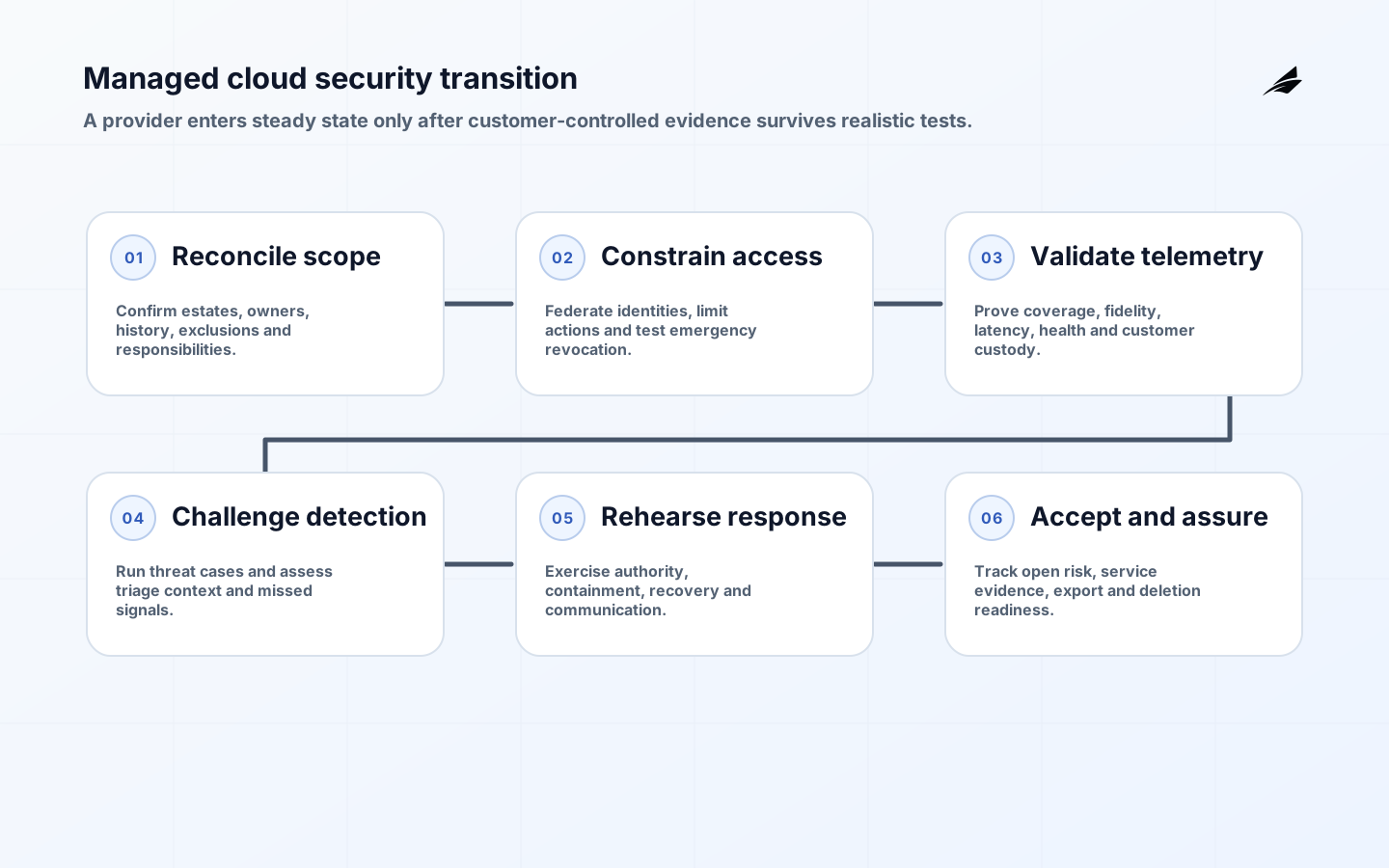
A security managed cloud services implementation checklist must prove that a provider can see the right environment, distinguish meaningful threats, act within authority and leave the customer stronger. Signing a contract and forwarding logs is not transition. Onboarding changes privileged access, evidence custody and incident decisions. Use these gates to establish control-level responsibility, validate detection and response, and preserve an exit path before steady-state service begins.
Frame commercial scope with the managed cloud security delivery guide and resolve operating questions in the managed cloud security FAQ. The general managed cloud checklist helps compare adjacent service models. This checklist focuses on transition evidence and the acceptance decision between customer and security provider.
1. Define scope, assets and responsibility
Identify cloud organizations, accounts, subscriptions, projects, regions, SaaS tenants, workloads, data classes, identities and business owners. Mark production, regulated and high-consequence services. Document unknown or excluded estates. Build a responsibility matrix by control action: configure, monitor, approve, remediate, test and evidence. Map outcomes to the NIST Cybersecurity Framework 2.0 so governance, protection, detection, response and recovery remain connected.
Define service hours, severity, language, staffing locations, subcontractors, escalation and customer prerequisites. Name the customer authority for containment, legal notification, business continuity and risk acceptance. Inventory existing cases, accepted risks and open vulnerabilities so the provider does not reset history at transition. Agree what success means at 30, 60 and 90 days. Exclude services only with an owner and compensating plan; silent gaps become incident blind spots.
| Transition gate | Evidence | Reject acceptance when |
|---|---|---|
| Inventory | Reconciled cloud and owner list | Known production accounts are absent |
| Responsibility | Action-level matrix and contacts | Rows say shared without a decision owner |
| Authority | Containment and emergency limits | Provider can take irreversible action broadly |
| History | Imported incidents, risks and exceptions | Open high-risk work is discarded |
| Success | Coverage, quality and response thresholds | Acceptance depends only on log connection |
2. Constrain provider identity and access
Federate provider users where feasible, require phishing-resistant authentication for privileged access, separate named analyst and automation identities, and prohibit shared accounts. Grant task-specific roles by environment and use just-in-time elevation with approval for higher-impact actions. NIST Zero Trust Architecture supports evaluating each access request rather than trusting network location. Log provider access to a customer-controlled destination that provider administrators cannot alter.
List permitted actions for read, investigate, quarantine, disable, rotate, modify policy and delete. Define dual control and customer approval thresholds. Test emergency revocation and provider staff termination. Review machine credentials, API rate limits and failure behavior. If the provider platform stores telemetry or case attachments, apply data classification, region, encryption, retention and export controls. Keep a break-glass route for the customer if provider identity or connectivity fails.
3. Validate telemetry coverage and evidence custody
Create a telemetry matrix from threat scenarios: control plane, identity, network, workload, endpoint, data access, keys, security findings and application events. For each source, record owner, scope, schema, latency, retention, time zone, health check and cost. CISA's Cloud Security Technical Reference Architecture describes cloud logging and visibility considerations. Verify events from every in-scope environment instead of trusting a connector's green status.
Generate known test events and trace them from cloud source to provider case. Confirm identity, account, resource, timestamp and raw evidence survive normalization. Alert when collection stops, permissions change or schemas drift. Preserve immutable or protected originals for investigation and legal needs. Define who owns enrichment and retention. A provider should not be the only custodian of evidence needed to investigate its own actions or continue service after termination.
| Validation | Test | Acceptance threshold |
|---|---|---|
| Coverage | Sample every account and required source | All critical sources verified; gaps owned |
| Latency | Measure event-to-platform and event-to-case | Within threat-specific objective |
| Fidelity | Compare raw and normalized identity/resource fields | Material context retained |
| Health | Disable a connector or permission | Customer and provider alerted |
| Custody | Export event, case and audit history | Complete, readable customer copy |
4. Test detections, triage and threat context
Inventory detection use cases with hypothesis, data dependency, severity, investigation steps, owner and test. Prioritize credential compromise, privilege escalation, exposed resources, logging interference, suspicious data access, persistence and destructive change according to the estate. Tune against representative activity, not by suppressing everything noisy. Measure validated true findings, missed test cases, duplicates, context completeness and analyst handling time. Raw alert volume is not service value.

Require analysts to understand cloud identity, resource hierarchy and provider services relevant to the environment. Cases should state what happened, evidence, affected assets, confidence, likely impact and required customer decision. Establish feedback from incidents and false positives into detection engineering with change control. Cloud Security Alliance CCM implementation guidance can help connect monitoring to a broader cloud-control program rather than operating detections in isolation.
5. Rehearse incident response and recovery
Write joint playbooks for representative incidents and name incident commander, technical leads, cloud vendor contact, legal, privacy, communications and business owner. NIST SP 800-61 Revision 3 integrates incident response with cybersecurity risk management. Define severity, declaration, evidence handling, containment options, recovery validation, notification inputs and post-incident review. The provider supports decisions; accountable customer authorities remain explicit.
Run tabletop and technical exercises. Compromise a test identity, alter a risky policy, simulate data access and interrupt telemetry. Measure detection, escalation, customer decision, containment and recovery. Verify the provider does not destroy volatile evidence or isolate a critical workload without understanding consequence. Test out-of-band contact and operation during provider-platform failure. Record gaps as owned work with dates, then repeat the failed portion before acceptance.
6. Accept service with assurance and exit readiness
Use a formal transition report listing scope, coverage, access, tests, open risks, exceptions, service levels and customer prerequisites. Accept conditionally only with bounded gaps, owners and deadlines. Establish weekly operational and periodic governance reviews. Track critical exposure age, detection coverage by scenario, collection health, response performance, recurrence, provider access and overdue actions. Review service changes, subcontractors and product releases before they alter the risk boundary.
Test export and offboarding before renewal. The customer should receive inventory, configurations, detection logic where contractually available, cases, evidence, audit history and open work in usable formats. Define credential revocation, connector removal, data return and deletion attestation. Maintain enough internal knowledge to supervise the provider and lead business decisions. A managed service should add capacity and expertise, not create an opaque dependency the customer cannot challenge or replace.
Practical example: transitioning cloud detection and response
A healthcare technology company transitions cloud monitoring from an understaffed internal queue to a managed provider. It begins with twelve production accounts, two identity tenants and the cloud services that store or process patient-related data. Discovery identifies one acquisition account, a legacy logging pipeline and thirty unresolved alerts. Those items remain visible in the transition register. The customer maps each control and response decision to security, platform, privacy, legal and service owners.
Provider analysts receive named federated identities with read-only access. A responder role allows narrowly defined containment after customer approval and expires automatically. Control-plane, identity, network, data-access and workload logs are tested from each account and retained in a customer archive. The team deliberately changes a connector permission; both parties must detect collection loss. Normalization checks preserve tenant, principal, resource, event time and source reference so investigations can return to original evidence.
Joint simulations cover stolen developer credentials, suspicious object reads, disabled logging and a vulnerable public workload. Analysts create cases with confidence, impact and containment options. One detection fires but lacks the assumed-role chain, so acceptance remains conditional until enrichment and triage steps are repaired. The incident exercise also shows that the provider's proposed isolation would interrupt a clinical integration. The playbook adds business-authority approval and a less disruptive credential-revocation path.
At ninety days, governance reviews coverage, missed tests, critical exposure age, escalation time, recurring configuration faults, provider access and overdue customer actions. The company exports all cases and audit logs, revokes a test analyst and verifies deletion of an uploaded evidence package. Internal responders reproduce a sample investigation from the exported record and confirm that cloud-vendor escalation remains available if the provider platform is down. Procurement records subcontractors, evidence locations, breach notice and change-notification duties. Steady-state acceptance follows only after those tests pass. The example distinguishes genuine managed security transition from forwarding events and hoping the provider's standard operating procedure fits the business.
The first steady-state review separates provider delay from customer decision delay and cloud-vendor dependency. That distinction directs investment toward the actual constraint. It also prevents contractual targets from encouraging premature case closure while containment approval, recovery validation or root-cause remediation remains open. Every severe case ends with an evidence-complete state and a named owner for systemic improvement. That owner reports closure evidence.
Implementation takeaways
- Reconcile the in-scope cloud estate and assign every control action.
- Limit and audit provider access with customer-controlled evidence.
- Prove telemetry coverage, fidelity, latency and failure alerts.
- Test threat-specific detections and require useful investigation context.
- Exercise joint containment, recovery and communications before acceptance.
- Govern open risk and rehearse export, revocation and deletion.
Frequently asked questions
How long does managed cloud security onboarding take?
It depends on estate size, inventory quality, telemetry, identity and playbook maturity. Define evidence-based milestones. A narrow environment may transition in weeks; a fragmented multi-cloud estate can require phased months without justifying reduced control.
Should the provider have permanent cloud administrator access?
Generally avoid broad standing administration. Grant the minimum investigation or response roles and use time-bound elevation, explicit approval and strong audit for exceptional actions. Authority should follow the contracted response model.
Conclusion
Security managed cloud services should enter production through tested evidence, not assumed expertise. Scope the estate, constrain access, verify telemetry, challenge detections and rehearse joint response. When customers retain authority, evidence and exit readiness, the provider can improve cloud defense without becoming a new uncontrolled risk.