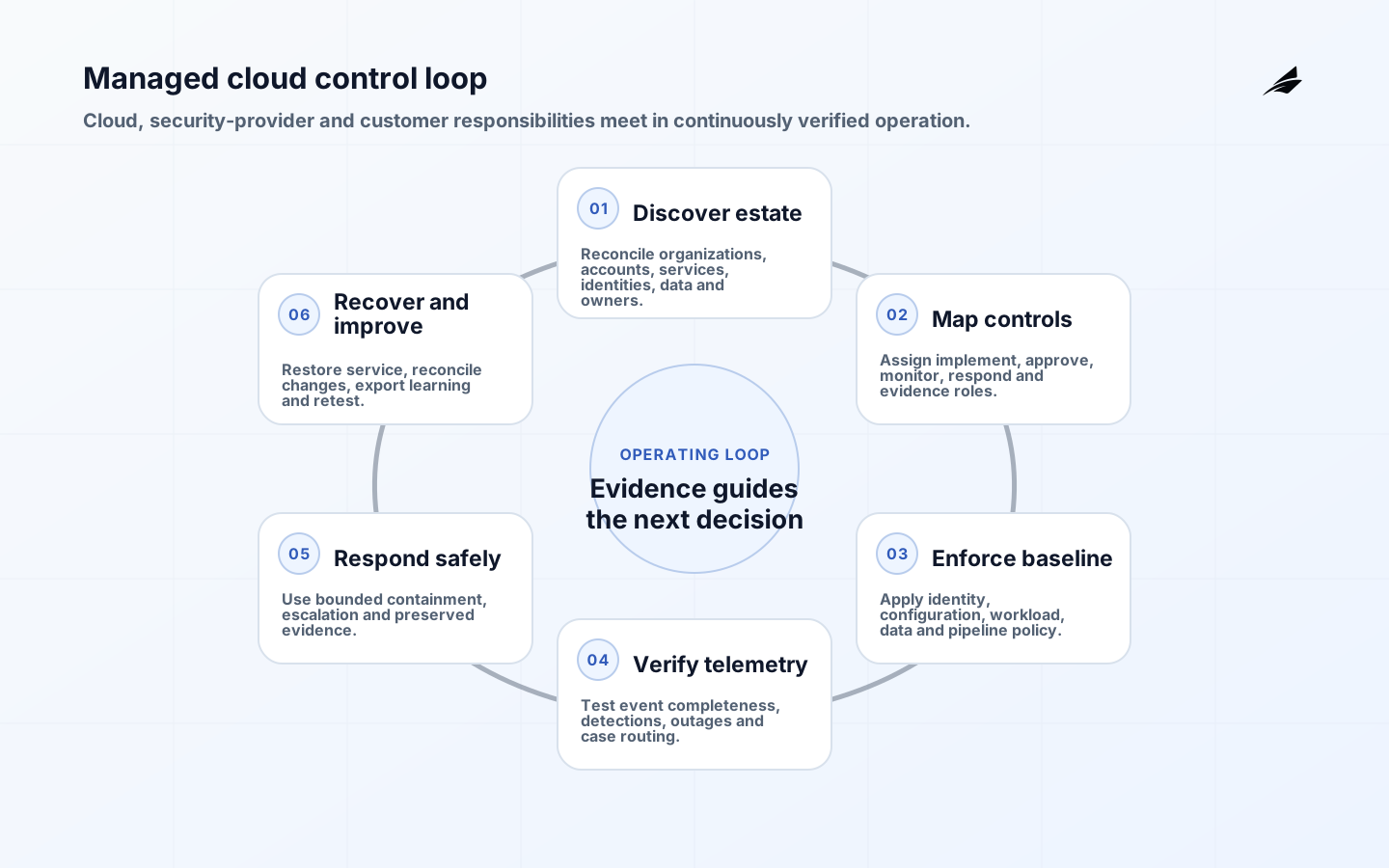
Managed cloud security is an operating service that helps a customer configure, observe, investigate and improve security across cloud infrastructure, platforms and software services. It does not transfer the customer's accountability to the provider or eliminate the cloud platform's own responsibility. A credible service makes control ownership explicit, proves coverage continuously and can contain and recover from incidents without relying on a dashboard that nobody is authorized to act on.
This FAQ complements the managed cloud security scope guide, the managed cloud security implementation checklist, the worldwide managed cloud security plan and its implementation checklist. Use it to compare internal, provider and hybrid operations against the same questions.
What should managed cloud security include?
Scope should cover the cloud organizations, tenants, accounts, subscriptions and projects that host the agreed business services. Common capabilities include identity and privileged access, configuration baselines, workload protection, data security, vulnerability and image management, key and secret management, network policy, logging, threat detection, incident response, recovery evidence and compliance reporting. SaaS configuration and developer platforms need explicit inclusion because they may not appear in infrastructure inventories.
The service must also define what it does not operate. NIST SP 800-144 emphasizes that accountability for security and privacy cannot simply be delegated to a public cloud provider. Managed service contracts should identify responsibilities across the cloud platform, managed security provider, application team, central IT, data owner and business service owner.
| Control area | Cloud or security provider role | Customer role |
|---|---|---|
| Physical infrastructure | Cloud provider operates facilities and base services | Select appropriate service and assurance |
| Identity configuration | Managed provider may implement and monitor policy | Approve roles, joiner-mover-leaver flow and exceptions |
| Workload and data | Provider can assess and alert within granted access | Classify data, fix applications and own business risk |
| Incident handling | Provider triages and performs authorized containment | Decide materiality, notification, continuity and remedy |
| Recovery | Provider supports protected configuration and evidence | Set priorities and prove business service restoration |
How is shared responsibility made operational?
Create a control matrix at service and cloud-service-model level. For each control, name the implementer, approver, monitor, evidence source, exception owner and response action. A SaaS vendor may secure the application platform while the customer controls identities, sharing, retention and integrations. In infrastructure as a service, the customer usually owns much more of the operating system, network and workload stack. Responsibilities can also vary by a specific managed database, container or serverless service.

Review the matrix when architecture or provider terms change. Map contractual commitments to evidence rather than copying broad responsibility diagrams. The Cloud Security Alliance CCM v4.1 provides 207 controls across 17 domains and supporting shared-responsibility material. Use it as a structured reference, then tailor the applicable control and actor to the real service.
What happens during onboarding?
Discover cloud estates through billing, identity, domain, code and organization records, then reconcile unknown and dormant accounts. Establish federated workforce access, separate emergency access, provider identities, short-lived credentials and approval. Collect architecture, data classification, criticality, regions, owners, repositories, deployment paths and dependencies. Baseline configuration before turning on enforcement so existing business impact is understood.
Connect logs using protected, least-privilege paths and verify event completeness, timestamps, fields and retention. Onboard policy in observe mode where practical, assign findings, then enforce guardrails for high-confidence conditions such as public storage, disabled logging or unrestricted administrative access. CISA's Cloud Security Technical Reference Architecture addresses shared services, cloud migration and posture management, which are useful workstreams for sequencing the transition.
Does managed cloud security implement zero trust?
It can support zero trust but cannot deliver it alone. NIST SP 800-207 focuses access decisions on users, assets and resources without implicit trust based solely on location. A managed service can operate identity signals, device posture, policy enforcement, microsegmentation and analytics, but the customer must define resource sensitivity, permitted workflows and acceptable exceptions.
Cloud-native service identities are as important as workforce identities. NIST SP 800-207A describes identity-tier and network-tier policies for cloud-native applications across multiple clouds. Inventory workload identities, rotate credentials, constrain east-west access and verify authorization at service boundaries. Network isolation alone does not prove that the calling service is entitled to read or change a resource.
| Operational signal | Decision supported | Failure to avoid |
|---|---|---|
| Identity and device context | Permit, step up, restrict or deny access | Trust based only on network or account existence |
| Configuration state | Prevent or prioritize unsafe exposure | Large finding lists without ownership |
| Runtime behavior | Investigate and contain suspicious activity | Alert closure without business context |
| Data event | Restrict access and assess affected records | Assuming encryption resolves excessive access |
| Recovery evidence | Restore a known-good service | Backup success reported without restore testing |
How should detection and incident response work?
Define priority threats by cloud service: stolen administrative sessions, exposed credentials, malicious API use, public data, compromised pipelines, destructive changes, cryptomining and persistence through new identities. Map each to required control-plane, identity, network, workload and data events. Test provider detections with safe scenarios and verify that correlation preserves account, region, resource, actor and business owner context.
Pre-authorize reversible containment such as session revocation, key disablement, standard endpoint isolation or blocking a known malicious path, with exclusions for critical systems. The NIST incident-response revision treats response as part of broader risk management. Preserve evidence in a separate trust boundary, coordinate application and business recovery, and document who assesses legal or regulatory duties. The security provider supplies facts; it should not make legal conclusions for the customer.
What drives managed cloud security cost?
Major drivers are cloud and SaaS count, resources, identities, log ingestion and retention, workloads, data volume, operating hours, response authority, compliance evidence and engineering backlog. Some tools charge per resource, event or gigabyte; service providers may charge per account, workload or analyst tier. Normalize proposals against expected growth and required telemetry. A low base fee can become costly if useful logs trigger consumption overages.
Include transition, remediation and internal ownership. Providers can identify an unsafe role or image, but application teams may need funded work to remove it. Also include cloud-native licenses, duplicate tooling during migration, exercises, incident surge rates and exit. Cost per covered critical service, high-risk identity or investigated priority event may be more decision-useful than total alert cost.
Which metrics and evidence matter?
Measure coverage before performance: known accounts onboarded, critical resources owned, identities governed, required logs arriving and policies enforced. Then measure time to assign and remediate exploitable exposure, tested detection success, containment time, recurring root causes, exception age, restore success and cost. Segment by criticality and platform so an average does not hide an unmonitored acquisition or region.
Require evidence access and portability. Customers should be able to export findings, cases, rule logic where licensed, configuration history, exceptions and audit records in usable formats. Sample evidence against source systems and investigate unexplained gaps. Provider reports should state collection outages and scope changes. A green posture score without data quality and coverage context is not assurance.
A minimum onboarding acceptance test
Choose one critical workload and trace it through organization inventory, owner, identity, network, data, code pipeline, logs, detections, backup and recovery. Compare cloud billing and organization APIs with the managed platform to find missing resources. Create and revoke a provider operator, verify privileged approval and confirm that emergency access is independent. Make a controlled configuration violation, observe the finding, assign it to the correct team, remediate through the normal delivery path and confirm the platform recognizes the corrected state.
Then run a safe suspicious-session scenario. Check event arrival, correlation, escalation, authorized containment, evidence and customer communication. Simulate a telemetry interruption so the provider reports loss of visibility rather than a green posture. Export the case, configuration history and exception in the format promised for exit. This single trace will not prove every control, but it exposes integration and responsibility gaps that document review misses. Repeat the pattern for materially different cloud services and high-consequence workloads.
Close onboarding with a signed coverage and limitations record. List accounts not yet connected, unsupported services, temporary broad permissions, accepted configuration exceptions and telemetry with reduced retention. Give each an owner and target state. Reconcile the record at the first monthly review and after acquisitions or organizational changes. Without this step, an implementation can appear complete while the provider and customer hold different assumptions about what is protected.
Key takeaways
- Define exact tenants, services, identities, data and operating hours in scope.
- Assign implement, approve, monitor, respond and evidence roles for every important control.
- Verify telemetry and exercise detections before relying on provider dashboards.
- Pre-authorize bounded containment and connect security response to business recovery.
- Retain internal risk ownership, evidence access and a tested provider exit path.
Frequently asked questions
Do we need one managed provider for every cloud?
No. One provider may simplify correlation and accountability, while specialist providers may fit distinct platforms. Whichever model is chosen, use a common asset, identity, severity, case and evidence model, and name who correlates incidents across boundaries.
Are cloud-native security tools enough?
They often provide the richest platform signals and should be evaluated first. Independent tools may add cross-cloud normalization, separation or specialist capability. The decision should follow required outcomes, coverage, skills, integration, data handling and cost, not an assumption that native or third-party is always superior.
Does managed cloud security make us compliant?
No. It can operate and evidence selected technical and procedural controls. The customer remains responsible for determining applicable obligations, scope, risk treatment and assertions. Map each requirement to an owner and evidence, and have qualified assurance or legal professionals assess conclusions.
Conclusion
Managed cloud security works when shared responsibility becomes observable daily work. Clear coverage, identity-aware architecture, verified telemetry, authorized response, tested recovery and portable evidence make the service dependable. The customer still owns business risk and provider oversight; the managed model should strengthen that ownership with timely expertise and operation, not obscure it.