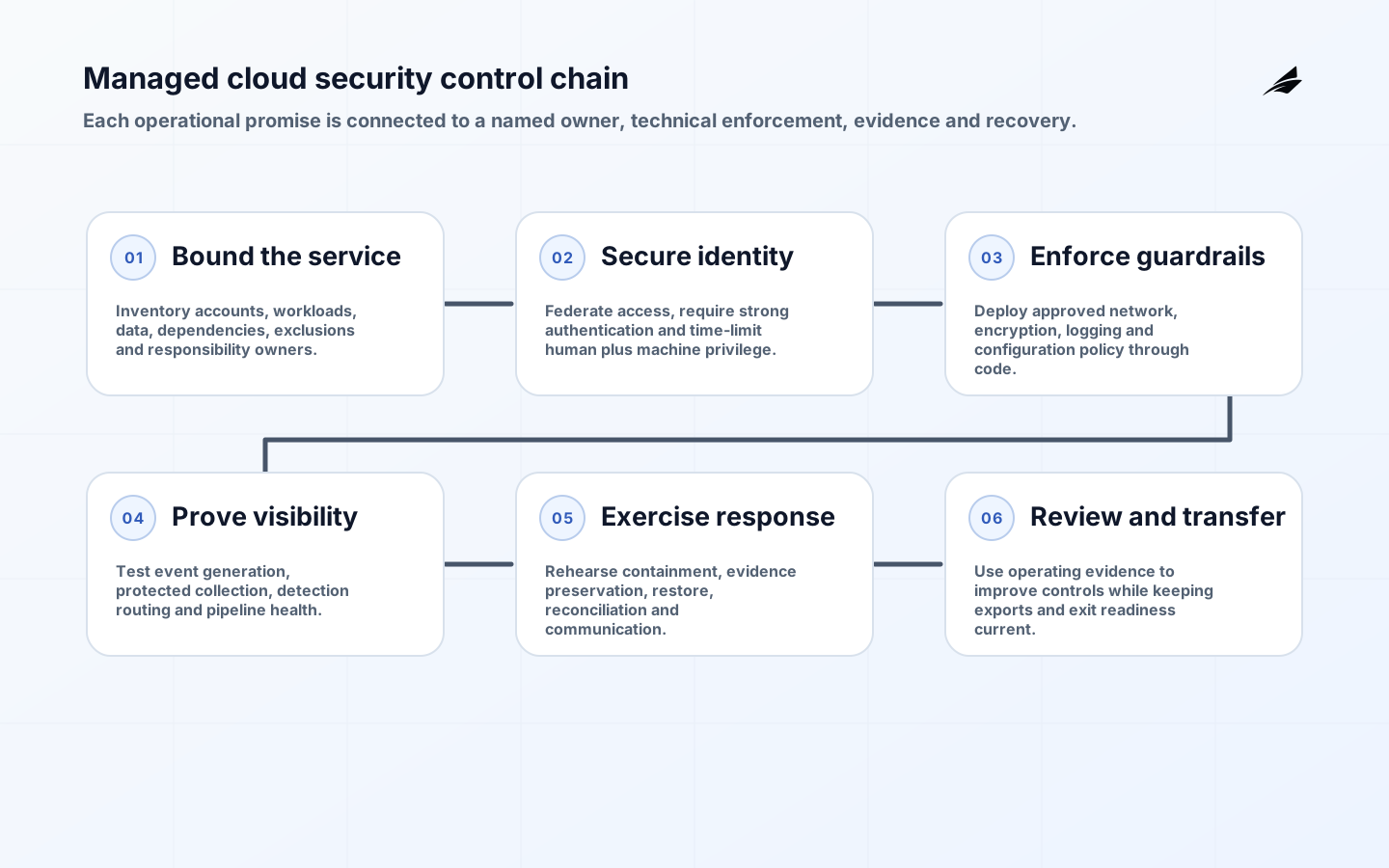
A managed cloud security implementation checklist should define what the provider will do, what the customer retains, and how both parties will prove that controls work. Buying monitoring or a round-the-clock operations label does not transfer accountability for data, identities, application behavior or business continuity. The implementation succeeds when every material risk has an owner, a technical control, an observable signal and a tested response. This guide is for teams onboarding a managed security provider or resetting an arrangement that has grown unclear.
Use this checklist with the managed cloud security delivery plan and managed cloud security FAQ. Organizations comparing broader coverage can also review the worldwide managed cloud security checklist. The sequence applies across public cloud, private cloud and mixed estates, but the exact controls must follow workload criticality, contracts and applicable law.
Define the service boundary and shared responsibilities
Inventory cloud organizations, accounts, subscriptions, regions, workloads, data classes, identities, network connections and third-party services. Mark what is in scope now, what enters later and what is explicitly excluded. For each control, identify the party that configures it, the party that monitors it, the party that approves exceptions and the party that restores service. Provider-native responsibility models are a starting point; a managed service adds another operational layer that must be reconciled rather than assumed.
Translate business impact into recovery, detection and response expectations. A public brochure stating “24/7 monitoring” is not an operating commitment. Specify event intake coverage, triage windows by severity, escalation contacts, evidence preservation, communication intervals and authority for containment. The NIST Cybersecurity Framework 2.0 adds Govern to Identify, Protect, Detect, Respond and Recover, which is useful for connecting technical activity to leadership decisions and supplier oversight.
| Decision | Customer owner | Provider duty | Acceptance evidence |
|---|---|---|---|
| Account baseline | Cloud platform owner | Implement approved templates | Policy scan and sampled configuration |
| Privileged access | Identity owner | Use managed identities and recorded elevation | Access review and elevation log |
| Security monitoring | Security operations lead | Collect, correlate and triage agreed signals | Coverage map and alert exercise |
| Incident containment | Incident commander | Execute pre-authorized playbooks | Tabletop and technical drill |
| Recovery | Service owner | Support restore and validation | Timed recovery test with reconciliation |
Establish identity as the primary control plane
Federate workforce access to the customer identity provider, require phishing-resistant multifactor authentication where risk warrants it, and prohibit shared administrator accounts. Give provider personnel named identities with role-based access, time-limited elevation and automatic removal when assignments end. Separate everyday administration from emergency access. Test the emergency route, alert on its use and review every session. Machine identities need the same ownership discipline: short-lived credentials, constrained audiences, rotation and an inventory tied to deployed workloads.
NIST SP 800-207 explains that network location or asset ownership should not create implicit trust. Apply that principle to cloud consoles, APIs, automation runners and support channels. Authorization should evaluate the subject, device, requested resource and context. Review effective permissions, not just role names, because inherited groups, service principals and cross-account trust can create access paths that neither party intended.
Deploy preventive guardrails through code
Create version-controlled landing-zone patterns for account structure, network boundaries, encryption, logging, approved regions, backups, tags and policy. Validate infrastructure changes before merge and after deployment. Prevent high-consequence misconfigurations when possible, such as public storage, unrestricted administrative ports or disabled audit logs. Lower-risk deviations can generate a ticket with an owner and expiry. A control that only produces thousands of unactioned findings is not an effective guardrail.
The CISA Cloud Security Technical Reference Architecture emphasizes shared services, cloud migration and cloud security posture management. Use those ideas to centralize approved capabilities without hiding workload responsibility. Maintain a documented exception path that records business reason, compensating controls, approver, affected resources and expiration. Recheck exceptions automatically; permanent waivers should require an explicit risk decision.
Build a complete and testable telemetry path
Collect identity events, administrative API activity, network flows, workload security events, key-management use, data-service audit trails and control-plane changes according to risk. Record source, schema, region, expected latency, retention and owner. Normalize timestamps while preserving original fields. Route logs to a security-controlled destination where an attacker or compromised administrator cannot quietly erase them. Protect the pipeline with health checks, volume baselines and alerts for silence.
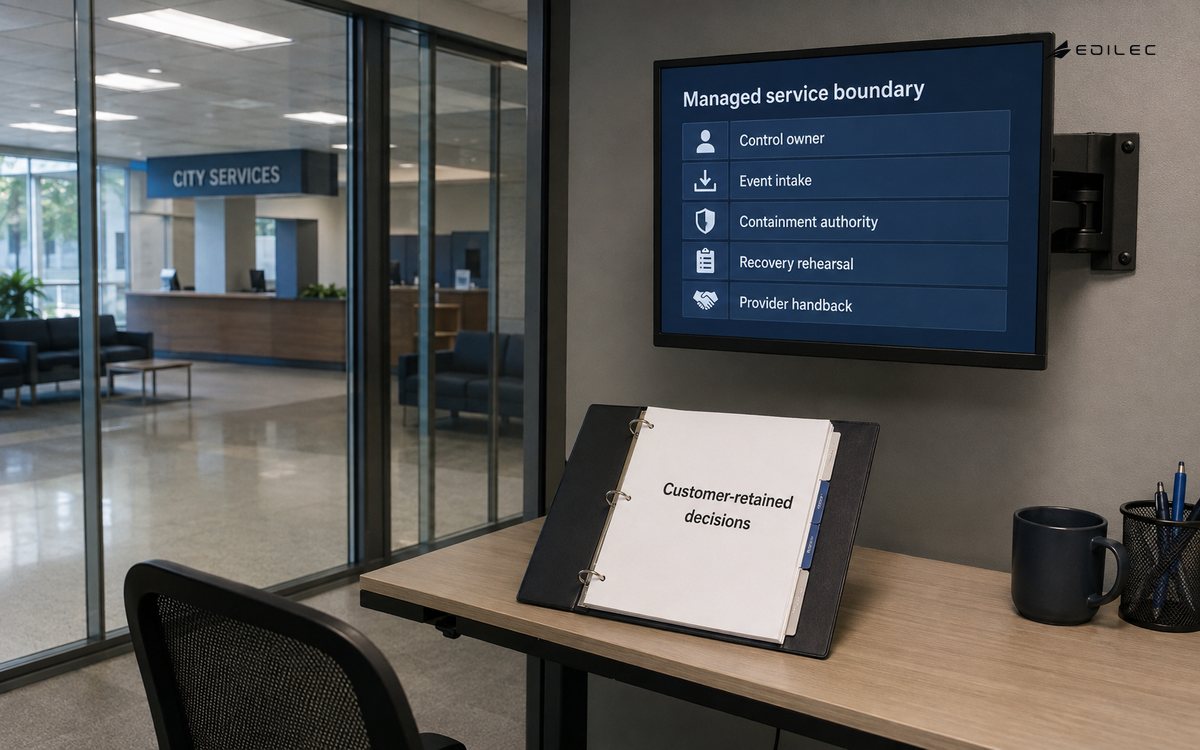
Test visibility by performing approved actions that should generate specific events: a denied login, policy change, secret access, firewall update and simulated malicious workload behavior. Confirm the event arrives with enough context for triage and that the alert reaches the right queue. Coverage should be measured against in-scope assets and attack paths, not daily ingest volume. Sampling, provider limits and new service versions can create blind spots, so include telemetry changes in release management.
Control vulnerabilities, images and secrets
Define who inventories assets, scans operating systems, containers, dependencies and cloud configurations, and who owns remediation. Set risk-based deadlines that account for exploitability, exposure and business impact rather than severity score alone. For managed runtimes, document which layers the cloud provider patches and what remains with the customer or service provider. Validate that autoscaling and disaster recovery use patched images instead of reviving an old vulnerable baseline.
Use approved registries, signed or provenance-aware artifacts where available, secret managers and automated detection of credentials in repositories and build output. Rotate exposed secrets immediately; deleting a commit is not enough. Include SaaS, CI/CD, identity and observability platforms in the dependency inventory because a managed cloud boundary rarely ends at infrastructure. NIST’s cloud computing publication index helps teams select detailed guidance for cloud-native access, data protection and software supply chains.
Rehearse incident response and recovery together
Write joint playbooks for compromised credentials, public data exposure, malicious workloads, key misuse, ransomware, provider outage and telemetry failure. Define who can isolate an account, revoke sessions, block a route or stop a deployment. Pre-authorize urgent reversible actions, while reserving destructive steps for the incident commander. Preserve cloud snapshots, logs and configuration history with a clear evidence chain. The provider must know the customer’s legal and communication contacts before an incident begins.
Recovery is a business verification activity, not merely restoration of infrastructure. Restore into an isolated environment, validate integrity, reconcile transactions, rotate credentials, confirm monitoring and obtain service-owner acceptance. Measure achieved recovery time and recovery point against objectives. Record dependencies that delayed the exercise. A backup report is weak evidence if no one has demonstrated that applications, identity, data and integrations can resume coherently.
| Control area | Operating measure | Target behavior | Escalation trigger |
|---|---|---|---|
| Asset coverage | In-scope resources reporting posture and logs | Known denominator and named exceptions | Unowned or silent critical asset |
| Identity | Privileged grants and stale accounts | Time-bound grants; prompt removal | Shared or unexplained privilege |
| Detection | High-risk techniques with tested signal | Alert reaches an accountable responder | Missing event or repeated false closure |
| Remediation | Exposure-weighted time to fix | Risk deadline met or exception approved | Exploitable overdue issue |
| Recovery | Achieved restore and reconciliation time | Objective met with intact controls | Untested dependency or data mismatch |
Plan governance, review and provider transition
Hold monthly operational reviews and quarterly risk reviews with evidence, not slide counts. Examine coverage, incidents, overdue remediation, access exceptions, control changes, recovery exercises, cloud cost and recurring manual work. Link each metric to a decision. Do not reward the provider for alert volume or ticket closure when the underlying exposure remains. Review subcontractors and provider platform changes that alter data location, access or support responsibilities.
Maintain an exit package throughout the engagement: configuration repositories, asset exports, detection content, case history, runbooks, credentials owned by the customer, evidence-retention arrangements and deletion obligations. Test export formats and the ability of an internal team or successor to operate a sample workload. Transition clauses become useful only when backed by current artifacts and rehearsed access. Avoid designs in which the provider alone owns the account, keys or automation required to recover the estate.
Apply the checklist to a customer data platform
Consider a customer data platform spanning a public API, object storage, a managed database, identity federation and a SaaS messaging provider. The managed security team first maps which account owns each resource and who can approve exports. It deploys policy that blocks public storage and requires protected audit trails, then tests a denied access, an administrative change and a data export alert. The workload owner confirms that the events identify tenant, actor and affected dataset without copying personal records into the security platform.
During the joint exercise, a simulated stolen support identity triggers session revocation, key rotation and temporary export suspension. The business owner verifies queued messages and customer records after restoration. The review finds that the SaaS provider’s audit feed arrives with a delay, so the team adds a compensating export limit and a separate anomaly signal. This is useful acceptance evidence because it connects architecture, responsibility, detection and business recovery rather than reporting that tools are enabled.
Key takeaways
- Map every cloud security control to customer and provider responsibilities.
- Use federated identity, time-bound privilege and controlled machine credentials.
- Deploy guardrails and evidence collection through version-controlled automation.
- Test telemetry, containment and recovery with real exercises.
- Preserve customer ownership and a workable transition route throughout the contract.
Frequently asked questions
Does a managed service transfer cloud security accountability?
No. It can transfer defined operational tasks, but the customer remains responsible for choosing acceptable risk, classifying data, setting policy and verifying outcomes. Contracts should make the provider’s duties measurable and preserve customer decision authority.
Is a provider security operations center enough?
Only when its visibility, detection content, response authority, staffing, escalation and evidence are matched to the estate. Test the path with known events and incident exercises instead of treating continuous staffing as proof of effective coverage.
Conclusion
A managed cloud security implementation checklist turns a broad service promise into an accountable operating system. Bound the estate, secure identity, automate guardrails, prove telemetry, manage vulnerabilities, rehearse response and retain transition control. The result is not the absence of incidents; it is a cloud environment in which material risk is visible, decisions are owned and recovery can be demonstrated.