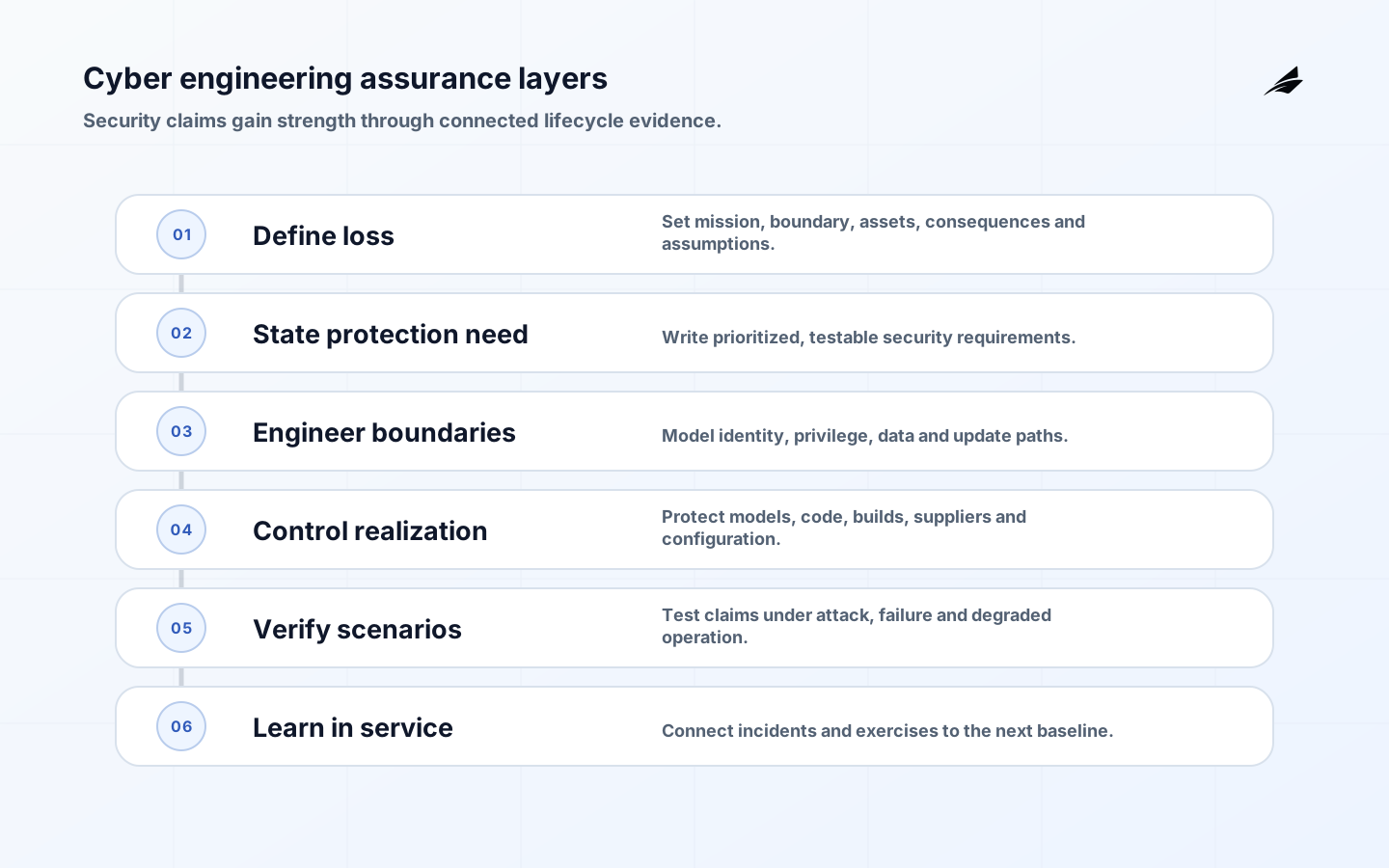
Cybersecurity digital engineering connects mission needs, protection concerns, architecture, implementation, verification and operating evidence through controlled digital artifacts. The objective is not a larger document repository. It is a system whose security claims can be traced to design decisions, tested configurations and observed behavior. This implementation checklist helps system, software, security, operations and supplier teams build that evidence into the lifecycle rather than attach it near release.
Use the cybersecurity digital engineering lifecycle guide for the operating concept and the cybersecurity digital engineering FAQ for common decisions. Apply the OpenID Connect checklist and encryption-at-rest checklist when those controls enter the design.
1. Define system purpose, boundary and loss concerns
Name the mission or business service, stakeholders, operating environments, critical assets and unacceptable losses. Include safety, financial, privacy, availability, integrity and reputational consequences. Draw the boundary across software, hardware, networks, cloud services, facilities, people, suppliers, maintenance channels and data exchanges. A diagram that stops at the application misses build systems, administrative identities and update mechanisms that can change what the system becomes.
NIST SP 800-160 Volume 1 Revision 1 establishes a systems security engineering approach for trustworthy secure systems across lifecycle processes. Use it to make protection an engineering concern, not a control-mapping exercise. Create a short loss scenario for each critical concern: initiating condition, affected asset, propagation path, consequence, detection opportunity and responsible decision owner. Approve which assumptions need evidence before architecture proceeds.
| Engineering concern | Required artifact | Acceptance question | Owner |
|---|---|---|---|
| Mission and loss | System context and loss scenarios | Are unacceptable consequences and affected stakeholders explicit? | Mission or business owner |
| Protection needs | Prioritized security requirements | Are needs traceable to loss and operating context? | Security architect |
| Architecture | Trust boundaries and decision record | Do mechanisms reduce named risks without unowned dependencies? | System architect |
| Implementation | Controlled build and configuration | Can the released system be reproduced and authenticated? | Engineering lead |
| Verification | Scenario-linked evidence | Do results support each security claim in representative conditions? | Independent verifier |
| Operation | Telemetry, response and recovery record | Can operators detect, contain, recover and learn? | Service owner |
2. Establish the security evidence thread

Assign authoritative locations and stable identifiers for protection needs, threats, architecture elements, interfaces, controls, code, configuration, tests, findings, releases and operational observations. Define permitted relationship types such as satisfies, implements, verifies, mitigates, supersedes and depends on. Each link needs version and status. A test result linked to an unversioned requirement or an architecture diagram with no baseline cannot support a release claim.
Start with one critical scenario. Trace an unauthorized administrative change from protection need to identity architecture, policy-as-code, implementation revision, negative test, deployed configuration, audit event and incident runbook. Sample the chain from both directions: can a reviewer find evidence for the claim, and can an operator identify which claim is affected by a failed control? Record exceptions and expiry in the same thread instead of hiding them in meeting notes.
3. Convert risk into testable security requirements
Write requirements that describe behavior, conditions and evidence. “Use strong encryption” is incomplete. A useful requirement names protected data, boundary, approved mechanism or property, key authority, failure behavior and verification method. Include abuse and degraded modes: expired credentials, lost connectivity, time drift, corrupted updates, exhausted storage and unavailable dependencies. Prioritize requirements by consequence and architectural influence, not by the order they appear in a catalog.
Use the NIST Cybersecurity Framework 2.0 to organize desired outcomes and responsibility across Govern, Identify, Protect, Detect, Respond and Recover. The framework is not a system design by itself. Tailor outcomes to the system context, then link them to requirements, mechanisms and measures. Document residual risk and the role authorized to accept it. A control inherited from a platform still needs a defined consumer responsibility and evidence that inheritance applies to the deployed configuration.
4. Engineer architecture and trust boundaries
Model data flows, identities, privilege transitions, update paths, management planes, physical access and external dependencies. For each boundary, state what is authenticated, authorized, validated, encrypted, logged and rate-limited. Analyze attack paths and single points of authority. Prefer designs that constrain blast radius, separate duties and remain understandable under failure. Record rejected alternatives and security tradeoffs so later changes do not revive a weak design without context.
CISA’s Secure by Design guidance places responsibility on technology producers to make customer security a core business requirement and to provide secure defaults. Apply that principle internally: ordinary deployment should produce the safe state without a customer or operator discovering hidden hardening steps. Remove default credentials, constrain dangerous features, make logs available and ensure security updates follow a supported path. Validate the installed state, not only the architecture intent.
5. Protect models, code, builds and configuration
Treat engineering artifacts as production assets. Restrict write authority, require reviewed changes, sign important releases, preserve provenance and back up authoritative repositories. Isolate build identities from developer identities and issue short-lived credentials. Pin dependencies and tools where reproducibility matters. Scan code, infrastructure, containers, models and secrets, but define triage owners and failure policy; an alert stream that can be ignored does not create assurance.
NIST’s Secure Software Development Framework groups practices into preparing the organization, protecting software, producing well-secured software and responding to vulnerabilities. Map those practices into the digital engineering toolchain, including generated code, model transformations, test harnesses and deployment scripts. Produce one immutable candidate artifact, promote it through environments with controlled configuration and record the builder, source revision, dependencies, tests and approvals.
6. Control suppliers and component evidence
Inventory external services, open-source components, commercial software, firmware, development tools and engineering partners. For each, record function, version, origin, privileges, data access, update channel, support period and replacement option. Contract for vulnerability notification, incident cooperation, component transparency, secure delivery and evidence access. A supplier assurance report does not prove that the customer deployed the evaluated configuration or enabled required logs.
Test intake and update workflows. Verify signatures or checksums, compare component inventory, run security and functional tests, stage the change and preserve rollback. Restrict supplier remote access to approved windows, systems and actions, with customer-observable logs. When a vulnerability appears, the evidence thread should identify affected baselines, deployed instances, compensating controls and business owners quickly. Measure that impact-analysis time during exercises.
7. Verify claims with representative scenarios
Create an assurance matrix linking each important claim to analysis, inspection, test or operational evidence. Use negative and adversarial cases, not only expected flows. Test identity revocation, privilege escalation attempts, malformed inputs, dependency loss, telemetry interruption, rollback and recovery. Include production-like scale and topology. Separate the team that implemented a critical mechanism from the role that accepts its evidence when consequence warrants independence.
Track evidence freshness. A penetration test from an earlier architecture, a dependency scan against a different build or a recovery exercise before a storage change may no longer support the claim. Define invalidation rules for architecture, code, configuration, threat and supplier changes. At release, generate an evidence index containing claim status, result, baseline, exception, owner and expiry. Review unresolved findings in the context of loss, not only severity labels.
| Scenario | Evidence to collect | Pass condition | Follow-up measure |
|---|---|---|---|
| Compromised workload identity | Policy decisions, denied calls, alerts | Access stays within bounded resources and response starts | Containment time |
| Malicious or corrupted update | Signature result, build provenance, rollout events | Update is rejected or safely rolled back | Affected baseline count |
| Telemetry dependency loss | Local logs, health state, operator notification | Critical actions remain observable or stop safely | Visibility restoration time |
| Administrative misuse | Approval, session and configuration records | Unauthorized action is prevented or detected promptly | Privileged exception age |
| Regional or network interruption | Failover, queue and reconciliation evidence | Approved services recover without silent data conflict | Recovery and reconciliation time |
| Supplier vulnerability | Inventory query and risk decision | Affected instances and owners are known within objective | Impact-analysis duration |
8. Prove resilience and operational handoff
Security engineering must address systems that operate through adversity. NIST SP 800-160 Volume 2 Revision 1 describes a systems approach to cyber resilience. Select techniques according to mission needs: segmentation, diversity, redundancy, deception, adaptive response, graceful degradation and recovery may each help, but they introduce tradeoffs. Define which functions continue, reduce or stop for each failure state.
Before production acceptance, operators should demonstrate asset identification, access removal, alert triage, containment, evidence preservation, restore, configuration reconciliation and stakeholder communication. Verify dashboards against injected events. Transfer known limitations, temporary controls and supplier contacts with named owners. Schedule recurring exercises and link operational incidents back to requirements and models. A digital thread is complete only when field evidence can change the next engineering baseline.
Key takeaways
- Begin with system purpose, unacceptable loss and the full operating boundary.
- Trace protection needs through architecture, implementation, verification and operation.
- Write security requirements with conditions, failure behavior and evidence.
- Protect models, code, builds and deployment configuration as one supply chain.
- Validate supplier and inherited controls in the deployed context.
- Exercise adversarial failure, resilience, recovery and operational handoff before scale.
Cybersecurity digital engineering FAQ
Is a specialized digital engineering platform required?
No. Begin with authoritative artifacts, identifiers, relationships and acceptance questions. Existing repositories can support a bounded evidence thread. Select new tooling when scale, analysis, access or interoperability needs justify it, and preserve portable exports.
Does this checklist replace compliance assessment?
No. Applicable laws, contracts and standards still require qualified interpretation and evidence. Cybersecurity digital engineering improves traceability and confidence, but authorized owners must determine the exact obligations and accept residual risk.
When is the security evidence thread finished?
It is maintained for the system lifecycle. A release can meet a defined acceptance baseline, but architecture, threats, suppliers and field behavior change. Assign ongoing ownership, freshness rules and retirement requirements.
Conclusion
Cybersecurity digital engineering makes security claims inspectable across the lifecycle. Define loss, assign authoritative evidence, engineer boundaries and build a controlled path from source to deployed state. Then test adversarial scenarios, resilience and operator action against the exact baseline. The result is not perfect security; it is stronger, current evidence for deciding whether a system can be trusted in its intended environment.