Use this checklist to turn a cloud cybersecurity consulting engagement into controlled, testable work. It is organized around decisions and evidence because a SaaS tenant, data platform and internet-facing application have different responsibilities. Tailor every gate to material risk and document exclusions. The companion scope and delivery plan explains estimation; the cloud consulting FAQ addresses procurement questions.
Key takeaways
- Authorize scope by service, owner, data and environment before evidence collection.
- Record provider, enterprise and third-party responsibility for each service model.
- Convert risks into owned changes with acceptance tests and rollback conditions.
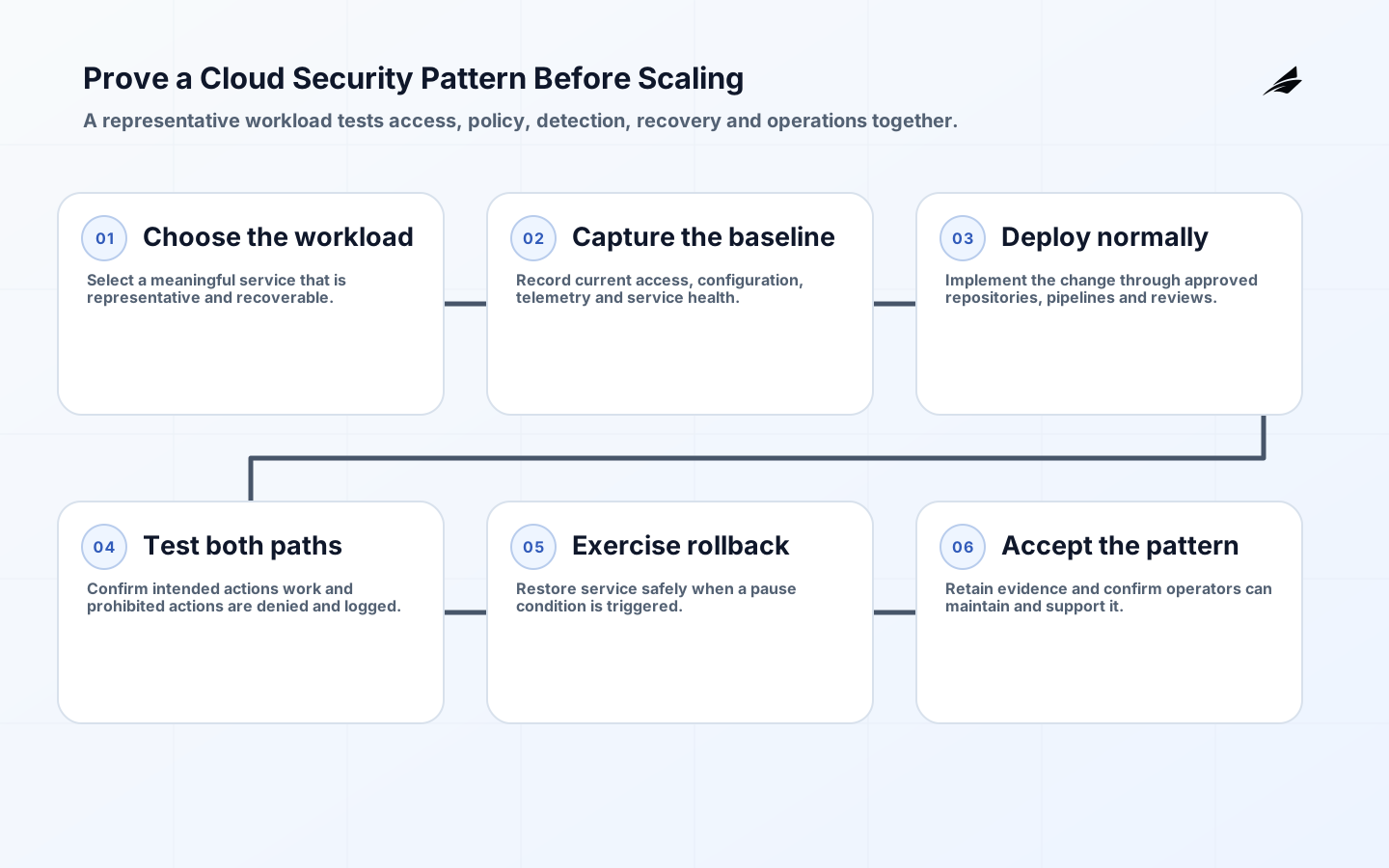
- Pilot guardrails on representative workloads before broad enforcement.
- Close only after operations can detect, respond, recover and maintain controls.
Gate 0: Establish mandate and decision rights
Name the sponsor, engagement lead, security risk owner, platform owner, application owners and incident contact. State the outcome, legal entities, regions, cloud organizations, tenants, workloads and exclusions. Separate assessment, remediation, validation and ongoing operation. Establish who accepts risk, approves production change, pauses rollout and declares an incident. Approve evidence custody, retention, deletion and subcontractor access before collection.
| Required evidence | Ready when | Stop when |
|---|---|---|
| Scope register | Identifiers and owners reconcile to enterprise records | Scope says only all cloud |
| Decision matrix | Risk and change decisions have named roles | Consultant is expected to accept enterprise risk |
| Data plan | Collection, transfer and deletion are approved | Logs will be copied without custody |
| Escalation test | Urgent finding route works | Only scheduled reporting exists |
Gate 1: Build a service-centered baseline
Reconcile cloud hierarchy and billing with configuration APIs, identity systems, DNS, certificates, repositories, pipelines and service catalogs. Include dormant and sandbox environments because abandoned resources may retain trust or public endpoints. Mark confidence and unresolved gaps. For each representative service, capture user journey, owner, criticality, data classes, trust boundaries, dependencies, recovery needs and deployment route. Account names alone are not enough context for risk.
- Map workforce, privileged, workload and emergency identities.
- Trace sensitive data through collection, processing, transfer, retention and deletion.
- Record internet exposure, private connectivity, egress and administrative paths.
- Connect source repositories and build identities to deployed resources.
- Identify log sources, attended queues, backup ownership and supplier escalation.
Gate 2: Define threats, requirements and outcomes
Use NIST CSF 2.0 or the enterprise framework to organize outcomes, then map obligations that actually apply. Build scenarios around plausible events such as stolen administrator credentials, exposed data, compromised build identity, unauthorized cross-tenant access, destructive administration, logging loss or failed recovery. Connect each scenario to business consequence, current evidence and a risk owner. A long control list without threat context cannot establish priority.
| Risk input | Question | Output |
|---|---|---|
| Business service | What must continue and what harm matters? | Criticality and consequence |
| Threat path | How could trust be abused? | Scenario and assumptions |
| Requirement | Which obligation or policy applies? | Mapped outcome and reviewer |
| Existing control | What already reduces likelihood or impact? | Evidence and residual risk |
| Target state | What decision or behavior must change? | Acceptance criterion |
Gate 3: Assign shared responsibility
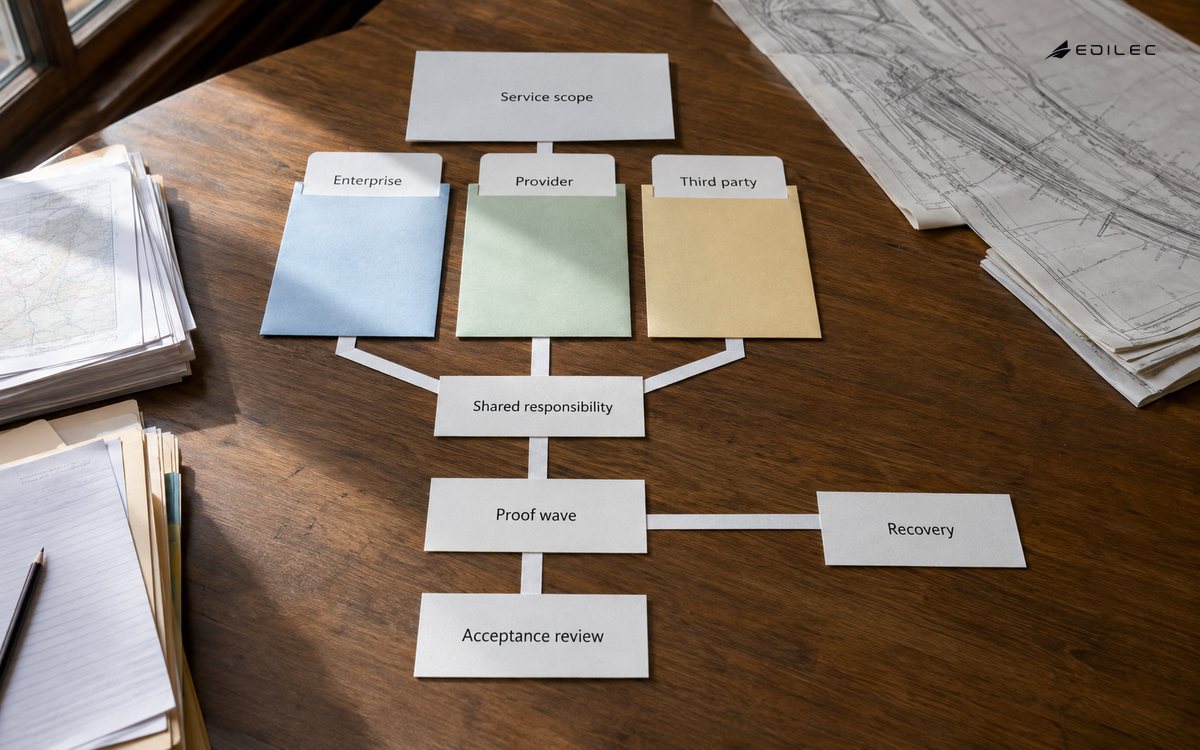
Create a matrix for each material service. Identify what the cloud provider operates, what the enterprise configures, what the application enforces and what a managed provider performs. Name an internal accountable owner even where execution is outsourced, and attach the evidence source and review frequency. Update the matrix when moving between virtual machines, managed databases, serverless services and SaaS.
| Domain | Checklist question | Evidence |
|---|---|---|
| Identity | Who creates, approves, reviews and revokes each identity type? | Federation, assignments, review |
| Data | Who controls keys, decrypt access and deletion? | Key policy, logs, lifecycle test |
| Exposure | Who approves ingress, egress and DNS? | Policy result, flow record, scan |
| Workload | Who patches runtime, dependencies and images? | Build record and disposition |
| Response | Who provides logs, contains access and restores? | Log map, escalation, recovery test |
Gate 4: Design controls and delivery
Write architecture decisions with alternatives and consequences. Prioritize identity foundations, protected administration, telemetry and repeatable deployment because later controls depend on them. Consider workload identity as well as user identity. Use preventive guardrails only when confidence, exception handling and rollback are adequate; begin with detective evaluation for uncertain legacy patterns. Define how policy is reviewed, tested, promoted and monitored.
- Use strong authentication, bounded elevation and protected emergency access.
- Protect repositories, CI/CD identities, artifacts, infrastructure state and production approvals.
- Set encryption, key separation, backup isolation, retention and deletion by data need.
- Define required events, routing, retention, alert ownership and telemetry-loss monitoring.
- Give every exception a reason, compensating control, owner, expiry and review.
Gate 5: Run a representative proof wave
Choose a meaningful but recoverable workload that exercises real identity, data, deployment and operating paths. Capture a baseline, implement through normal pipelines and rehearse rollback. Test intended and denied access, policy behavior, log arrival, alert routing, backup restoration and support procedures. A deployed configuration is not proof that the control works.
| Test | Pass evidence | Pause trigger |
|---|---|---|
| Access | Approved paths work; denied paths are logged | Critical identity is blocked |
| Policy | Drift and violations are visible | Unexpected resources change |
| Detection | Test event reaches an owned queue with context | Telemetry is absent or unowned |
| Recovery | Service or data restores with integrity | Restoration cannot be verified |
| Operations | On-call follows runbook and escalates | Process depends on consultant knowledge |
Gate 6: Scale in controlled waves
Group rollout by architecture pattern, risk and ownership rather than account count. Move from observe to notify to enforce as evidence improves. Each wave needs affected services, prerequisites, change window, exception plan, health measures and explicit pause conditions. Preserve policy versions and decisions. Watch denied requests, privileged changes, exposure, telemetry coverage, deployment failures, incidents and support demand together.
A surge in exceptions may indicate incomplete discovery or a poor target pattern, not resistant users. Feed recurring exceptions into architecture review. Stop a wave when critical identities fail, required logs disappear, unexpected policy changes occur, recovery evidence is invalid or support demand exceeds capacity. Resume after cause, rollback and revised testing are understood.
Gate 7: Prove response and recovery
Use NIST SP 800-61 Rev. 3 to connect incident response with risk management. Update severity criteria, provider contacts, evidence preservation, containment authority and recovery decisions. Run a tabletop for a plausible scenario, then conduct safe technical tests for key alerts and access revocation. Confirm who acts if the normal identity plane, messaging service or primary region is unavailable.
- Map cloud, identity, application, data and pipeline logs to detection use cases.
- Test enrichment, ownership, escalation and after-hours acknowledgement.
- Rehearse credential revocation, workload isolation, key rotation and evidence capture.
- Verify isolated recovery copies and restoration with integrity checks.
- Assign exercise actions and update risks, architecture and runbooks.
Gate 8: Accept and hand over
Confirm that target changes operate in the agreed scope, exceptions are governed and residual risks have decisions. Transfer repositories, dashboards, queries, architecture records and runbooks into enterprise-owned locations. Pair internal operators during maintenance and a simulation. Verify consultant identities, tokens, support channels and copied data are removed rather than accepting an informal assurance.
| Closeout item | Acceptance check | Evidence retained |
|---|---|---|
| Control operation | Owner performs review or response unaided | Completed procedure |
| Backlog and risk | Open items have priority, owner and decision date | Register and backlog |
| Knowledge transfer | Teams maintain and troubleshoot changes | Practical exercise |
| External access | Accounts, tokens and copies are removed | Revocation and deletion record |
| Measurement | Baseline, denominator and cadence are defined | Metric owner and definition |
Risks to track throughout
| Risk | Signal | Response |
|---|---|---|
| Unknown estate | Resources appear outside inventory | Repeat reconciliation and assign orphan handling |
| Privileged automation | Broad long-lived pipeline credentials remain | Use federation, narrow roles and rotation |
| Control breaks delivery | Teams bypass policy to release | Pause and repair the approved path |
| Stale evidence | Report reflects one early snapshot | Repeat checks and date artifacts |
| External dependency | Only consultants understand the control | Pair operators early; make practical handover a gate |
Maintain a dated decision log throughout the gates. It should connect each material risk to the evidence reviewed, selected treatment, accountable owner, affected services and next review. When architecture, provider capability or business use changes, reopen the decision rather than assuming the earlier evidence still applies. This small discipline prevents old screenshots and expired exceptions from being treated as current assurance, and it gives future operators the reasoning they need to maintain the control safely.
Frequently asked questions
Must every item be completed? No. Tailor the checklist to material services and obligations, record why an item is not applicable and obtain appropriate approval for exclusions.
Can it be used for SaaS? Yes, but emphasize tenant identity, administrator roles, sharing, retention, integrations, audit logs, supplier assurance and exit rather than infrastructure settings.
How much evidence is enough? Enough to support the decision across the declared scope. Use samples only when the method and limitations are explicit; automate population-wide checks when feasible.
Who signs off? Control owners accept operation, service owners accept business impact, risk owners govern residual risk and authorized change roles approve deployment. One signature should not collapse these duties.
What follows closeout? Move access review, exception aging, drift, log coverage, incident exercises, recovery tests and architecture change into recurring governance.
Conclusion
A cloud security checklist is useful only when it changes how work is owned and verified. Move through gates with dated evidence, stop when assumptions become unsafe, and scale after a real workload proves the pattern. The result should be an internal operating capability, not a one-time collection of screenshots.