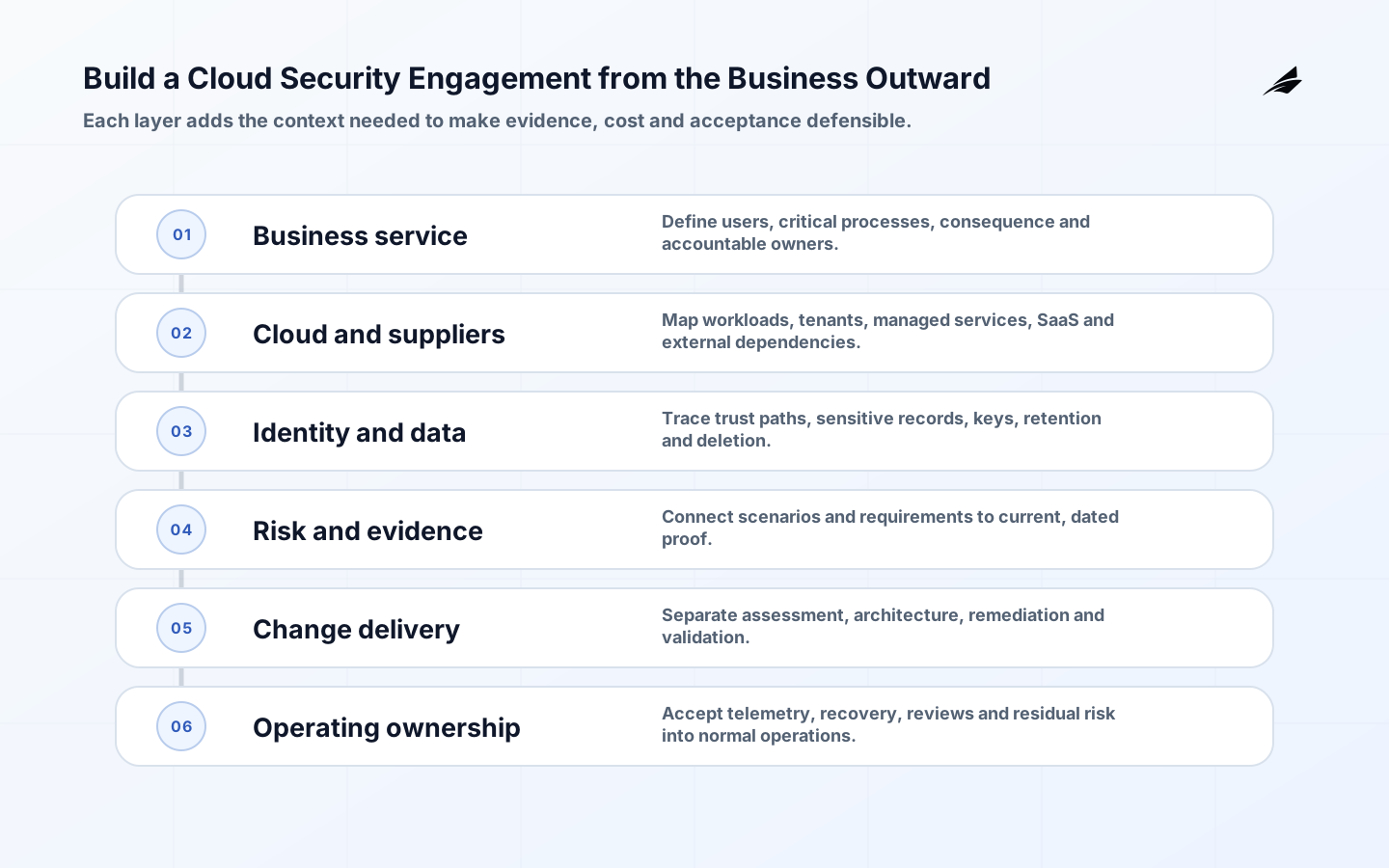
Enterprise cloud security becomes manageable when scope follows business services and delivery follows evidence. An account inventory is necessary, but it does not explain which customer journey depends on a workload, who owns its data or what failure matters. This guide shows how to define an engagement, estimate without invented market rates, control delivery risks and move from assessment to an operating capability. Use the implementation checklist during execution and the cloud consulting FAQ for procurement questions.
Key takeaways
- Scope around services, data, identities and decisions, then map the technical estate.
- Separate assessment, remediation, validation and operation so cost and acceptance stay visible.
- Estimate from workload diversity, evidence quality, control change and operating readiness.
- Treat identity, secure delivery, telemetry and recovery as cross-cloud foundations.
- Scale only after a representative workload proves access, logging, rollback and support.
Define the outcome before the control list
A useful outcome describes a risk decision or operating improvement: establish ownership for internet-facing services, remove standing production administration, prove that critical logs reach an attended queue, or enable a regulated workload to recover from destructive action. “Improve posture” is too broad to estimate or accept. State the affected service, current evidence, target behavior, risk owner and acceptance method.
Use NIST CSF 2.0 to organize outcomes across Govern, Identify, Protect, Detect, Respond and Recover, then add applicable law, contracts and internal policy. A framework aids communication but does not select priorities or establish compliance by itself. Record material scenarios, current and target profiles, decision rights and evidence needed.
| Scope layer | Include | Qualify or exclude |
|---|---|---|
| Business | Services, users, processes, consequence and owners | Benefits without baseline or owner |
| Technology | Cloud hierarchy, workloads, identities, data, pipelines and suppliers | Resources inferred only from account names |
| Assurance | Requirements, risks, controls, evidence and validation | Claims that one framework proves compliance |
| Delivery | Changes, dependencies, rollback and support | Remediation hidden inside assessment |
| Operations | Telemetry, incident authority, recovery and reviews | Handover by presentation alone |
Choose the right engagement shape
Discovery establishes estate and service context. Assessment compares evidence with target outcomes and prioritizes risk. Architecture records patterns and decisions. Remediation implements approved changes. Validation tests behavior. Operating support maintains controls and responds to events. Activities may be combined, but outputs, permissions and acceptance criteria should remain separate.
A new platform may need architecture and a proof workload before broad assessment. An established but inconsistent estate may start with inventory reconciliation, identity analysis and configuration review. A regulated workload migration may need a narrow end-to-end threat model and recovery rehearsal. Select the smallest engagement that enables the next risk decision.
Map responsibility for each service model
Provider responsibility changes across infrastructure, managed platforms and software services. The enterprise still decides appropriate access, data use and business authorization. Application teams may own controls that neither platform nor security can implement. Managed providers add an execution layer without removing internal accountability. Create a service-level matrix naming provider capability, enterprise configuration, application behavior, evidence and accountable owner.
| Area | Provider may operate | Enterprise still decides or performs |
|---|---|---|
| Infrastructure | Facilities, hardware and managed substrate | Service selection, configuration and risk |
| Identity | Authentication and authorization capabilities | Lifecycle, role design, approval and emergency access |
| Data | Encryption features, durability and service logs | Classification, access, keys, retention and deletion |
| Application | Managed runtime and protective services | Secure code, authorization, dependencies and secrets |
| Operations | Platform status and support | Monitoring, incident command, recovery and coordination |
Build a defensible cost model
Do not estimate from cloud spend or employee count alone. Estates with similar spend can differ in workload count, architecture diversity, identity complexity, documentation and regulatory burden. Begin with verifiable units: organizations and tenants, representative service patterns, identity providers, production workloads, regions, data classes, required mappings, log sources, pipelines and recovery tests.
Separate one-time work from recurring operation. Discovery and architecture produce finite artifacts; monitoring, access review, incident coverage and exception governance continue. Include internal time for interviews, evidence access, legal interpretation, change approval, testing and training. Transition cost rises when old and new patterns coexist or many local teams must change production.
| Cost area | Drivers | Estimate evidence |
|---|---|---|
| Discovery | Fragmentation, ownership gaps, documentation | Inventory sample and interview plan |
| Assessment | Control breadth, patterns, evidence automation | Assessment matrix and sample |
| Engineering | Policy, identity, pipeline and workload change | Backlog with dependencies |
| Validation | Safety constraints, recovery and simulations | Acceptance and rehearsal plan |
| Transition | Exceptions, coexistence, migration and training | Wave and support plan |
| Run | Telemetry, on-call, reviews and upkeep | Demand and responsibility assumptions |
Use ranges where uncertainty is real and state what moves the estimate. A bounded discovery can reduce uncertainty before broad remediation. Fixed price can suit an assessment with known inputs; engineering benefits from staged funding and estimate refresh after a proof slice. Avoid incentives based on finding volume because they reward noise rather than risk reduction.
Prioritize cross-cloud foundations
Identity is the control plane for users, services and automation. Establish federation, strong authentication, bounded privilege, workload identity and protected emergency access. NIST SP 800-207A is relevant to multi-cloud applications because it considers identity-tier policy alongside network controls. Document trust sources and failure behavior instead of assuming network placement creates trust.
Secure delivery turns decisions into repeatable infrastructure and application changes. Protect repositories, build identities, artifacts, infrastructure state and deployment approvals. Centralize enough telemetry to investigate cross-service events while preserving service context. Design recovery for compromised credentials, control planes and data, not only infrastructure failure.
- Create approved landing-zone and workload patterns with explicit exceptions.
- Include security telemetry in platform and application definitions of done.
- Separate key administration, workload administration and monitoring where risk warrants it.
- Treat logging or policy-evaluation loss as a control failure.
- Test restoration and business reconciliation before claiming recoverability.
Plan for delivery risks
| Risk | Consequence | Control |
|---|---|---|
| Incomplete inventory | Resources remain outside decisions and monitoring | Reconcile billing, APIs, DNS, identity, repositories and owners |
| Generic mapping | Teams implement settings unrelated to threats | Tie controls to services, scenarios and evidence |
| Policy blast radius | Enforcement interrupts valid workloads | Observe, pilot, support exceptions and rehearse rollback |
| Consultant over-access | Assessment creates confidentiality or privilege risk | Use scoped identities, time limits and approved custody |
| No operating owner | Controls decay or alerts go unanswered | Assign run ownership and test procedures |
| Provider concentration | Design assumes one vendor indefinitely | Record exit, portability and provider-specific duties |
Example: a customer document service
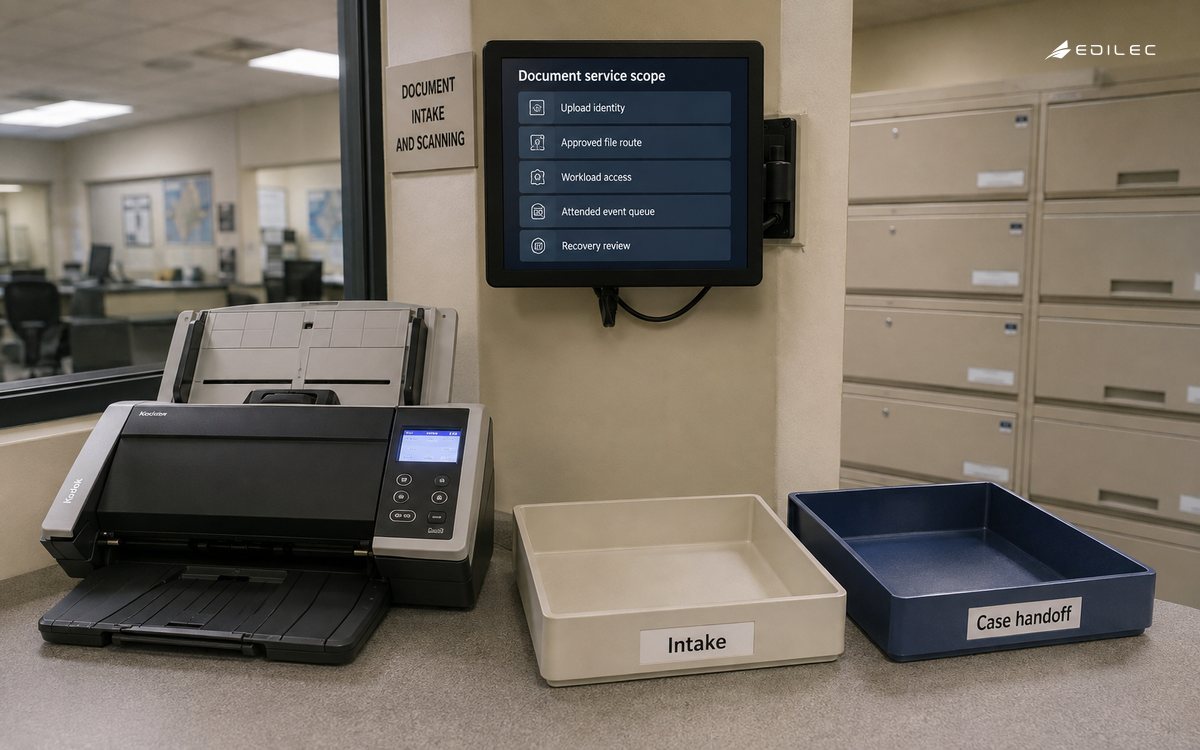
Consider a hypothetical service that receives customer documents, scans them, stores originals and sends approved files to a case-management platform. It uses object storage, serverless processing, a managed queue, custom code and a SaaS integration. A request to “review the cloud account” would miss business authorization in the case platform and the external integration credential.
A better scope maps upload identities, public endpoints, service identities, encryption and key access, queue retries, audit events, retention, deletion, support access and recovery. Suppose evidence shows an integration credential is long-lived and broad. The team does not claim a breach; it records a plausible path and remediation. A proof wave replaces the credential with bounded workload identity where supported, narrows storage access, adds unusual-retrieval detection and tests restoration.
Acceptance covers normal upload and retrieval, denied cross-case access, required events reaching an attended queue, rollback for identity change and an operator-led incident exercise. This scenario demonstrates planning; it is not a client result or a claim that one design fits another service.
Use a phased delivery plan
| Phase | Work | Exit evidence |
|---|---|---|
| Frame | Outcome, scope, obligations, rights and data handling | Approved charter and responsibility map |
| Discover | Estate reconciliation and service mapping | Dated baseline with confidence |
| Assess | Scenarios, evidence and prioritization | Owned risk register |
| Design | Patterns, decisions and acceptance tests | Approved backlog |
| Prove | Implement one representative workload wave | Test, rollback, telemetry and support evidence |
| Scale | Roll out by pattern and risk | Wave acceptance and trends |
| Operate | Transfer ownership and exercise response | Operator sign-off and review calendar |
Build pause criteria into production waves: blocked critical identities, unexpected policy impact, missing logs, failed backup validation or support demand beyond capacity. A pause is a control, not failure. Resume after the cause, rollback and revised test are understood. Make internal operators lead the final exercise before accepting handover.
Measure risk reduction and operating health
Track coverage with denominators: critical services with owners, privileged roles reviewed, required log sources connected and tested, recovery procedures exercised, public assets reconciled and exceptions within expiry. Track high-priority paths remediated or accepted and unresolved action age. Pair these with deployment failure, incident and support measures to reveal controls creating unsafe workarounds.
A governance forum should review decisions rather than status slides. Examine new services, expired exceptions, recurring policy failures, provider changes and exercise actions. Architecture and engineering owners must participate so remediation can be sequenced and funded. Keep metric definitions stable enough for trends and disclose scope changes.
Frequently asked questions
How long should an engagement take? There is no universal duration. A bounded assessment can be planned after scope and evidence access are known; remediation depends on backlog, change windows and proof-wave results.
Should providers use identical controls? Use common outcomes and evidence where practical while allowing provider-native implementation. Forced uniformity can hide service differences and increase complexity.
Is tooling included? State whether tools are consultant-owned, enterprise-owned or temporary, and account for licenses, data custody, integration and operation after closeout.
What belongs in acceptance? Require approved scope, owned risks, tested changes, usable telemetry, recovery evidence, operator handover and revoked temporary access.
When is specialist advice needed? Obtain qualified legal, regulatory, privacy, forensics or safety advice when work crosses those decisions.
Conclusion
A sound cloud security consulting plan makes uncertainty visible, prices the work that changes controls and leaves ownership inside the enterprise. Frame around services and material scenarios, prove the pattern on a real workload, and expand only when security and operations can carry it. Cybersecurity services may provide further context, but any capability or outcome must remain tied to an agreed engagement.