Cloud security consulting should help an enterprise make better risk decisions about real workloads, not produce a generic maturity score. Useful work connects business services, data, identities, cloud configurations, software delivery and operations, then leaves accountable owners with verified changes. This FAQ answers the questions buyers, security leaders, platform teams and application owners should settle before commissioning work and while judging delivery. It complements the cloud security implementation checklist and the detailed scope and delivery guide.
Key takeaways
- Start with business services and material risk scenarios; a provider inventory alone is not an enterprise scope.
- Write the responsibility boundary for every service model and name the internal owner for customer tasks.
- Require evidence from configurations, identities, logs and recovery tests instead of accepting policy statements as proof.
- Deliver changes in bounded workload waves with rollback conditions and operational handover criteria.
- Measure reduced exposure and stronger response capability, not simply findings closed or tools deployed.
What should cloud cybersecurity consulting cover?
A complete engagement connects governance to engineering. It identifies the business services in scope, their owners, cloud accounts or subscriptions, data classes, identity paths, external exposure, repositories, pipelines, logging, backup and incident dependencies. It then compares current evidence with the organization’s obligations and risk appetite. NIST CSF 2.0 is useful at this level because it describes outcomes without forcing one technology; provider architecture guidance adds service-specific implementation detail.
The scope should distinguish assessment, remediation and validation. Assessment discovers and prioritizes gaps. Remediation changes configuration, code, identity, pipelines or procedures. Validation proves that agreed changes behave as intended. Treating all three as one undefined package creates disputes about completion and often leaves high-risk findings without an accountable delivery path.
| Workstream | Question answered | Evidence |
|---|---|---|
| Governance | Which services and risk decisions are owned? | Service catalog, decision rights, risk register |
| Identity | How are workforce, privileged, workload and emergency identities controlled? | Role assignments, federation settings, access reviews |
| Data and workloads | What protects sensitive data throughout its lifecycle? | Data flows, keys, retention and deletion tests |
| Detection and response | Can the team identify, contain and recover from an incident? | Log coverage, alert tests, runbooks, exercises |
| Delivery security | How do infrastructure and applications reach production? | Repository controls, pipeline identities, artifact records |
How does shared responsibility change the engagement?
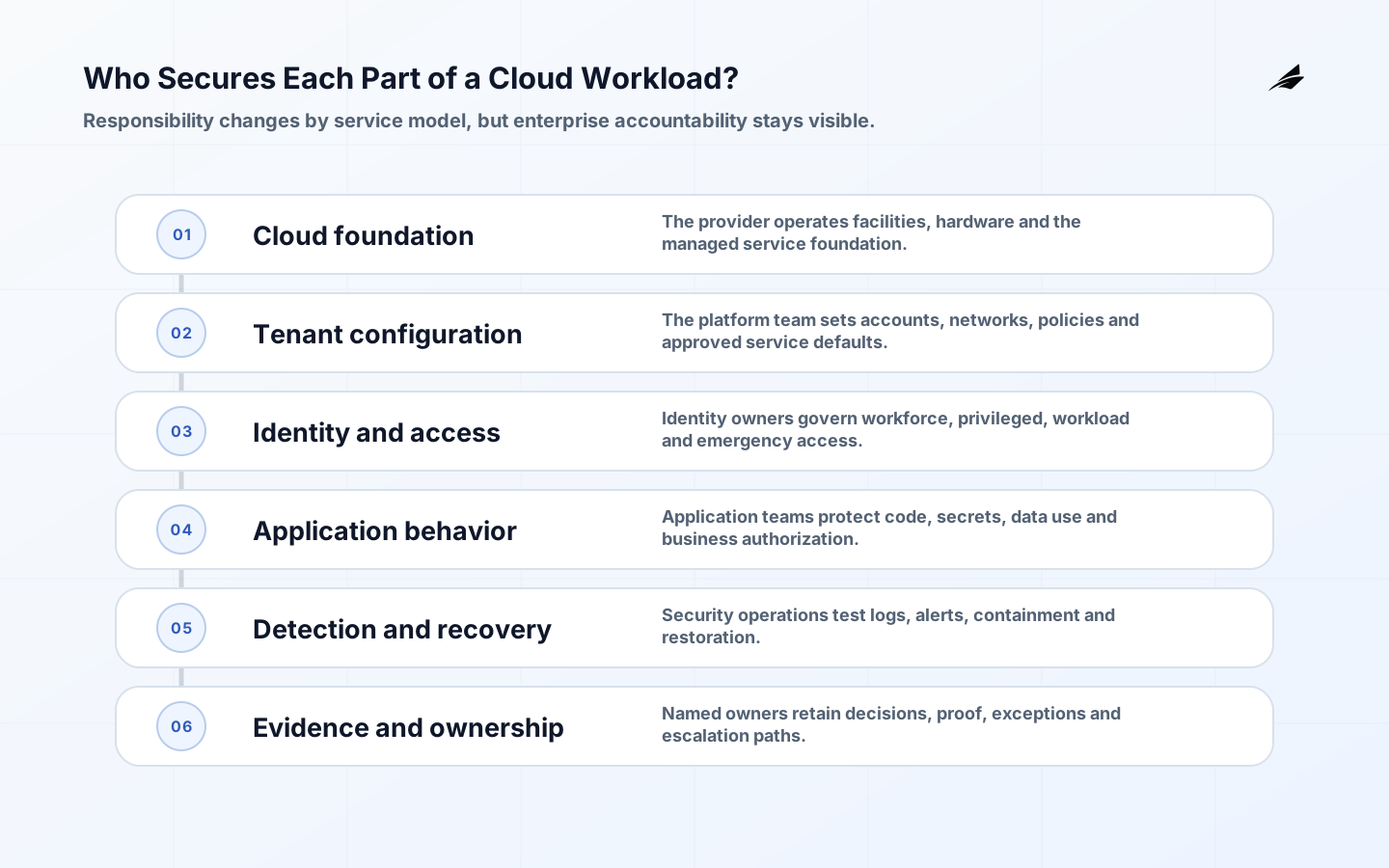
Cloud providers secure facilities and the underlying services they operate, while customers retain responsibilities that vary by service model. With infrastructure as a service, the customer controls more of the guest operating system, network and application stack. Managed platforms remove infrastructure work but do not decide who should access business data, whether application authorization is correct or how records must be retained. SaaS still leaves tenant configuration, identities, data use and integration risk with the customer.
Ask for a responsibility matrix for each material service, not one diagram for the entire estate. It should name the accountable internal role, provider capability, evidence source and escalation route. Include managed providers and software vendors where they execute controls. A responsibility described as “shared” without a decision owner is work likely to fall between teams.
Is an assessment the same as penetration testing?
No. An assessment examines architecture, configuration, identity, data protection, delivery and operations against defined risks and requirements. Penetration testing attempts to demonstrate exploitable paths under agreed rules. A review may identify public storage or an excessive role without exploiting it; a penetration test may demonstrate a chain crossing an application flaw and cloud permissions. Neither automatically verifies recovery or incident command.
| Method | Best use | Limitation |
|---|---|---|
| Threat and architecture review | Finding risky trust boundaries before deployment | Depends on accurate diagrams and owner participation |
| Configuration assessment | Checking implemented settings at scale | A snapshot can miss runtime and business authorization |
| Identity path analysis | Finding privilege concentration and escalation routes | Must include human and workload identities |
| Penetration test | Demonstrating selected attack paths safely | Does not establish that every control is effective |
| Tabletop or simulation | Testing decisions, telemetry and recovery | Actions need owners and completion dates |
What determines cost and duration?
A responsible estimate comes from scope evidence rather than employee count or a promised number of weeks. Major drivers include workload diversity, cloud organizations and regions, identity providers, regulatory mappings, inherited platforms, integrations, data sensitivity, documentation quality and telemetry access. Remediation also depends on deployment automation, test coverage, outage tolerance and how long old controls must coexist.
Request separate estimates for discovery, analysis, implementation, validation and handover. State assumptions such as representative workloads, interviews, configuration exports and test environments. Distinguish change-control waiting time from active effort. A fixed price can suit a bounded assessment with known inputs; uncertain remediation is safer as staged work with a funded proof slice and refreshed estimates.
How should consultants be evaluated?
Ask candidates to show how they move from a business service to threat scenarios, evidence, decisions and verified changes. Review anonymized deliverable structures rather than customer claims: a responsibility matrix, risk statement, architecture decision, remediation ticket and validation record reveal the working method. Confirm who performs the work, which platform and identity patterns they understand, and how specialist questions are escalated.
- Require disclosed methods, tooling access and data handling, including deletion of copied configuration and logs.
- Test whether findings name an affected service, consequence, evidence, owner and practical remediation.
- Confirm independence when the same party recommends and sells a product or managed service.
- Set expectations for runbooks, architecture records, knowledge transfer and internal participation.
- Agree how urgent exposures are communicated before the final report.
What access should consultants receive?
Use the least privilege needed for each task. Read-only configuration access is often sufficient for assessment, but it is not harmless: inventories, policies and logs may disclose sensitive architecture or customer information. Create named or federated identities, require strong authentication, time-bound access, record activity and prohibit shared credentials. Separate assessment access from remediation permissions and use normal production change approval.
Define permitted data before access starts. Prefer metadata and sampled evidence where full records are unnecessary. State whether logs can leave the tenant, how screenshots are redacted, who can access copies and when they are destroyed. At closeout, verify revocation, token invalidation and deletion rather than relying on an email confirmation.
What deliverables should be required?
A report is one part of acceptance. Require agreed service and asset scope, current-state diagrams, a responsibility matrix, prioritized risks, control-to-evidence mapping, target decisions, remediation backlog, validation results and operating handover. Findings should separate confirmed facts from assumptions and explain the service or data at risk. Recommendations should be implementable without requiring an unnamed future purchase.
| Deliverable | Acceptance question | Continuing owner |
|---|---|---|
| Risk register | Are impact, evidence, scope, priority and owner clear? | Business and security risk owners |
| Architecture decisions | Are alternatives, constraints and consequences recorded? | Architecture and platform owners |
| Remediation backlog | Can teams estimate, sequence and test each change? | Application, platform and identity teams |
| Validation pack | Does evidence show the control works in scope? | Control owner and assurance |
| Operating handover | Are alerts, runbooks and support routes usable? | Security operations and service owners |
How should success be measured?
Count outputs only as delivery health. Better measures show whether material exposure and uncertainty changed: critical services with named owners, privileged access reviewed, external assets reconciled, high-risk paths removed, required logs reaching the detection platform, alerts tested, recovery objectives exercised and remediation aging. Define denominators and evidence sources so improvement cannot be created by silently shrinking scope.
Avoid a single maturity score as the executive result because an average can hide a severe gap. Present a small set of risk narratives, trends and unresolved decisions. Where production changes are involved, monitor reliability and support demand as guardrails; a security control that repeatedly breaks work will be bypassed.
What commonly goes wrong?
| Risk | Early sign | Response |
|---|---|---|
| Account-led scope | Nobody can explain the business process an account supports | Map representative services, owners and data flows |
| Tool output becomes the report | Hundreds of findings lack context | Triage by attack path, impact and compensating controls |
| Identity means workforce only | Automation uses long-lived broad credentials | Inventory service identities, secrets and privilege paths |
| Remediation stalls | Findings have no delivery team or test | Create owned backlog and fund a proof wave |
| Ceremonial handover | Operations cannot use alerts or runbooks | Run a scenario before acceptance |
Additional frequently asked questions
Should one framework be mandated? Use a common outcome framework for communication, then map applicable legal, contractual and technical requirements. A control catalog is not a substitute for risk prioritization, and provider guidance is not an independent compliance conclusion.
Can a consultant guarantee compliance or security? No credible engagement can guarantee that incidents will not occur or issue a universal compliance determination. It can provide evidence, analysis and tested improvements within a stated scope. Legal and regulatory conclusions require qualified review.
Should multi-cloud be standardized immediately? Standardize outcomes, identity principles, evidence and guardrails where that reduces error. Do not force unlike services into a lowest-common-denominator design without a business reason. Provider-specific controls may be stronger and simpler.
When should remediation start? Urgent confirmed exposure should enter the incident or emergency-change path immediately. Other work should be sequenced by risk, dependency and capacity. A representative proof wave can validate policy, telemetry and rollback before broad enforcement.
When is the engagement complete? Completion occurs when agreed evidence is delivered, priority decisions have owners, implemented changes pass acceptance, operations can run the controls and temporary access is removed. Open risk may remain, but it must be explicit and governed.
Conclusion
Cloud security consulting is valuable when it leaves clearer responsibility, verified controls and a delivery system that can continue improving after consultants leave. Anchor work in business services, give evidence priority over presentation, and use rollout waves that operations can support. Teams exploring delivery support can review cybersecurity services while keeping any capability or outcome tied to a separately agreed scope.