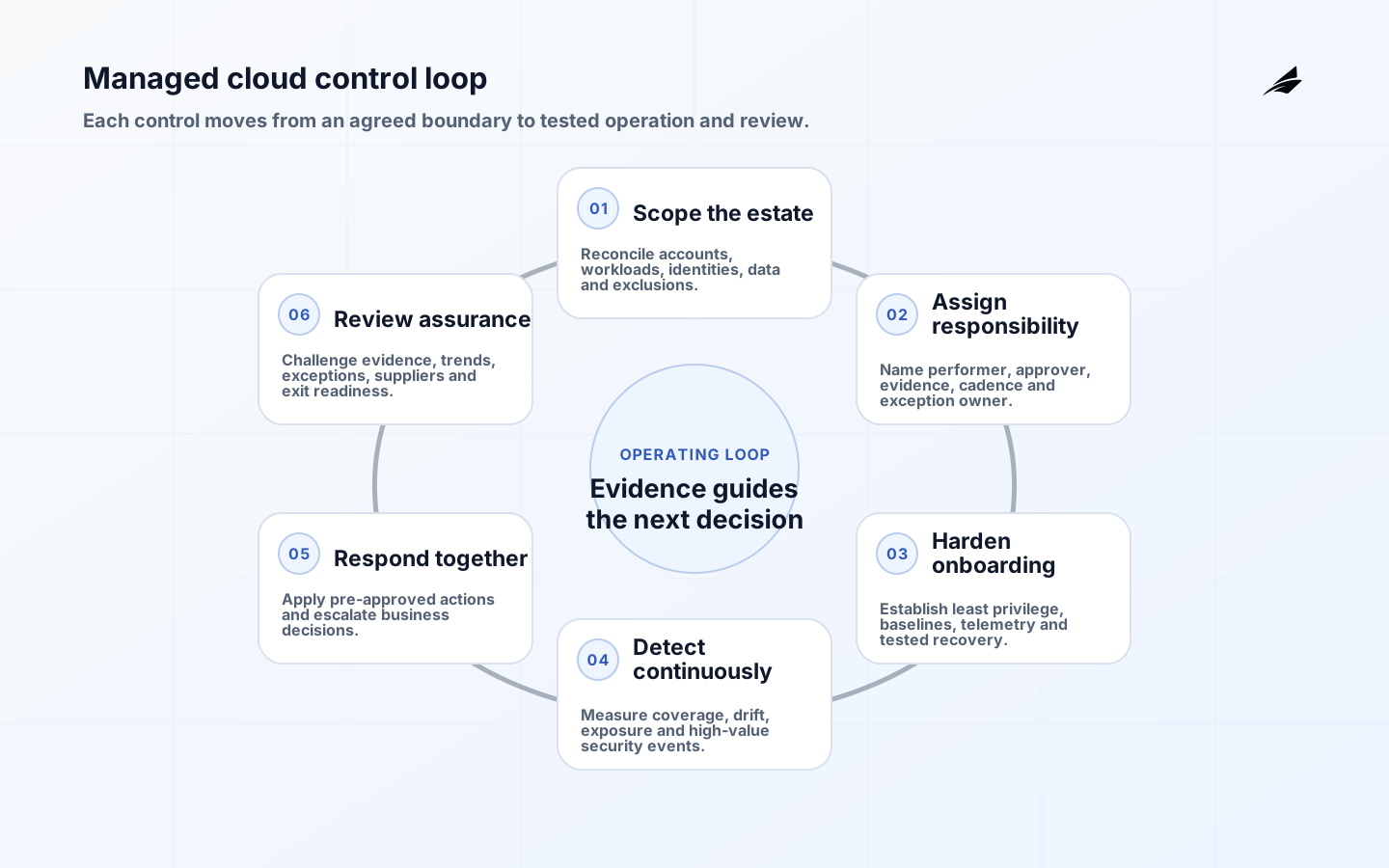
Security managed cloud services combine day-to-day cloud operations with defined security responsibilities, evidence and response obligations. A provider may configure identity, network controls, logging, vulnerability management and backups, but the customer still owns business risk, data decisions and oversight. This security managed cloud services FAQ helps buyers distinguish an operated control from a vague promise and turn a proposal into an accountable service.
Use this FAQ with the security managed cloud services delivery plan, the implementation checklist and the managed cloud security checklist. The useful question is not whether a provider “handles security.” It is which control is performed, for which resources, with what authority, on what schedule, and how the customer verifies the result.
What do security managed cloud services include?
A credible service starts with a named cloud estate and service catalog. Common activities include secure landing-zone maintenance, identity administration, configuration monitoring, log collection, vulnerability triage, endpoint or workload protection, key and secret operations, backup monitoring, incident coordination and compliance evidence. Some providers also operate application controls; others stop at the cloud account or platform boundary. The contract and responsibility matrix must identify that boundary per service and cloud model.
The CISA Cloud Security Technical Reference Architecture treats cloud migration, shared services and posture management as connected architecture concerns. That is a useful buying lens: a dashboard alone is not a managed outcome. The service needs people who can interpret findings, approved access to act, change procedures, escalation paths and records showing what happened.
| Service area | Provider may operate | Customer must still own |
|---|---|---|
| Identity | Federation configuration, privileged-role monitoring and access tickets | Workforce authority, role design, joiner/mover/leaver decisions and exception approval |
| Cloud posture | Baseline policies, drift detection, remediation workflow and evidence | Risk tolerance, permitted exceptions and application-specific requirements |
| Detection and response | Telemetry, alert triage, containment actions and incident coordination | Incident authority, legal and business decisions, notifications and recovery priorities |
| Resilience | Backup jobs, replication checks, restore execution and runbook maintenance | Recovery objectives, data criticality, business validation and continuity decisions |
How does shared responsibility change with a managed provider?
Cloud shared responsibility already divides control work between the cloud service provider and customer. A managed service provider adds another operator; it does not erase the customer side. The Cloud Security Alliance CCM v4.1 organizes cloud controls and responsibility across provider and customer roles. Extend that model with a third column for the managed provider, then name the party that performs, approves, supplies evidence and accepts residual risk.
Responsibility should be resource-specific. For example, the cloud provider may secure the managed database service, the managed operator may configure encryption and alerts, and the customer application team may control which identities can read customer records. “Shared” is not an owner. For every shared control, record the trigger, handoff, response time and evidence location. Assign a customer service owner who can challenge missed work and resolve conflicts between security, platform and application teams.
What should happen during onboarding?
Onboarding should produce an accepted baseline, not merely connect a monitoring tool. Inventory accounts, subscriptions, regions, workloads, identities, data classes, internet exposure, keys, logs, backups and existing exceptions. Reconcile cloud-native inventories with configuration and billing records. Decide whether newly discovered resources are automatically in scope, quarantined, or routed for owner review. Unknown resources are both a security concern and a commercial dispute waiting to happen.
Use a hardened access pattern. The provider should receive federated, attributable identities with least privilege, strong authentication, time-bounded elevation and recorded administrative activity. Avoid shared accounts and permanent owner privileges. NIST zero trust guidance rejects implicit trust based only on network location or ownership; apply the same principle to the operator. Provider access should depend on identity, device or workload context, task and policy.
- Approve the in-scope inventory, service boundaries, data locations and criticality tiers.
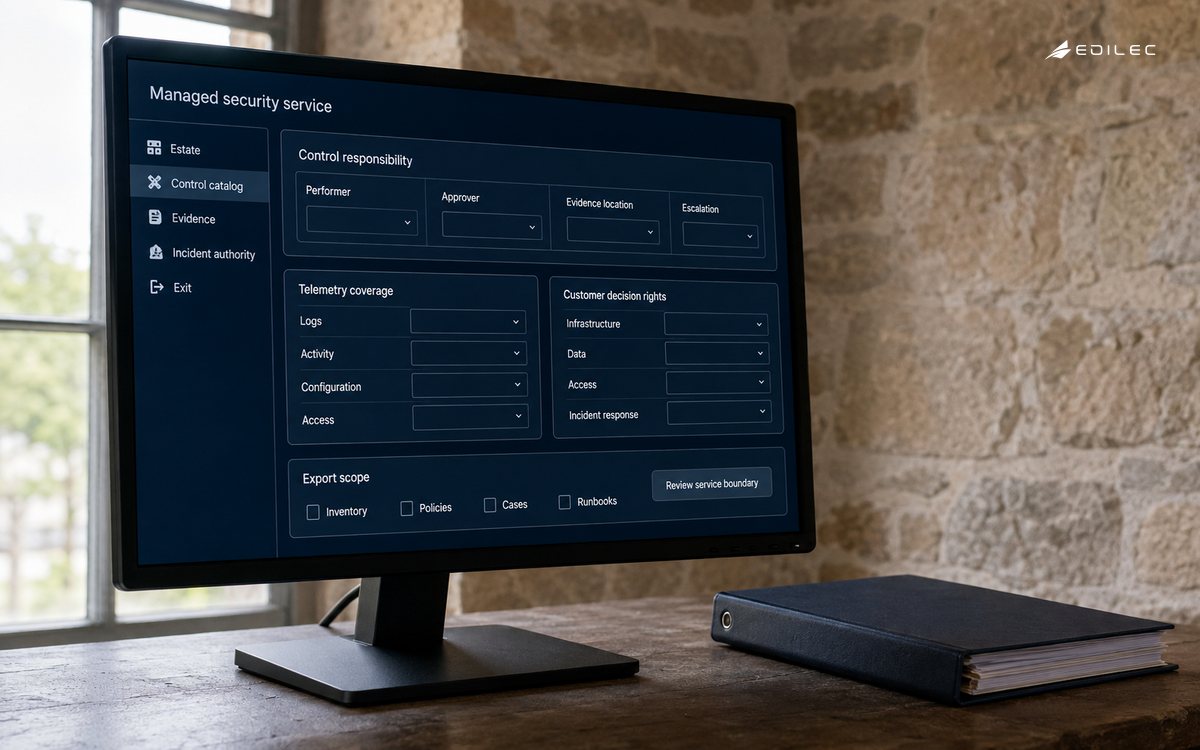
- Map each control to performer, approver, evidence, cadence, escalation and exception owner.
- Agree secure configuration baselines, using applicable CIS Benchmarks as inputs rather than blindly enabling every setting.
- Connect logs and alerts, test their timestamps and fields, and document expected telemetry gaps.
- Run one access revocation, one configuration remediation and one restore before accepting service.
- Record inherited risks and a dated backlog for gaps that cannot be closed during transition.
What does effective continuous monitoring look like?
Continuous does not mean every signal receives an immediate human response. Define what is collected continuously, how quickly it is evaluated, and which events create action. High-value signals include privileged identity changes, disabled logging, public exposure, key-policy changes, unusual data transfer, unapproved regions, backup failures and drift from required baselines. Alert logic needs an owner, version history, test cases and a review cadence; otherwise the service accumulates noise and operators learn to ignore it.
Dashboards should support decisions. Show coverage as well as counts: percentage of in-scope accounts sending required logs, critical assets meeting baseline, overdue high-risk vulnerabilities, unresolved privileged-access exceptions and successful restore tests. A falling alert count is ambiguous if telemetry coverage also fell. Give customers access to raw or exportable evidence needed for investigation and audit, with retention and integrity controls specified.
Who leads a cloud security incident?
The customer should designate incident authority before a crisis. The provider may detect, enrich and contain, but isolation can interrupt revenue or destroy volatile evidence. Pre-authorize a narrow set of emergency actions for defined severity levels, such as disabling a compromised provider identity or blocking a known malicious endpoint, and require immediate notification. Other actions should wait for the named customer incident commander. Include cloud provider escalation where the underlying platform may be involved.
NIST SP 800-61 Revision 3 integrates response across Govern, Identify, Protect, Detect, Respond and Recover rather than treating it as a stand-alone team. Reflect that in the service: maintain contacts and decision records, preserve logs, define evidence transfer, rehearse communications and validate recovery. After an incident, track corrective work through normal change management and verify that detection and runbooks were updated.
| Measure | Good definition | Question it answers |
|---|---|---|
| Inventory coverage | In-scope resources observed divided by reconciled resources | Can the service see what it promises to protect? |
| Triage time | Time from alert availability to documented severity decision | How quickly is a signal understood? |
| Containment time | Time from authorized decision to verified containment | Can approved action be executed reliably? |
| Baseline compliance | Applicable checks passing, with exceptions shown separately | Are controls operating across the agreed estate? |
| Restore proof | Critical recovery scenarios successfully restored within objective | Can data and service actually be recovered? |
How should buyers compare price and service levels?
Normalize proposals against scope drivers: number and type of cloud accounts, resources, identities, log volume and retention, regions, compliance obligations, support hours, response authority and required reporting. A low fixed fee may exclude remediation, incident hours, application telemetry or cloud consumption charges. Ask for unit assumptions, overage rates and a worked example using your estate. Separate one-time discovery and transition cost from recurring operation and optional response retainers.
Service levels should measure provider-controlled work. Cloud availability may be outside the managed provider’s control, while acknowledgement, triage, change execution and evidence delivery are not. Define the clock, severity rules, pause conditions, customer dependencies and remedy. Pair speed measures with quality measures such as repeat findings, failed changes and reopened incidents. Review trends monthly and control changes to the measurement method.
What vendor assurance and exit rights matter?
Review independent assurance, vulnerability disclosure, staff screening where lawful, subcontractors, data locations, privileged-access controls, tenant separation, incident history and continuity arrangements. Map evidence to the exact service rather than accepting a corporate certificate as proof that every operating activity is covered. Require notice for material control or subcontractor changes and a route to request current evidence.
Exit planning protects security as well as commercial leverage. Specify export formats and time limits for inventory, policies, tickets, exceptions, detections, cases, logs, runbooks and reports. Revoke provider identities, rotate credentials and keys the provider could access, transfer open incidents, confirm data deletion and retain required evidence. Test a partial export during the contract; an untested exit clause is only hopeful prose.
Key takeaways
- Treat managed cloud security as an operated control system with named boundaries, authority and evidence.
- Extend cloud shared responsibility to the managed operator; never leave “shared” without a performer and approver.
- Accept onboarding only after inventory, access, telemetry, remediation and restore paths have been tested.
- Measure coverage and quality alongside response speed so quiet dashboards cannot hide blind spots.
- Design incident authority, evidence portability and provider exit before the service goes live.
Frequently asked questions
Is a managed SOC the same as security managed cloud services?
No. A managed SOC commonly focuses on telemetry, detection and incident triage. Security managed cloud services may also operate identity, configuration, vulnerability, backup and platform controls. The offerings can overlap, but compare the actual control catalog, resource scope and authority rather than the label.
Does the customer still need an internal security team?
Yes, although its size depends on risk and scope. The customer needs accountable owners for policy, data, access decisions, business impact, legal obligations, exceptions and supplier oversight. A provider can supply specialist capacity; it cannot accept the customer’s enterprise risk on its behalf.
Can one provider manage multiple clouds consistently?
It can provide a common control model and reporting layer, but cloud services and evidence differ. Require provider-specific implementation details, supported-service lists and tests in every environment. Uniform dashboard colors do not prove equivalent control behavior underneath.
Conclusion
Security managed cloud services work when responsibility, access, evidence and decision rights are explicit. Build the service around a reconciled estate, defensible baselines, tested actions and customer-owned risk decisions. That makes the provider an accountable extension of operations while preserving the visibility and authority the customer needs to govern its cloud.